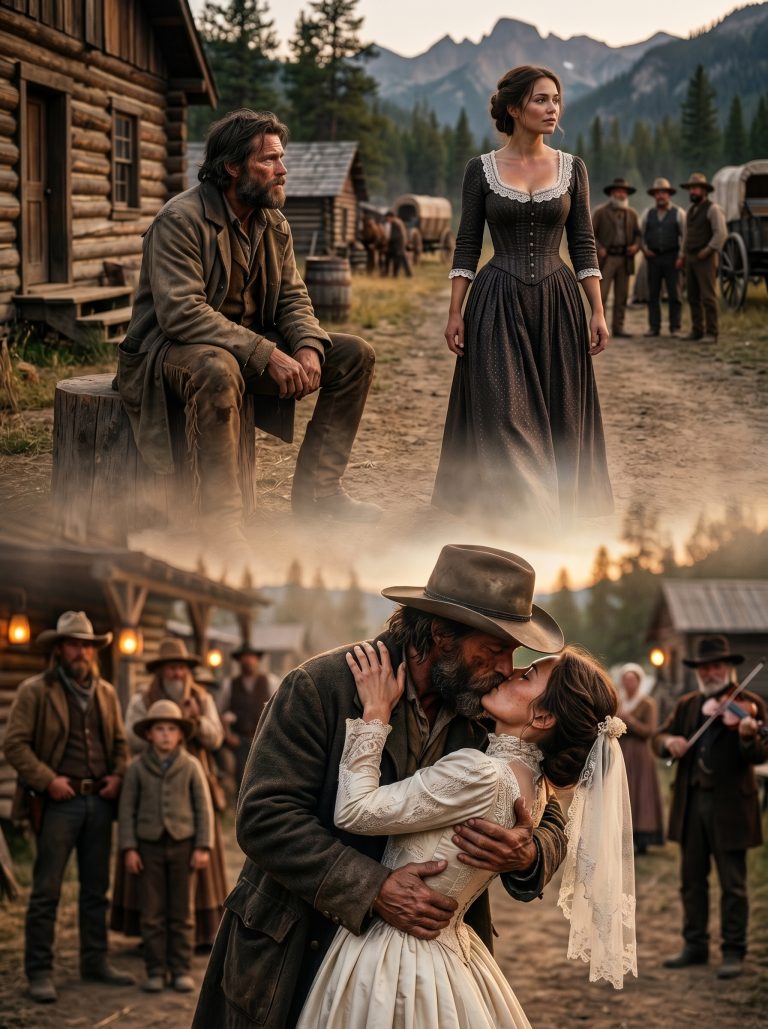
They Mocked Him for Marrying the “Big Bride”—Until She Turned His Dead Saloon Into the Richest Spot in Town

Part 1
Greta Voss was the last passenger off the stagecoach, as she always was. Twenty-six years of being a broad-shouldered woman in a world that measured women by inches had taught her to let the crowd thin before she stepped into it.
She smoothed her traveling coat, lifted her trunk herself before anyone could hesitate over it, and walked toward the man she recognized from his photograph: Caleb Ashford, saloon-keeper and rancher, thirty-six, widower. His letters had been careful and a little stiff, like a man writing checks he wasn’t sure he could cover.
He looked at her the way men had looked at her since she was fourteen — first at her size, and only later, if ever, at her face.
“Miss Voss,” he said. “I confess I pictured someone smaller.”
“I confess I pictured someone with better manners,” Greta said. “We are both disappointed. Shall we begin again, or shall I get back on the coach?”
A ranch hand near the platform choked on a laugh. Caleb’s ears went red.
“Begin again,” he said.
The saloon on Larkspur Hollow’s main street had good windows and a dead kitchen. Greta found both facts within a minute of walking through the door — the glass clean, the hearth cold, the whole back room carrying that particular hollowness a kitchen gets when no one has fed anyone in it for a long while.
“My wife did the cooking,” Caleb said, following her gaze. “Before.”
“I’m sorry for your loss.” Greta did not linger on it; grief handled carelessly only wounds twice. She opened the firebox of the great brick oven along the back wall and studied its draft with the flat of her hand. “Who built this?”
“Her father. Mason before he was a rancher.”
“He understood angles.” She closed the door gently, the way you’d close a door on a sleeping child. “I can have coffee and bread ready by six tomorrow. If by supper you want me gone, I’ll go, and you’ll owe me nothing but the flour.”
Caleb studied her the way a man studies a number he doesn’t trust yet.
“Six,” he agreed.
By nine the next morning the saloon was fuller than it had been in a year. Word had gone down the road with Ed Pruitt, who’d come in for coffee and stayed forty minutes for bread that cracked properly when you broke it. By noon, Caleb was watching his own establishment with the mildly stunned expression of a man who has been handed back something he’d quietly decided was lost.
“Two days like this,” Greta said, sliding her tally sheet across the bar, “and you can hire help for the front. A week, and Hess stops flinching when you walk into his store. A month —”
“You don’t know that.”
“I know arithmetic, Mr. Ashford. Arithmetic doesn’t care about your feelings, which is its chief virtue.”
It was on the third afternoon that she heard the name that made her hands, for one unguarded second, go still over the ledger.
Ed Pruitt was complaining to another hand about his cousin’s ranch, sold at a loss to cover a debt he swore he’d never signed for at that rate. “Note holder’s a man name of Nathaniel Vane,” Pruitt said. “Come in from the territory capital eighteen months back. Sharp dresser. Sharper numbers.”
Greta did not look up from the bread she was shaping. But something in her chest had gone very cold and very quiet, the way a room goes quiet before a storm reaches it.
She had heard that particular combination of syllables before. Not in Kansas. In St. Louis, nine years earlier, on a promissory note that had taken her father’s bakery, brick by brick, out of his hands.
She told herself it might be nothing. Names repeated. Territories were full of men reinventing themselves west of wherever they’d left their debts and their sins.
But she remembered the handwriting on that old note — a distinctive, looping numeral seven, crossed twice, the mark of a man who had learned his letters somewhere particular and never unlearned the habit. She had not thought of that seven in years. She thought of it now, and did not sleep well.
She said nothing to Caleb. Not yet. Suspicion built on a memory and a common surname was not evidence, and Greta Voss did not deal in anything less than evidence if she could help it. She had learned that from her father too, in the last hard year of his life, watching him try — and fail — to prove in a St. Louis court what he knew in his bones to be true.
First the bread, she told herself, rolling the dough tighter than it needed. Then everything else.
Part 2
Silas Vane — no, Nathaniel Vane, Greta corrected herself sharply, catching her own slip — came into the saloon on the following Tuesday, ordered whiskey, and looked around the room the way a man looks at property he intends to own.
He did not recognize her. Why would he. She had been nineteen the last time he’d sat across a desk from her father, and grief and six years had rearranged her face as thoroughly as weather rearranges a coastline.
But she recognized him. The set of his jaw. The particular way he flicked his coin onto the bar, smallest denomination first, as though testing whether anyone would object.
“Your note’s coming due end of August,” he told Caleb, pleasant as a man discussing weather. “Four hundred dollars is a serious number for a saloon that was serving sawdust and silence a fortnight ago.”
After he left, Caleb brought her the loan papers, frustrated and unable to say why the terms felt wrong. Greta went through them at the kitchen desk, and there it was: a compounding calculation dressed up to look simple, the true rate buried two decimal places deep where a tired or trusting man would never think to look.
She had seen this exact trick before. Not a similar trick. This one. The same buried decimal, the same false modesty in the arithmetic.
And then, at the bottom corner of the second page, half-hidden under Caleb’s own signature — a looping numeral seven, crossed twice.
Greta sat very still with her pen in her hand.
“Clara — Greta. What is it?” Caleb had never seen her go pale before.
“I need to see every note Vane holds in this county,” she said. “Every one. And I need you to trust me for a week without asking why.”
“That’s difficult, given you’ve just gone the color of flour.”
“Then trust me difficultly,” Greta said. “I have a reason for what I’m about to do, and it is older than this town.”
Part 3
She told him that night, in the cold kitchen, with the oven banked low and Tommy Reese — the dishwashing boy she’d taken under her wing — long asleep in the storeroom loft.
“My father owned a bakery in St. Louis. A good one. In 1865 a man came through offering credit at what looked like a fair rate to expand the ovens. Three years later my father owed four times what he’d borrowed, on terms neither of us could find written anywhere we’d agreed to. He lost the bakery. He died eighteen months after, of what the doctor called his heart and I have always called shame.”
“The man’s name,” Caleb said quietly.
“He called himself Nathaniel Voight, then. He is Nathaniel Vane now. Same buried decimal in the interest. Same crossed seven. I would know that numeral if I were blind and reading it with my fingers.”
Caleb was quiet for a long moment. “You didn’t tell me this when you arrived.”
“I didn’t know it was the same man when I arrived. I knew a debt collector had a common trick and an uncommon name, and I told myself that wasn’t enough to act on. It wasn’t, until I saw his hand on your paper.”
“What do we do with it?”
“What my father never had the chance to do,” Greta said. “We make it impossible for one judge, one clerk, one frightened town to bury it quietly. A man who has done this in two territories under two names is not a local nuisance. He is a pattern. Patterns are federal marshal business, not county sheriff business — if you can prove the pattern.”
She had, it turned out, kept things. A daughter clearing out her dead father’s desk keeps more than she knows why she’s keeping. Buried in her trunk, beneath winter stockings and a Bible, was the original 1865 note — the one with the buried decimal, the one with the crossed seven, the one no St. Louis court had ever agreed to examine because her father had been, in their eyes, only a baker, and Vane’s clients had been, in the town’s eyes, respectable men who vouched for him.
“That’s nine years old,” Caleb said. “Will anyone care?”
“They will if it’s not alone,” Greta said. “One old note from a grieving baker’s daughter is a sad story. One old note plus Ed Pruitt’s cousin plus Bill Henderson’s cut fences plus John Dale’s shame plus every buried decimal in this county is no longer a story. It’s a ledger. Ledgers, Thomas learns me — Ledgers, men can be made to answer for.”
They built the case the way Greta built bread: methodically, before dawn, with no wasted motion. Tommy learned to cross-reference note dates against land transfers and turned out to have a gift for it that surprised no one more than himself. Margaret Dale went to the wives; Greta had long since learned that shame kept alone survives, and shame spoken aloud in a room full of witnesses does not.
Sixty-one people came to the supper Greta organized in the saloon eleven days later — every family Vane had squeezed, fed at one long table, told plainly that what had been done to them had a name and a method and, now, a witness who had watched the exact same method ruin a bakery a thousand miles east.
Vane arrived near the end of the meal, flanked by two men in city coats, expecting to collect fear.
He found Sheriff Halloran instead, and beside him a territorial marshal Caleb had ridden two days to fetch — because interstate fraud, spanning Missouri and Kansas Territory under two aliases, was no longer a matter any local judge could be pressured into losing.
“You don’t have jurisdiction,” Vane said, and for the first time his voice lost its pleasant, unhurried edge.
“I have a note from 1865 with your handwriting on it, Mr. Voight,” Greta said, and watched something in his face come loose at the old name, “and eleven notes from 1874 with the same hand disguised only by nine years of practice. A man’s writing changes less than he thinks it does when he believes no one is comparing it.”
The room was silent enough to hear the fire settle in the grate.
“You don’t know what you’re doing,” Vane said.
“I know precisely what I’m doing,” Greta answered. “I am doing what my father should have had the chance to do, in a room he should have had the chance to stand in. I simply had to travel nine hundred miles and marry a stranger to find the room.”
Vane looked for the weak point in the crowd, the way men like him always did — searching for the one debtor too frightened to hold his gaze. He found none. Sixty-one people looked back at him, and not one of them looked away first.
He was taken into the marshal’s custody that night. The territorial case, built on two states’ worth of matching evidence, moved faster and further than a single county fraud ever could have; within the year, Nathaniel Vane, formerly Voight, would answer for defrauded ranchers in Kansas and a dead baker’s ledger in Missouri both, in a courtroom too large and too watched for money to quiet.
Three weeks later, on the courthouse steps, Caleb Ashford took Greta’s hand — the left one, unbandaged, steady — and said, “I should tell you I am difficult to live with. I go quiet for days when something troubles me. I hold opinions about the bar’s arrangement that are wrong, but firmly held.”
“I know,” Greta said. “I’ve lived above your storeroom for a month.”
“I want to be certain you know what you’re agreeing to.”
“Thomas — Caleb.” She caught herself, and for once didn’t mind the mistake; some names simply arrived early. “I am a large German woman who out-argued your entire town before breakfast on my first morning, found your creditor’s crime by the shape of his handwriting, and buried both our griefs in the same ledger. I know precisely what I am agreeing to. The question is whether you do.”
“Yes,” he said. “God help me, yes.”
That evening the saloon was full in the way a place is full once it has remembered what it’s for — not with panic, not even with relief exactly, but with the ordinary, durable noise of people who no longer believed their troubles were theirs to carry alone.
Greta stood at the oven her husband’s late wife had helped design, drawing out bread that cracked properly when broken, and thought of her father, who had died believing his ruin was a private failure rather than a documented crime.
It had taken her nine years, nine hundred miles, and a stranger’s proposal to learn the lesson she would spend the rest of her life repeating to anyone who needed it: shame survives on isolation, and fraud is only ever a private sorrow until someone with nothing left to lose stands up and calls it, out loud, by its true and countable name.
The bread stayed ready. The ledger stayed balanced. The door stayed open.
And nobody in Larkspur Hollow ever again mistook Greta Voss Ashford’s size, her accent, or her patience for anything softer than what they were: the exact dimensions of a woman who had decided, once and for good, what she was willing to build — and defend — with her own two hands.
— END —