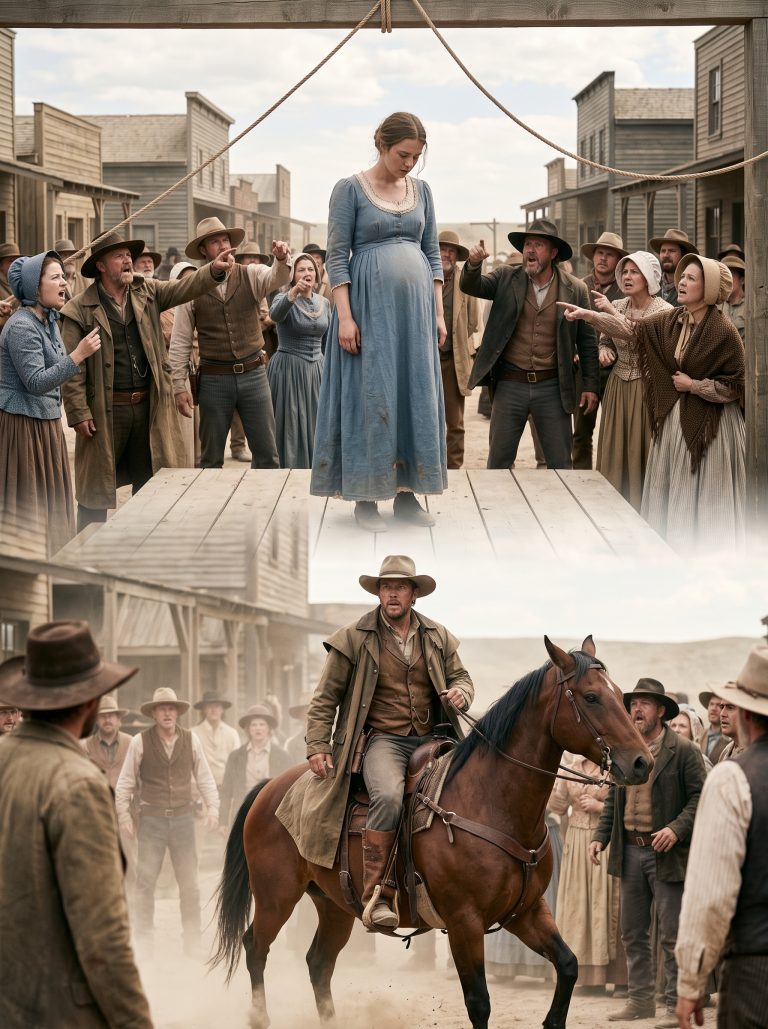
A Poor Widow Entered the Mercantile With a Bundle of Pelts—But the Merchant’s Shocking Offer Stunned the Whole Town

Part 1
The morning Eleanor Ashworth rode into Hollow Creek with a mule-load of pelts, half the town decided they already knew her story, and every one of them was wrong.
It was hot for April, the kind of Texas heat that climbed out of the dirt before nine o’clock and put a shimmer on the tin roofs. The Brazos ran west of town, low and brown, and the whole settlement had the squint of a place that expected little from weather or luck.
Eleanor rode a rawboned bay with a mule trailing behind, its pack lashed tight with rope she had knotted herself. Her calico dress was sun-faded, her hat battered, her dark hair pinned back plain. She did not look right or left as she came down the street, and that alone made people stare. Widows were supposed to look smaller than they were. Eleanor Ashworth did not.
Thomas Reed saw her from behind the counter of his mercantile when the bell over the door gave its tired jangle. Old Otis Kane stopped mid-sentence. Dorothea Finch looked up from a bolt of cloth. Deputy Silas Cobb, leaning by the cracker barrel, straightened with a slow interest he did not bother to hide.
Eleanor came straight to the counter. “I was told you buy hides.”
“Yes, ma’am. Depending on quality.”
“Then look.”
She went out and came back carrying bundles with no wasted motion — nine beaver, dense and dark from cold water; three otter sleek as poured oil; and beneath them, wrapped apart, a mountain lion hide the color of dry grass, cured by a hand so careful it bordered on reverence.
Thomas had handled furs since he was a boy. He knew the smell of careless work. This was not that.
“Who tanned these?”
“I did. All of them.”
Cobb made a small sound through his nose, something close to a laugh. Eleanor did not look at him. Thomas did, and the deputy’s face smoothed over fast.
“This is exceptional work,” Thomas said, and meant it.
Something shifted in her eyes — not gratitude exactly, more like recalibration, as if she’d expected to have to fight for that sentence and hadn’t needed to.
He turned his price sheet so she could read it with him, named fair numbers, and told her what a San Antonio buyer might pay for the mountain lion hide once freight and commission were taken out. She listened without interrupting, then asked three sharp questions about grading and transit. He answered plainly, admitting what he didn’t know. That seemed to matter to her more than the prices had.
“Where do you trap?” he asked, once the count was settled.
“Willow Bend. Thirty miles up the river.”
“Hard country.”
“It is.”
“Alone?”
Her jaw set, not with shame but warning. “My husband trapped it with me. He died of a fever last November.”
Cobb spoke up from the cracker barrel, too easy, too curious. “Sudden, was it? Fever like that?”
Eleanor’s eyes flicked to him, cool and brief. “Fever isn’t known for asking permission, Deputy.”
“No,” Cobb said, smiling in a way that didn’t reach his eyes. “Suppose not.”
Thomas noted it — a small wrongness in the question, gone as quickly as it came — and set his hat down harder than he meant to, an old habit around grief that wasn’t his own. “I’m sorry for your loss, Mrs. Ashworth.”
“Thank you. But I didn’t bring grief to sell. I brought pelts.”
“Yes, ma’am. And fine ones.”
She bought her supplies plainly: cornmeal, quinine, beeswax, cartridges for a rifle she clearly knew how to use. Dorothea drifted close to ask if she wasn’t awfully lonely out there, and Eleanor answered that she preferred competent to brave, because brave implied she’d had other choices.
Cobb offered an escort home. She declined without slowing down to consider it. It was the second time that morning he’d asked about her, and something in the way he watched her load the mule — less curiosity than appraisal, the way a man sizes up a piece of land he intends to have — stayed with Thomas longer than he could account for. Willow Bend, he knew, sat on the best river frontage for twenty miles; more than one man in town had grumbled that a lone widow had no business holding ground like that. Cobb had never grumbled aloud. Thomas would later wish he had.
When she’d loaded the mule and ridden north without looking back, Otis came to pay for his tobacco. “That woman could skin a lie off a man before breakfast.”
“Noticed,” Thomas admitted.
That night, in the back room where he’d slept for nine years out of habit rather than need, he wrote to his San Antonio contact about a mountain lion hide of unusual quality. He sat a long while afterward with the lamp burning low, aware for the first time in years that the small, orderly room around him felt less like a life and more like a waiting room.
He did not yet know how much the fever that took Daniel Ashworth would come to matter. He only knew that Silas Cobb’s question had landed wrong, like a nail struck slightly off true, and that some part of him had filed it away without deciding to.
Three weeks later, the buyer’s letter came back with a price higher than expected. Thomas could have pocketed the difference. Instead he wrote Eleanor the full accounting, added a line about the roads, and signed his name.
Her answer came two weeks after that, in a precise hand: I value a buyer who does not mistake widowhood for ignorance. Beneath her name, in smaller script, a warning about a washed-out crossing, meant for no one but strangers who might need it.
Thomas read it twice, then set aside the finest jar of arrowroot in the store, and did not examine too closely why.
Part 2
By late May, Thomas knew the sound of Eleanor’s horse before he saw it. She came in sun-browned and steady, and this time there was more to unload — hides cured a new way, smoke-scented and supple, because she’d read an agricultural journal and ruined five hides improving on it before she got it right. He laughed before he could stop himself. She looked startled that he had.
She stayed the night in town, and they took supper at Ma Gunderson’s, at a corner table with the window open to the evening cool. They spoke first of leather and freight because it was safe ground — the going rate for otter in San Antonio, whether a second curing shed made sense before winter. Then, without either of them quite steering it there, the talk turned to the river, and then to Missouri, where Thomas had grown up.
“You’ve lived here nine years,” Eleanor said, “and you still say back home like Missouri’s waiting on you.”
“Habit, I suppose.”
“Or you never decided this was home instead of just where you landed.”
He set down his fork. “That’s an uncomfortable thing to be right about.”
“I’m told I have a talent for it.” But she said it gently, and when he told her — plainly, without dressing it up — that he’d slept in the same back room for nine years because leaving it had never seemed worth the trouble of deciding to, she didn’t soften it with sympathy. She only nodded, as if he’d confirmed something she’d already guessed. He found that he liked being trusted to carry the truth himself, rather than having it carried for him.
There was a dance in June, held in the yard behind the church with two fiddles and a washtub bass. Cobb asked her first, before Thomas could cross the room; she declined him politely and without explanation. Thomas waited out one full song for dignity’s sake, watching her stand at the edge of the lantern light, and then discovered that dignity had its limits. He asked. She said yes before he’d finished the sentence.
They didn’t talk much while they danced — the fiddles were too loud and neither of them was skilled enough to spare the breath — but there was a moment, turning under the lanterns, when her hand tightened slightly on his shoulder and she looked at him a beat too long to be nothing. Neither of them named it that night. Both of them understood it had been named.
Letters crossed the thirty miles all summer, folding slowly from business into something else — a line about lamp oil giving way to a line about a book she’d read twice, an argument about whether Missouri or Texas summers were worse settling, eventually, into a kind of correspondence neither of them called courtship but both understood to be exactly that.
In September, a contract offer from San Antonio gave Thomas a reason — thin, and he knew it was thin — to ride to Willow Bend and discuss lumber for a second curing shed. Her home sat above the river, whitewashed and precise as everything else she built. They walked the property talking of drainage and hide frames, professional and careful, until they reached the porch, and the careful conversation ran out.
“You didn’t ride thirty miles about lumber,” Eleanor said.
“No,” Thomas admitted. “I rode thirty miles because I wanted to see whether the reason I kept finding for writing to you was still there when I arrived. It was.”
She studied him for a long moment. “If that question you’re circling ever comes,” she said, “it comes with the understanding that Willow Bend is mine. Not merged. Not managed. Mine.”
“I would never have asked it any other way.”
“I have noticed,” Eleanor said, “that you are not many men.”
In August, before the September visit, Cobb had crowded her at the counter with too many questions about her routes and her house alone; Thomas had closed the store early to end it. “I did not need rescue,” she told him afterward. “No,” he agreed, “I only wanted my store peaceful.” Her hand found his forearm — the first time she’d touched him without cause — and she said his given name for the first time. He felt it like a small shift underfoot, the ground admitting it had never been quite level before.
In October, walking the river road below Willow Bend while the cottonwoods turned, he told her plainly that he loved her — not because she needed him, but because he did not want to spend his life pretending otherwise. She was quiet long enough that he began to regret his timing.
“I loved Daniel,” she said finally. “That hasn’t stopped and I don’t expect it to. I was afraid that loving you would mean choosing between the two, or betraying one to make room for the other.”
“And now?”
“Now I think I was wrong. There’s room.” She looked at him steadily. “I love you too, Thomas. I have for a while.”
He kissed her once, carefully, on the river road with the cottonwood leaves coming down around them, and the whole shape of his life — nine years of a back room he’d mistaken for enough — opened toward something larger.
Part 3
They married in January, in a church too small for the whole town but full anyway. Eleanor wore deep green wool and kept her rifle at home out of respect for the reverend, not superstition. When the reverend reached the word obey, Eleanor went very still and raised one eyebrow at Thomas, who cleared his throat and asked, in front of the whole congregation, whether they might promise instead to love, honor, and walk beside one another. The reverend, after a pause, allowed that Scripture had room for it. The congregation laughed, and Thomas loved her so much in that moment it nearly hurt.
She did not sell Willow Bend. She leased the lower acreage and kept the house and the trapping rights, and moved into the rooms above the mercantile only after Thomas had consulted her by letter about every shelf. Marriage reorganized his stock within three weeks — she proved with numbers that he’d been overbuying ribbon and underbuying lamp oil, and he accepted the correction without injury, which pleased her more than flattery would have.
Silas Cobb did not accept the marriage so well.
He came around less openly now, but he came. A remark here about a married woman keeping separate property. A comment there about a man who couldn’t manage his wife. In March, he rode out to Willow Bend while Eleanor was alone checking drying frames, and told her plainly that folks talked, that a rifle wouldn’t always be close enough, that she ought to remember who wore the badge in this county.
She told him her aim helped just fine, and that patience was not the same thing as invitation.
He might have pushed further if Otis Kane hadn’t happened along the road with two freighters behind him. Cobb left, muttering about checking the crossing. Eleanor told Thomas that evening, not because she needed protecting, but because a marriage built on plain dealing required the truth even when it was uncomfortable.
Thomas listened with his hands closed hard around his coffee cup. “I want to put him through a wall,” he said.
“I know. What I want is a formal complaint, witnessed properly, so his conduct is named where the town can see it. I want you beside me. Not ahead of me.”
He agreed, and the complaint was filed, and the marshal — who had tolerated Cobb out of convenience more than respect — pulled his badge for a month pending review. It should have ended there.
It didn’t, because of an old trunk.
That spring, workmen shoring up a sagging wall in the storeroom pulled back a section of shelving that had been built flush against the studs, and behind it found a trunk no one remembered — freight receipts, mostly, left by the mercantile’s previous owner, a man named Pruitt who’d sold out and moved on six years before. Thomas had known the wall was there; he had never once suspected anything was behind it. Buried among the receipts was a private daybook in Pruitt’s own hand, with an entry from the previous November — the same November Daniel Ashworth had died.
S. Cobb came by again asking after the quinine stock at Ashworth’s place. Told him same as before — I sold Ashworth the full jar in October, plenty to last a man through fever season. Cobb seemed relieved to hear it gone from my shelf and none of mine unaccounted for. Odd thing to fret over.
Eleanor read it twice, standing very still. Thomas watched her go pale in a way he had never seen before — not from grief, but from arithmetic.
Daniel had died of fever that November — a fever, the doctor had said at the time, that should not by rights have killed a man his age and strength, except that no quinine could be found in the house when neighbors came to help, though Eleanor distinctly remembered buying a full jar that same October, from this very store, under Pruitt’s ownership. She had always assumed it lost, or used, or simply gone the way small things go in a hard season. She had never once thought to ask where.
Cobb had asked after it. Twice, by Pruitt’s account. As if checking that no one could trace its absence back to him.
“I need to know if this is true before I let myself believe it,” Eleanor said. “Not suspect it. Know it.”
She wrote to Pruitt that week, care of a cousin in Waco who was known to still correspond with him, laying out exactly what she’d found and asking him to confirm or deny it under his own hand.
The three weeks that followed were the longest of the marriage so far. Eleanor kept the daybook in the top drawer of the dresser and did not look at it again, but Thomas noticed she’d taken to standing at the window some nights instead of sleeping, and that she’d stopped mentioning Daniel’s name at all, as though saying it might spend some luck she needed to save. Thomas took to walking to the postmaster’s window most mornings before he’d even unlocked the store, and twice caught himself hoping for no letter at all — that it might turn out to be nothing, that Eleanor could go back to a grief that was simply sad instead of one that itched like this.
Cobb noticed something too, though he couldn’t have said what. He came into the mercantile twice that month on thin pretexts — a box of cartridges he didn’t need, a question about freight schedules he could have asked anyone — and both times his eyes went, briefly and involuntarily, to the storeroom door. Thomas gave him nothing to read in his face. He had learned that much from Eleanor already.
His reply, when it came, was cautious but unmistakable: he remembered the visits clearly, remembered thinking them strange even at the time, and had written them down because something about Cobb’s manner had unsettled him enough that he wanted a record, in case it was ever needed. He had never thought to connect it to Daniel’s death until Eleanor’s letter arrived.
Thomas, meanwhile, tracked down the freighter Otis had once mentioned in passing — a man named Vance who hauled goods along the river road twice a month. Vance was reluctant at first; he made his living on that road and had no wish to cross a deputy, badge or no badge. But he confirmed, once pressed and once assured his name would be kept from Cobb as long as possible, that he’d twice seen Cobb’s horse tied near the Ashworth place in the week before Daniel took sick, on no official business he could name — and that he’d seen Cobb again the following spring, going through what looked like an old strongbox behind his own cabin, muttering about a jar he’d meant to get rid of and hadn’t.
That detail — the jar, kept rather than destroyed — proved decisive. When the county’s investigation, prompted by the reopened complaint, searched Cobb’s cabin under warrant, they found a small apothecary bottle at the back of a shelf, still bearing Pruitt’s mercantile mark pressed into the glass. Eleanor was asked to examine it, and did not need long. Pruitt, it turned out, had scratched a small credit-account number beneath every bottle he sold on account rather than for cash — a habit for settling his books, nothing more — and the number beneath this one matched, exactly, the account Daniel Ashworth had kept with the store that October. There was no mistaking it for any other bottle sold that season. It did not prove poisoning. It proved, past reasonable argument, that this was the very jar of quinine taken from the Ashworth place, and that Cobb had kept it rather than let himself throw it away.
Cobb did not go quietly. When he learned of the investigation, he came to the mercantile once more, ostensibly to buy tobacco, and leaned on the counter a while longer than the purchase required. “Dry season coming,” he said, almost idly. “Old buildings like this, timber this old — a man never knows what’ll set them off.” He turned the tobacco tin over in his hand. “And that river road out to Willow Bend. Lonesome stretch. Man’s horse could throw him out there and nobody’d know for a day, maybe two.” He set a coin on the counter, unhurried. “Just talk. Folks talk about all manner of things this time of year.”
Thomas did not raise his voice. “They do,” he said. “And I expect the judge will find it interesting talk, coming from a man already under investigation, should anything at all happen to this store or to my wife from today forward.” He slid the coin back across the counter, untouched. “Take your tobacco somewhere else, Silas.”
Cobb left without it.
There was no proof of poison, and none was ever found. What there was, was theft, corroboration, and motive laid plainly side by side: a stolen jar of quinine kept rather than discarded, two unexplained visits to a dying man’s home, a deputy who had spent a year afterward positioning himself as the concerned neighbor of the widow whose husband he had, at the least, deliberately left without medicine that might have saved him.
Eleanor did not fall apart. She had not built a life out of falling apart. She sat with the daybook a long while, then closed it, and said, “I want him gone from this county. Not shot. Not martyred. Gone, and known for what he is.”
They took Pruitt’s letter, Vance’s sworn statement, the recovered bottle, and Otis’s own recollection to the circuit judge who rode through in April. It was not enough to hang a man on, and it did not need to be. It was not enough to prove murder, but it was enough to strip him of his badge, his authority in the county, and any standing he had left to stand on. Cobb was charged with theft of the quinine under old county code, convicted on the physical evidence and the corroborating testimony, and run out ahead of a county that no longer had any taste for defending him. He did not come back.
Eleanor grieved Daniel again that spring, differently than before — not the fever now, but the theft of whatever chance he might have had against it. She rode to Willow Bend alone for three days, and Thomas let her go without asking to come, because some griefs needed room he could not fill and shouldn’t try to.
When she came back, she said only: “I have made my peace with what I can’t undo. I won’t make peace with a man walking free because no one thought to ask a hard question at the right time.”
“You asked it,” Thomas said.
“We asked it,” she said, and that was the correction he needed.
The mercantile prospered through that year and the next. Eleanor’s leather work built a name in San Antonio among buyers who cared more for quality than convention, and Thomas had a sign painted for the side window: Reed Mercantile — fine leather and river-cured hides, by E. Ashworth Reed. She stood on the boardwalk reading it a long time.
“You used Ashworth.”
“That name built the work before mine ever touched it.”
She didn’t cry, though her eyes filled. “You’re a very good man, Thomas.”
“I’m a man who hires a decent sign painter.”
In the winter of the following year, in the apartment above the store with sleet on the window, she told him she was expecting a child, and for once her steadiness wavered before his did. He held her hands and could not, for a moment, find words, and she asked, half-laughing, half-afraid, whether he was happy.
“I am beyond happy,” he managed. “I don’t have a word past it, but that’s the shape of it.”
Their son was born the following autumn, furious and loud with his mother’s lungs. They named him Daniel Thomas Reed — Daniel for the husband whose faith in her had shaped the woman Thomas fell in love with, and Thomas for no one but himself, because Eleanor insisted a boy ought to carry at least one name earned rather than inherited.
Years later, people in Hollow Creek would tell the story shorter than it had actually happened — the widow, the storekeeper, the pelts on the counter, a tale trimmed of its hard edges. They forgot the year Eleanor Ashworth walked into town expecting to be doubted and refused to be. They forgot the deputy who had mistaken her solitude for an opening, and paid for it. They remembered only that it had ended well, and called that inevitable.
Thomas remembered all of it — the mountain lion hide like poured gold, the daybook that changed a widow’s whole understanding of her grief, the long ride home from Willow Bend with a lumber order and a certainty he hadn’t asked for but couldn’t refuse. He understood, by the end, what the whole town had gotten backward from the start: Eleanor Ashworth had never needed rescuing. What she had needed, and finally found, was someone willing to look at her plainly enough to see the truth standing in front of him — and someone willing, when the truth turned out to be dangerous, to help her drag it into the light instead of looking away from it.
One evening, long after the store had closed, Eleanor stood at the window with their son asleep against her shoulder. Two ledgers lay balanced side by side on the table below — his and hers, no longer really separate. Her rifle hung on its peg by the door, unremarkable now, just another tool in a household that had learned to trust her with all of them.
“Do you miss being alone?” Thomas asked, coming up behind her.
“Sometimes,” she said honestly.
“Good,” he said. “I’d hate to think love had made you smaller.”
She turned. “It hasn’t. It’s made more room for myself — and taught me who’s worth trusting with the rest of it.”
Outside, the river ran on toward Willow Bend, indifferent and steady, the way rivers are. Between them, the son stirred, and the store settled beneath them like a promise that had finally been kept.