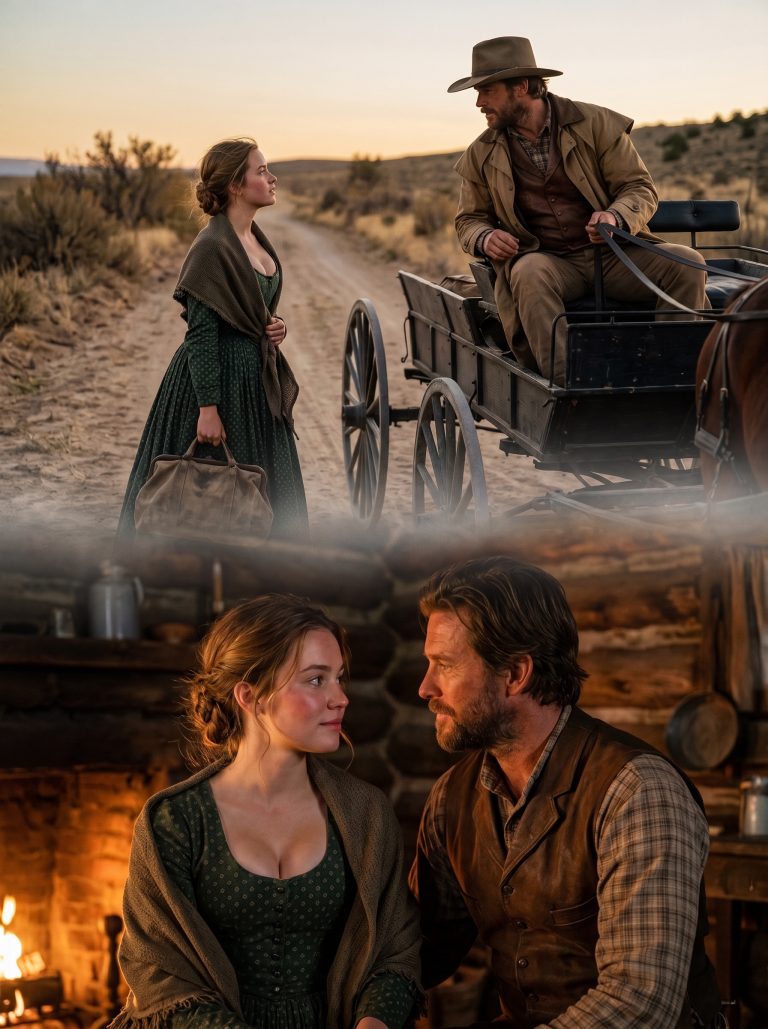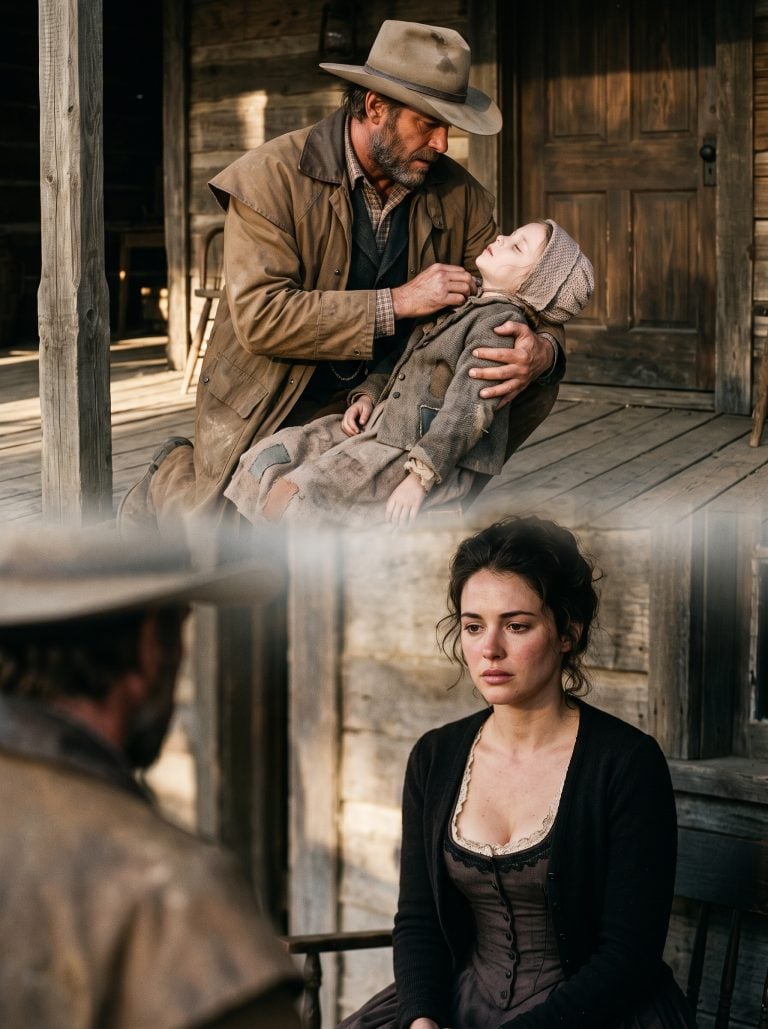
They Kicked Her Out Before Winter—But Her Cat Led Her to the Secret Room Her Husband Never Spoke Of

PART 1
The crosscut saw fought back hard against Clara Whitfield the way everything else in that valley had fought her since the funeral.
She dragged it through frozen pine with both arms shaking, breath torching white in front of her face, palms blistered raw beneath split gloves. She was sawing against the grain and she knew it, but the tree she’d managed to drag down alone was the only one small enough for one person to move, and pride wasn’t worth freezing over.
“You’re doing that wrong,” a voice said behind her.
Ambrose Teague stood at the tree line, pale-eyed and weathered past guessing at his age, the way high-country men eventually stopped belonging to any particular decade. He trapped above where anyone else bothered to live and came down twice a season, if that.
“I know,” Clara said.
“Know it and still doing it.”
“It’s the only tree I could drag down myself.”
His eyes were pale and studied her for a long moment, the way a man studies a fence line to see if it’ll hold. “Silas was a good one. Good men die up here more than the bad ones do.”
“You should leave before the pass closes,” he added, not unkindly, and it was the same thing everyone in Crane’s Hollow had been telling her since October.
She pulled the saw again instead of answering.
Ambrose watched another minute, then walked to a stump near the tree line and set something down without a word — a rabbit snare, already baited — before he vanished back up the slope the way he’d come.
His mouth had told her to go. His hands had left her something to eat.
It was the first help anyone had offered that didn’t come wrapped around a demand.
Silas Whitfield had been dead four months. A miner, though not the reckless kind who chased rumors into saloons — Silas read stone the way other men read scripture, could lay his palm flat against granite and tell you where water ran behind it. The cough had started that spring, dust in his lungs from ten years underground, and by June the blood on his handkerchief told a story neither of them wanted to say aloud. He died with her hand in his, lips moving at the end around words she never fully caught — something about the hill, something about behind — before his breath simply stopped arriving.
She buried him on the east slope, where morning light came first, near an unfinished dig he’d called a root cellar and never got to finish, or so she’d believed.
Two weeks later, Desmond Whitfield rode up from Denver with a lawyer and his wife Vera, papers already drawn, a train ticket already purchased — second class, quite comfortable, Vera had said, as if comfort were the question. Desmond explained that Silas had borrowed against the land when he bought it, that the deed served as collateral, that with his brother gone the property simply reverted to family.
“A matter of business,” he’d said.
“No,” Clara told him.
He’d sighed like a man burdened by a woman’s stubbornness and laid out the arithmetic for her slowly, as if she hadn’t already done it herself a hundred times in the dark: no reserves, no proper wood, no man to cut more, a cabin that leaked wind through a dozen seams, a pass that would close within weeks. Be sensible, he said. The family wouldn’t be responsible for what winter did to a woman who wouldn’t leave.
She said no again, and meant it more the second time.
Crane’s Hollow had punished her for the refusal ever since. Mr. Colton cut her credit at the store. The reverend’s wife rode up with prayer but no flour. Beatrice Colter, the valley’s wealthiest widow, told the sewing circle that Clara’s stubbornness endangered the whole community’s reputation — a neat trick, turning one woman’s possible death into everyone else’s embarrassment — and quietly wrote to Desmond suggesting the town might declare Clara unfit before the snow made the problem worse.
Clara knew nothing of that letter. She was too busy sawing wood she couldn’t spare the strength to saw.
It was her cat, in the end, who found what Silas had actually left her.
Slate was small, gray, narrow-faced, named for the color of the stone behind the cabin, and the only creature in her life that had stopped looking at her with pity. Since late October he’d taken to disappearing behind the woodpile stacked against the rear hillside every afternoon, gone for hours regardless of wind or sleet.
When he came back, he was always dry.
Not merely less wet than the weather should have allowed. Dry, and calm, and — when Clara finally thought to press her palm flat against his belly — warm in a way that had nothing to do with the pale winter sun outside.
PART 2
By November, Clara was keeping a record — outside temperature, hour of departure, hour of return, condition of fur — until the pattern became impossible to ignore. Something behind that woodpile was keeping her cat warm every single day, and she had buried that woodpile there herself, unable to look at Silas’s unfinished dig without grief closing her throat.
*The earth remembers,* his voice said in her memory, clear as a bell over snow.
She spent two days hauling nearly a full cord of pine, log by log, her back screaming, splinters finding every soft part of her palms. Halfway through, she found a piece of aspen carved with her own initials in Silas’s small, uneven hand — one of the little hidden claims of love he’d always left on tools and crates — and she sat down in the snow and wept with it clutched against her chest before she could make herself keep working.
Behind the last of the wood stood a door. Three thick pine planks, iron-strapped, sunk into a timber frame no handle, no lock, only a warped seam that looked like it had been waiting.
She drove Silas’s pry bar into the gap and threw her whole weight against it until the wood finally groaned and gave.
Warm, damp air breathed out into the cold.
Inside, by lantern light, she found exactly what he’d once described under July sun — eight feet by ten, dry-stacked river stone fitted so tight a blade wouldn’t pass between the joints, a packed earth floor, empty shelves waiting along the back wall. She hung her thermometer from a nail and stepped back out to wait an hour that felt longer than the four months since the funeral.
When she returned, the reading stopped her cold.
Outside: twenty-two degrees.
Inside: forty-eight.
No fire. No stove. Only stone, patience, and the lesson Silas had tried to teach her before she understood she’d ever need it.
She spent the next week sealing every seam with clay hauled from the half-frozen creek, moving her cot and trunk and stores down into the earth log by log, renouncing the failing cabin above one armload at a time.
On the fifth day, fever took her — throat raw, joints burning, no water left by the second morning, crawling to the door to scoop snow into a jug with her hands shaking too hard to hold the lantern steady.
For the first time since Silas died, Clara Whitfield began to wonder if Desmond and Vera and all of Crane’s Hollow had been right about her from the start.
PART 3
The thought lasted about thirty seconds before anger burned through it, cleaner and more useful than any fever could be.
Clara drank melted snow. She chewed dried beans because she lacked the strength to cook. She sat against the fitted stone walls Silas had built and spoke into the dim chamber, not to the fever, not even to Desmond or Vera, but to the whole story the valley had already written for her.
“No.”
She said it once, and then, when the room didn’t answer, said it again, louder, as if volume alone might make it truer. The stone gave nothing back but its steady, patient warmth, which was somehow answer enough. She thought of her mother once telling her that grief was a debt everyone eventually had to pay, and thought, lying there sweating and furious in a hole in the ground, that she intended to pay it on her own terms and no one else’s.
On the third morning she found a skinned rabbit hanging from the cabin latch, no note, one set of tracks leading up to the tree line and back. She made broth. By nightfall the fever had broken, and the next day she left a jar of blackberry preserves on Ambrose’s stump. It was gone by morning. Neither of them ever spoke of it directly. It became its own quiet language.
The first great storm hit on November fifteenth, not weather so much as outright assault — wind driving snow sideways through every gap in the cabin walls, the water bucket freezing solid overnight, her fingers refusing to close properly around anything she tried to hold. Rather than burn a quarter of her remaining wood fighting a battle the cabin was never built to win, Clara took one candle and Slate under her arm and sealed herself into the hillside room instead, leaving the fight to a house that had already lost it months ago.
The wind didn’t fade. It simply vanished.
Within the hour the thermometer read fifty-four degrees, and something in her body loosened that had nothing to do with comfort and everything to do with her bones finally believing they might survive the season after all. Slate turned once on the cot and settled with the satisfied air of a landlord inspecting property he already knew was sound. Clara sat in the rocking chair with a quilt over her shoulders and listened to the storm try, and fail, to find any way through the stone. She slept without dreams for the first time in months.
Word reached Crane’s Hollow by December that Clara was somehow still alive, and Faith Prentice, the reverend’s wife, came first in a sleigh wrapped in scarves, half expecting a corpse. She found Clara upright in the cold main cabin instead, color in her cheeks, no visible fire anywhere, and left without an explanation Clara was willing to give her, carrying home a story too strange to repeat whole.
The town split around the mystery. Some grew reluctantly convinced of Clara’s competence — the kind of men who worked outdoors themselves and recognized skill when they saw its results, even if they couldn’t explain the method. Others, led by Beatrice Colter, decided isolation had unbalanced her mind entirely, and Beatrice sent her petition — paired with Desmond’s property claim — straight to Marshal Otis Reyburn before the roads closed for good.
He arrived in mid-December with paperwork in his coat and weariness in his shoulders, stamping snow from his boots in the cold main cabin, asking how she survived without adequate heat when the whole structure around them argued otherwise.
“I am surviving,” Clara said. “That is all you need to verify.”
He looked at her a long moment — clear eyes, straight back, more composure than half the men who received his notices ever managed to hold onto — then folded the papers without opening the case further. “I’ll report what I see,” he told her. “A woman living on land deeded to her husband under hard circumstances, but breaking no law I’m empowered to enforce.” It wasn’t rescue. It was neutrality. That winter, neutrality felt close enough to grace.
Two weeks later Desmond and Vera returned, dropping all pretense of concern. “You think one storm proves something?” Desmond called from the wagon. “February will break you.” Vera added, smoother and crueler, that Silas had never known his own limitations either, and it appeared Clara shared the defect.
The words landed exactly where Clara was least guarded. She wanted badly to march them behind the cabin and fling the hillside door wide open, to force them to see Silas’s stonework, his intelligence, his love made solid in rock. Instinct stopped her. If Desmond knew about the chamber, he’d find some way to claim that too.
“I am staying,” she said instead, and let them see only the cold, ordinary cabin behind her.
They left. She walked back to the warm room, pressed both palms to the stone, and whispered, “They do not get to know yet.”
Deep winter arrived after New Year’s and did not relent for three straight weeks, temperatures locked below zero, some nights forty below, the sun reduced to a pale disc without any real warmth in it. The Marsh ranch lost cattle when a lean-to roof caved under snow load. Mr. Colton rationed coal oil at the store, doling it out by the cupful. Dr. Halden arrived two days too late to save a laboring woman’s infant across the ridge, and rode home afterward with his hands still shaking from the cold and something worse than cold. Reverend Prentice preached endurance from the pulpit until even the most faithful in his congregation grew tired of hearing suffering dressed up as virtue meant only for other people to admire.
Underground, Clara’s chamber held steady between fifty-two and fifty-six degrees regardless of what the sky did above her, an indifference to the weather that had once seemed impossible and now felt as ordinary as breathing. She cooked once daily in the cabin, then returned below to mend, read, and keep Silas’s old ledger current in careful handwriting: *Outside frozen at the lowest mark. Chamber fifty-six degrees with one candle and one cat. Beans sufficient thirty-six days. Slate displeased by rationed milk.*
Near midnight in the third week of that cold, someone pounded on her door hard enough to rattle the frame.
Jonah Marsh stood frosted white on her step, eyes wild. “Our chimney cracked. Cabin’s full of smoke, fire won’t draw. Wren’s breathing’s gone bad.”
Clara didn’t ask what his family had said about her at church. “Bring them here.”
An hour later the whole Marsh family stumbled into her clearing — Jonah, his wife Ada, their older children, and small Wren making a wet rattling sound in his chest that no parent should ever have to hear. Clara led them straight to the hillside door instead of the failing cabin, and warm air rolled out over the frozen family the instant it opened. Ada gasped. Jonah made a sound close to a sob. The older children stood frozen at the threshold as though they’d been promised something impossible and were afraid stepping forward would make it disappear.
Clara laid Wren on the cot, fed him broth a spoonful at a time from her small spirit lamp, and watched his color slowly return while Ada wept silently into his hair, rocking him with the particular desperate rhythm of a mother counting each breath as a small mercy. The tight pull at the boy’s ribs eased by degrees through the night. Jonah sat on the plank floor with one hand flat against the stone wall, saying nothing for a long while, wearing the exact expression of a man discovering the world was larger than his certainty had allowed.
By morning Wren slept peacefully, the thermometer reading fifty-nine degrees, the whole family breathing easier in a room none of them had known existed an hour before.
“Your root cellar,” Clara asked him once the boy was settled. “Is it dug into a bank?”
He nodded.
“Then you can build this too.”
She understood, watching them sleep, that charity alone wouldn’t save Crane’s Hollow through the rest of that winter. One family warmed for a single night could easily freeze the very next, and there were more families scattered across that valley than she could ever hope to shelter under one roof, however warm it ran. What mattered wasn’t the room itself — it was the knowledge of how to make one, knowledge that could travel farther and faster than she ever could on foot through snow like this. She spent the following days showing Jonah every last detail with her own hands: the fitted stone, the clay-and-straw seal, the angled vent that kept air moving instead of turning stale and dangerous, the quilted inner door that slowed a draft without ever quite stopping it. “It won’t hold as steady as this one does,” she warned him honestly, unwilling to promise more than the ground could actually deliver, “not unless your bank runs as deep as mine does. But it will hold warmer than your floor ever will. Warm enough to matter, which is all any of us can really ask for.”
Word traveled across the snow faster than any wagon could carry it, faster than gossip even, which was saying something in a valley that ran mostly on gossip through the long winter months when there was little else to occupy an idle evening. Within a week, three more families arrived — not for pity, and not for charity either, but for instruction, arriving with tools and questions instead of empty hands held out. Men who had doubted her openly at the general store now stood quietly with their palms flat against Silas’s stones and went silent in a way that told her everything their words never could have. Women who had murmured over sewing baskets about her ruined judgment wept openly when the warm air first touched their faces, undone by something as simple as heat where they’d expected none. Clara taught every one of them without charging a cent, though cornmeal, coffee, and hand-knitted wool socks began appearing at her door regardless, and she accepted them because refusing would have cost more than it saved.
By mid-February, eleven separate families across the valley had fully learned the method themselves, and the knowledge had long since outrun her — a sleeping chamber dug off a neighbor’s barn bank twenty miles to the north, a rancher adapting her design for lambing ewes through the worst of the cold, a shopkeeper gaining a full twelve degrees for his frostbitten father. Crane’s Hollow had confidently expected Clara Whitfield to die alone that terrible winter. Instead, against every prediction, she had quietly become entirely necessary to it.
Beatrice Colter burned her petition the day two of its signers rode up to withdraw their names, then walked the mountain herself not long after, black coat and stiff bonnet cutting through the snow, careful steps that betrayed nothing of what had brought her. “Show me,” was all she said at the door — no greeting, no apology, just the weight of pride she couldn’t yet fully set down.
Clara could have refused her. She thought of the petition, the letter to Desmond, the cruelty dressed as civic concern, every sewing-circle whisper that had made that winter harder than it needed to be. She stepped aside instead and led Beatrice around the cabin to the hillside door.
Warm air touched the older woman’s face, and something in her expression cracked quietly along a seam that had clearly been under pressure for years — not loudly, not theatrically, but the way old ice finally gives beneath weight it’s carried too long. She stood inside with her palm against the stone as if she’d entered a church, silent for a full minute before she spoke at all.
“My husband Garrett died the winter of seventy-nine,” she said, voice smaller than Clara had ever heard it. “Pneumonia. Three days, start to finish. The cabin was so cold the blankets froze to him. I couldn’t warm him.” She swallowed hard, staring at the fitted stone as though it might have been able to save him too, twenty years too late to matter. “If I had known about this—”
The sentence broke before it finished, and Clara understood then that Beatrice had never really feared embarrassment. She’d feared memory — the question no grieving person wants answered. *Could he have lived, if we had known?*
“You could have let me fail,” Beatrice said finally.
“I could have.”
“But you didn’t.”
“That was never the point.”
They sat together after that in the warm dim quiet, two widows in a room built by a dead man’s hands, and Beatrice withdrew her complaint from the county clerk that same week. It wasn’t an apology, but it cost her more than one would have.
A few days later Ambrose Teague sat on his stump instead of vanishing after leaving his hares, and told Clara something he’d been carrying since October — that he’d known Silas years earlier in the San Juans, worked the same shaft, watched him lay a bare hand on rock and read what lay behind it better than any man alive. Silas had known he was dying before he ever broke ground on that chamber, Ambrose said. The cough had started that spring; he’d seen the same death take too many miners to mistake it for anything else.
“He wasn’t building a root cellar,” Ambrose told her, turning a piece of bark over in his scarred hands as though the words were easier to say while his fingers had something to do. “Not only. He was building you a way to stay after him.”
Clara sat very still, watching her own breath fog and vanish in the cold.
Silas had trusted her, Ambrose said, to find the room when the time finally came, and to understand exactly what it was for without needing to be told outright — because some things, said plainly, only made grief harder to survive, while a secret discovered slowly could be carried instead of endured. “He told me once you were clever enough to find it,” Ambrose said. “Said he trusted you to understand.”
Clara thought of Silas’s last hours — the broken whisper, the hill, behind — and understood finally that it hadn’t been water in his lungs scrambling his words after all. It had been the truest sentence he had left in him, and she’d simply needed a whole winter to translate it.
She closed her hand around the carved piece of aspen still riding in her coat pocket and said thank you to Ambrose for the first time since she’d known him. He nodded once, receiving the words like something he’d been carrying for months and could finally set down, then vanished back into the pines the way he always did — no goodbye, just an absence where a moment before there’d been a man.
The final reckoning arrived near the very end of February that year, on a morning soft enough finally to remind the whole valley that winter, for all its terrible power, was not actually eternal after all. Desmond and Vera returned once more that season, their wagon horse visibly tired, Desmond’s coat worn thin and shabby at the cuffs now, Vera’s once-sharp posture folded inward instead, as if the relentless cold had finally reached some inner hinge in her too and simply worn it loose. Their well had frozen weeks earlier. Their firewood was nearly gone. They didn’t ask directly — pride held the last ragged edge of them together — they simply stood in front of the woman they’d once tried to remove from her own home and waited for whatever judgment she chose to hand down.
Clara thought of the papers on her table, the ticket already purchased, every certainty they’d stacked against her that October. She could have let the winter finish what they’d started, could have listed every cruelty back to them one by one until they understood exactly what their arithmetic had cost. She thought of all of it, and found, to her own surprise, that she no longer wanted to spend it.
She opened the door wider instead.
“There is broth on the stove.”
She brought them into the ordinary cabin, not the chamber — the stone room was sanctuary, not a stage for anyone’s humiliation, and some gifts weren’t meant to be used as weapons even against people who’d earned it. Vera held her cup with shaking hands and said nothing at all. When Desmond finally rose to leave, he paused at the door with his back to her.
“Silas,” he said, voice scraped thin, “was always the best of us.”
Then he went out into the thinning snow.
It wasn’t enough to undo what they’d done. But it was the first true thing Desmond Whitfield had ever said inside her house.
Spring came by inches. Mr. Colton arrived with flour and coffee and an apology he hadn’t been asked for, setting them down on her porch and removing his hat before he could meet her eyes properly. In April, Jonah Marsh led a delegation of eleven families to the county seat, affidavits in hand, testifying that Clara Whitfield had survived the hardest winter in memory through skill and judgment, had saved lives, and had taught the whole valley how to do the same. Marshal Reyburn added his own account, plain and unembellished, exactly the kind of testimony that carried the most weight precisely because it asked for nothing in return. Beatrice signed last, adding one line beneath her name: *Mrs. Whitfield demonstrated the kind of character this community should aspire to, not merely admire.*
Desmond’s claim collapsed for lack of any actual paper behind it. He and Vera sold their Denver house within the year and moved east, fading out of the valley’s memory the way people do when irrelevance turns out to be a harder sentence than ruin.
Clara never left the homestead. That summer, Jonah and his sons helped her finish the tunnel Silas had planned between cabin and chamber, lined it with stone, added shelves for roots and jars, even a small stove — not from need, but because comfort, once hardship has been earned, becomes its own kind of justice. People called it Whitfield’s Room for the rest of her life and came from as far as Denver to study it — ranchers, builders, widows, schoolteachers with notebooks, men in polished city boots who arrived skeptical and left with their hats in their hands — and Clara showed every one of them the stones, the seals, the vent, the way snow above could mean either enemy or blanket depending entirely on what a person understood about the ground beneath their feet, refusing payment every single time. “The knowledge kept me alive,” she’d say, whenever someone tried to press coin into her hand. “It belongs to the living.”
Wren Marsh, the boy whose ruined breathing had brought his father to her door in the dead of winter, grew up to build houses known across the county for holding warmth without wasting fuel, always facing windows toward winter sun the way Clara had taught his father, using dressed stone where other builders relied on guesswork, and telling his own apprentices, decades later, not to fight the land until they’d first learned to listen to it — words that had been Silas’s originally, passed down through a chain of people who’d never met him and owed him everything anyway. Ambrose kept bringing furs each autumn until he died peacefully by his own cold hearth in 1891; Clara buried him on a ridge where morning light came first, the same way she’d buried Silas, because some kindnesses only made sense repeated. Slate lived to an improbable age curled in the warmest corner of the room he’d discovered before any human had the sense to follow him, and when he finally died, Clara buried him near Silas beneath a small aspen marker. He knew first, she always said, and meant it every time she said it.
She grew old in that chamber, hair going the color of the snow that had once been expected to bury her, hands thinning while her eyes stayed clear and sharp, still walking the land with visitors well into her seventies, still pressing her palm flat to a slope or stone and telling them plainly what she felt there before they’d broken a single shovelful of ground. It was never magic, whatever the Denver newspapers eventually tried to call it when a reporter came through in 1902 looking for frontier color and stayed a full week before Clara sent him gently on his way, declining every lecture invitation and book proposal that followed. She had no interest in becoming a curiosity for men who wanted to applaud what they had never once had to endure. It was only ever attention. She had learned that first from Silas, then from winter, then from survival itself, and she spent the rest of her long life teaching other people the same patient lesson, one cold season at a time.
Clara Whitfield died in March of a year long after, asleep in the rocking chair inside that stone room with a wool blanket over her knees, the stove gone cold hours before anyone found her.
The room itself never did.
When new owners tore down the old cabin the following year to build something modern on the site, they found the heavy timber door still set into the hillside beneath wild rose and columbine, and pried it open expecting nothing but old dirt. Instead they found stone walls fitted with a care that bordered on devotion, a floor worn smooth by decades of feet, a rocking chair with shallow grooves traced into the planks beneath its runners, and on the ceiling beam, an old thermometer still hanging from its nail — glass clouded, markings faded, mercury resting exactly where it had rested for half a century.
Fifty degrees.
A promise, kept in stone, long after the man who made it and the woman who trusted it enough to survive an entire winter on faith in his hands were both finally gone from the world that had once tried so hard to prove them wrong about everything that mattered.