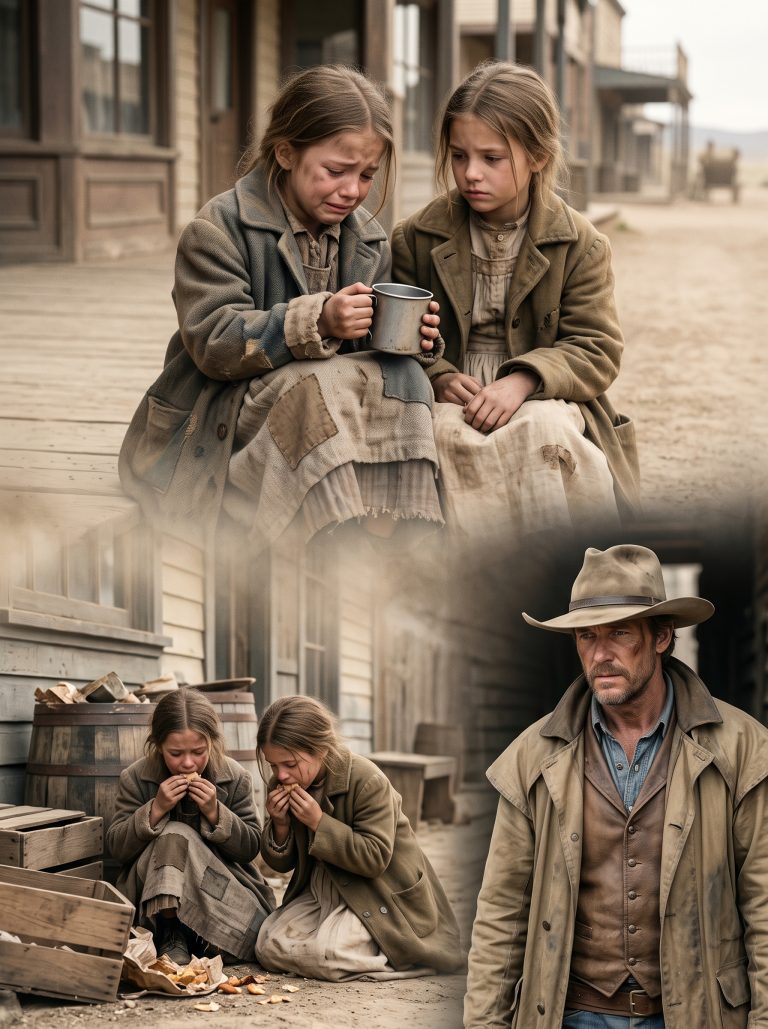
After Her In-Laws Shamed Her and Shaved Her Bald, the Rancher Walked In and Said One Sentence That Changed Everything

Part 1
The shears made a sound like a bone breaking, and Clara Whitfield would remember that sound long after the pain of it had faded.
Three days earlier they had buried her husband. Henry Whitfield had gone into the ground behind the house he’d built for her, taken by a fever that settled in his lungs and never let go. Clara had barely slept in the month before he died — every night spent listening to his breath catch and rattle, every dawn spent wondering if it would be his last. When it finally came, she had held his hand until it went cold, and she had not cried, because crying felt like something she owed him later, in private, when there was time.
There was no time. The Rourkes came through the gate before the sun had cleared the hills.
Agatha Rourke led them — Henry’s older sister, thin and sharp-faced, a woman who had never once looked at Clara without calculating something. Behind her came the brothers: Silas, broad and cold-eyed, the head of the family in all but name; the twins Cyrus and Owen, who moved and thought as a single creature; Wesley, whose nervous laugh always came a moment before trouble; and Caleb, the youngest, who seemed to enjoy cruelty in a way the others at least pretended not to.
“You couldn’t wait for the ground to settle,” Agatha said.
Clara gripped the porch rail. “I’ve done nothing.”
“You were seen at the fence line. Talking to that Bennett boy.”
Walt Bennett worked the Turner spread next door. He had asked, from a respectful distance, whether she needed help with a fallen section of fence. A dozen words, no more. In Agatha’s mouth they became something else entirely — proof, motive, a story already written before Clara had opened her mouth to answer it.
That was the first thing that struck her as strange, though she wouldn’t understand why until much later: how ready the accusation was. How little room it left for facts.
They dragged her into the yard. Silas forced her to her knees in the dirt while Agatha came forward with sheep shears, her face lit with something that looked almost like relief. The twins held her wrists. Clara bit the inside of her cheek and did not scream, though tears came anyway — not for the pain, but for the understanding, arriving all at once, that this was not really about Walt Bennett at all. It was a stripping. A public unmaking. Whatever came after, everyone in the county would look at her shorn head and believe the worst without needing to ask a single question.
“Now everyone can see what you are,” Agatha said, stepping back.
Silas hauled her to her feet. “Sundown. Take what you can carry.”
“The house is mine —”
“The house is Whitfield land,” he said. “You were only ever borrowing it.”
Only borrowing it. The phrase would return to her later, turned over like a stone with something crawling underneath.
By noon the Rourkes had returned with bottles and neighbors, settling onto the porch to watch her packed and gone by evening as though it were entertainment owed to them. Inside, Clara looked into the mirror Henry had given her on their wedding day and did not know the woman looking back — scalp raw and uneven, eyes too large in a face gone white with shock.
She packed with the strange, steady calm that comes after the worst has already happened. Her mother’s Bible. A wedding photograph. A little hoard of coins. And from the desk drawer, Henry’s journal, its last entries written in a hand gone shaky with fever.
One line, near the end, stopped her breath entirely:
I have made things right, in writing, should anything happen to me. Alderman has it filed. Say nothing to A. until it’s done.
She did not know what it meant. She did not have time to wonder. Wesley cornered her once in the kitchen, smelling of whiskey, and suggested there might be gentler terms available to her. She answered him with the kitchen knife and a look that sent him backing out the door.
By dusk she walked the road alone, carpet bag in hand, twenty pairs of eyes on her back. At the gate, Silas caught her wrist.
“Show your face in this county again, and I’ll finish what my sister started.”
She said nothing. She walked.
A mile down, Mrs. Doyle from the general store rode up without dismounting and threw down a blanket and half a loaf of bread — help dressed in fear, but help all the same. There was an old trapper’s shack three miles north, she said. The roof might still hold.
It did, barely. Clara lay on the single bunk that night, blistered and bleeding, and listened to the desert come alive around her. She thought, briefly and without drama, about simply not waking. Something in her refused the thought before it could take root. Anger, maybe. Or just the plain animal stubbornness of one more breath.
By dawn she was still alive, and she heard a horse.
One rider. Unhurried. A big man came around the junipers and stopped twenty feet off — weathered face, dark hair going silver at the temples, eyes the color of old honey. He looked at her a long moment: the shaved scalp, the bag, the shack, all of it.
“You’re coming with me,” he said.
“I don’t know you.”
“Nathaniel Cross. Crossroads Ranch.” He paused. “Walt Bennett works for me now. Told me exactly what passed at that fence. Nothing more than a downed rail and a few words.”
Relief nearly buckled her knees.
“Why does this concern you?”
“My wife made me promise something, before she died,” he said. “That if I ever had land and standing enough to matter, I’d use it for people who had neither.” He nodded toward a gentle mare behind him. “I need help at the house. Fair wages. A room of your own. That’s all I’m offering.”
She looked at the shack, the empty road, the whole cruel shape of a life the Rourkes had tried to hand her.
“I’m coming with you,” she said.
Part 2
The Rourkes arrived at Crossroads before noon, riding hard, expecting to finish what they’d started at Clara’s own gate. They found something else waiting.
Nathaniel stood in the yard with a second gun belt on, his foreman Rafael and four hands spread along the porch, rifles held loose and ready in a way that wasn’t loose at all. Consuela, who ran the house, stood at the rail with her arms crossed.
“Well,” Silas called, finding Clara behind them. “Found herself a protector.”
“You’re on my land,” Nathaniel said. “State your business.”
“Our business is with her.”
“Your business,” Nathaniel said, “was shearing a widow like livestock and driving her into the desert three days after burying her husband. Funny way to treat family.”
Silas’s jaw worked. Behind him, Agatha said nothing at all — and it was that silence, more than anything, that made Clara look at her twice. The brothers thrived on noise, on momentum. Agatha had gone very still, watching Nathaniel the way a woman watches a fire she’d hoped had gone out.
Consuela stepped forward and said plainly that she’d carried medicine to the Whitfield house through Henry’s whole illness and had seen with her own eyes how faithfully Clara had nursed him — no lechery, no neglect, only exhaustion and grief.
Sheriff Prescott arrived at the exact moment the standoff might have tipped into gunfire, and informed Silas, without much patience left in his voice, that he was harassing a widow who had broken no law of the county.
The Rourkes rode off, but not because they’d been convinced of anything. Only because the arithmetic had turned against them for the day.
Clara noticed, as they left, that Agatha looked back once — not at her, but at the house, and then, briefly, toward the road that led to the county seat.
She would not understand the meaning of that look for many months.
Part 3
Life at Crossroads settled into something Clara had almost forgotten was possible: ordinary days. She worked in the kitchen and the linen room until Consuela declared her fit for more, then learned to ride, to keep books, to read weather off the color of the sky. Her hair grew back close and uneven, and no one at the long supper table seemed to notice or care.
When the town’s respectable wives came to the gate a few weeks later — Agatha among them, this time dressed in concern rather than shears — Clara met them on the porch with her scarf removed and her scalp bare for all to see.
“You did this,” she said to Agatha. “And now you want me to disappear quietly so it stops being a story.”
Agatha’s composure slipped, just slightly, at the word story. “It would be better for everyone,” she said, “if this were finished.”
“It will be finished,” Clara said, “when it’s finished honestly.”
The women left. Nathaniel said nothing, only stood beside her, and that was enough.
The Will
It was Walt Bennett who first mentioned the county lawyer, a careful man named Alderman who kept an office above the bank and rarely left it. Clara had never had reason to visit him. But Henry’s journal line — Alderman has it filed. Say nothing to A. until it’s done — had never stopped nagging at her, and one gray morning she rode into town and asked him directly.
Alderman went pale.
He had, he admitted, been waiting for someone to ask. Three weeks before his death, Henry Whitfield had come to him in secret and signed a new will — one that left the house, the land, and everything on it solely to Clara, revoking an older document that would have split the estate among his sister and brothers-in-law. Henry had told Alderman he suspected his illness wasn’t running its natural course. He’d grown suspicious of the tea Agatha brought him each evening “for the cough” — suspicious enough to stop drinking it the week before he died, though by then the damage, if there was any, was already done.
Clara sat very still in the lawyer’s office as the shape of the last month rearranged itself in her mind.
The shearing. The eviction before sundown, before any executor could so much as read a will aloud. The haste that had never made sense — why strip a grieving widow of her home the very afternoon of the funeral, unless someone badly needed her discredited and gone before the truth of an inheritance could surface. A woman driven out as a supposed adulteress could claim nothing and be believed by no one. A woman quietly murdered for land, on the other hand, might be believed by a great many people — if she lived long enough to say so.
It had never been about Walt Bennett at all. It had been about a will Agatha had somehow learned existed, and a sister-in-law who needed to vanish before it could be read.
The Reckoning
Sheriff Prescott, once shown Alderman’s copy of the will and the dates Henry had stopped drinking his evening tea, ordered an exhumation. The county doctor’s findings were not conclusive on their own — enough time had passed, enough uncertainty remained — but combined with the frantic timing of Clara’s eviction, and with a scullery girl from the old Whitfield house who came forward, trembling, to say she’d once seen Agatha mixing something bitter-smelling into Henry’s cup and told her never to speak of it, it was enough for an indictment.
Agatha Rourke was charged as an accessory to her brother’s death, and with fraud, for having concealed the existence of a will she knew invalidated her own claim.
The brothers, humiliated and furious, chose the only response they knew. A week later the Crossroads barn went up in flames at three points at once — oil-soaked rags found smoldering at the foundation, a neighbor’s boy swearing under his father’s eye that he’d watched Silas and the twins do it. Clara fought the fire alongside every hand on the ranch, hauling horses into the cold, her hands blistered raw by dawn.
The Rourke men barricaded themselves in the saloon when the sheriff came for them and held out until the saloon’s own owner turned his rifle on them rather than lose his building to their pride. They surrendered, filthy and shouting that everyone had always been against them.
At trial, it all came out together — the murder by slow poison, the theft of a house that was never theirs to take, the shearing meant to silence a witness before she could be believed, the arson, the years of intimidation. The judge did not move slowly. Agatha and Silas were sentenced to prison; the twins and Wesley to lesser terms for the arson and assault. Caleb, youngest and least willing under questioning, testified against his own family in exchange for leniency and left the county entirely, never seen again.
The Whitfield land — and the money owed from the Rourke estate in damages — came back to Clara by court order. She sold it within the month. There were too many ghosts in those walls, and too much poison in the ground, literal and otherwise.
What Grew After
She used the money to buy into Crossroads as a partner rather than remain merely an employee, over Nathaniel’s gentle objections. “I don’t need rescuing anymore,” she told him. “I want to build something.”
He took her hand across the porch rail. “Partners, then.”
They married the following spring, under a wide sky, with half the valley in attendance — including, unexpectedly, Mrs. Doyle from the general store and even a few of the wives who had once stood at the gate urging Clara to disappear quietly. Consuela stood witness for Clara. Walt Bennett stood for Nathaniel. Clara’s hair, grown back fully now, dark and threaded with silver where the old wounds had healed wrong, was pinned loosely beneath a plain white flower, and for the first time in a year and a half she stood in a crowd and felt entirely, unapologetically herself.
Their son was born the following winter. Two more children came after him in the years that followed. The ranch grew alongside them — a schoolhouse first, then a second bunkhouse to shelter families who arrived with nothing, having heard, somewhere down the wire of frightened whispers that runs between desperate people, that Crossroads was a place that said yes.
Six years after the trial, a letter reached Clara from the state penitentiary. Agatha was dying, and had asked to see her.
Clara went alone.
Prison had worn Agatha down to something smaller than the woman who’d once stood over her with shears held high. She did not ask forgiveness — she seemed to know better than to expect it — only asked, in a voice gone thin, whether Clara understood that none of it had ever really been about a fence-line conversation.
“I know,” Clara said. “It was about land, and a will you were afraid I’d live long enough to read.”
Agatha’s eyes closed. “I told myself it was about family honor. It was easier than telling myself the truth.”
“Most cruelty is,” Clara said. “That doesn’t make it forgivable. It just makes it explainable.”
She did not tell Agatha she forgave her, because she didn’t, not fully, not yet. But she told her she no longer carried it as a weight she checked each morning, and that this, in the end, was its own kind of freedom — one Clara intended to keep for herself, whatever became of the woman in the cell.
She rode home lighter than she’d expected to.
Years Later
The grandchildren, gathered at her feet on Sunday evenings the way children always gather for the stories that frighten and thrill them in equal measure, liked to ask her to tell it again — the bad men, the shears, the rancher who rode up out of the junipers and said you’re coming with me.
She told it differently now than she once had. Not as a story about what was done to her, but about what it revealed: that cruelty, however carefully dressed up as righteousness or family honor, is very often just fear wearing a louder coat — fear of losing land, of losing control, of being found out. And that the answer to it was never to make herself smaller or quieter or easier to erase. It was to keep asking questions until the truth had nowhere left to hide, and to let people who owed her nothing choose, again and again, to stand between her and the people who wished her gone.
“The man who found me in that shack didn’t just save one life,” she told them. “He gave me enough safety to go looking for the truth instead of running from it. Everyone this ranch has sheltered since — every one of them came from that.”
That night a young woman rode up to the gate with two children clinging to her skirts and the old, familiar look in her eyes — the one Clara could recognize now from any distance, because she had once worn it herself.
“We heard this was a place where second chances start,” the woman said.
Clara rose without hesitation.
“You’re safe here,” she said. “Come inside.”
Behind her, the lamps of Crossroads were already being lit for one more supper, one more room made ready, one more life the Rourkes’ straight, cruel line had failed, in the end, to erase.
— THE END —