“Before Winter Falls, You’ll Carry My Bloodline” — The Apache Giant’s Shocking Promise to the Lonely Widow

Part 1
The first time Elena Whitfield heard the footsteps, the wind was screaming around the cabin and the lamp flame trembled in its glass.
She stood in the center of the room with her late husband’s rifle in her hands and listened. The steps moved along the outer wall, slow and deliberate, as though measuring each board. Then came three knocks on the door — steady, unhurried.
“Who’s there?” she called. “I’m armed.”
Silence answered. The wind eased. When lightning split the sky, it showed a shape on the porch, too broad for sense. In the next flash, the porch was empty.
At dawn she found what he had left: a bundle of clean-cut venison and a packet of dried roots, no note, no tracks near the cabin — only wide prints circling the yard where rain had softened the earth. Someone had pushed a water barrel against the chicken coop to break the wind. Someone had wedged the shutters firm.
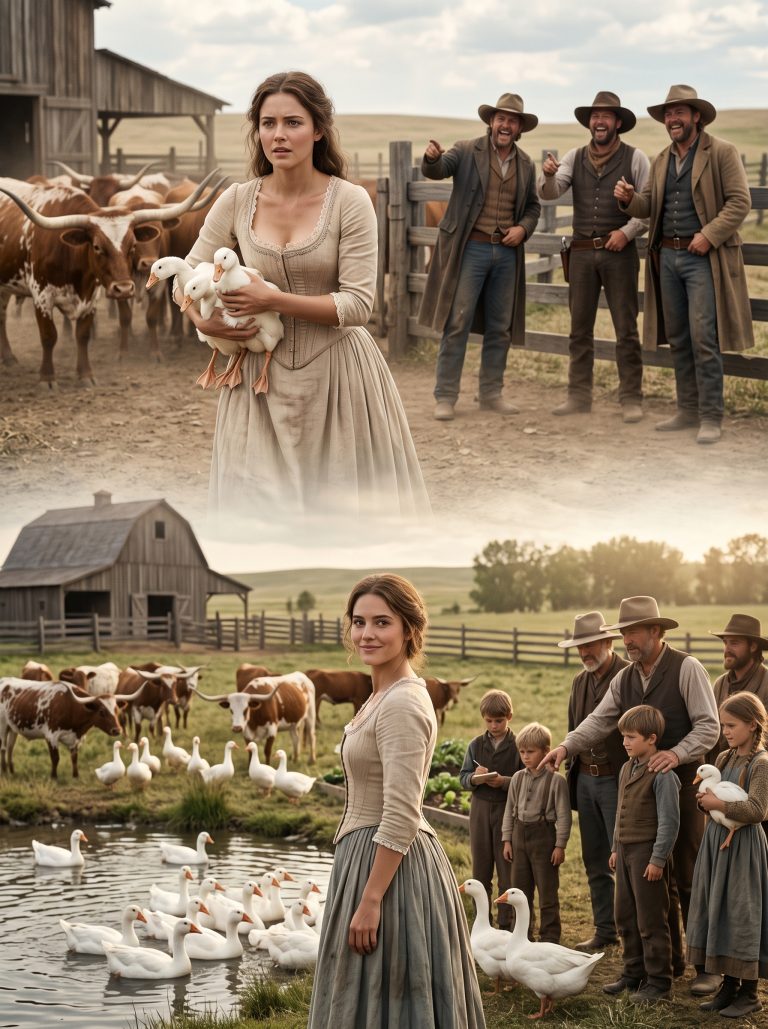
Elena was twenty-four, three months a widow on the Nebraska prairie. The cabin held everything she and Caleb had planned — the stone fireplace he’d laid by hand, the one glass window that had cost more than they could spare. She kept his chair by the hearth because it felt like keeping him. But the quiet had become a waiting. Supper tasted like ash when there was no one to pass the salt.
In town, whispers drifted from the well into the general store — a man moving through the border grass, some said seven feet tall, a ghost, a story told to frighten children. Elena kept her head down and told herself the meat on her porch was only luck.
Two mornings later, frost silvered the ground near the well, and beside it stood prints too large to belong to any settler. A voice came from the tree line.
“You are too thin.”
She spun, the bucket falling from her hands. He stood thirty feet off, where her cleared land gave way to prairie — tall, broad-shouldered, black hair loose past his shoulders, skin like copper in the winter light. His face was calm, watchful, not unkind.
“You’ve been leaving food,” she said.
“The widow Whitfield needs meat for winter,” he answered.
“I can manage.”
“You have tried,” he said simply. “You grow weak.”
She lifted her chin. “That is none of your concern.”
“It became my concern the night your husband pulled my brother from the river.”
The words stopped her cold.
“I don’t know what you mean.”
“Two winters past. The Platte, in flood. A white man went in after a boy who was not his own, and nearly drowned doing it. My brother lived because of him. I have watched this cabin since, from a distance, to see that the debt was paid if it was ever needed.” He paused. “I did not expect to need to pay it to a woman burying him.”
Elena’s throat tightened. Caleb had come home soaked and shivering one night two years back and would only say he’d slipped crossing the river. He had never told her the rest.
“My name is Nakohe,” the man said. “Of the people who were on this land before your husband’s stakes went into it. I don’t come to claim the ground. I came to see a debt closed. But I’ll admit — I have stayed longer than a debt requires.”
“Then you should go.”
“I should,” he agreed, and did not move. “The town says a giant haunts the grass. Let them say it. It has kept riders from your fence line all autumn.”
She almost smiled before she caught herself. “The herbs you left. What are they?”
“Yarrow and raspberry leaf, for a woman’s pain, and to build strength for winter. Nothing more than that. I am not a man who tricks a widow into anything, Mrs. Whitfield. I only intended to leave meat and go. The talking is new. I don’t entirely understand it myself.”
That honesty disarmed her more than any grand claim could have.
“Get off my land,” she said anyway, because it was easier than the alternative.
He simply dipped his head and stepped back into the grass. “I’ll come again before the first real storm. Bar your door until then.”
Then he was gone, and the yard felt larger and emptier than it had in months.
That night she set the herbs on the table, meaning to throw them out. When her pain came three days later and folded her double, she reached for the kettle instead, and hated how much it helped, and hated more how deeply she slept once it did.
The gifts continued — firewood stacked before a storm, a deer dressed and hung, rabbit-skin mittens on the porch rail, always without a word left behind. In town, the sheriff asked careful questions. Elena said she’d seen nothing.
At dusk she took to standing in the doorway, watching the grass turn purple, telling herself she was only watching the weather.
Winter was coming. So, she suspected, was a reckoning she hadn’t asked for and could no longer pretend not to want.
Part 2
The wolves came on a hard white night.
Elena woke to frantic clucking and teeth scraping wire. Six gray shapes circled the coop. She raised the rifle, hands shaking, and a shadow dropped past the window and landed crouched in the snow.
Nakohe rose with a club in one hand, a knife in the other, bare-armed against the cold. The lead wolf rushed him; he stepped aside and the club came down. A second lunged; the knife flashed. The rest lost their courage and scattered into the dark.
Only then did Elena unbar the door.
“You’re hurt,” she said. A slash marked his ribs, bleeding hard.
“It is little,” he said, and swayed once.
“Inside. Now.”
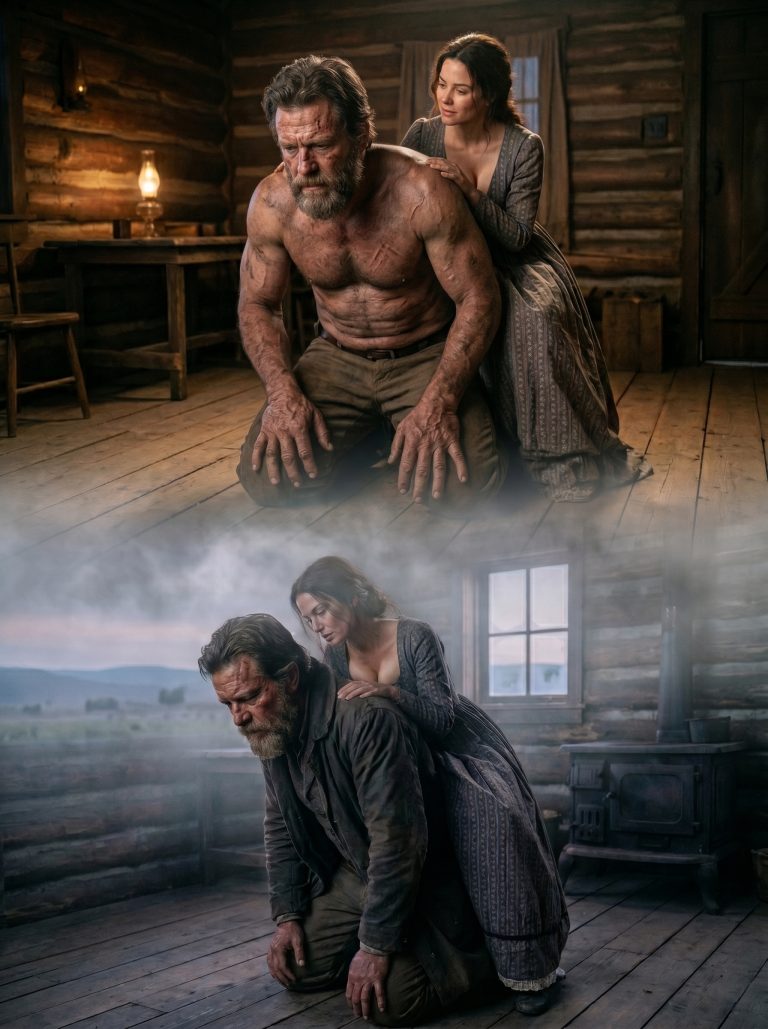
He ducked through the doorway, filling the small room with cold air and the smell of snow. She sat him in Caleb’s chair and cleaned the wound with hands steadier than she felt. He watched her work without flinching, without saying anything clever, which she found she trusted more than if he had.
“You didn’t have to do that for a coop of chickens,” she said.
“Not for chickens.” He met her eyes. “I told myself I was only closing a debt. I have known for weeks that isn’t the whole truth, and I have been ashamed of wanting more than I was owed.”
“Why ashamed?”
“Because a debt is simple. Wanting is not. I buried a wife and a daughter to fever brought in on soldiers’ wagons. I promised myself I would never again let hope build a house it might lose.” He looked at the bandage, not at her. “Then I found myself standing in your yard at night for no reason I could explain to my own brother.”
It was the plainest thing anyone had said to her in a year.
“I have been telling myself the same thing,” she admitted. “That I only speak with you because you saved my chickens. That isn’t the whole truth either.”
He almost smiled. “Then we are both poor liars.”
“Stay until the storm breaks,” she said. “Nothing more than that, tonight.”
“Then I’ll stay until morning,” he said, “and not a moment past what you’ve asked.”
He kept watch by the fire until dawn, and left before the sun cleared the grass, and Elena stood a long moment in the doorway after he’d gone, understanding that whatever this was, it had stopped being about a debt owed to a dead man, and started being a choice she would have to make for herself.
Part 3
The blizzard came three days later, out of the north with no warning worth the name. By nightfall Elena’s woodpile was gone and the lamp guttered low. Three knocks sounded through the wind, and she lifted the bar herself before she’d finished deciding to.
Nakohe came in with a full cord of wood on his shoulder and built the fire high until the cold retreated to the corners.
“You waited too long to call for help,” he said.
“I didn’t know how to call for a man who only appears when he chooses to.”
“Then I am telling you now. You need only stand in your doorway at dusk. I have been watching for it longer than either of us has said aloud.” He set the last of the wood by the hearth. “I told you once I wouldn’t take by force, and I meant it. I also told myself I wouldn’t ask, because asking meant risking losing something before I’d even let myself hold it. I was wrong to let fear decide it for me. So I am asking, plainly, the way I should have from the first night. Will you have me — not because of a debt, not because of a hard winter, but because you want to?”
Elena thought of Caleb’s chair, of the grave outside Clearwater, of a year of suppers eaten alone. She thought of a man who had told her the truth about herbs when a lie would have served him better, who had named his own fear instead of hiding behind a claim of destiny.
“Yes,” she said. “I want to.”
He didn’t move to close the distance until she crossed it first, and that, more than anything he’d done all winter, was what told her she’d chosen right.
By February the snow had softened to gray slush, and Elena stood before the small mirror Caleb had hung years before, a curve just beginning to show beneath her wool dress. Nakohe watched her reflection from the doorway rather than come closer, as though he still hadn’t quite trusted himself to believe the room could hold this much good fortune without cost.
“They’ll know soon,” she said. “The town.”
“Then we go before the passes close again,” Nakohe said. “There’s a valley to the west where my brother’s family winters — the same brother your husband pulled from the river. He’s already asked twice when he’ll finally meet the widow I keep talking about.”
“I’m not marrying a debt.”
“No,” he agreed. “You’re marrying a man who is finally glad the debt gave him a reason to knock on your door in the first place.”
He began teaching her, in the weeks that followed, what she would need beyond the cabin walls — how to read the coming weather in the color of the grass, how to move without leaving sign, how to tan a hide until it was soft enough to sleep on. Her hands roughened. Her step grew surer. She found she did not miss the woman who had only known how to wait.
Not everyone in Clearwater would prove as generous as the sheriff.
It was Delia Marsh, who kept the counter at the general store, who first said the word aloud — savage — loud enough to carry across the yard when Elena came in for thread, and it was Delia’s husband, a man named Otis who ran cattle east of town, who rode out one April evening with two others, torches unlit but carried all the same, meaning only to frighten, he would say later, never to burn.
Nakohe heard them coming from a mile off — he always did, Elena had learned, some sense trained into him by a childhood of watching for soldiers — and he did not meet them with a club or a knife. He met them standing in the open yard, empty-handed, between the riders and the cabin door.
“There’s a woman in there carrying a child,” he said, before Otis had gotten a word out. “Say whatever you rode here to say to me, not through the wall at her.”
“She don’t belong with your kind,” Otis said, though his voice had lost some of its certainty now that the giant of the stories was simply a man standing still in the dark, refusing to be provoked.
“She belongs where she chooses,” Nakohe answered. “Her husband pulled my brother out of the Platte two winters before you ever rode onto this land, Mr. Marsh. I’d ask what you’ve done for anyone in this county besides frighten a widow, but I expect the answer would embarrass you more than the question already has.”
It was Sheriff Watson, arriving late and out of breath on a borrowed horse, who finally sent the riders home — not with threats, but by reminding Otis Marsh, in front of his own men, exactly whose son it had been in that river, and exactly whose grave sat outside Clearwater with a debt still owed against it. Shame, it turned out, could do what fear could not.
Elena stood in the doorway through all of it, Caleb’s rifle loaded and ready in her hands, and understood — watching a man choose words instead of violence even when violence would have been easier and perhaps deserved — exactly why her husband had once thought it worth nearly drowning to save a stranger’s brother.
“You didn’t fight them,” she said, after the riders had gone and Nakohe had finally let his shoulders drop.
“Fighting them would have proved every story they tell about me,” he said. “I’d rather prove the other kind true instead.”
Sheriff Watson rode out twice more that spring with careful questions, and twice more Elena answered them evenly and told him little, and twice more Nakohe stood his ground in the open rather than vanish into the cottonwoods, because hiding, he’d decided, had never once made either of them safer. On the second visit, the sheriff paused at his saddle and said, not unkindly, “Whatever you’ve decided, Mrs. Whitfield, folks in town aren’t as narrow as Otis Marsh, whatever he’d have you believe. Some of us remember your husband pulled a boy from the Platte and never once said whose boy it was. Man like that, I doubt he’d have minded who looked after his widow, so long as she was looked after.”
It was the first time anyone in Clearwater had said aloud what Elena had been afraid to hope — that grief and prejudice were not the same thing, and that some people were capable of telling them apart.
Summer came slow and green that year, and with it a kind of peace Elena had stopped believing she was owed. She sold the cabin to a young couple newly arrived from Ohio, keeping only Caleb’s chair, his rifle, and the small mirror, and in June she and Nakohe rode west together toward the valley he’d promised, a string of pack mules behind them loaded with everything a life could be rebuilt from.
His brother’s name was Chogan, and he met them at the valley’s mouth with a laugh so loud it startled birds out of the cottonwoods.
“So this is the woman who married a debt,” Chogan said, looking Elena over with open curiosity rather than the careful, sideways glances she’d grown used to in Clearwater.
“I keep telling him that’s not what I did,” Elena said.
“No,” Chogan agreed, grinning at his brother, “but it’s the only story he’ll tell around a fire, because the true one embarrasses him too much to say out loud — that he loved you well before the debt gave him an excuse to knock on your door.”
Nakohe did not deny it, which was answer enough.
The valley people were careful with her at first, as she’d been careful with them — a widow with a white husband’s grave behind her and a Cheyenne man’s child growing inside her belonged fully to neither world, and she felt the weight of that some evenings more than others. But Nakohe’s mother, a small sharp-eyed woman named Iva, took to walking with her in the mornings, teaching her the names of plants in a language Elena was slow to learn and slower to forget, and by the time the first frost came, Elena found she had stopped counting the days by which world she belonged to and started counting them, simply, by how close she was to meeting her son.
There were harder nights too — nights when grief for Caleb rose up unexpected and fierce, sharpened rather than softened by how happy she’d become. She would sit outside under a sky thick with stars and let herself cry for a man who would never know his own kindness on a flooded river had circled back, years later, to save the wife he’d left behind.
Nakohe never once tried to talk her out of that grief or hurry her through it. He would simply sit beside her, silent, until she was ready to go back inside. It was in those nights, more than any other, that Elena understood the difference between a man who wanted to replace what she’d lost and a man who only wanted to stand beside her while she carried it.
The child came on the shortest day of winter, in a cabin warm with firelight, Nakohe’s hands steady through hours she would later remember only in pieces — boiled water, cool cloths, a voice low and constant beside her in a language she didn’t understand but somehow always trusted.
“A son,” he said at last, his own voice breaking on the word.
Dark hair. Green eyes, Caleb’s eyes, blinking open in a face that was otherwise entirely his father’s.
“Samuel,” Elena whispered. “Samuel Nakohe Whitfield. A name for every man who kept this family alive.”
“Samuel means God has heard,” Nakohe said.
“Then he heard all of us,” she answered, “even when we weren’t sure we were asking for anything at all.”
They stayed in the valley through Samuel’s first spring, and it was there, watching her son take his first unsteady steps across grass instead of cabin floorboards, that Elena finally let go of the idea that she had left one life behind for another. She had simply widened the one she already had.
Word of the confrontation with Otis Marsh had traveled further than any of them expected, and traveled strangely, the way stories do — by the time it reached the valley secondhand, some tellings had Nakohe fighting off a dozen armed men single-handed, and others had Elena herself standing between the riders and her husband with the rifle raised. Neither was quite true, but Nakohe liked to say the truth of a thing mattered less, in the end, than what people chose to do with the version they’d heard, and in Clearwater, at least, the version that spread was the one where a white widow had been protected rather than endangered by the man the town had once called a ghost. It didn’t erase Delia Marsh’s word, spoken loud across the store, or the fear that had put torches, however unlit, into three men’s hands. But it meant that when Elena rode back through Clearwater two years later to visit Caleb’s grave, no one turned their face away, and one or two, including the sheriff, tipped their hats to the boy riding in front of her on the saddle, dark-haired and green-eyed and entirely unbothered by which world was watching him.
Samuel grew up moving easily between the cabin his mother still owned a corner of and the valley his father called home, fluent by six in two languages and stubborn in both of them, and it was Chogan, more often than his own parents, who told him the story of the river — how a stranger with no reason to risk himself had gone into floodwater after a boy who wasn’t his, and how that single choice had rippled forward through two families until it became one. Chogan told it with embellishments Elena privately thought Caleb would have found mortifying, but she never once corrected them, because the shape of the story mattered more than its exact edges: that courage, offered freely to a stranger, could travel further and longer than anyone offering it ever intended.
Iva taught Samuel the plants she’d once taught his mother, and Elena taught him his letters from a Bible that had traveled from Ohio to Nebraska and now to the valley, and between the two of them the boy grew up with more names for the same sky than most children ever learned, and no confusion at all about which ones were his.
It was Nakohe, though, who gave him the answer he’d remember longest, on an evening not long after his eleventh birthday, when Samuel came home from a visit to Clearwater with his fists clenched and his jaw tight, having overheard a boy his own age repeat something his father had said about people who weren’t “one thing or the other.”
“Am I one thing or the other?” Samuel asked, and it was not a question either of his parents could answer for him with anger, however much anger they both felt.
Nakohe sat with him a long while before he answered, the way he had once sat beside Elena under the stars and let her grieve without hurrying her through it.
“When I was young,” he said finally, “I believed a man belonged to one people or he belonged to none. I lost a wife and a daughter believing that, and I nearly lost your mother too, holding so hard to an old certainty that I told her I’d already decided her future before I’d bothered to ask what she wanted for herself. She was the one who taught me a better way to say it — not that fate had settled anything, but that two people could look honestly at what they wanted and accept it anyway, even knowing it would cost something. You’re not one thing or the other, Samuel. You’re the proof that something embraced honestly is worth more than any single bloodline could be on its own.”
Elena, listening from the doorway, thought of a night years before when a stranger had told her that her body knew what her mind denied, and how frightened and furious that claim had made her — and how far both of them had traveled since, from a man who once spoke of destiny to a father who now, unprompted, told his own son that destiny was the wrong word for what love actually required.
In the years after, when Samuel was old enough to ask how his parents had met, Elena never told him about fate, or prophecy, or a claim made across thirty feet of frozen grass. She told him the truer story instead — that his father had come to pay a debt, and stayed because he was honest about wanting more than he was owed, and that his mother had let him stay only once she was certain the wanting went both ways.
“That’s not as good a story,” Samuel said once, at eleven, disappointed, still young enough to prefer the version with a giant and a prophecy in it.
“It’s a better one,” Elena told him. “The other kind ends in destiny, and destiny doesn’t need anyone to be brave. This kind ends with two people who both had every reason to say no, and said yes instead. Only one of those endings is something you get to be proud of, when you’re old enough to understand the difference.”
Samuel didn’t understand it fully that year, or the next. But he carried the story with him anyway, the true one and not the embellished one, and told it himself one day, decades later, to a daughter of his own who asked how her grandparents had met on a frozen prairie neither of them had been born on — and he told her, the way his mother had told him, that the story wasn’t about a ghost in the grass or a debt owed to the dead.
It was about what two grieving people, given every reason to keep their doors barred against the world, opened them to instead.
The End