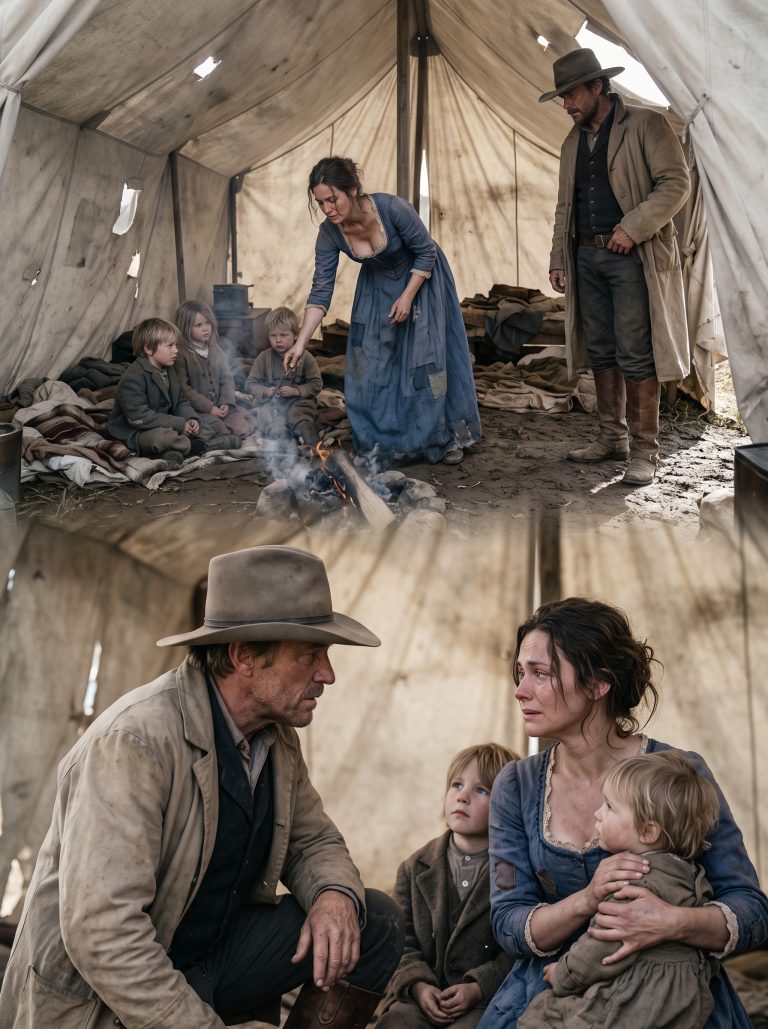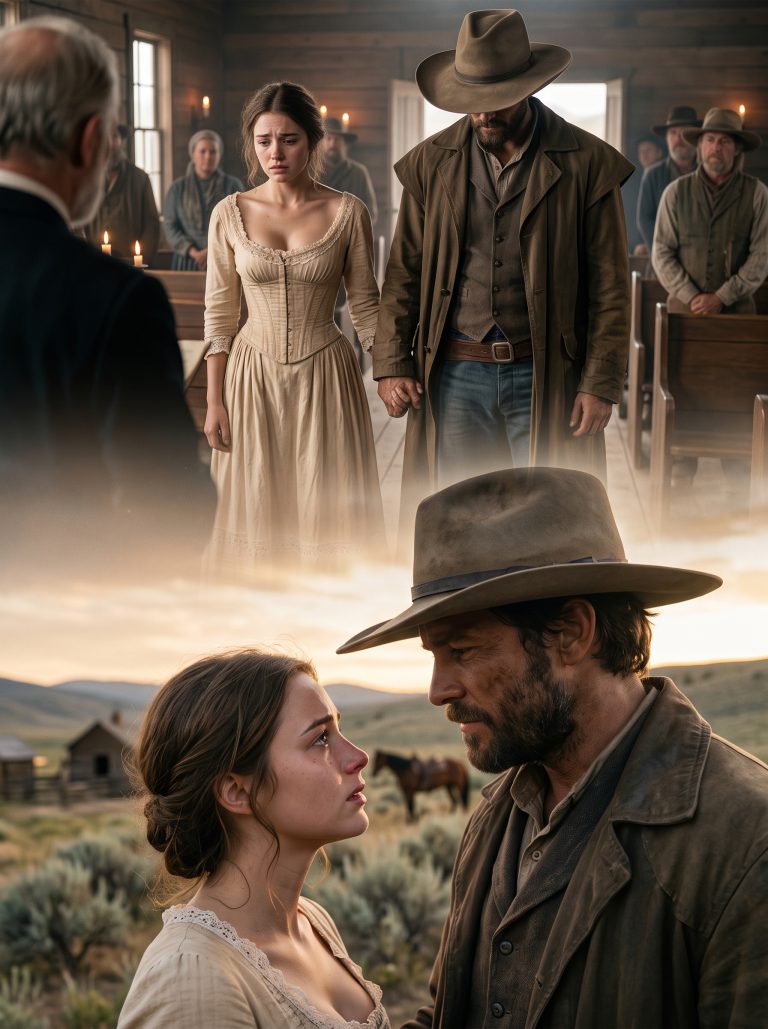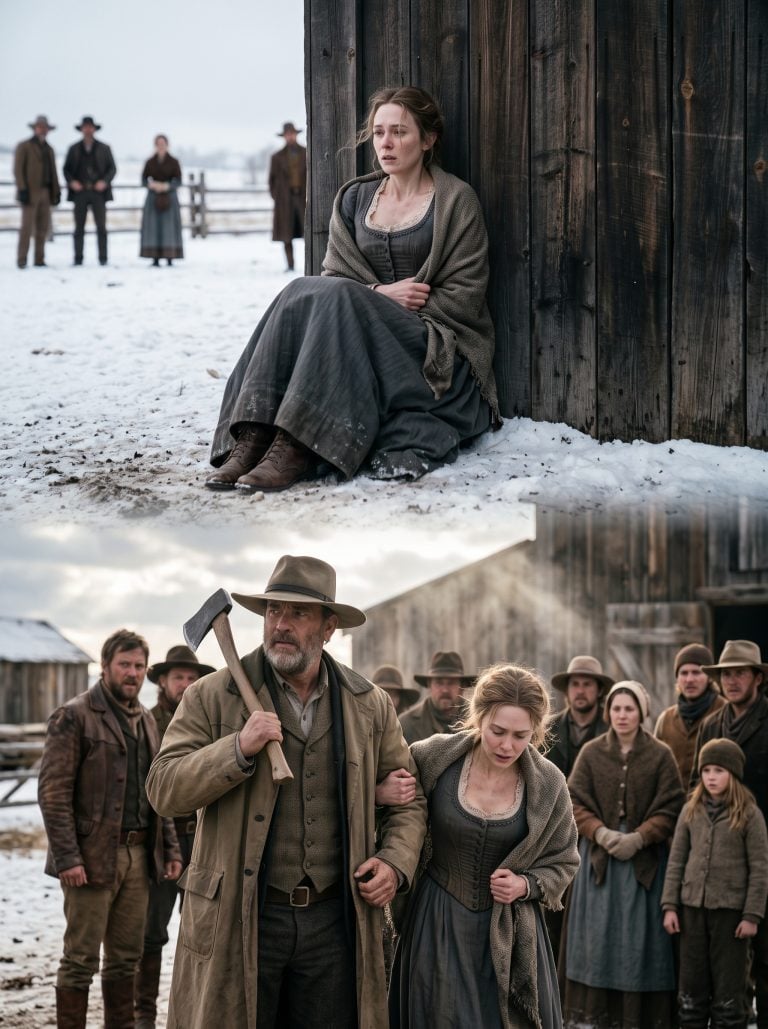
The Giant Asked for a Quiet Wife — Instead, He Married a Wild Storm… By Dawn, She Smirked, “You Picked the Wrong Woman.”

PART 1
The blood had dried to rust by the time Clara Reece reached Coldwater Bluff.
She stepped off the noon train the way people step off trains when they’ve stopped caring about appearances — directly, without pause. Her dress was mud-brown. Her dark hair was braided tight. On her left sleeve, a smear of dried blood announced itself to anyone willing to look.
The platform went quiet.
Coldwater Bluff had been whispering for six weeks about Ethan Voss — the giant of Iron Ridge, who had finally written off for a bride. The biggest man in three counties, they said. The woman who went up that mountain with him would need to be desperate, stupid, or made of granite.
They had expected someone small. Frightened. Hollow-eyed and grateful for any roof that held.
Clara came down the iron steps carrying a carpetbag and a leather satchel, and she moved like someone who had stopped apologizing for the space she took up. Full-figured. Solid. Twenty-nine years of being told she was too much had not made her less.
She scanned the platform once, found who she was looking for, and walked straight toward him.
Ethan Voss was impossible to miss — broad, dark-bearded, a brown coat strained across a frame shaped by two decades of mountain work. He stood near the luggage cart with the careful stillness of a man who’d learned that moving quickly made smaller people flinch.
Clara stopped in front of him.
“You Ethan Voss?”
His eyes went to the blood on her sleeve. Stayed there a moment.
“Yes, ma’am.”
“Good.” She set down her bag. “Then I’m your wife, unless you plan on fainting.”
Three women near the ticket window inhaled. A man who’d been pretending not to listen pretended harder.
Ethan’s brow came down — not in anger. In concern. “Are you hurt?”
“No.”
“Whose blood is that?”
Clara glanced at her sleeve the way someone checks the weather. “A man on the train decided my seat belonged to him because I was a woman traveling alone. His nose disagreed.”
Something moved through Ethan’s face then — through his jaw, into his eyes — and every man within ten feet of him suddenly remembered urgent business elsewhere.
“Where is he now?” Ethan asked.
“Still on the train. Reconsidering his life.”
A ghost of something moved beneath Ethan’s beard. Not quite a smile.
Clara held his gaze. “Your advertisement said you wanted a quiet wife. If that’s accurate, say so now and I’ll wait for the next train east. I’d rather waste a ticket than both our lives.”
His jaw tightened. “I wrote steady. Whatever the paper printed was their word, not mine.”
“Then we agree. Steady I can offer. Quiet is not among my gifts.”
An older woman by the water barrel whispered, “Lord have mercy on him.”
Clara turned. “Ma’am, the Lord’s had twenty-nine years to improve me and appears to have declined.”
It was Ethan who laughed — a low, sudden sound, like thunder deciding to be human.
Clara stared at him. The sound changed his whole face — less legend, more man. Like someone who’d forgotten laughter worked and was surprised to hear it return.
Behind them, the stationmaster Mr. Caldwell muttered something about the mountain swallowing her inside a week.
Clara stopped walking.
Ethan stopped with her.
She turned with a smile so polite it made Caldwell’s collar tight. “Mr. Caldwell,” she said, reading his badge. “I have outlasted poverty, a controlling husband, and a winter in Kentucky that killed my neighbor’s mule. Your opinion is noted.”
Ethan coughed into his fist. Hiding something.
They rode six hours up the mountain. The trail narrowed from wagon road to argument as the light failed. Ethan drove one-handed, patient. Clara sat beside him, refusing to grip the bench even when the wheels struck stone hard enough to rattle her teeth.
“Why did you answer my letter?” he said, an hour in.
“Because it was honest.” She pulled her shawl tight. “Most men advertising for wives write promises. You wrote warnings.”
His hands flexed on the reins. “And what are you looking for?”
“A place where I don’t have to make myself smaller to be tolerated.”
He accepted that like weather.
“I didn’t ask for a quiet wife,” he said at last.
“No?”
“I asked for someone the mountain wouldn’t break.”
Clara looked toward the darkening peaks. “Then perhaps you got more than you paid postage for.”
The cabin stood in its clearing under a sky of hard stars. Log walls. Stone chimney. One rocking chair. No curtains, no flowers, no second chair waiting by the fire. A house built by a man who had expected no one to stay.
Inside, Clara touched the back of that single chair and felt the absence in the room like a draft.
“You live like a man apologizing for taking up space,” she said.
“It suited me.”
“It suits a man who’s never been laughed with.” She met his eyes. “That changes now.”
He looked at her, and she saw it — brief and real — a crack in the stone. Something that might have been hope, if it had gotten more practice.
“We’re still strangers,” he said quietly. “I won’t expect anything you’re not ready to give.”
She had braced herself, on the train ride, for arrogance. For a man who believed a marriage paper granted ownership.
She had not prepared for decency.
“Take the bed,” he said. “I’ll use the loft until we learn to speak without stepping wrong.”
Clara studied him for a long moment.
“You’re either the most honorable man I’ve ever met,” she said, “or the most tired.”
“Tonight,” he said, “I’m both.”
She unpinned her hat.
The mountain went quiet. Clara lay in a stranger’s bed staring at a ceiling without curtains and thought: I have no idea what happens next.
For the first time in years, that felt like possibility.
PART 2
The town gave her six days before it started predicting her failure.
She ignored it. She woke before dawn, braided her hair, and learned Iron Ridge by doing — reorganizing the hayloft by flood risk, memorizing which spring failed first in drought, asking questions about the drainage cuts that Ethan hadn’t expected anyone to ask.
On the tenth morning, she asked to ride the black gelding.
His name was Deacon. He’d sent three men to church ahead of schedule.
“No,” Ethan said.
“Is it my riding that worries you,” Clara said, hands on her hips at the corral fence, “or are you afraid I’ll succeed?”
“I’m afraid you’ll break your neck.”
“That wasn’t one of the options.”
Deacon struck the ground and showed his teeth.
“He bites,” Ethan said.
“So did my first husband.”
The words left her before she could catch them.
Ethan went very still.
She hadn’t meant to say it. The marriage had been mentioned in her letters — ended, legal, done. She had not planned to describe what it had cost her. Not yet.
He didn’t press. Didn’t ask. Only looked at her once with something she couldn’t name — quieter than pity, deeper than curiosity — and opened the corral gate.
“Ride him,” he said. “But you’ll listen first.”
She was thrown twice before noon. She climbed back on twice before noon. By evening she was still in the saddle, walking Deacon in slow circles under a moon gone bone-white, and Ethan stood at the fence watching her with an expression she couldn’t read.
By morning, Deacon carried her across the clearing without a fight.
By breakfast, the story had grown teeth in town.
That afternoon, Reginald Ware arrived — the richest man in the valley, who owned the mill, the grazing contracts, and the comfortable belief that money made a man correct. He smiled at Ethan in the dry goods store with the warmth of a sharpened knife and said something about traditional communities and impressions made.
His wife Dorothea added, silk-smooth: “A woman’s conduct reflects on her husband.”
“Then Ethan must look very interesting this week,” Clara said.
Dorothea’s smile thinned. “Attention isn’t the same as respect.”
“And cruelty,” Clara replied, “isn’t the same as manners.”
That night, by lantern light, Ethan set down his axe and asked: “Do you regret it? Coming here.”
She hadn’t expected the question. Hadn’t expected how deep it landed.
“No,” she said.
“You got a mountain and a town that treats you like a traveling circus.”
“I’ve been a spectacle before. At least here the barn doesn’t leak.”
He was quiet a moment. Then, rough and low: “For what it’s worth — I like your laugh.”
He picked up the axe and became very interested in the next log.
Clara smiled into the dark.
She only knew she did not want to leave.
She only knew that for the first time in years, she did not want to be anywhere else.
PART 3
Winter came to Iron Ridge the way it always had — early, heavy, and without apology.
The first snow fell in October and didn’t stop having opinions until late March. The trail disappeared. The spring above the barn slowed to a thread, then less than a thread. The well still ran, but the trough froze by midnight and had to be broken up by dawn. Two calves were born in November into a barn so cold their breath made small clouds, and Clara and Ethan took turns sitting up with them through the worst nights.
They argued on the fourth night when she refused to come inside and sleep.
“You’ll freeze,” Ethan said.
“The calf will freeze if nobody watches.”
“I’ll watch.”
“You watched last night.”
“And the night before.”
“Then we watch together and neither of us argues about it.”
He sat down beside her in the straw without another word.
That was how they learned to share the mountain — not through negotiation, but through accumulated small decisions, each one saying: I’m not leaving. Are you?
The drought was the hard thing. Worse than cold, worse than isolation. It was a drought in winter, which made no sense and was true anyway. Snow was everywhere, but snow had to be melted, hauled, strained, rationed. The livestock needed water in quantities that turned every day into a calculation. Two young steers died in January. A mare in February. Ethan stood over her in the snow for a long time before he came inside, and he didn’t speak through supper, and Clara put a plate in front of him and said nothing, and that was its own kind of language.
It was on one of those nights — both of them stiff with exhaustion and smelling of hay — that Clara told him about Tennessee. Her father reading creek beds and cloud formations. Teaching her how to find water by what grew above it. The particular way willows lean. The way rock in shaded cuts sweats in summer even in a drought year.
“There’s something under the north hollow,” she said.
“The old surface spring there dried three seasons ago.”
“Not that. Deeper. The slope of the land, the way the drainage cuts — something runs under that hollow that nobody’s reached yet.”
Ethan looked at her across the table. “We’d have to dig.”
“Yes.”
“That could be thirty feet.”
“Then we start tomorrow.”
Reginald Ware came in January with three riders and Dorothea and a smile that had been carefully arranged to suggest sympathy.
“I’ve come as a neighbor,” he said to Ethan, who was replacing a barn hinge.
“You haven’t come as a neighbor in fifteen years,” Ethan said.
Clara was in the hayloft, invisible.
Ware explained, at some length, that the valley was suffering. That small operations were doomed. That a man of practicality would consider an offer before the season made the decision for him.
“No,” Ethan said.
“You haven’t heard the figure.”
“No.”
Dorothea sighed the sigh of a woman performing concern. “Mr. Voss, surely your wife deserves better than this. A town. Society. Comfort.”
The pitchfork landed in the snow six inches from Dorothea’s horse.
Clara appeared at the loft opening.
“Mrs. Ware,” she said pleasantly, “I’m touched by your concern, which I’m sure has nothing to do with your husband’s finances.”
Ware looked up at her with the expression of a man reassessing a piece on a board. “I was telling your husband that this property has unrealized value.”
“Under proper stewardship, you mean.”
“With respect, you’ve been here less than a season.”
“Long enough to recognize when someone’s complimenting the furniture while measuring you for a coffin.”
One of the riders stifled a sound.
Ware’s tone went smooth as river ice. “Winter exposes weakness, Mrs. Voss. I’d remember that.”
Clara climbed down the ladder and crossed the barn and stood beside her husband, the top of her head not quite reaching his shoulder.
“And thieves,” she said. “Winter exposes those too.”
Ware looked at her for a moment that stretched too long, then gathered his riders and rode away without another word.
Ethan waited until the sound of hooves faded. Then he looked down at her.
“You are not what he expected,” he said.
“I’ve spent my life being punished for that.” She brushed hay from her sleeve. “I might as well get something from it.”
They started digging in March, when the worst of the snow had packed down enough to work. Ethan went down into the pit; Clara rigged the pulley, sorted stone, kept records, hauled what her body allowed. She was healing from something she hadn’t yet told Ethan about — something she’d suspected since February, confirmed by the end of March, and held inside herself like a small fire she wasn’t ready to share.
The morning sickness was its own argument.
On the twelfth day, Ware came back to watch.
“This is sad, Voss,” he called down into the pit.
Ethan, fifteen feet down, drove his shovel into the earth. “Then go be sad somewhere else.”
“You’re digging your own grave.”
Clara stood at the pulley rope, hair escaping its braid, back aching in a way it hadn’t ached before February. “Mr. Ware, if so, I promise the funeral won’t require your attendance.”
Ware looked at her with the first genuine assessment he’d ever aimed in her direction. “Pride is a luxury for people who can afford it.”
“So is threatening a woman holding a rope over a hole,” Clara replied.
He left.
That night, Ethan looked at her across the supper table and said quietly: “You’re unwell.”
“I’m tired.”
“Clara.”
“Ethan.”
“You’ve been sick in the mornings for three weeks.”
She had meant to choose the right moment. She had been waiting for a moment that felt steady enough.
But the right moment, she was learning, was usually the honest one.
“Something is happening,” she said.
He went very still.
She touched her stomach. Not rounded yet — nothing visible. But no longer only hers.
The color left his face. Then flooded back. Then left again.
He came around the table in two strides and went to one knee in front of her like the floor had given way beneath him.
“Clara,” he said. His voice broke on her name.
“I’m afraid,” she said.
“So am I.”
“That’s terrible comfort.”
“I know.”
She laughed and cried at the same time, which she’d always considered an embarrassing combination, and couldn’t stop either one. Ethan’s arms came around her slowly, carefully, like she was something he didn’t trust himself not to break.
“Don’t,” she said into his shoulder.
“Don’t what?”
“Don’t treat me like glass. I broke a man’s nose on a train.”
His breath shook.
“I won’t sell to Ware,” he said. “Not for any price. Not unless you tell me to.”
“I won’t tell you to.”
“Then he’ll have to dig us out.”
She pressed her face against his coat.
“We’re going to be terrible at this,” she whispered.
“We’ve been terrible at everything else and it’s worked out.”
She almost believed him.
The baby came in the worst storm of the year.
Clara woke in the night with pain that started in her spine and spread, and a cold wetness that told her everything was happening too fast, too early, in the worst possible conditions. The trail was buried. The nearest doctor was forty miles of impassable mountain. The wind was hitting the cabin walls hard enough to make the beams complain.
“Ethan.”
He was awake before she finished his name.
What followed could not be made smaller than it was. Clara had expected fear. She had not expected this particular quality of terror — the kind with no bottom to it, where she couldn’t find the next thought past the pain and the knowledge that the baby was too early and the storm was too total and there was nothing to do but go through it.
Ethan boiled water. He tore clean linen into strips. He stoked the fire until the cabin was hot enough to be stifling and knelt beside her and let her break his hand.
“I need you to keep being angry,” he said once, when she went quiet.
“I’m not angry, I’m in—”
“I know. Stay angry anyway.”
She cursed him comprehensively for the better part of an hour. He said nothing she needed to argue with.
Near dawn, the baby arrived in silence.
A girl. Small. Far too still.
Ethan’s hands — enormous, clumsy with terror — cleared her airway. Rubbed her back. Whispered words Clara couldn’t hear.
Nothing.
“Give her to me.” Clara’s voice came from somewhere below language.
“She isn’t—”
“Give me my daughter.”
He placed the baby against Clara’s chest. Skin to skin, the way she’d heard was done, though she couldn’t have said where she’d heard it.
Clara curled around the child. She was shaking so hard she could feel it in her teeth.
“You came through me,” she said. Her voice was steady in a way her body was not. “That took four months of misery and a blizzard and a pit we dug with our own hands. You do not get to be polite about surviving. You hear me? You are my daughter. You are not allowed to be quiet.”
Ethan bent over them, helpless in the way that the largest people are helpless when the thing they’d move mountains for is beyond the reach of strength.
Clara kept moving her hand in slow circles against the baby’s back. Kept talking.
“Be greedy,” she whispered. “Be loud. Take up the whole room.”
The baby made a sound like something deciding.
Then a cry — thin, furious, loud enough to cut through the storm’s noise — split the cabin open.
Ethan made a sound that Clara had never heard from a human throat. It came from somewhere past his chest, past language, past the composure he’d been holding since she woke him. He dropped to his knees beside the bed and pressed his forehead against her shoulder and shook.
Clara held their daughter and cried without stopping and didn’t feel ashamed of it once.
They named her Ruth. For stubbornness. For survival. For the way she’d arrived angry at the inconvenience of existing and done it anyway.
The fever took Clara on the second night.
Ethan kept Ruth warm in a padded drawer near the stove and sat beside Clara through the long hours, giving her broth by the spoon, talking when she was awake and when she wasn’t. He talked about the spring he’d found at sixteen that nobody else knew about. He talked about his father and the rockslide and the man he’d been before he understood that survival and living were different things. He talked about the letter he’d written and the seventeen drafts that had come before it, each one more honest than the last because he’d finally decided honesty was the only thing he had left to offer.
When she drifted into fever dreams, he said: “You don’t run from hard things. That’s the whole of you. So don’t run from this one. I can’t follow where you’d go.”
On the third day, the storm broke.
On the fourth, Ethan made it down the mountain and returned with Dr. Harriet Crane, who had medical training, a horse that could navigate drifts, and absolutely no patience for self-pity.
She examined Ruth. “Premature. Small. But breathing with intent.”
She examined Clara. “You need a month of rest. No hauling, no riding, no proving yourself to anyone.”
“I wasn’t planning—”
“You were.” Dr. Crane pointed at her. “I know you were. Stop.”
For three weeks, Ethan did nearly everything. His cooking was sincere but structurally questionable. He washed diapers with the focus of a man performing surgery. He slept in pieces, upright in the rocking chair with Ruth tucked against his chest, one broad hand curved around her like a roof.
Clara watched him from the bed and understood, without drama or announcement, that she had fallen in love with him.
Not the breathless kind. Not the kind from the novels she’d read in the lending library in her first life. This was the quiet kind. The kind that comes from watching someone do something small and difficult and unglamorous with total dedication, night after night, without an audience.
That was more dangerous than passion.
Passion ended. This looked permanent.
By April, the problem they’d dug a hole to solve had worsened.
The spring had reduced to mud. They had Ruth, who was growing by ounces, fierce and imperious and unaware that the world owed her anything. They had each other, which was more than either had expected in October. They had almost no livestock left and water they couldn’t count on.
One evening, Clara stood in the doorway with Ruth sleeping against her shoulder and watched smoke columns rise from the valley. Families leaving. Seven last week. Three more yesterday.
“Ware will buy every one,” she said.
“Already started,” Ethan said behind her.
“Then us next.”
“No.”
She turned toward the north hollow. The slope of it. The way the melt ran. She had been thinking about it since January, since the conversation at the supper table, since her father’s voice in her memory: water finds its own level, girl. Learn the land’s logic and you’ll always know where it goes.
“We go back to the pit,” she said.
“We stopped at twenty-two feet.”
“We go deeper.”
He looked at her. At Ruth. At the land. At her again.
“If we dig and find nothing—”
“Then we’re no worse than we’d be selling. And we’d be worse in different ways.”
He was quiet for a moment. Then: “We dig.”
They began again at dawn.
Ethan went down. Clara ran the pulley, sorted stone, kept the ledger of what came up and at what depth, and fed Ruth in the intervals. She rested when her body demanded it, but she did not stop. The town heard within days. People came to watch — some curious, some skeptical, most somewhere in between.
Ware came on the ninth day.
He looked down into the pit and smiled with his mouth. “This is difficult to watch, Voss.”
Ethan, below, drove his shovel in without answering.
“You’re exhausting what little you have left.”
Clara stood at the pulley rope, Ruth in a sling across her chest. “Your concern continues to cost nothing, Mr. Ware.”
“I could end this today. Fair price. You leave with something rather than nothing.”
“We leave with something either way,” Clara said. “We leave with the answer.”
“The answer won’t feed that child.”
Clara looked down at Ruth’s sleeping face — round cheeks, lashes curved against them, small fists curled at her collar. She looked like determination in miniature.
“She’s already fed,” Clara said. “And she’ll be fed tomorrow. You’ll need a better argument.”
On the twenty-first day, Ethan’s shovel went into earth that was different.
Darker. Colder. He crouched and touched it.
“Clara.”
She was at the pulley, back to the pit. The exhaustion in her shoulders was something she’d stopped cataloguing.
“What?”
“Come here.”
She turned. Looked down. He was holding a handful of earth that glistened.
Her hand went over her mouth.
He dug with his fingers, and water came up between them. Slow, then faster. He laughed — and it echoed up from the pit like something that had been waiting underground alongside the water.
“Is it—”
“Cold. Clear. Clean.” He drank from his cupped palms. “Clean.”
Clara sat down on the ground beside the pit without planning to.
She didn’t cry prettily. She cried the way people cry when the thing they’ve been braced against not having suddenly exists — great, shaking sobs that came from below her ribs. Ruth startled awake and added her own opinion. Ethan climbed out of the pit covered in mud, laughing, and sat down beside them both in the dirt.
“We did it,” Clara said.
“You did it.”
“We.” She wiped her face with her sleeve, which was filthy, which didn’t matter at all. “Don’t practice being modest now. We are terrible at false humility, both of us.”
He put his arm around her and she leaned into him, Ruth between them, all three of them muddy and exhausted and entirely, ridiculously alive.
Word reached Coldwater Bluff before nightfall.
The next morning, families came with barrels. Ethan priced the water fairly. He gave it free to households with young children and no coin. Clara kept the accounts in a ledger and told two men who tried to negotiate a lower price for themselves that the well had developed opinions about who deserved generosity.
For two weeks, Iron Ridge became a different kind of place. Hope, hauled up in buckets.
Then Reginald Ware came back with five riders, and this time he left Dorothea at home.
“That tells you what kind of visit this is,” Clara said to Ethan as they watched the riders approach from the window.
She handed him Ruth. Picked up her jacket. “Stay here.”
“Absolutely not,” Ethan said, and gave Ruth back.
They stepped out together.
Ware dismounted. His gloves were spotless. His expression was not. “I’ll buy the well. Full price. Plus the acreage.”
“No,” Ethan said.
“You haven’t—”
“The answer will continue to be no.”
Ware turned to Clara. “Be reasonable.”
“I’m very reasonable,” Clara said. “I’ve been reasonable for months. It’s taken some effort.”
“I can claim legal water rights. I can argue the underground source crosses my land. I can tie you in court until the fees finish what the drought started.”
She felt it — the cold, practical fear of that. Paper and courts and systems built for men like Ware, who knew how to use them.
One of the riders said, quietly and stupidly, “Boss, let’s just break the rig. Nobody can prove—”
Ware turned on him with fury.
But the words had reached everyone in the yard.
Clara smiled. She felt it come slowly, like water through stone.
“There it is,” she said.
Ware looked at her.
“The civilized man’s interior,” she said. “Law on the outside. Violence waiting underneath, getting impatient.”
She saw him decide whether to speak.
Before he could, a voice from the tree line said: “I’d consider that carefully, Reginald.”
Dr. Harriet Crane rode in from the east trail with Sheriff Nate Boone beside her and a delegation of valley families behind them — seven, eight, ten people. Including, to Clara’s profound satisfaction, Mr. Caldwell, who looked as though his principles had arrived at some personal inconvenience.
Dr. Crane pulled up her horse. “Mrs. Voss sent me a letter last week suggesting there might be trouble once the well was proven.”
Ethan turned to look at Clara.
She looked back. “I was resting. I had time to think.”
Sheriff Boone dismounted. “Ware, I’m going to need your men to make their hands visible.”
Ware stood very still. “This is a private negotiation.”
Boone looked at the riders. “Didn’t sound private.”
The man who’d spoken looked at Ware, looked at the sheriff, and made the decision cowards always make when the odds shift. “He said to scare them off,” he said. “Said if the rig got broken, nothing could be proved.”
“Fool,” Ware said.
Clara laughed.
She couldn’t help it. It came up from somewhere past exhaustion and fear, loud and real, and it went across the yard and up the mountain and probably disturbed somebody’s sleep at a distance.
Ethan, holding Ruth, smiled in a way that went all the way to the back of his eyes.
Ware was not finished. He was never simply finished.
He filed suit in June. Water rights. Shared underground source. Unlawful diversion. He had lawyers who could make theft sound like conservation.
The trial was in September.
Clara prepared for it the way she’d survived the winter — by beginning earlier than anyone expected and stopping later than anyone else wanted to.
She gathered testimony from every household that had drawn water. She mapped the land, the slopes, the old drainage, the geological survey from 1851. She found an aged county surveyor named Otis Fenn who was half-blind, fully cantankerous, and in possession of a memory that put younger minds to shame.
She sat up nights by lamplight while Ruth slept in a basket at her feet, and Ethan watched her from across the table with an expression she recognized now.
“What?” she said, not looking up from her notes.
“You,” he said.
“That’s not an answer.”
“It is,” he said. “You’re the whole answer.”
She didn’t respond to that because she couldn’t find words that fit. She kept writing.
In the courtroom, Ware arrived with two lawyers who wore their confidence like good clothes.
Clara arrived with Ethan, Otis Fenn, Dr. Crane, Sheriff Boone, and fourteen families from the valley.
Ware’s attorney was eloquent about property rights, precedent, and the necessary order of civilization.
Clara, on the stand, was asked how she’d chosen the well site.
“My father taught me to read land,” she said. “Water leaves memory in soil and stone. Willows lean toward it. Runoff avoids it. Grass thickens over it. If you know how to look, the land will tell you where the water is.”
Ware’s attorney rose. “Are you a surveyor?”
“No.”
“A geologist?”
“No.”
“Then your judgment was effectively guesswork.”
Clara looked at him. “Most survival is.”
Several gallery members failed to conceal their reactions. The judge frowned, but his frown was directed at the ceiling.
Otis Fenn testified next. He produced a survey map from 1849 showing a natural underground basin beneath Iron Ridge, entirely within Ethan’s property line. Ware’s land drew from seasonal surface flows, not the deeper source. Furthermore, the map showed a blocked test shaft on a parcel Ware had purchased three years prior — sealed with stone in a way that redirected surface water onto his own lower fields.
The courtroom’s temperature dropped.
Sheriff Boone confirmed his office had located the blocked shaft exactly where the map indicated.
Ware’s lead attorney stopped taking notes.
The judge ruled before the end of the afternoon.
The Iron Ridge well belonged to Ethan and Clara Voss. The blocked shaft on Ware’s land would require a full inquiry by the county surveyor’s office. The question of illegal water diversion was referred for further action.
Outside the courthouse, Ware approached Clara alone.
He stood very close. His voice was low and careful. “You’ve won a battle.”
“I wasn’t counting battles,” Clara said.
“You will lose the war.”
“Mr. Ware, I’ve been at war since I was twenty-two years old and I’m still here.” She met his eyes. “You mistake me for someone who expects to win everything. I only expect to still be standing.”
He looked at Ethan. “She’ll be the end of you.”
Ethan put his hand on Clara’s shoulder. “She’s the beginning of me.”
Time moved the way it always did — indifferent to what it was carrying.
The herd took three years to rebuild. The cabin grew a second room, then a third, because Ruth did not remain small despite everyone’s preferences. Dr. Crane’s monthly clinic in Coldwater Bluff became a permanent practice because Clara spent two years writing letters and attending meetings until the town council agreed to fund it. Families who had lost land to Ware began, one by one, to challenge the contracts they’d signed in desperation. Some won. Some didn’t. But the challenging itself changed something.
Women came to Clara quietly, first individually, then in pairs. How do you read a deed? How do you keep an account Ware’s bookkeeper can’t argue with? How do you speak in a room that was built to make you feel like you don’t belong?
Ethan built a second trough near the well and a broader road down the first section of the trail so families could come without risking their wagons. He said little about any of it and did all of it.
Ruth grew up hearing the story of the well from everyone in the valley, each version different.
At ten, she demanded the truth.
Clara was making bread. Ethan was at the table mending a bridle. The third room of the cabin held Ruth’s narrow bed, a bookshelf, and approximately forty thousand rocks she’d been collecting since she could walk.
“The true story,” Clara said, kneading the dough, “is that your father wrote for a steady wife. A newspaper in Denver printed the word quiet instead. I arrived having corrected a man’s behavior on the train, and I asked your father if he was afraid of women.”
“Was he?”
Clara looked across the table. Ethan looked back.
“A little,” he said.
“Wise,” Clara said. “I’m still afraid of your mother.”
Ruth frowned. “But you were brave.”
“Bravery is what people call fear after it’s finished the work,” Clara said. “Your father taught me that.”
Ethan raised his eyebrows. “You taught me that.”
“We arrived at it together. Like most things.”
Ruth picked at the edge of the table. “Did you ever want to leave?”
Clara’s hands kept moving. Flour. Dough. The rhythm of it.
“Yes.”
Ruth looked up, surprised.
“Many times. When you turned blue in the first minutes of your life. When fever had me. When the water stopped and the animals died and men with money told us that wanting to stay was a kind of vanity.” She paused. “I wanted to leave because I was so tired I couldn’t see past the tiredness. And because sometimes the hard thing is hard enough to make cowards out of honest people.”
“But you stayed.”
“We chose it. Every day, separately and together. We chose the same thing.” She turned the dough. “Staying once is an event. Staying every day is a life.”
Ruth thought about this with the seriousness of a child learning something too large to hold all at once.
Ethan reached across the table. Clara put her flour-whitened hand in his.
Ruth looked at their joined hands and understood, in the dim way of ten-year-olds who know more than they know they know, that she had been raised inside a decision her parents kept making. Not a story about two people who had found each other and been completed.
A story about two people who chose, over and over, in small ways and large ones, to stay.
Forty-one years after Clara Reece stepped off the train with blood on her sleeve, she sat on the porch of the Iron Ridge house and watched the last light move across the valley.
The house had acquired things. Curtains in colors Dorothea Ware would have found improper. A bookshelf on the porch for weather-appropriate reading. A carving of a horse on the railing post that Ruth had done at sixteen and never finished, which Clara had decided was complete as it was. Apple trees. A second well. A bunkhouse for the hands.
Ethan sat beside her, larger in some ways than the day she’d met him and slower in others, his beard gone almost entirely silver and his hands still the size of small continents. He had not become smaller. Neither had she. They had both become more exactly what they were.
“Do you regret it?” she asked.
He turned to look at her with an expression she knew as well as the sound of the spring in April.
“Which part?”
“Not getting quiet.”
He was quiet for a moment.
“I’m remembering the platform,” he said. “You came down those steps and asked me if I was afraid of women.”
“You were.”
“I was. I was also grateful someone finally asked.”
The valley lights were coming on below them. Families who’d drawn water from their well. A clinic that had delivered forty-seven babies in the last decade. A cooperative that had outbid Ware’s estate for the old mill three years after his death.
Small things. Things that didn’t make the story the way the valley told it.
“They won’t remember it right,” Clara said.
“No.”
“Doesn’t that bother you?”
Ethan thought about it the way he thought about everything — without hurry, getting there when he got there.
“What matters is that Ruth knows,” he said. “That the woman who came to you last spring about her deed knows how to read it now. That the family who drew water last January is still here because of the well and not because of Ware’s charity.” He paused. “The story people tell isn’t ours. Ours is the one we lived.”
Clara leaned against him. He was warm. Still enormous. Still solid in the way of things built to last.
“You found words again,” she said.
“Only when you’re listening.”
Night came in fully over the mountains. Stars appeared, the hard bright kind that had been there the night she arrived and would be there long after.
Clara closed her eyes.
Wind. The distant sound of water. Ruth’s children, half a valley away. Ethan breathing.
Not silence. Never silence again.
Once, a man had written an honest letter about a difficult life and hoped for a steady woman.
Once, a woman had read it and recognized something she’d stopped believing existed: truth offered plainly, without promise of ease.
She had arrived broken in specific ways, carrying other people’s definitions of who she was. He had been alone so long he’d built the aloneness into the walls.
They had not healed each other the way stories say people do. They had simply been honest, and worked hard, and chosen each other through the kind of days that make that choice complicated.
And the life they made was not beautiful the way ornaments are beautiful — static, safe behind glass.
It was beautiful the way working land is beautiful. Marked by weather. Shaped by use. Bearing evidence of every hard season and still, somehow, still producing.
That was enough.
That was everything.
THE END