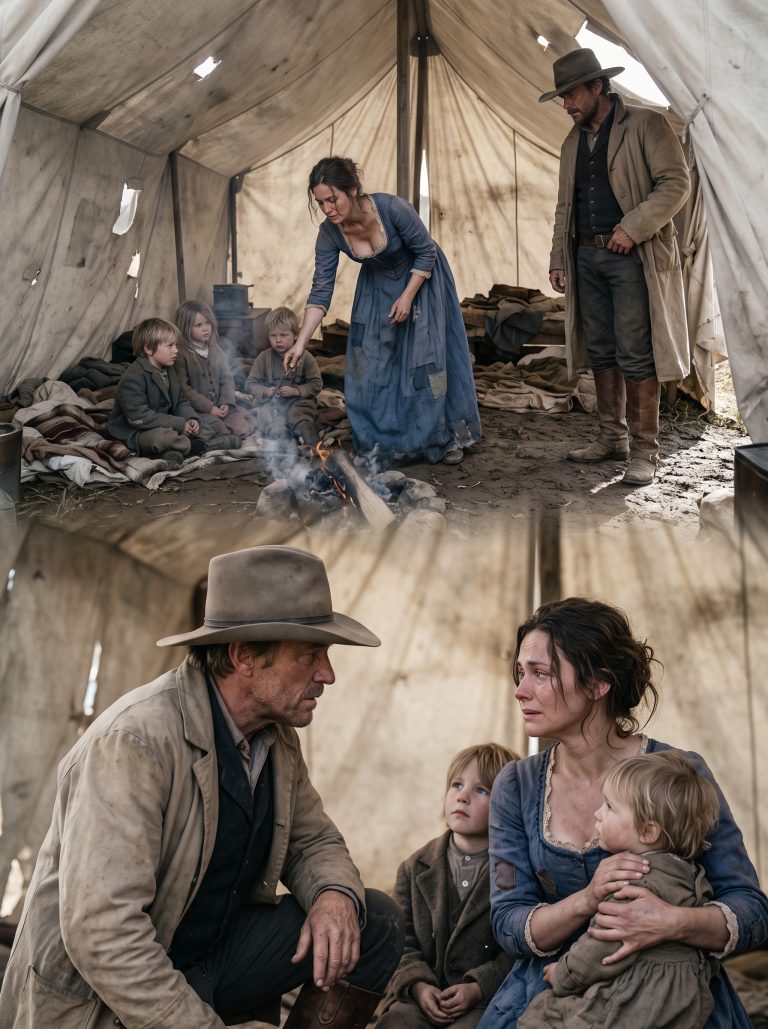
Cast Out in a Blizzard, She Hid Behind a Waterfall—Then Discovered Something That Saved Her Life

Part 1
Nine days after Blackfir Camp branded Nora Fenwick a thief, the storm was still trying to finish what the camp had started.
Wind came down off the ridge like something with teeth, and behind the frozen curtain of Widow’s Veil Falls, Nora sat by a small, steady fire she had built inside a chamber no one at Blackfir knew existed. Charcoal marks climbed the stone wall in careful columns. Day seven: outside bitter, vent cleared, smoke clean. Day eight: spring holds. Day nine: four days of food certain, six if careful.
She had learned to count before she had learned to fear, and lately the two had become the same skill.
Three weeks earlier she had been only a pair of useful hands to Cormac Voss — the man who owned the timber contract, the store, the debt book, and, in every practical sense, the people who worked his camp. Nora had come to Idaho Territory four years before, orphaned by fever on the trail, and Cormac had folded a labor contract across his desk with his thumb pressed over the line where she signed. She would work off her parents’ debt. The debt, curiously, never shrank no matter how carefully she kept his books.
And she kept them very carefully. Her mother had taught her sums at a kitchen table in Ohio, tapping a slate whenever Nora tried to guess instead of reckon. Numbers don’t care who’s speaking, her mother used to say. That’s why liars fear them.
It was that habit — checking, rechecking, never letting a column close until it balanced — that had, without her quite meaning it to, begun turning up small wrongnesses in Cormac’s freight receipts. A few dollars of flour bought but never delivered. Freight costs paid twice. Nothing large enough to accuse a man of. Large enough, though, that Nora had started keeping a private page of her own, tucked behind the false bottom of her sewing box, where she copied the discrepancies she found and the dates she found them.
She never told anyone. Not even Martha Doyle, the laundress with lye-red wrists who left warm kettles and mended sleeves near Nora’s bunk when she could risk it. Not even Daniel Ashford, the new schoolmaster who’d arrived in October with a blackboard, a bad limp he tried to hide, and a way of looking at Nora as though she were a person and not a set of useful hands.
“You sound certain enough to teach,” he told her once, after she’d fixed a wedge under his sagging blackboard leg.
“A person can know things without being permitted to teach them,” she’d said, and he had looked at her the way no one at Blackfir ever had — as if that sentence cost her something, and he intended to remember the price.
Cormac’s son, Devlin, watched Nora too, but the way a man watches something he means to use. Twenty-six, handsome in the way of men never forced to doubt their welcome, Devlin gambled with the teamsters behind the lower shed and grew charming when he won, sullen and dangerous when he lost.
In late October a payroll box came through with foreman Reuben Cole — walnut, iron-strapped, brass-locked, carrying wages for two dozen miners bound for Silver Run. Cormac made a show of locking it in his own office and pocketing the key.
That night Devlin lost badly at cards. By dawn the box was gone.
Devlin was the first to say he’d seen Nora near the office. The search that followed had the shape of justice and none of its substance. When a single piece of stamped mining scrip turned up in Nora’s sewing box — beneath the very page where she’d hidden her private ledger of discrepancies — Martha cried out as if struck.
Nora did not.
“If I stole a locked box,” she said, “why hide one piece of scrip among my needles, and nothing else?”
“Thieves are seldom wise,” Cormac said.
“Then check the lock. Ask who else holds a key.”
No one moved. Daniel stepped forward, pale with anger, and said this was not a hearing and Cormac had reached judgment before asking the only useful questions. Cormac reminded him he’d been hired to teach children letters, not law, and reminded the room that snow was coming and he would not keep a thief under his roof.
He tore Nora’s contract in half. The sound was small and terrible.
“The debt remains recorded,” he said, as if that were mercy.
She was allowed her clothes, her sewing box, one blanket, a tin cup, a dull knife, and half a loaf of bread Martha pressed into her hands when Cormac looked away. At the yard’s edge, in the first needling rain, Daniel came after her with his coat held out.
“You’ll freeze,” he said.
“If I take it, he turns you out too, and then no one is left asking questions.”
“I can go with you.”
For one dangerous second she wanted that more than she wanted to survive the night. She had spent four years surviving by needing as little as possible, and she was not about to relearn need now, in the rain, in front of him.
“No,” she said. “Stay. Remember what happened in that room.”
“I’ll find proof.”
“Proof doesn’t keep a body warm.”
“No,” he said. “But it may bring you home.”
She turned south before the word could do any more damage, and did not look back.
Part 2
She made it three miles before the fallen road and the rising wind turned her north instead, climbing blind through spruce and rock with no trail at all, rationing her strength the way she’d learned to ration flour — carefully, without drama, never spending what couldn’t be replaced.
By late afternoon she heard water — not creek water, but a deep, steady roar. Widow’s Veil Falls dropped fifty feet into a stone basin, spray blowing sideways in the wind, and behind its right edge she saw what the spray nearly hid: a dark gap where the ledge overhung the curtain of falling water.
Reaching it cost her a boot full of ice water and two falls on the rock. The crack behind the falls was too low to stand in. She crawled.
The passage sloped upward into dry stone, and the storm fell away behind her like a door closing. Her hands found old work before her eyes found any light — a ring of blackened stones, a rotted basket, a dented tinderbox. It took a dozen trembling tries to coax a flame from damp flint, and when it finally caught, the chamber came slowly into being around her.
It was no miracle cave. It was the remains of people who had understood this mountain before Blackfir scarred it with stumps, and after them, some trapper who had added his own tools before time and damp claimed most of it back. But not all. Three sealed crocks of food, old but dry. Hides, some ruined, two still usable. A rusted knife. A deer hide marked with symbols she couldn’t read — water lines, slope marks, a warning hand.
Nora sat before the small fire and laughed once, a broken sound that turned into a sob before she clapped a hand over her own mouth, ashamed though no one could hear her.
Then she wiped her face and began, out of old habit, to count.
She took charcoal from the hearth and drew columns on the stone. Food. Fuel. Dry material. Repairs. Unknown.
Numbers had belonged to Cormac’s debt books for four years. Tonight, for the first time, they belonged to her own future.
Part 3
The next morning nearly killed her through ignorance — she built too large a fire and choked on smoke that had nowhere to go, learning by coughing fit that the shelter had not failed her, only her understanding of it. A narrow vent behind a stone shelf, clogged with roots and an old bird’s nest, took half a day to clear. When she warmed the flue first with dry bark before feeding it wood, the smoke rose thin and clean, and she sat back on her heels and wept without sound.
Over the following days she built a smaller, livable world inside the vast and deadly wilderness outside: a sleeping frame off the cold stone floor, snares repaired from rawhide and a scrap of spring steel, a drainage trench to keep her stores dry. On the fourth day, a snowshoe hare waited in her willow snare. She knelt beside it a long moment before she cleaned it.
“I’m sorry,” she said, and meant it more than she had meant anything Cormac Voss had ever made her sign.
Back at camp, Devlin told anyone who’d listen that Nora had likely fallen into some canyon, and the telling made his shoulders loosen every time. Daniel heard each version and grew colder. He had tried to follow her that first night; the washed-out road and the falling snow had swallowed her tracks before he was a mile past the gate, and his bad leg had put him on the ground before dusk. Martha found him there, coat still in his arms.
“You can’t help her dead by being dead yourself,” she said.
“She asked me to remember,” Daniel answered.
“Then do it standing.”
So he did. He wrote down, by lamplight, every detail the camp had been too frightened to examine — the unbroken lock no one had checked, the boot prints outside the office no one had followed, Devlin’s hand buried in his coat pocket the whole time. And, because it was the only skill he had that might matter, he began quietly copying pages from the freight ledgers whenever Cormac’s office stood empty, not certain what he was looking for, only certain that Nora had once gone very still over those same pages, several weeks before the box ever went missing.
It was old Silas Greer, a trapper down from the northern line, who first reported smoke near Widow’s Veil. Cormac said it was steam. Silas said he knew smoke from steam. Devlin volunteered too quickly to lead a party out to check, and Daniel — watching him the way a schoolmaster watches a boy who has memorized an answer without understanding it — thought: an innocent man would be curious. That one is afraid.
When Devlin came with two loggers, a rifle, and more fear than sense, Nora heard the metal on stone long before they reached the falls. She moved her stores deeper into the passage, narrowed the main crack with loose rock until it looked like collapse, and listened from the dark while Devlin shouted that no one was coming for her, not with the storm rolling in.
You’re wrong, she thought. But she did not mean Blackfir. She meant herself.
The blizzard hit that night and did not build — it simply arrived, all at once, and did not let go for four days. On the fifth, something pounded at the lower passage that was not ice.
“Nora!”
She dragged the hide baffle aside and found Daniel collapsed against the passage wall, blue-lipped, one glove gone, Martha’s scarf frozen stiff at his throat.
“You fool,” she said, furious and terrified in the same breath, and pulled him in by inches, wrapping him in dry hides and warm stones set near but not against him, remembering that cold could kill twice if driven out too fast.
When his eyes finally opened and found her face, he said, “Had to tell you. Found something in the old ledgers.”
“It could have waited.”
“No.” His voice was a rasp. “It couldn’t. Nora — the shortfall in the payroll box was two hundred dollars. Reuben counted it twice before he handed it over to Cormac. But the freight ledger discrepancies I copied, the ones I found because I remembered you going quiet over those same columns weeks before the box ever went missing — those add up to more than eleven hundred dollars, going back a year and a half. Before Devlin ever touched a card table.”
Nora went very still.
“Devlin’s theft was real,” Daniel went on. “He stole the two hundred dollars to cover his gambling debts. But Cormac was willing to sacrifice his own son over that smaller crime, because it kept everyone from ever looking hard enough to find the eleven hundred dollars he’d been skimming for eighteen months. A foolish son caught stealing is a story that ends in one night. A father skimming freight money for a year and a half is a story that ends in a hanging, or at least in ruin. Cormac needed a thief the camp could see and punish quickly — and he needed the one person clever enough to eventually notice the older pattern gone before she noticed it out loud.”
“Me,” Nora said.
“You.”
She sat back on her heels, and for a long moment the only sound in the chamber was the muffled thunder of the falls. Four years of careful sums, of never once saying aloud what she’d found because saying it aloud had seemed like the fastest way to lose the only shelter she had — and it had cost her that shelter anyway, the moment Cormac decided she’d noticed too much.
“He didn’t throw me out because Devlin needed a scapegoat,” she said slowly. “He threw me out because I was already dangerous to him, and Devlin’s mess simply gave him the excuse.”
“Yes.”
She looked at her own charcoal columns on the wall — food, fuel, air, repairs — and understood, with a clarity that felt almost like grief, that the numbers had been trying to save her long before the mountain had.
For three days the storm kept Daniel in the chamber while he mended, and Nora nursed him with willow bark tea and a patience that surprised them both. He copied the last of her charcoal entries into his notebook, and beside the old route and shelter markings on the deer hide — the ones Nora had puzzled out herself, line by line, through that long winter — he wrote not just their meaning but her own observations, in ink, as though her knowledge deserved permanence.
“You put my name beside them,” she said.
“They’re your notes.”
Once he could stand without swaying and the wind had finally broken, Daniel made her promise to keep the vent clear and the fire small, and went back down the mountain with his notebook of copied ledgers pressed inside his coat, meaning to bring the sheriff back by the safest route she had shown him.
When the road opened enough for travel, it was not Cormac who came first through the passage, but Sheriff Elias Tate, with Reuben Cole and Martha close behind, and Daniel leading them by the shortest route he now knew better than his own schoolroom. Old Silas Greer came last, and paused at the marked deer hide long enough to say the symbols showed water routes, unstable slopes, and winter shelter points — the same ones Nora had already learned to trust with her life.
“Devlin Voss has been taken near the southern bridge,” the sheriff said. “Silver Run scrip in his saddlebag. But Mr. Ashford’s ledger copies changed things, Miss Fenwick. The freight discrepancies predate the robbery by better than a year. We’ll want your private pages, if you kept any.”
Nora went to the false bottom of her sewing box, which had traveled with her through the storm the way some people carry a Bible, and drew out the pages she had never shown anyone.
Cormac arrived an hour later, summoned rather than invited, and had to duck his head to pass beneath the rawhide baffle Nora herself had strung across the passage — a small, complete reversal that no one in the chamber missed.
“What happened was unfortunate,” he began.
“You knew what I’d found before I did,” Nora said. “You didn’t cast me out because your son gambled. You cast me out because I kept better books than you could afford.”
He had no ledger clever enough to argue with that, and for once, no one in the room was frightened enough to let him try.
Cormac Voss was held for the circuit court alongside his son that spring. Reuben Cole, ashamed of how easily he’d looked away, testified to every figure Daniel had copied and returned every dollar wrongly added to Nora’s old debt. The camp’s books were opened to any worker who asked, for the first time in its history.
Nora did not go back to Blackfir, not even for a night. She stayed at Widow’s Veil, and through the slow Idaho spring she and Daniel built a small cabin on the high ground east of the falls — he offering labor, never command, learning quickly that a corrected board was welcome and a board re-cut without asking was not. By June it stood square on its footings, with a stovepipe that drew clean because she’d tested it herself, and a shelf for the records that were, at last, entirely her own.
Children came from the scattered cabins to learn letters from Daniel and arithmetic from Nora, who taught them to read a column the way she’d learned to read smoke — for what it was actually telling you, not what you were afraid it might be.
“Numbers aren’t cruel,” she told them, chalk in hand before the old stone wall of the chamber that had once nearly been her grave. “People use them cruelly. That’s exactly why you have to learn to read them yourselves, and never let anyone else’s ledger decide who you are.”
She married Daniel Ashford in late summer on the high ground above the falls, in a dress Martha had helped sew, with Silas watching from the tree line and Reuben ringing a schoolhouse bell he’d paid for himself. Cormac did not come. No one missed him.
That evening, in the chamber behind Widow’s Veil, Nora took a piece of charcoal and wrote one final line beneath nine winter days of careful counting.
Late summer. Debt closed. Truth kept its own ledger. Balance even.
Daniel read it over her shoulder and laughed softly.
“What?” she asked.
“Only that I’m relieved to see the sums finally come out in your favor.”
“The sums were always right,” Nora said. “I just needed the chance to put them where no one could erase them.”
Outside, the falls kept their old thunder, indifferent as they had always been to the debts and lies of Blackfir Camp — and somewhere above them, in a cabin with a clean-drawing stove, the smoke that rose into the evening told anyone wise enough to read it that a woman once written off as a thief had done the one thing no false ledger could undo: she had balanced her own account, in her own hand, and it had come out true.