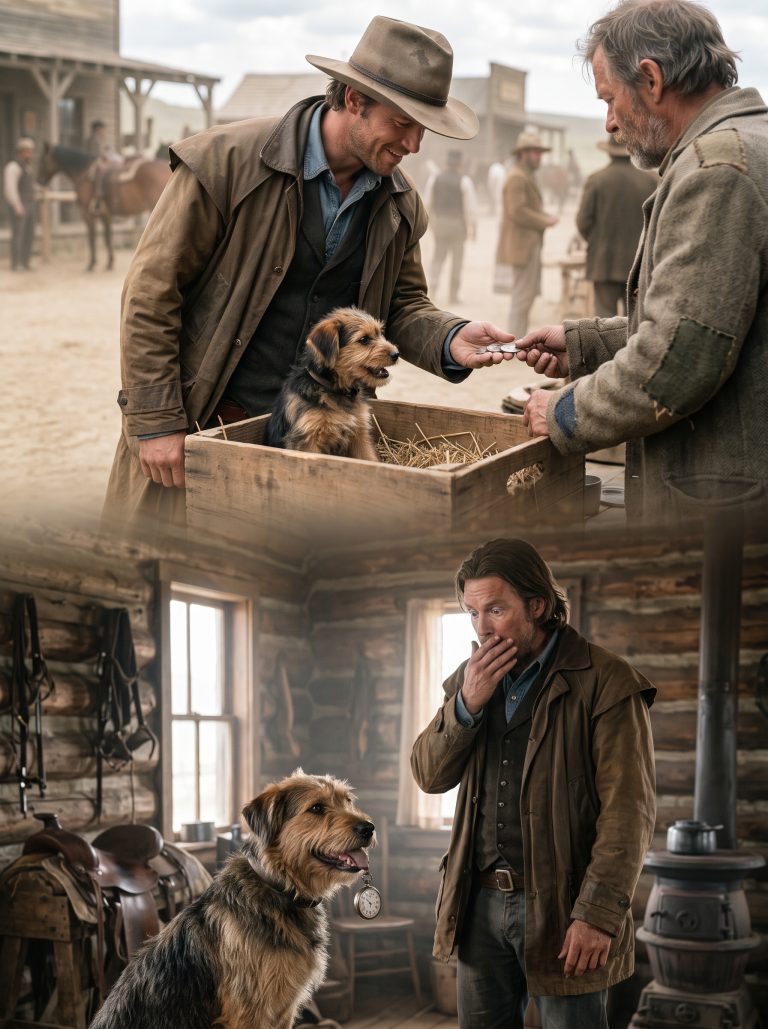
“Don’t ask questions—just marry me. My boys need a mother, and you need a roof,” the cattle king said—yet the “broken” schoolteacher uncovered a hidden truth beneath his late wife’s blue ribbon before the winter storm sealed the valley forever.

Part 1
“My three children need someone steady, and you need a roof before the pass closes.”
Nathaniel Hale said it the way a man discusses fence posts, not the way a man asks a disgraced woman to marry him inside a week.
Clara Ashford stood at the far end of the boardinghouse parlor in Copper Falls, one hand resting on the back of a chair she did not need until her knees betrayed her. Rain dripped from his hat onto the landlady’s rug. He was broad-shouldered, sun-worn, somewhere near forty, with the kind of quiet that made a small room feel smaller. He had not smiled at her. He had not looked at her the way men in this town had started looking at her lately — as though her ruin were an invitation.
He had simply asked.
“You can’t mean marriage,” she said.
“I do.”
“You don’t know me, Mr. Hale.”
“I know what happened at the Whitmore house isn’t the whole of you. I know you kept that schoolroom running two winters running without a single complaint from the children. I know the accusation came the week after Edmund Whitmore stopped receiving invitations from families with unmarried daughters and started needing money quietly.”
Clara’s breath caught. “You looked into it.”
“I look into anything that walks onto my land,” he said. “Even a housekeeper.”
She had not agreed to be a housekeeper. She had agreed to nothing yet. But the word landed less cruelly than she expected — practical, not contemptuous.
“Then you already know I was dismissed for theft,” she said. “No wages. No reference. The Whitmores told half of Copper Falls a brooch went missing from Mrs. Whitmore’s dressing table the same week I refused Edmund’s attentions. You know what people call a woman after that.”
“I know what fools call her,” Nathaniel said. “I don’t put much stock in fools.”
He turned his hat once in his hands — the only sign, she would later learn, that he was working up to something difficult.
“I have three children,” he went on. “Silas is twelve, and angry enough to frighten grown men into leaving him alone, which is exactly what he wants. Ada is eight, sharper than most schoolteachers I’ve hired to teach her, and she knows it. Josiah is five. He hasn’t spoken more than a dozen words since his mother died last spring. I’ve brought in an aunt, two hired nurses, and a widow from Bozeman who lasted eleven days. None of them stayed.”
“And you believe I will.”
“I believe you might,” he said. “That’s more than I’ve believed about anyone else.”
“That isn’t confidence.”
“No. It’s honesty. I won’t waste yours pretending otherwise.”
Clara almost hated him for that, the way honesty leaves nowhere to hide a fear. A lie could be resisted. Pity could be refused. But a man who simply told her the truth and waited left her no argument except her own doubt.
“Do you care for me, Mr. Hale?”
“No,” he said. “I don’t know you well enough to.”
The word should have stung. Instead it steadied her, the way solid ground steadies a foot that expects to sink. She had been wronged by a man pretending admiration and abandoned by an employer pretending virtue. A clean no held more respect in it than every false kindness she’d been offered since.
“Then hear my terms,” she said, surprising herself with how firm her voice came out. “If I marry you, I will not be a servant wearing your name. I will have authority in the household — over the children’s lessons, their meals, their days. I will not be overruled in my own kitchen by a housekeeper who resents me, or ignored at my own table.”
“Agreed.”
“I will not pretend to love your children before I do. And I will not pretend to have loved their mother, whom I never knew.”
Something shifted behind his eyes — not offense. Something closer to relief. “Agreed to that as well.”
“And if the day comes that you tire of this arrangement,” she said, quieter now, “you will not put me out with nothing, the way the Whitmores did.”
“I’ll have the terms drawn up in writing, in town, before we leave.”
“How romantic,” she said, and heard the bitterness curl at the edge of it.
“I never claimed to be a romantic man.”
“No,” she said. “I gathered that.”
Rain kept at the window. Somewhere behind the parlor door, the landlady had stopped pretending to sweep. Everyone in Copper Falls listened when a ruined woman was offered a way out — to judge it, or to envy it, Clara no longer cared which.
She thought of the coal she couldn’t afford, the letters that had stopped being answered, the mercantile owner who’d begun watching her purse instead of her face. Winter did not care about dignity. Wolves did not care about reputations.
She lifted her chin. “Then I accept, Mr. Hale.”
He gave one short nod, the same nod, she suspected, he gave when a cattle deal closed to his satisfaction.
“We leave at first light.”
Part 2
Three days earlier, Clara had lost her life without losing her breath.
“You’ve stolen from this family and shamed my son with your accusations against him,” Mrs. Whitmore had said, though it was Edmund who had cornered her in the linen room, Edmund whose hand had closed too hard around her wrist, Edmund who had laughed when she twisted free and struck him across the face.
By the next morning, his shame had become her crime.
The brooch — a garnet pin belonging to Mrs. Whitmore’s mother — had vanished from the dressing table the very week Clara refused him. No one asked where Edmund had been seen twice that month, quiet and grim, at the card tables behind the Silver Anchor saloon. No one asked why a boy with a fine allowance had recently sold his father’s watch to a peddler passing through. A governess’s word was wool against silk, wages against land.
“You’ll leave without reference,” Mrs. Whitmore had said, chin high, as though denying Clara the courtesy of tears was itself a mercy. “And without wages. I won’t have thievery paid for in this house.”
Clara had not begged. Begging bought nothing from people who preferred a villain to blame over a son to correct. She packed her trunk with the strange, hollow calm of a woman with no money left to spend on panic.
Doors closed before she reached them. Women who had once asked her to check their children’s sums stopped answering her notes. Men who had never looked twice at her began looking too long, as though ruin were an invitation rather than a wound.
Then Nathaniel Hale came in from the rain with mud on his boots and grief in his house, and offered her a bargain instead of pity.
Winter was already sharpening its teeth in the high country. Pride did not buy coal, and dignity did not stop a woman from freezing. Some humiliations, Clara was learning, were simply the price of surviving to be humiliated another day.
She had said yes because the alternative was not survival at all.
Part 3
Larkspur Creek Ranch did not look like a home when Clara first saw it through sheets of thin autumn rain — a long timber house crouched against a hillside, smoke rising from only two of its five chimneys, corrals stretching toward hills gone the color of rust. A house that had stopped expecting warmth in every room told her more about its grief than any conversation could have.
Nathaniel had said little on the two-day ride. His silence was not sullenness, she came to understand, but a habit of a man who’d learned that words changed nothing weather couldn’t be talked out of.
When the wagon rolled into the yard, a housekeeper with tired eyes and a stiff back stood in the doorway — Mrs. Odette Byrne, who looked at Clara the way a woman looks at a candle she expects the wind to take.
Then the children came.
Silas arrived first, tall for twelve, dark-eyed like his father, radiating a cold, contained fury that made shouting look like a lesser weapon. He took in Clara’s plain brown traveling dress, her work-roughened hands, and dismissed her in the space of a breath.
Ada followed, quick and freckled, smiling in a way that was not friendly so much as curious — the look of a girl deciding how fast she could take a new puzzle apart.
Josiah lingered in the doorway last, small and pale, one fist curled around something he didn’t want seen. A carved wooden fox, its paint worn to bare wood at the ears from years of being held.
“Children,” Nathaniel said, “this is Mrs. Clara Hale. She’s my wife now.”
Silas’s jaw set. “She isn’t our mother.”
“No,” Clara said, before Nathaniel could answer for her. “I’m not.”
The plainness of it caught Silas off guard; he’d braced for a lie and gotten truth instead.
“They all say that at first,” he muttered.
No one corrected him. That silence told Clara everything about how many women had come and gone through this house already, arriving with soft promises and leaving with the same trunks they’d brought.
“I don’t intend to erase anyone,” Clara said. “I don’t expect to be loved because a paper says I’m your father’s wife. I only intend to stay long enough to find out whether that’s possible.”
Silas looked at her as if deciding whether truth from a stranger was more dangerous than the lies he already knew how to survive.
The first two weeks were a slow, careful war.
Silas answered obedience with quiet refusal — late to breakfast, absent from lessons, always exactly present enough in the yard that no one could call him disobedient outright. Ada turned schoolwork into performance art: correct sums buried inside columns of nonsense, Latin translated into deliberately absurd English, delivered with grammar so precise Clara nearly laughed instead of scolding. Josiah simply vanished — under tables, behind curtains, into corners where no fire had been lit until Clara ordered one lit herself.
The nursery held the hardest grief. Margaret Hale’s sewing basket still sat by the window, thread gone dusty. Her portrait hung above the mantel — a narrow, gentle face, eyes the same pale gray as Josiah’s. The room had not been allowed to breathe since she’d died; it had been sealed like a wound no one dared clean.
On the fifth day, instead of fighting for the children’s attention, Clara stopped trying to win it.
She walked into the nursery, looked up at the portrait, and said simply, “She had a kind face.”
Every child in the room went still.
“You don’t get to talk about her,” Silas said.
“I’ll speak of her with respect, or not at all,” Clara answered. “Your choice.”
Ada, too clever to resist correcting an outsider’s ignorance, muttered, “She liked the curtains open in the mornings.”
Clara crossed the room and opened them without another word. Cold light spilled across the floor. Josiah stared at the change as though something impossible had happened.
“She used to hum during storms,” Ada added, then looked annoyed at herself for saying it.
“Which song?”
Josiah, barely audible: “The rain song.”
Silas said nothing, but he didn’t leave the room either. That, Clara was learning, was its own kind of surrender.
She gave Silas responsibility instead of orders — Josiah’s morning boots to warm by the fire, the nursery hearth to tend. She gave Ada work hard enough to be worth sabotaging honestly. She gave Josiah nothing but patience, warm milk left near whatever corner he’d chosen, and the promise, repeated without pressure: I’ll be here when you’re ready.
By the end of the second week, the fire in the nursery burned every evening. The curtains opened every morning. Silas still would not call her anything at all — but when Josiah dropped the little wooden fox one afternoon, it was Silas who picked it up and set it back in his brother’s hands with more care than anger usually allowed him.
The storm came on the sixteenth night, rolling down off the mountains hard enough to rattle the windows. Clara had just banked her own fire when she heard it — not a cry, exactly. A small, swallowed sound, the sound of a child who had learned that a house tired of grief did not welcome being woken by it.
She reached the nursery to find Josiah upright in bed, the fox clutched in both fists, tears silent on his face. Ada stood beside him, pretending irritation and failing badly.
“He’s being foolish,” Ada said. “It’s only thunder.”
“He’s frightened,” Clara said gently, and sat on the edge of the bed without touching him until he leaned into it himself.
“Mama used to hum,” Josiah whispered.
Clara didn’t know the tune. But Ada, after a long pause, hummed the first uncertain notes — and Clara caught the shape of it and carried it forward, soft and unsteady, until Josiah’s grip on the fox loosened and his head found her sleeve.
She did not pull him closer than he offered.
At the doorway, unseen by his brother and sister, Silas stood with one hand on the frame, his face for once undefended. Clara noticed him only when the candlelight shifted. She kept humming. She did not call attention to him, did not claim the tune as hers, only finished it the way it had been given to her.
In the morning, at breakfast, Silas looked at her across the table.
“Mrs. Hale,” he said quietly.
Not Mama. Not warmth, exactly.
But no longer the ruined woman his father had brought home either.
Nathaniel began appearing less like the master of the ranch and more like a man relearning his own house. He asked after lesson schedules, after Josiah’s nights, after whether Ada’s tutor had finally stopped assigning her baby work and blaming her for behaving like a baby over it. Clara answered him plainly, and each time he lingered a little longer than the question required.
One evening, after the children’s laughter had rung out over supper for the first time in longer than any of them could remember — Ada narrating the tragic, noble death of a pea that had drowned in Josiah’s water glass, Silas failing to smother his own laugh behind a cough — Nathaniel sat by the hearth long after the boys had gone up.
“Eight months,” he said. “I don’t think I’ve heard all three of them laugh at once in eight months.”
“Children stop laughing when they think happiness will be punished,” Clara said.
“Did I punish it?”
She could have spared him the answer. She chose not to.
“You buried it,” she said, “along with everything that reminded you of losing her.”
His jaw tightened. For a moment she feared she’d gone too far. Then he looked into the fire and said, quietly, “I thought leaving her things untouched was how I honored her. I didn’t see that it meant the children were still living in the week she died.”
“They’re starting to live past it now.”
He was silent a long moment. “I trust you,” he said finally, as though the words startled him as much as they did her.
Trust, she was coming to understand, was not a compliment from a man like Nathaniel Hale. It was a weight he had decided to hand her.
“I’ll be careful with it,” she said.
Copper Falls did not forgive as easily as Larkspur Creek had. At church, eyes followed Clara down the aisle. Women who had once asked her to correct their children’s penmanship offered closed-mouth smiles instead of conversation. At the next social, when a merchant’s wife asked, with false sweetness, how Clara was “adjusting to her sudden elevation,” Nathaniel set down his cup before Clara could answer.
“My wife has done more good at Larkspur Creek in a month than most of this town manages in a year of talking about it,” he said, and returned to his supper as though he’d only remarked on the weather.
The table went quiet. Clara looked at him. He did not look back — but something had shifted between them all the same, a line crossed without either of them naming it.
Then, in late October, a fine black carriage came up the ranch road, and everything they had built together was tested at once.
Prudence Vance Ashcroft stepped down from the carriage in traveling silk too fine for the mud, her veil pinned with surgical precision. She was Margaret’s older sister — sharing her sister’s pale eyes without a trace of her sister’s warmth.
“Prudence,” Nathaniel said. Not a welcome. A name, delivered like a debt called in.
Her gaze slid to Clara. “So this is the replacement.”
The word landed hard enough that Josiah, on the stairs, gripped the banister with both hands.
“Mrs. Ashcroft,” Clara said evenly.
“How quickly you’ve learned to speak as though this house were yours.” Prudence’s eyes moved over Clara’s plain dress, her work-roughened hands, with a cruelty so practiced it barely needed to try. “A dismissed governess. A thief, by all accounts. Married for convenience by a grieving man too tired to know better.”
“Whatever you’ve come to say,” Clara said, “say it away from the children.”
“Giving orders in a house not six weeks yours?”
“Protecting children. People who confuse the two rarely manage either.”
Ada made a small, strangled sound that might have been admiration. Nathaniel’s mouth twitched and was gone.
Prudence’s smile thinned to something colder. “My attorney has filed a petition in the territorial court. As my sister’s closest living relative and trustee of the children’s inheritance from the Vance estate, I intend to seek guardianship — or at minimum, oversight of their care, until the court can determine whether this household is fit.”
“You can’t take us,” Silas said, coming down the stairs.
Prudence’s expression softened into something false enough to be its own insult. “Dear Silas. You’re grieving. You can’t know what’s best for you.”
Clara watched the blow land — not because Prudence had threatened him, but because she had, in one sentence, erased his right to his own mind in the name of loving him.
“Go upstairs,” Clara said gently. “Take your brother and sister. I’ll come up soon.”
Silas hesitated — not from obedience, but because she had trusted him with something. He went.
When the children were gone, Nathaniel’s voice was low and hard. “You have never once visited these children in eight months, Prudence. Not a letter. Not a dollar toward their care beyond what the trust required.”
“I was grieving my sister.”
“You were counting the trust,” he said. “You’ve always been better at arithmetic than affection.”
Her eyes flickered — the first honest thing Clara had seen from her.
The hearing was held in Helena under a flat white winter sky, snow waiting on the mountains like a verdict withheld. The courtroom filled fast — ranchers, merchants, church women who had turned Clara from their doors and now leaned forward hungry for a second act of her ruin.
Prudence’s attorney, a narrow, polished man named Mr. Reeve, opened by dismantling the marriage itself — its haste, its convenience, Clara’s dismissal from the Whitmore house.
“Mrs. Hale,” he said, “isn’t it true you married Mr. Hale because you needed shelter, with no true feeling between you?”
The room stilled, hungry.
“Yes,” Clara said. “At first, it was exactly that.”
The murmur that followed was sharp, satisfied — until she continued.
“I needed shelter because I had been dismissed without wages or reference, after refusing the advances of a young man whose family preferred a lie about me to the truth about him. There was no respectable door left open. Mr. Hale needed steadiness for three grieving children. Neither of us pretended it began as anything grander than necessity.”
“So you admit,” Reeve pressed, “the marriage was a bargain, not a bond of affection.”
“It began as one,” Clara said. “I did not stay because of the shelter it gave me.”
She told the court, then, of curtains opened because a dead woman had loved morning light. Of a fire kept burning in a nursery that had gone cold with mourning. Of a hymn hummed during storms, kept as it was given, never claimed as her own.
“I did not come to replace their mother,” she said. “I came to make sure her sons and daughter were not asked to bury her a second time, in silence, because everyone around them had grown too afraid of grief to speak her name.”
Silas stood without being called.
“May I speak?” he asked the judge, and at the nod, crossed the floor on legs that were trying very hard not to shake.
“She stayed,” he said. Two words, plainer than any argument Reeve had made all morning. “I tried to make her leave. I ignored her. I told her she wasn’t our mother. She never once said she was. She never took Mama’s picture down. She stayed.”
Ada rose next, chin lifted, because silence had become unbearable. “She gave me harder lessons instead of easier ones. Everybody else thought I liked trouble because I was bad at behaving. She knew I was bored.”
Then Josiah slid down from the bench, crossed the floor, and pressed himself against Clara’s side, the little wooden fox held out where the judge could see it.
“She hums Mama’s storm song,” he whispered. “But she says it still belongs to Mama.”
The room, for the first time all day, went entirely silent — not with judgment, but with something closer to shame at how quickly it had been ready to condemn.
It was Mr. Hargrove, Nathaniel’s attorney, who delivered the second blow — the one Clara had not expected.
“Your Honor,” he said, “before this court rules on fitness, I would ask it to examine the fitness of the petitioner herself.”
He produced a ledger, subpoenaed from the territorial bank in Helena, alongside sworn correspondence from the Vance family’s own solicitor in Chicago. The trust established for Silas, Ada, and Josiah upon their mother’s death — administered solely by Prudence Ashcroft as named trustee — showed withdrawals far beyond any accounting for the children’s care. Debts of Prudence’s late husband, gambling losses, a mortgage on property in her own name, all quietly drawn against a fund meant for three grieving children.
“An audit was requested eleven months ago by the bank’s own trust officer,” Hargrove said. “Mrs. Ashcroft resigned from correspondence with that officer the following week. Guardianship of the children — removed from a father’s oversight and placed under her sole authority — would place the very fund in question entirely beyond outside review until the youngest child reaches majority. Sixteen years from now.”
Prudence’s face went the color of the snow outside.
“This is outrageous,” she said, but her voice had lost its edge.
Separately, a second witness had been found — a pawnbroker from a town two days from Copper Falls, brought forward after quiet inquiries by Hargrove’s clerk. He identified, with the shop’s own dated ledger, a garnet brooch matching Mrs. Whitmore’s description, sold to him some eight months prior by a young man he recognized from a photograph as Edmund Whitmore.
“He needed the money that week,” the pawnbroker said. “Said as much himself. Owed it to men who don’t wait politely.”
The old scandal did not vanish in an instant — society rarely surrenders its appetite for a woman’s ruin so cleanly — but it cracked, publicly, in front of the very people who had helped spread it.
The judge’s ruling, when it came, was quiet after so loud a morning. Prudence Ashcroft’s petition was denied. The court ordered an immediate independent audit of the Vance trust, and referred the matter to the territorial prosecutor. No cause was found to disturb the children’s home.
Prudence left the courtroom with her back straight and her reputation in ruins behind her — not through spectacle, but through the plain, unglamorous weight of numbers that did not lie the way people could.
Larkspur Creek in December did not look like the house Clara had first ridden into. Fires burned in every room the children used. The nursery curtains stayed open through every gray morning. Margaret’s portrait remained exactly where it had always hung — honored, not hidden.
One evening after prayers, Josiah fell asleep against Clara’s knee while Ada corrected Silas’s recitation and Silas told her to mind her own scripture. Half-dreaming, entirely unguarded, Josiah murmured, “Good night, Mama.”
The room went still. Ada studied her hands as though they had suddenly become interesting. Nathaniel went very quiet by the fire. Silas’s face moved through surprise, then something gentler, before he looked away to hide it.
Clara did not correct the boy. She bent and kissed his hair.
“Good night, my darling.”
Later, when the fire had burned low and the children were long asleep, Nathaniel found her on the porch, snow falling soft and windless over the yard.
“I thought I was hiring someone to manage my children,” he said.
“That’s what you asked for.”
“It’s not what I got.” He turned to face her fully, stripped for once of the composure that ran his ranch and his grief alike. “You became the reason this house remembers how to be warm. I love you, Clara. Not out of gratitude. Not because the children needed you. Because I do.”
She had been proposed to once already in her life, in a rain-streaked parlor, as a bargain struck out of necessity. This felt like nothing that had come before it.
“Then I love you too,” she said. “Not because you rescued me.”
“Then why?”
“Because you let me stay long enough to belong.”
Epilogue
Spring came early to the valley that year. The fences Silas mended himself. The books Ada demanded grew harder by the season, and she complained about every one of them with visible pride. Josiah still carried the little wooden fox sometimes, especially through storms — no longer a shield, but a keepsake, carried the way people carry things they’ve chosen to remember rather than things they’re afraid to lose.
Prudence Ashcroft’s name was never spoken at Larkspur Creek again, though the audited trust, restored and properly overseen, quietly paid for a new roof on the schoolhouse in Copper Falls the following autumn — the kind of ending Clara found she preferred to any dramatic reckoning: not vengeance, just correction, plain and lasting.
What Clara had come to understand, in the year since a stranger in a wet coat had offered her a bargain instead of pity, was this: family was rarely a thing anyone was born owning outright. Sometimes it was blood. Sometimes it was a signature on a paper drawn up out of necessity. But mostly, she thought, it was the plain, unglamorous act of staying — through storms, through suspicion, through every door that closed and every person who doubted you’d still be there in the morning — until one day, without ceremony, a half-asleep child called you by a name you hadn’t asked for and hadn’t earned by blood, only by refusing, again and again, to leave.
THE END