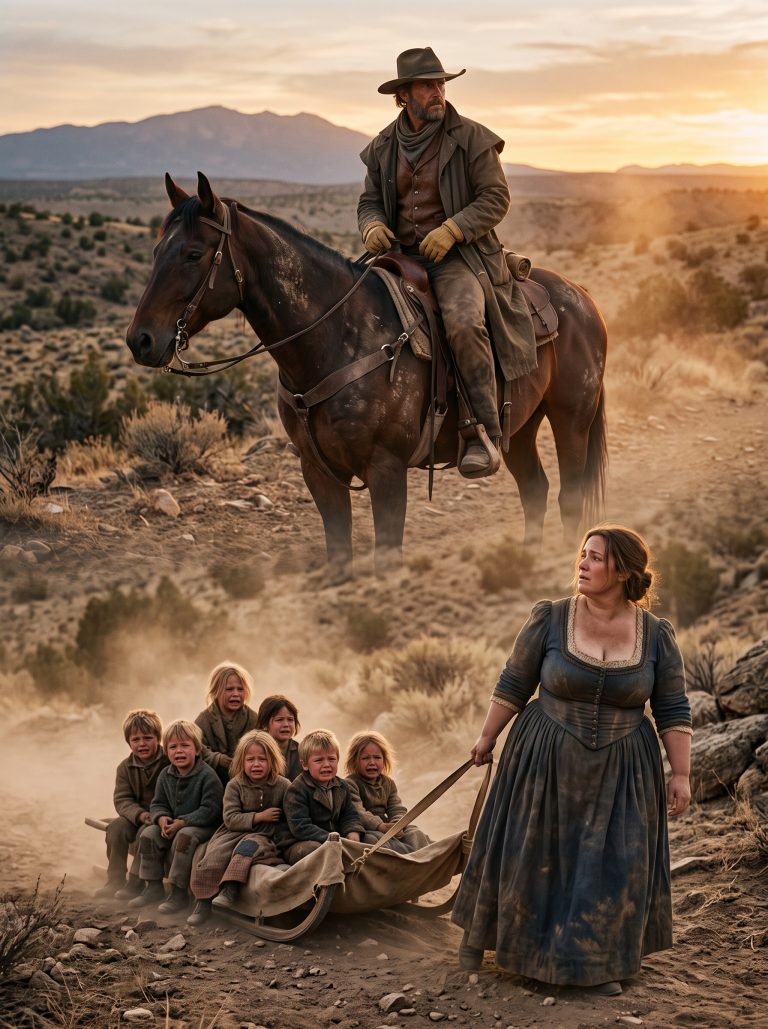
Everyone Mocked the Mountain Man’s Mail-Order Bride—Until Her Hidden Skill Saved His Dying Ranch Overnight

PART 1
When the Wells Fargo stagecoach rattled into Millford and jolted to a stop, Cole Marsh hung back and told himself this was already a mistake.
Two iron-reinforced trunks hit the dirt first — far too heavy for clothes and blankets.
Then she stepped down.
Clara Voss descended with deliberate steadiness while the town stared. Her face was fine-boned, sharp with intelligence, and her green eyes moved over Cole himself with cool assessment that made him feel like the one being examined. She looked like a woman taking inventory.
“Mr. Marsh, I presume.”
“Miss Voss.” He removed his hat, absurdly aware of the dirt under his fingernails. “You brought a lot of baggage for a woman seeking a simple life.”
She glanced once at the trunks. “A woman must come prepared for the wilderness. A simple life rarely means an easy one.”
When he put a hand at her waist to help her mount behind him, a sharp awareness passed between them — startling and immediate. She was warm despite the cold, softer than her rigid bearing suggested. She smelled faintly of lavender and carbolic soap.
On the long, mostly silent ride back to Cutter’s Creek, he told her the truth.
“The letters I wrote were true when I penned them. But a sickness has taken my herd. The ranch is failing. There’s a man named Braddock waiting for me to bleed out so he can take the land. I’m not offering you a future anymore — just a front-row seat to a funeral.”
He expected tears. Maybe anger.
Instead he felt her grip tighten slightly — not out of fear, but to steady herself as the horse picked through frozen rock.
“I did not come for your money, Cole. I came for the sanctuary of the mountains. We will see about your dying ranch.”
He rode the next half mile without speaking at all.
The first two weeks at Cutter’s Creek: a careful dance of habits colliding, a woman who moved through his kitchen as though she had always understood how to make rough frontier spaces less hostile. Who baked bread. Who never asked foolish questions. On her second day she asked to fire the Sharps rifle. On her third try she hit a tin can at two hundred yards and blew it clean off the stump. Cole stared at the empty stump. Clara looked back with one eyebrow raised just enough.
And over all of it hung the sickness. Cows with dull eyes. Calves too weak to stand.
Then came Tuesday and the bull went down just after dawn.
Colton was the future of the herd — a massive black bull with bloodlines Cole had paid too much for. By noon he was on his side near the watering hole, eyes gone hollow with the deadening weakness Cole had come to dread.
Cole stood over him with his Colt revolver drawn.
“Put the gun down, Cole.”
He turned so fast the movement jarred his shoulder.
Clara was coming down the slope with the locked leather satchel she had guarded since the day she arrived. No apron. No domestic disguise. Only a heavy wool coat and an expression he had never seen on her face: focused, furious, without hesitation.
She popped the lock on the satchel. Inside: a gleaming brass microscope, glass slides and vials, steel scalpels, journals thick with notes.
“What in God’s name is all that?” he demanded.
She didn’t answer immediately. With iron tweezers she parted the hair along Colton’s neck, plucked a swollen tick from the skin, and dropped it into a glass vial.
“My real name is not Clara Voss. It’s Maren Holt.”
Cole frowned. “Holt. Like the scientist the papers were calling a butcher.”
“My father. He worked with federal scientists to prove this fever is carried by a parasite. The cattle barons burned his laboratory. He died a month later.”
From another bottle she drew a foul-smelling liquid into a heavy glass syringe and found a vein in Colton’s neck with the certainty of a practiced hand.
“I was his lead assistant. I wrote half the papers they burned. Women aren’t permitted to hold veterinary licenses, and no rancher back east would let a woman touch their stock. I had the cure — arsenic and sulfur to kill the parasite, a chemical wash to kill the ticks.”
“I lied to you,” she said. “I came west looking for a desperate man with a dying ranch. If you want to put me back on the stagecoach, I’ll go. But if you give me two weeks, I will save your ranch.”
Every part of him should have been furious. But all he felt was a flood of respect so intense it nearly took his breath. She was not a fraud. She was a fighter.
Before he could answer, four riders emerged from the timberline. Marcus Braddock rode in the center.
“Morning, Marsh. The bank says you’re officially in default by sundown. I’m here to take Cutter’s Creek.”
Cole stepped in front of Maren. Braddock’s gaze slipped over his shoulder. “Shame to drag a pretty little mail-order bride into your squalor.”
Before Cole could raise the Colt, Maren stepped out from behind him and pulled a Remington derringer from her coat.
“Mister Braddock,” she said, her voice so calm it made the hired guns look at each other, “in Pennsylvania we shoot trespassers who threaten our livestock and our husbands. I suggest you turn that horse around. If you return before the bank’s official deadline, I will put a bullet through your eye and dissect what’s left of your brain under my microscope.”
Braddock’s smile collapsed. “Sundown on Friday,” he spat. He wheeled his horse and rode out.
Cole stood staring at his wife. She slid the derringer back into her coat.
“Bullets won’t save this ranch. We have three days until Friday. I need lumber, tar, and every horse you have left.”
“For what?”
“We’re building a dipping vat.”
PART 2
The next seventy-two hours resembled war. Cole and Maren threw themselves at the work with the intensity of people who understood precisely how much depended on getting every detail right. No room for wounded pride, no room for the reckoning her confession had earned.
Following diagrams Maren drew in hard pencil on old feed invoices, Cole chose a flat site near the main corral and started cutting into the frozen ground. He dug with shovel and mattock, split pine planks, set braces, drove spikes, and pitched seams with boiling tar until the air stank of resin, earth, and smoke. By the end of the first day, the trench was shaped. By the end of the second, it was lined and ready.
While he built, Maren took over the kitchen: iron pots boiling, sulfur grinding, arsenic weighed, chemical vapor turning the cabin rank with brimstone. Cole came in once for water and found her bent over a notebook with calculations running down the page, soot darkening her cheek, hair fully escaped from its pins. Not a bride. A commander.
“Will the mixture work?” “It will if the disease hasn’t progressed too far.” “Then we get it right.”
They began the roundup at dawn on Wednesday.
The remaining fifty head were driven hard and scared. Cole rode until he and his horse were both lathered. Maren adjusted gates and shouted instructions without wasting breath.
He had expected fear from her out there among the sickened cattle. There was none.
Each animal had to go through the vat completely — head and all, every inch of hide touched by the acrid wash. Cole stood at the edge with a heavy pole while the chemicals burned his hands. Maren moved along the line changing the wash when its strength dropped.
By Thursday night the last calf had been pushed through.
The ranch fell eerily quiet.
Cole collapsed onto the porch steps. His hands were blistered open beneath the yellow stains left by sulfur.
Maren stepped out carrying a basin of warm water and salve. She knelt before him and took his hands. He watched her bent head and felt something inside him give way that he had held rigid for a very long time.
“You believed in me,” she whispered. “Most men would have called me a madwoman.” “I trusted the woman who stood beside a dying bull and declared war,” Cole answered.
Her green eyes lifted to his. When he brushed the soot from her cheek, Maren leaned into the touch with a hunger so equal to his own that it erased every remaining hesitation.
He kissed her. Fierce and urgent, tasting of coffee, exhaustion, and all the desire they had been stepping around since the stagecoach arrived in Millford. She kissed him back, her hands sliding into his shoulders as though anchoring herself to something she had chosen at last to trust.
They pulled apart both breathing hard. Neither said anything foolish.
There are kisses that begin stories. This one confirmed the one already underway.
PART 3
Friday dawned brittle and blue.
Cole woke before the sun with dread sitting in the cabin like another person. Bank deadline. Braddock’s return. The possibility that the vat had been too late, or too weak, or useless against whatever this plague truly was.
Maren’s side of the bed was empty.
The absence hit him with a pulse of alarm he had no right to feel so strongly after so little time. He dressed fast and went outside into cold hard enough to make his lungs ache. Frost glittered across the yard.
He trudged to the lower pasture and stopped dead at the fence.
Colton was standing.
The great black bull was gaunt, stained yellow from the dip, and far from recovered — but alive. And eating. Beyond him, other animals that should have been down by now were moving with purpose. Weakly, yes. But moving. Their eyes were clearer. Their hides, though ragged and dirty, were no longer crawling with the same living tide of ticks. Here and there dead husks of parasites lay shriveled in the snow-mud mix.
The cure had worked.
Not perfectly. Not magically. But enough.
Cole removed his hat and stood there with the cold going unheeded against his face, relief coming through him so violently it felt almost like pain. He had not realized until that moment how completely he had prepared himself for final failure.
He turned to run for the house and stopped again when he saw Maren.
She was not on the porch.
She was down near the geothermal runoff at the lower watering place, kneeling in the mud with her satchel open beside her and a brass magnifying glass in hand. Not looking at the cattle. Looking at the ground.
“We won,” Cole called, voice thick. “They’re standing. The fever broke.”
Maren did not look up.
“It wasn’t a fever, Cole.”
Something in her tone halted him.
“And it wasn’t a curse of the land.”
He came closer and saw what she had already found: dead brush piled unnaturally against the edge of the warm runoff. She kicked it aside, exposing three large burlap sacks half-buried in the steaming mud.
The smell hit him an instant later. Rot, blood, hide, and something far fouler than ordinary decay.
Maren’s face had gone white with rage.
“I came to gather soil samples,” she said. “I needed to understand how this species could survive a Montana winter. A hard freeze should have killed them.”
Cole knelt and slashed open the nearest sack with his knife.
Rotting cattle hides spilled into the mud. Thick with dead and living ticks.
Maren’s voice sharpened into certainty. “They did not survive the winter on their own. Someone brought infected hides up from the South and buried them here at the warm runoff so the larvae would hatch and climb onto your cattle.”
Cole looked at the burlap.
Red ink stamped the side:
Braddock Cattle Co., Missoula
The entire pattern of the past months clicked into place with sickening simplicity. The mysterious outbreak. Braddock’s timed offers. His certainty. The pressure from the bank. The way he had circled Cutter’s Creek like a man who knew death was already under way and wanted only to choose the exact hour of surrender.
It was not misfortune.
It was sabotage.
“I’m going to kill him,” Cole said.
The sentence came out stripped bare of everything but intention.
Maren rounded on him instantly and seized his arm.
“No, you are not.”
“He poisoned my herd.”
“He seeded the ranch with infected hides, yes.”
“He tried to break me and take the land.”
“And if you shoot him, he wins anyway. He takes the ranch and I become a widow before I have truly become a wife.”
The words hit harder than reason alone could have.
He looked at her.
Her hair was coming loose in the damp heat off the spring. Her eyes were blazing. Her skirt was mud-spattered to the knee, the satchel open beside her like a surgeon’s kit at a battlefield. She looked like fury harnessed to intellect.
“We use the law,” she said. “I have proof. Specimens. Soil transfer. Branded sacks. My notes. Microscopic findings. If we have to, we summon the US Marshal.”
For one terrible instant he still wanted blood. He wanted Braddock choking in the dirt with a boot on his chest and fear in his eyes. But the logic in her voice, the scale of the conspiracy, the stamp on the burlap — all of it opened another road.
A road that ended with Braddock ruined publicly instead of merely dead privately.
By high noon, that road had already begun.
Braddock rode in exactly as promised — his carriage heavy behind him, Sheriff Thomas Rynne and a nervous bank manager named Pettit with him, along with hired guns who thought numbers made them brave. He came to the porch smiling.
Cole and Maren were waiting.
He stood with his Winchester across his shoulder, broad and calm and very dangerous. She stood beside him with a locked wooden box in her hands and a composure that made the scene feel, suddenly, as if Braddock had not arrived to claim victory but to walk into a trap he couldn’t yet see.
“Time’s up, Marsh,” Braddock called. “Sheriff Rynne is here to serve the eviction. I expect you off this property by nightfall.”
Sheriff Rynne looked genuinely tired. “I’m sorry, Cole. I have to ask you to vacate.”
“I ain’t vacating,” Cole said. “Because the debt is fraudulent, born from the malicious destruction of private property.”
Braddock laughed too quickly. “The man’s gone mad.”
Maren stepped forward.
“My name is Maren Holt,” she said, voice carrying cleanly across the yard. “Former lead biological researcher for the United States Bureau of Animal Industry. I have spent the last three days curing this herd of a parasitic infestation. An infestation caused by these.”
She unlocked the box and removed the burlap sack.
Then she dropped it at Sheriff Rynne’s feet.
The smell of rot hit the yard immediately. Pettit gagged and turned aside.
“Notice the brand,” Cole said.
Rynne bent, read it, and straightened very slowly.
“Braddock Cattle Co.,” he said.
Maren continued before Braddock could recover.
“We found three such sacks buried at the geothermal runoff feeding our watering hole, filled with infected hides carrying southern cattle ticks. I also found wagon ruts leading directly from the site back toward the private rail loading point used by Braddock’s shipments. My microscopic analysis proves the parasites are southern stock. Someone deliberately transported quarantined biological material across state lines and introduced it here in order to collapse this ranch and force a seizure.”
The yard went silent.
Braddock’s face began to empty of color.
“She planted it,” he said. “She’s lying. She’s a hysterical—”
“I have documented notes,” Maren cut in. “Specimens sealed and labeled. Comparative drawings. Treatment outcomes. A federal circuit judge will be very interested in the findings.”
The trap shut then. Not physically. In something deeper.
Braddock understood before anyone else did that this had moved beyond money. Deliberate spread of Texas fever was not a civil matter. It was a federal crime with prison and ruin behind it. He looked at his men. At the sheriff. At the box. At the woman beside Cole Marsh who had just destroyed him with science, patience, and a sack of rotting hides.
“Shoot them,” he screamed.
He reached inside his duster for the hidden derringer.
Cole moved first.
He didn’t bother aiming the Winchester. He swung it like an axe.
The solid walnut stock came up under Braddock’s jaw with a crack so loud Pettit cried out. Braddock dropped instantly, the little pistol flying from his hand into the frosted dirt. Sheriff Rynne’s gun was out a second later, trained not on Cole, but on Braddock’s hired men.
“Hands in the air! Drop the iron now!”
The hired guns looked at their unconscious employer, looked at the burlap sack, looked at the bank manager already backing away, and understood that no wage was worth a federal charge for biological sabotage. Their belts hit the ground.
Cole stood over Braddock breathing hard, rage draining out through his hands and shoulders until only relief remained.
Then he turned to Maren.
She had not flinched.
Not when Braddock ordered murder. Not when the gun came out. Not when the rifle stock broke the silence. She stood with the wooden box in her hands and her chin lifted and looked, to Cole, like the fiercest and finest thing ever to step onto his land.
“Sheriff,” he said, a real smile finally breaking through his beard, “I believe you’ve got some trespassing trash to haul off my property.”
—
Cutter’s Creek Ranch did more than survive that winter.
It changed in ways Cole had not anticipated and Maren had not dared to plan for.
The surviving herd recovered — slowly but decisively — and once the tick cycle was broken the deaths stopped entirely. Braddock’s operation was investigated by federal officers who arrived from Missoula within the week. They found the wagon ruts, the rail loading records, the payment ledgers. They matched the parasites under Maren’s microscope to southern stock. They found a second set of records that connected Braddock’s agent to the bank manager Pettit, who had been pressuring Cole’s loan under instruction.
The debt that had seemed like the final iron fact of Cole’s ruin turned out to be part of a scheme ugly enough that even institutions built to favor money had to retreat when exposed too publicly.
Braddock went to trial in the spring. He was convicted under federal agricultural regulations and sentenced to three years in Deer Lodge. His cattle empire in Missoula, built on acquired land and borrowed ruin, collapsed within a year when the men who had feared him understood he was no longer worth fearing.
Cutter’s Creek remained in Cole’s hands.
The ranch hands who had weathered the plague months alongside Cole returned that spring with a different bearing toward Maren. Not the guarded skepticism of men who resent a woman’s authority in working space, but the frank respect of people who have watched someone do something genuinely hard and get it right. Old Pete, the barn manager who had said the least and noticed the most throughout the crisis, presented her with a handmade box for her specimen vials on the morning after Braddock was led away. He said nothing to accompany it. Maren understood.
Maren published her research not under a false name this time, but under her own. The work that had gotten her chased out of Pennsylvania became the very thing that changed cattle treatment across the West. Ranchers who would never have let a woman near their stock when she first began now sent inquiries, then requests, then formal invitations. Her cure and dipping method spread through Montana, Wyoming, and beyond. Men who once would have called her dangerous began calling her brilliant once the results fattened their herds and saved their ledgers.
She accepted the praise with far less interest than she had in the work itself.
The publication created a different kind of trouble than she had expected. Not hostility exactly — though there was some of that too — but the particular difficulty of being taken seriously by people who did not want to take her seriously and found themselves with no other respectable option. She dealt with it the same way she dealt with most obstacles: by continuing to work until the obstacle either moved or became irrelevant.
The following summer, a delegation of three cattle barons arrived from Helena to consult with her about a new outbreak reported along the Yellowstone. Cole stood on the porch and watched them remove their hats to her. He did not say anything about it. He did not need to. She caught his eye from across the yard with a faint private expression — part satisfaction, part defiance, part something that was only ever between them — and he answered with the slow, deliberate nod of a man who had always known this was coming.
Cole watched all of it with a pride so deep it often took the shape of silence. He had spent years believing survival on the frontier was a matter of force, endurance, weather sense, and an honest trigger finger. Maren had not disproved those things. She had simply revealed that another form of power belonged beside them. Knowledge. Precision. Proof. There was something almost sacred in the way she moved through a problem once she understood it. He admired her for that long before he fully admitted to himself how thoroughly he had come to love her.
Their marriage deepened in the way the best frontier marriages often did: not through grand speeches or constant confession, but through labor shared until it became intimacy. Morning coffee. Late accounts. Her hand on his wrist when his temper rose too fast. His body between her and danger without discussion. Winter stores stacked together. A lantern carried out to the barn at midnight because a heifer was struggling to calve. Her laugh, when it came freely now, still startling him every time because it was something he had to stop and listen to.
They argued about the price of sulfur, the correct angle of a drainage ditch, whether the north fence line needed replacing before winter or could wait until spring. They argued, Cole thought, the way two people argued when they were no longer careful about being liked — when they trusted the other to hold the weight of a real disagreement without breaking.
He came to value that more than almost anything else.
In the third winter after the plague, Maren delivered a daughter in the room that had once been Cole’s study. The midwife from Stevensville had to be fetched through eight inches of fresh snow. Cole had never quite admitted to himself how frightened he was until the baby’s first cry struck the room, and what came through him then was so large and formless it had no name he could put to it. He had stood beside the bed after, looking at Maren’s exhausted face and the small red furious creature she held, and understood for the first time that what he felt for her went beyond partnership, beyond respect, beyond the sum of what they had survived together.
She looked up at him from the pillow with her green eyes clear even through the weariness.
“She has your stubbornness already,” Maren said.
“She has your chin,” Cole answered.
Maren smiled then, fully, and he counted that smile among the things he would carry to the end of his days.
The winter of 1884 was harsh, but ordinary. Cole mended fences in January. Maren corresponded with a federal livestock committee in February. They survived March together, then April, then the green shock of May arriving as it always had along the Bitterroot. The spring brought calves and mud and early wildflowers along the creek, and it brought also the first easy silence they had known — the silence of people who no longer need to prove anything to each other.
Some evenings Cole would find her at the small desk in the study, writing by lamplight with the brass microscope to one side and the baby asleep in the cot nearby. He would bring coffee without being asked and set it at her elbow without speaking, and she would look up with that expression he had learned to read — part gratitude, part absorption in whatever the problem was, part warmth that was specifically and only for him. He had come to understand that he was necessary to her in a way that had nothing to do with the ranch or the work, that he was the person who made the walls of her particular life feel like shelter rather than confinement.
He suspected she understood something similar about him, though neither of them had found adequate words for it, and neither of them were sure that was a loss.
Years later, people in the Bitterroot Valley would still tell the story of the winter when Cole Marsh brought a mail-order bride home from the stagecoach and discovered he had married not a timid helpmate but a woman carrying a microscope, a loaded Remington, and enough dangerous intelligence to save a dying ranch and destroy a cattle baron.
They told it as legend because frontier people prefer legends to the slower truth.
But the slower truth was better.
A lonely man had written for company and gotten a partner.
A brilliant woman had come west looking for a testing ground and found a home.
A ranch that should have died was saved not by bullets alone, but by intellect disciplined into action.
And a love that began in secrecy and necessity became, through shared battle, the kind of trust that no blizzard, banker, or cattle baron could uproot once it had taken hold.
Cutter’s Creek grew prosperous after that. Not overnight, not magically, but honestly. Healthy cattle, careful records, sound quarantine, and the reputation of a spread run by a man who could still outshoot most of the valley and a woman who could outthink nearly all of it.
Cole had not been a man who thought much about legacy. He had thought about land, weather, cattle, debt, and the particular daily arithmetic of keeping a working spread alive. Legacy had seemed the sort of word men used when they had stopped doing useful things and started talking about the useful things they had done.
But standing at the fence on a November morning in 1887, watching his daughter — four years old now and in possession of opinions well beyond her standing — try to instruct a yearling heifer in the proper use of a water trough, Cole found himself thinking about time differently.
Maren came up beside him.
She had been at the desk since before dawn, working on a monograph about tick resistance in northern breeds. She still worked with the same focused urgency she had arrived with, as though the work itself were a debt she owed to her father and to science and to every rancher who had lost animals to something that might have been prevented. Cole understood that. He even, sometimes, shared it.
He handed her a cup of coffee.
She leaned against the fence beside him.
“She told me this morning that horses are scared of everything and bulls are scared of nothing,” Maren said. “I did not correct her.”
“She’s mostly right.”
“She is entirely right. I simply didn’t want to encourage the confidence.”
Cole smiled. Below them, the heifer had given up resisting and was drinking calmly from the trough. Their daughter stood at a respectful distance with her arms folded, looking satisfied, looking very much like her mother.
The ranch hands who stayed on through those years often said, when asked, that working at Cutter’s Creek was unlike other spreads. They meant by this that the woman who ran the books and managed the dipping schedule and occasionally addressed the bunkhouse on the topic of tick prevention talked to them like men who were capable of understanding things. And that the man who ran the cattle side of operations talked to them like men who were worth trusting. It was a combination they had not often encountered.
It produced, over time, a crew that stayed.
In the end, what saved the ranch was not only Maren’s cure.
It was that Cole chose belief over pride at the exact moment pride would have been easiest.
He believed the woman in the snow.
He gave her the land, the animals, the time, the trust.
And she answered with science, ferocity, and the refusal to let him drown in a future others had already sold off in their minds.
That was the real foundation of Cutter’s Creek after the winter of 1883.
Not timber. Not cattle. Not law.
Trust earned under pressure.
Respect proven in action.
And the kind of love that is born when two fighters recognize each other clearly enough to stop standing alone.
Cole had once thought of marriage as a practical arrangement between people who needed what they could not provide for themselves. He had been right about that and entirely wrong about what it meant. What it meant, he understood now, was that the practical arrangement — the shared labor, the divided responsibilities, the mutual endurance of difficult seasons — had the capacity to become something else entirely when both people inside it were honest enough to let it. Not immediately. Not without difficulty. But over time, and with sufficient stubbornness on both sides, it could become the one thing in a hard country that neither weather, debt, sickness, nor another man’s greed could take from you.
He had learned that from Maren.
She would have said, if asked, that she had learned something similar from him.
Neither of them ever put it quite that plainly, because they were both people who had discovered that what mattered most tended to show itself in action rather than in declaration.
And so it did.
Year after year after year.
THE END