Everyone Mocked the Tall Girl No Man Would Choose — Until One Cowboy Paid Two Dollars and Changed Both Their Lives

Part 1
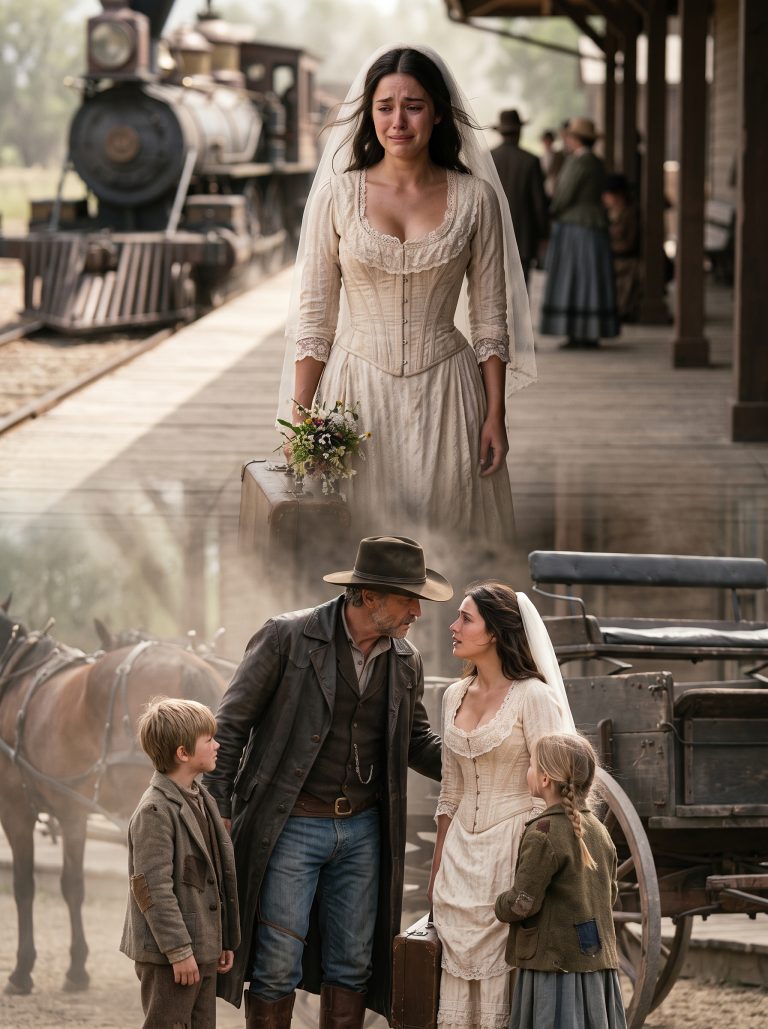
Split Rock, Arizona Territory, called it a placement fair. Ezra Colt called it what it was.
October, 1881. The sun sat low and orange over the churchyard fence, and the dust in the square smelled of horses and boiled coffee. Men in clean shirts walked the line of the unclaimed — children first, then boys strong enough for fence work, then a widow with a boy of her own who went to a miller before noon.
By the time Ezra stopped near the feed store, one person remained standing at the end of the line.
She was not young in the way the crowd wanted young to mean helpless. She stood a full head above the county clerk beside her, dark red hair scraped back under a gray bonnet, hands folded, chin level. Men glanced at her height, at the directness in her eyes, and moved on to easier choices.
Ezra was thirty-six, riding for a ranch job outside Tombstone that might already be filled. He had a horse, a bedroll, and no earthly reason to stop.
He stopped.
“Name’s Vera Ashford,” the clerk said, flipping his ledger without looking up. “Twenty-four. Father’s wagon went off the Bisbee grade in March. No kin located in the territory. Under county rule, any unmarried woman without property or standing family gets placed into supervised employment till she’s claimed or settled.”
“I have kin,” Vera said, quiet and even. “In St. Louis. They simply haven’t answered.”
The clerk ignored her. “Fee’s two dollars, placement into employ or guardianship, your choice how you file it.”
“I’m not filing her like a claim,” Ezra said.
The clerk looked up, annoyed at the interruption of a transaction he considered finished. “Then you’re not much use to me, mister.”
“I didn’t ask to be useful to you.” Ezra looked at Vera. “Employ or guardianship?”
The question did something to her face — a small crack in the composure, quickly sealed. “Employ,” she said. “I’m no one’s ward.”
He nodded, put two silver dollars in the clerk’s palm, and took the paper that made it lawful.
She picked up a bag so thin it told him everything about what she’d lost, and fell into step beside him without being asked.
“Where are we bound?” she said.
“Tombstone, if the job’s still open. A ranch. I’ve one horse.”
“I can ride.”
“I believed you the first time you said it with your spine.”
That earned him something close to a laugh, swallowed before it fully arrived.
They traded his spare tack for a sturdy gray mare at the livery, and left Split Rock as the light went copper over the road. For the first miles neither spoke. Ezra had lived alone long enough that silence sat on him like an old coat. Hers was different — watchful, testing the seams of him.
At the night fire she cooked beans without being told and mended a tear in her sleeve with stitches so fine he had to look twice to find them.
“My mother’s needle,” she said, when she caught him noticing. “Everything else went to pay the debt on the wagon.”
“What debt?”
Something shuttered behind her eyes. “A land debt. My father borrowed against a claim he filed before I was born. It’s why my uncle writes so often and visits so little — he believes the claim is worth collecting.”
Ezra filed that away and asked nothing further. A man learned, in this country, that grief kept its own hours.
“My wife died of fever in ’74,” he said instead, surprising himself. “Her and the child both.”
Vera did not offer sympathy dressed as pity. She only said, “Then you know what it is to keep walking anyway.”
“I do.”
They reached the Marrow ranch two days later, under a sky bruising toward violet. Otis Marrow, barrel-built and gray-bearded, looked at the two of them, the mare, and the paper Ezra held out.
“Hired help,” Ezra said. “She keeps books, cooks, rides better than most of your men.”
Otis’s wife, Bess, small and sharp as a tack hammer, appeared in the doorway wiping flour from her hands. She studied Vera a long moment.
“Can you read a ledger without falling asleep in it?”
“Yes, ma’am.”
“Room off the kitchen locks from the inside,” Bess said, as though daring anyone to make that necessary. “You’ll take it.”
Vera’s shoulders eased by a fraction Ezra alone seemed to notice.
That night he fixed the door’s loose latch by lantern light before she came in with her bag, and nailed a plain board shelf above the washstand.
“What’s that for?” she asked from the doorway.
“Your things.”
“I don’t have many things.”
“Then it won’t take long to fill.”
She crossed the little room and set down a cracked prayer book, a wrapped hair comb, and a folded letter, already opened and read, in an unfamiliar hand. She did not explain it. Ezra did not ask.
At the door he said, “Bunkhouse is across the yard. Any man troubles you, wake the house.”
“And if you trouble me?”
He met her eyes. “Then wake it louder.”
Something almost like a smile crossed her mouth.
“Good night, Mr. Colt.”
“Ezra,” he said.
“Good night, Ezra.”
He walked out into the cooling dark with his own name sounding strange and warm behind him, the way a thing sounds when you’ve heard it said correctly for the first time.
Part 2
By the second week, the Marrow kitchen had been quietly conquered. Vera reorganized the flour bins, found a hidden debt in Otis’s shoeing accounts that made Bess crow with satisfaction, and hung a strip of blue cloth over the window because, she said, a room ought to know it was cared for.
Ezra rode fence with Otis all day and came home each evening to find the plain house a little less plain. He began listening for her voice before admitting to himself that he was doing it.
He kept his distance on purpose — no closed doors, no unnecessary hands offered — until the morning she caught him at it directly, sheets snapping on the line between them.
“You avoid standing near me,” she said.
“I’m being careful of talk.”
“I know how people talk. I knew it before Split Rock.” She stepped around the sheet to face him fully. “I’d rather stand close to an honest man than safe beside a careful one.”
That undid something in him he’d kept tied shut since 1874.
In town that Saturday, a storekeeper’s son leaned on a cracker barrel and said, loud enough for the room, that a woman her size would make a fine plow mule if the real one went lame.
The store went still. Ezra took one step toward the boy.
Vera set down the cloth she was examining and beat him to it. “Your father’s sugar is priced two cents high a pound,” she said. “I’d mind my arithmetic before my manners, if I were you.”
The boy’s smirk died. His father snatched the ledger away from him.
Outside, climbing onto the wagon, Vera said, “You were about to hit him.”
“I was considering it.”
“That’s worse. Considering men usually finish the thought.”
“Does it bother you? What they say?”
She looked at the road a long moment. “It used to. At fifteen I prayed to wake up smaller. Then I decided the Lord built me for work that hadn’t introduced itself yet.”
“That’s a hard thing to know young.”
“I learned it early,” she said, “because no one was going to teach it to me kindly.”
Ezra said nothing more, but he understood, watching her profile against the dusk, that he had stopped thinking of her as help he’d paid for, and started thinking of her as a woman he could not now imagine the ranch, or himself, without.
Part 3
Otis offered Ezra a permanent post before the first hard frost — year-round wages and the old line cabin three miles west, with a garden patch if he wanted one. It was the kind of offer that should have pleased a man clean through.
It gave Ezra a problem shaped exactly like Vera Ashford.
She could not go on living as hired help under Bess’s roof forever on the strength of two dollars paid at a churchyard fair. Winter changed things. Men came and went from the bunkhouse. Reputations were fragile currency out here, and Vera’s had already survived one dent it shouldn’t have had to survive.
He found her in the garden at dusk, pulling the last carrots before the freeze, mud to her wrists.
“Otis offered me the line cabin,” he said. “I can’t ask you to live there unmarried. Not with talk what it is.”
She went very still. “What are my choices?”
“Real ones,” he said. “You can stay on here with Bess and take in town work if you’d rather. You can write your uncle and go to St. Louis, and I’ll pay the fare myself. Or—” His mouth had gone dry as August. “Or the preacher’s in town till Sunday. A marriage in name and under the law. Separate room. Your wages stay yours. If spring comes and you want to leave, I’ll help you secure a divorce, with no claim on your wages or anything you own. Whichever it is, it has to be yours to choose.”
“Why would you marry a woman no one wanted at a fair?”
“Because everyone there was a fool,” he said, “and because when I ride in tired, I find myself looking for you before I remember I shouldn’t.”
They married two days later in the Marrow parlor, Bess crying without shame, Otis pretending he wasn’t. Ezra kissed her cheek before the small crowd of witnesses — not her mouth, not yet, not on a bargain still tender with caution — and the warmth of it stayed with him longer than he cared to admit.
The cabin he’d readied himself: swept floor, blacked stove, and along one wall, four pine shelves where one would have done.
“For my things?” she asked.
“For the ones you have. And the ones you’ll get.”
Winter closed the pass by December. They learned the shape of married life in small honest pieces — coffee before dawn, silence that grew companionable instead of lonely, her hair loose at night before she vanished behind her own door and he lay awake wanting more than he let himself say.
Then, in February, the second letter came — thicker than the first, carried up from Split Rock by one of Otis’s hands.
Vera read it at the table while snow melted off Ezra’s coat by the door. Her face went the color of the tallow candle beside her.
“My uncle,” she said. “Thomas Ashford. He’s in the territory now — not St. Louis, as he claimed. He’s here, in Tombstone, and he says he can offer me a respectable home, since he knows the truth of my situation.”
Ezra came no closer. “What truth?”
She set the letter down with a hand that wasn’t quite steady. “He says my father’s old claim — the one the wagon debt was borrowed against — was never worthless scrub, as we were told. He says silver was found on it two years past, under another man’s name, and that the debt paper my father signed gives whoever holds it the right to the mineral claim beneath it.” She looked up. “He wants me to sign it over to him. For safekeeping, he says. Family looking after family.”
The room went cold in a way the stove couldn’t fix.
“You never had that debt paper,” Ezra said slowly.
“No. My father kept it hidden. I thought it burned with the wagon.” Her eyes went to the shelf above the washstand — to the cracked prayer book she never let anyone else touch. “But I don’t believe it did.”
She crossed the room, opened the prayer book’s back board, and drew out a folded, brittle paper that had ridden three hundred miles under Ezra’s roof without his knowing it.
The claim was real. The debt against it, real. And crossed at the bottom, in her father’s hand, one line neither of them had understood until that night: paid in full, witnessed, the ninth of December, 1880 — three months before he’d died, three months before her uncle had first written asking where she’d gone.
“He’s not trying to collect a debt,” Ezra said. “He’s trying to collect a claim that’s already clear — before you learn it’s clear.”
Vera sat down hard. “He was never grieving my father. He’s been waiting for me to be desperate enough to sign something I hadn’t read.”
“Would you have?”
“At the fair, with nothing in my bag but a comb and a prayer book?” Her jaw set, and for a moment she looked exactly like the woman who’d stood alone at the end of that line, refusing to bow to a crowd that had already decided she was unwanted. “Yes. I might have. That’s what makes me angriest.”
Ezra knelt by her chair, not touching her, only close enough that she’d know he wasn’t going anywhere. “Then we ride to Tombstone with the paper and a lawyer before he rides here with a story.”
“We,” she repeated.
“You’re not signing anything alone. Not this time.”
They went at first light, the paper sewn into the lining of Ezra’s coat, Vera riding beside him and not behind, sitting her own saddle the whole way. In Tombstone, a territorial attorney named Prudence Harper — a spare, sharp-eyed woman who’d read law under her late father back in Ohio before coming west to practice under her own shingle — read the discharged debt twice and told them plainly that Thomas Ashford had no claim on anything, and likely knew it, which was why he’d come asking for a signature instead of a judge.
“The original claim stayed filed in your father’s name,” Harper said, turning the brittle paper over. “This lien only proves no creditor holds mineral rights beneath it — meaning your father held them free and clear when he died. As his sole living heir, Miss Ashford, you inherit his interest in the claim outright. There was a partner listed on the original filing, a man named Duel, still working the ground under his own name. You’d share the claim with him, not owe him a thing.”
They found him at the Cosmopolitan Hotel, a soft-handed man in a good coat who paled when Vera set the paper on the table between them without a word.
“Your father would have wanted family to benefit,” he tried.
“My father marked it paid in full and told no one,” Vera said. “He knew exactly what kind of family he had.”
Thomas Ashford left the territory within the week. He did not write again.
They rode home slower than they’d come, in no hurry now that nothing was chasing them. Near the pass, with the sun dropping gold over the hills, Ezra reined in.
“I told you once I’d help you leave, if you wanted it,” he said. “That still stands. You’ve got half a silver claim now. Money enough to go anywhere — St. Louis, San Francisco, wherever a woman with your head for figures could want to go.”
Vera studied him a long moment, wind pulling a strand of red hair loose from her braid.
“I know what I’m worth now,” she said. “That’s different from knowing what I want.” She nudged her mare closer, until their stirrups nearly touched. “I want the cabin with too many shelves. I want a garden I’m allowed to ruin. I want a husband who rode into Tombstone beside me instead of deciding for me what I could bear to hear.”
“That’s not much of a claim to stake a fortune on.”
“It’s the only one I’ve ever wanted to file.”
He crossed the last of the distance and kissed her there on the trail, plainly, in daylight, with no witnesses but the horses and the hills — the first kiss neither of them measured out in caution.
They used the proceeds from Vera’s half of the claim the way she had always meant to use anything she earned: forty acres bordering the Marrow south pasture, bought outright in both their names, a schoolroom built the following spring for the ranch children after Vera tired of teaching letters at Bess’s kitchen table. Ezra built shelves before he built the second wall, the way he always did, and never once needed to explain why.
Years later, people in Tombstone told the story of the two-dollar woman from the Split Rock fair who turned out to own half a silver claim and married the cowhand who never once asked to see it.
They told it wrong, mostly — as though the money were the point, or the rescue, or the twist itself.
Those who knew Ezra and Vera Colt best understood it differently. The twist had never been the silver. It was that a man who’d learned to own nothing he couldn’t carry had built shelves anyway, on faith alone, before he had any proof she’d stay to fill them — and that a woman who’d spent her life being valued for what she could lift or sign away had finally found someone who asked what she wanted, and then believed the answer.
On spring evenings, the garden green against all reasonable expectation, Vera would sometimes ask, because the answer still pleased her:
“Are you glad you stopped, that day in Split Rock?”
And Ezra, older now, quieter in the way of a man who’d finally stopped bracing for loss, would take her hand and look out over land that was legally, unmistakably, entirely theirs.
“Every day,” he’d say. “Though I didn’t know then that I was finding my way home.”