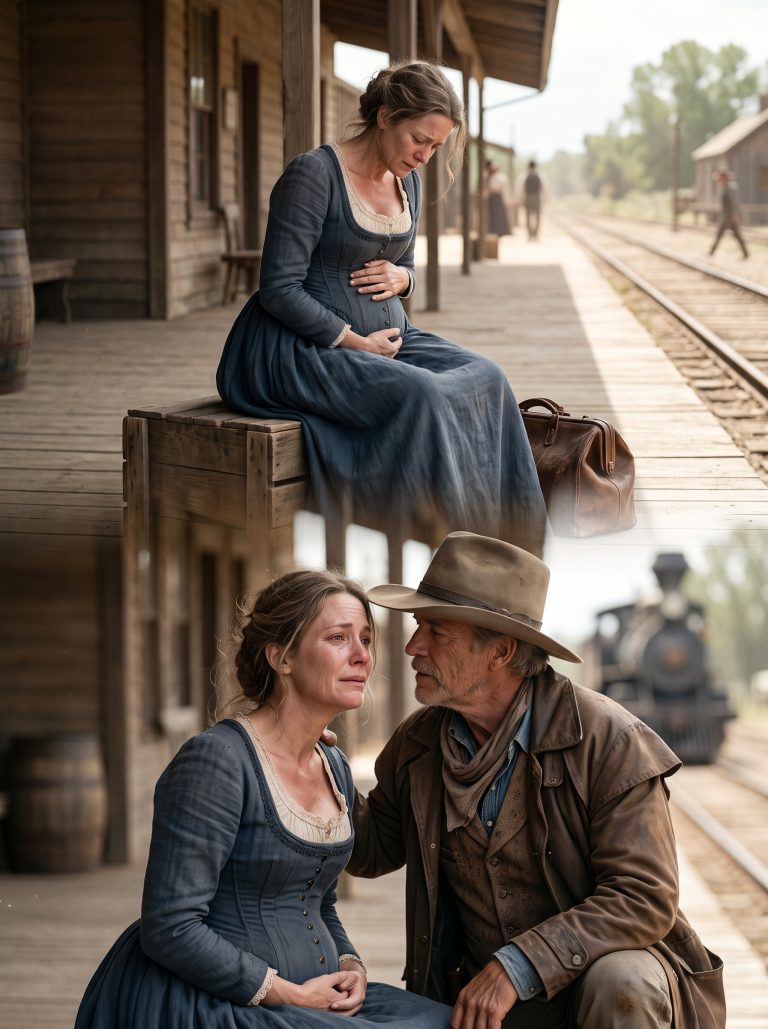
The abandoned bride stood alone at the train station in tears—until a cold billionaire pulled over and whispered, “My twins chose you.”

Part 1
The crowd on the platform scattered like startled quail as Eleanor Hastings stepped down from the train, her traveling dress gray with cinder soot, a crumpled telegram crushed in her gloved fist.
Prescott, Arizona Territory, 1887. As far west as her courage had ever carried her.
Engagement dissolved. My mother forbids the match. Do not come.
Eleanor had read the words eleven times since Albuquerque, and they still did not make sense. She had corresponded with Walter Pierce for fourteen months, had memorized the slant of his handwriting, had crossed two thousand miles of prairie to marry a man she had never once seen in the flesh. Now she stood alone on a strange platform with a trunk, a train ticket she could not afford to use twice, and a future that had evaporated somewhere between Kansas and here.
“Ma’am, you’ll want to mind the edge of the platform.”
The voice belonged to a broad-shouldered man wrestling with two identical little girls, both perhaps five years old, both possessed of unruly dark curls and the singular goal of reaching the horse trough before their father could stop them. One of them collided directly with Eleanor’s skirts.
“I do apologize,” the man said, catching the child by her pinafore. His eyes, gray as a coming storm, moved from Eleanor’s soot-streaked face to the telegram still crumpled in her hand, and something in his expression sharpened with understanding.
“You were meant to be met,” he said. It was not quite a question.
“That is no longer any concern of yours, sir.” But her voice cracked on the last word, and the man’s face gentled.
“Forgive me. Caleb McKenzie.” He shifted the wriggling girl to his hip. “These are my daughters, Ivy and Wren. I run a horse ranch eleven miles out past Dust Creek, and I am, at this moment, a man who has gone through four housekeepers in a year — the fifth quit just yesterday, and no fault of hers, either. A fever’s gone through her family and she’s needed at home, so I can hardly blame her for it.”
Eleanor blinked at him. “I fail to see how that concerns me.”
“It concerns you,” Caleb said, “because I need a governess, and you, unless I am gravely mistaken, need somewhere to be that isn’t a train platform.”
She opened her mouth to refuse — the very idea was scandalous, improper, absurd — when the second twin broke free and darted toward the tracks. Eleanor’s hand shot out on pure instinct and caught the child’s collar before Caleb had even turned.
“Wren, no,” he said, breathless, and Eleanor looked down to find the little girl staring up at her with wide, storm-gray eyes, entirely unbothered.
“You have excellent reflexes,” Caleb said. “For a governess.”
“I am not a governess.”
“You could be, for a fortnight. Room, board, and a fair wage, and if at the end of two weeks you’d rather board a stage for Sacramento, I’ll drive you to the depot myself and never speak of it again.” He hesitated. “My wife died two years ago. The girls have run wild ever since, and I have run out of ideas.”
Eleanor looked at the departing train, then at the two small, hopeful faces watching her as though she might, at any moment, disappear back into the crowd. She thought of Boston, of the letters she would have to write explaining her humiliation, of her cousin’s smug satisfaction. She thought of the alternative: two weeks, a wage, a roof.
“Eleanor Hastings,” she said, offering her hand before she had fully decided to accept his offer. Hastings had been her mother’s name, the one she had traveled under since leaving Boston. It was not quite a lie — only a name she had chosen to answer to, and a truth she was not yet ready to hand a stranger on a train platform.
“A fortnight,” she said. “Nothing more is promised.”
“Nothing more is asked,” Caleb answered, and for the first time since the telegram, Eleanor felt something in her chest loosen.
The ranch, when they reached it after a jolting three-hour drive, was not what she expected — a sturdy timber house with a wide porch, corrals full of horses in every shade from cream to midnight, and a woman built like a stove pipe who came out wiping flour from her hands and took one look at Eleanor’s ruined traveling dress.
“Caleb McKenzie,” she said, “what in creation have you done now.”
“Hired a governess, Mrs. Turner.”
“Hired her off the train platform, more like.” But the woman’s eyes were kind as she ushered Eleanor inside. “Well. Sit yourself down, dear. You look like you’ve been rode hard and put away wet.”
That night, after the twins had finally surrendered to sleep and the house had gone quiet, Eleanor sat on the porch steps and watched the stars needle their way into the enormous Arizona sky. She had lost a fiancé she had never met, a future she had never truly examined, and had gained, in the space of a single day, two small girls who had already asked her to braid their hair and a man who watched her with careful, curious eyes.
She did not yet know that Caleb McKenzie’s account of his own arrival at the station that morning was not entirely the truth — or that the fortnight ahead of her would end not in a stagecoach to Sacramento, but in a reckoning neither of them could yet see coming.
Part 2
The two weeks passed the way water finds its way downhill — quietly, and then all at once.
Eleanor learned that Ivy hoarded books under her mattress and Wren hoarded frogs in her apron pocket. She learned that Caleb reviewed his ledgers each night by lamplight with the tight jaw of a man hiding worry from his children, and that when she offered, without being asked, to look over his accounts, he stared at her the way a drowning man stares at a rope.
She learned, too, that the horses on Dust Creek Ranch were not merely a business — they were his late wife Rosalind’s dream, a breeding line she had begun and he had sworn to finish, whatever it cost him. And it was costing him. The ledgers told a story of debts quietly accumulating, of a rival breeder named Vance Whitmore who had been buying up notes on Caleb’s land from the bank in Prescott, one signature at a time.
“He wants the water rights,” Caleb admitted one evening, when Eleanor finally asked why his jaw tightened every time Whitmore’s name came up in town. “Dust Creek runs through my north pasture before it reaches his spread. Without it, his herd goes thirsty by August.”
“Then why does the bank sell him your notes?”
Caleb’s silence answered before his words did. “Because Whitmore’s the bank’s biggest customer, and I’m a widower two payments behind.”
On the last night of the trial fortnight, Caleb found Eleanor on the porch, the same as the first night, though nothing between them was quite the same anymore.
“Your two weeks are finished,” he said.
“They are.”
“And?”
Eleanor thought of Boston, of Walter Pierce’s cowardly telegram, of a life she had almost lived by someone else’s design. She thought of Ivy’s fierce hug that morning, of Wren’s frog collection, of Caleb’s steady, unshowy kindness.
“I’d like to stay,” she said. “If the offer still stands.”
“It stands,” he said, and the relief in his voice told her everything his pride would not.
Neither of them yet knew that Vance Whitmore was three days from making his move — and that the truth behind it would test everything they had only just begun to build.
Part 3
Autumn came to Dust Creek dressed in gold cottonwood leaves and the sharp smell of frost on sage. Eleanor had been at the ranch four months, and the lessons she gave the twins each morning had become, without her quite noticing, the center around which the whole household turned. Ivy could now read passages from her mother’s old poetry books without stumbling. Wren, to everyone’s astonishment, had taken to arithmetic with the same ferocity she once reserved for catching frogs.
Caleb had stopped reviewing his ledgers alone. Some evenings Eleanor sat across from him at the kitchen table, sleeves rolled, correcting a column of figures he’d added wrong three times, and he would watch her work with an expression she had learned to recognize as more than gratitude.
“You have a gift for this,” he said one such evening, nodding at the neat rows she’d restored to his accounts.
“I have a gift for arithmetic,” Eleanor said. “Boston schools are good for little else besides arithmetic and posture.”
“I disagree.” His eyes held hers a moment too long, and she looked down at the ledger to hide the warmth rising in her cheeks.
It was Mrs. Turner who first said aloud what the household had quietly begun to understand. “That man hasn’t smiled so much since Rosalind was alive,” she told Eleanor one washday, wringing a shirt with unnecessary violence. “You’d be doing him a kindness to let him say so himself, one of these days.”
“We have an arrangement, Mrs. Turner. A professional one.”
“Mm-hm,” said Mrs. Turner, in the tone of a woman who believed no such thing.
The harvest social in Prescott changed everything.
Eleanor had not wanted to go — a governess attending a town dance on the arm of her employer invited exactly the sort of talk she had crossed a continent to escape — but Caleb had asked with such quiet hope, and the twins had campaigned so relentlessly, that she relented. She wore a blue dress that had belonged to Rosalind, altered to fit, and when Caleb saw her come down the stairs, he went very still.
“You take my breath,” he said simply.
“It’s your wife’s dress.”
“It was,” he said. “Tonight it’s simply beautiful, on you.”
The dance hall was warm with lantern light and fiddle music when Vance Whitmore arrived, immaculate in black broadcloth, his mustache waxed to points sharp enough to cut. The room’s temperature seemed to drop several degrees as he crossed toward them.
“Miss Hastings,” he said, with a bow so shallow it was nearly an insult. “Or should I say — Miss Carver?”
Eleanor’s stomach turned to ice. Caleb stepped closer to her side. “Whitmore. Say your business or leave.”
“My business,” Whitmore said, savoring the word, “is that I’ve spent considerable money finding out who our governess truly is. Eleanor Carver, formerly of Boston, formerly employed as a companion to the invalid Mrs. Prescott Ashford — until Mrs. Ashford’s nephew accused her of theft. Ten thousand dollars in missing bonds. There’s a warrant out on her still, McKenzie. Did she mention that, before you brought her into your home? Around your daughters?”
A ripple of shocked murmuring moved through the hall. Eleanor felt every eye in the room turn toward her, and for one terrible moment the old paralysis of Boston — the fear of being seen, judged, discarded — rose up to choke her.
Then she made herself speak.
“It’s true my name was Carver before it was Hastings,” she said, loud enough to carry. “Hastings was my mother’s maiden name. I took it up the day I left Boston, not to hide a crime, but to stop carrying a stranger’s accusation on my back everywhere I went. And it’s true there was a warrant. What Mr. Whitmore neglects to mention is why.”
Whitmore’s smile faltered, just slightly.
“Mrs. Ashford’s nephew, Julian Ashford, was draining his aunt’s accounts while she lay dying and unable to defend herself. As her companion, I kept the household ledger, and it was I who noticed ten thousand dollars in railway bonds missing from her strongbox, their serial numbers no longer matching the estate inventory her own solicitor had drawn up that spring. I searched Julian’s desk while he was out and found the bonds there, still bearing those same serial numbers. When I confronted him, he did not deny it — he threatened me instead, and within two days his cousin, a clerk in the sheriff’s office, had sworn out a warrant naming me as the thief, on Julian’s word alone and no evidence but his say-so. I left Boston within the week, before that warrant could be served on a woman with nothing but a ledger and her own testimony to defend her. I have never once denied being Eleanor Carver. I simply stopped answering to a name that came wrapped in another man’s lie.”
The hall had gone silent enough to hear the fiddle player’s bow rest against the strings.
Sheriff Taylor, who had been standing near the punch table, stepped forward. “That’s a serious claim, Miss Hastings.”
“It is,” Eleanor said steadily. “And it can be proven. Before I fled, I copied the bonds’ serial numbers into my own household ledger and matched them against the solicitor’s estate inventory — a public record any Boston clerk can produce. I also have a letter from Mrs. Ashford’s physician, written and signed before I ever left the city, confirming that Julian visited the house alone and unsupervised six times in the month before she died. But you needn’t take my word, or even the physician’s. A teller at the Merchants’ Bank of Boston recorded Julian attempting to redeem one of those very bonds, under his own name, only two days after I left the city — an entry that sits in the bank’s own ledger, not mine, made by a man with no reason to lie for me. I sent copies of all of it to my brother in Boston the day I boarded my train. He can wire confirmation to the sheriff’s office by morning, and follow it with the certified papers themselves on the next eastbound train, now that the rail line runs clear through to Prescott.”
Whitmore’s composure cracked at last. “This is absurd. A convenient story—”
“Convenient enough that I can prove it,” Eleanor cut in, “and inconvenient enough that I’ve carried the fear of it three thousand miles rather than risk facing a rigged courtroom. Tell me, Mr. Whitmore — how did you come to have the resources to investigate a governess’s past in Boston? That seems a costly, particular sort of curiosity for a horse breeder to indulge.”
The question landed harder than she intended. Whitmore’s jaw tightened.
“I make it my business to know who I’m dealing with,” he said.
“You make it your business,” Caleb said quietly, “to know who’s standing between you and my water rights. That’s the whole of it, isn’t it, Vance? You didn’t dig up Eleanor’s past to protect the town’s morals. You dug it up hoping scandal would drive her off my ranch and leave me with no one to keep my books straight while you buy up my notes out from under me.”
The silence that followed had a different quality now — no longer shocked, but calculating, as the room began to see the shape of what Whitmore had actually attempted.
Sheriff Taylor cleared his throat. “Whitmore, you and I are going to have a conversation about how a horse breeder affords private investigators in Boston. Tonight, if you don’t mind.”
Whitmore’s eyes flicked between the sheriff, Caleb, and Eleanor, weighing his remaining options and finding none of them favorable. He inclined his head with as much dignity as he could salvage and allowed himself to be led away, though not before saying, quietly, for Eleanor alone: “This isn’t finished.”
“It very nearly is,” she answered, and did not let her voice shake until he was out of earshot.
The ride home was quiet, but not with the strained silence of before. Halfway back, Caleb reached over and took her hand.
“You should have told me,” he said. “About Boston.”
“I was afraid you’d send me away. Afraid the ranch, the girls, all of it, would vanish the way everything else had.”
“Eleanor.” He stopped the wagon beneath the enormous spray of stars, the twins asleep behind them. “I built this ranch out of nothing but stubbornness and my father’s debts. I know what it costs to keep something that other men decide they’d rather take from you. I would never have sent you away for surviving a man like Julian Ashford. I’d have gone to Boston myself and settled accounts with him.”
“That’s not your fight.”
“You made it mine the day you caught Wren by the collar instead of watching her run toward the tracks,” he said. “You’ve been fighting for this family since your first hour in it. Let me fight for you, for once.”
She did not have words ready for that, so she simply leaned into his shoulder, and he wrapped the reins around one hand so he could put the other arm around her, and they rode the rest of the way home like that, under a sky enormous enough to hold every version of the future that might still come.
The certified copies of the ledger pages, the physician’s letter, and the bank teller’s sworn statement arrived from Boston eleven days later by rail post, exactly as Eleanor’s brother had promised, along with a letter from the Ashford family’s own attorney confirming that Julian Ashford had been formally charged with fraud and theft, and that the warrant against Eleanor Carver had been quietly, permanently withdrawn.
Sheriff Taylor’s own inquiry, meanwhile, turned up a second set of crimes far closer to home. Under territorial banking law, any transfer of a mortgage note above five hundred dollars had to be recorded under the true purchaser’s name; the bank’s own loan clerk confessed under questioning that he had falsified the transfer ledger for months, listing Caleb’s overdue notes as sold to a fictitious buyer while quietly funneling them to Whitmore in exchange for regular cash payments — a plain violation of the bank’s charter and grounds enough, under territorial statute, for the clerk’s indictment on charges of forgery and breach of fiduciary trust. Whitmore himself faced a separate charge of bribery for the payments, and a charge of extortion besides: the territory’s statute defined extortion as obtaining advantage through the threat of exposure or injury to reputation, and Sheriff Taylor’s report made plain that Whitmore’s paid investigation into Eleanor’s past had been undertaken for no purpose but to force her from Prescott and clear his path to Caleb’s water rights. Facing trial on both counts in the same territory where he’d hoped to ruin two people to get at a creek, Whitmore sold his spread before the circuit judge could hear the case and left for California, never to return. Dust Creek’s water stayed where it had always belonged.
Caleb proposed in October, in the same pasture where Rosalind’s mares still grazed, with a ring that had been his grandmother’s and a proposal so plainly, practically worded that Eleanor laughed through her tears before she said yes.
“We should probably marry,” he said, “before Ivy starts planning the ceremony herself. She’s already chosen the flowers.”
“Has she indeed.”
“Wren wants the frogs involved. I’ve told her no. I make no promises she’ll listen.”
They married in November, under a sky scrubbed clean by early snow, with Mrs. Turner crying loudly enough to be heard over the fiddles and the twins solemnly certain that the entire event had been their idea from the start.
A year later, Dust Creek Ranch had a new foal named for a Boston governess who’d once caught a runaway five-year-old by pure instinct, a set of account books so precise that three neighboring ranches paid Eleanor a fee to review their own, and a baby due in the spring that neither Ivy nor Wren could stop announcing to every stranger who passed through the gate.
Her brother’s letters still reached her every month, and one of them, that autumn, mentioned in passing that Walter Pierce had married a banker’s daughter from Hartford — a match his mother had, it turned out, been arranging for the better part of a year before Eleanor’s telegram had ever arrived, which explained well enough why the engagement had been severed so abruptly and so far from home. Eleanor read the news standing at her own kitchen table, in her own house, and found that it moved her no more than a stranger’s weather report. The girl who had once wept in a soot-stained wedding dress over that man’s cowardice felt, at this distance, like someone she had known briefly and outgrown. She folded the letter, set it aside, and went out to find Caleb, who was teaching Wren to sit a green colt while Ivy narrated the whole affair to an audience of unimpressed chickens. Whatever Walter Pierce had spared her, without meaning to, she no longer wished to thank him for it. She simply no longer thought of him at all.
Eleanor had once believed that home was something handed to you — a name, a marriage, an inheritance, granted or withheld by other people’s judgment of your worth. She understood now that it was something else entirely: not a gift she’d been given, but a truth she had refused to abandon, even when a man tried to use her past as a weapon against her future.
She had not been rescued at that train platform. She had simply, finally, been believed — and had spent every day since proving that belief correct.
The End