Forced to Marry a Feared Mountain Widower, She Arrived Trembling—Then His First Gentle Words Changed Everything

PART 1
The bruise was still there when the stagecoach stopped. Powder couldn’t quite hide it, not in the flat gray light of a mountain town at the end of winter.
Elena Marsh had been three weeks getting to Colorado. Three weeks of trains that smelled like coal smoke, boarding houses with thin walls, and a fear that rode with her the whole way — the fear that her father’s men were one town behind, always one town behind, waiting to drag her back to Boston and hand her over like a piece of furniture that had been sold at auction.
Because that was what she was, in the eyes of the man who raised her. Furniture. Merchandise. Grady had erased fifty thousand dollars of her father’s gambling debts in exchange for her hand — and for control of the small inheritance her mother had left her, the one thing of her own Elena had ever possessed. He had made his intentions very clear the last night she’d spent under her father’s roof — the night he grabbed her wrist so hard it left marks, and her father stood in the doorway and said nothing.
She hadn’t screamed. She’d learned a long time ago that screaming only made men angrier.
She had, instead, answered an advertisement. A strange one, torn from the back pages of a paper she wasn’t supposed to be reading.
Man seeks wife. Mountain homestead. Hard work. No experience required. Write to J. Colt, care of the post office, Larkspur, Colorado.
She had written back four sentences. Three of them were true.
The reply came in a hand so rough it looked carved rather than written.
Come to Larkspur. I’ll meet you there.
So here she was, stepping down into frozen mud in a town that looked like it had been built by people in a hurry to leave again — a leaning general store, a saloon missing half its sign, mountains behind it all like the walls of a room she hadn’t chosen to be locked in.
An older woman crossed the street before Elena had taken three steps, silver hair pinned back, a folded letter and a faded photograph clutched in one hand — Elena’s own letter, and a photograph of Elena’s mother tucked inside it. Her eyes moved from the picture to Elena’s face and stayed there.
“You have your mother’s eyes,” the woman said.
Elena’s breath caught somewhere behind her ribs. “You knew my mother?”
“I’m Ruth Bennett. Cousins, once, a long time ago.” The woman’s mouth did something sad and soft at the same time. “Come warm up, child. There are things you ought to know before he gets here.”
He.
Inside, over tea that scalded her hands more than it warmed them, Ruth told her about Jonah Colt.
“He is not what you’re picturing,” Ruth said.
“What am I picturing?”
“Somebody easy to talk to.” Ruth’s eyes held hers, steady. “When you see him, you’re going to want to run. I need you not to.”
Elena’s fingers went white around the cup. “Why would I run?”
“Because he’s the biggest man you’ve ever laid eyes on, and there’s a scar down the side of his face that looks like it was put there on purpose, and he keeps a wolf instead of a dog, and he has not smiled at another living soul in four years.” Ruth said it all in one breath, like she’d rehearsed it. Then, quieter: “And because underneath every bit of that, he’s the best man in this county, and I will not have you scared off before you’ve had the chance to see it.”
“What happened to him?”
Ruth looked at the stove instead of at Elena.
“Outlaws killed his wife and his little girl while he was two counties over selling horses. Five men did it. Jonah hunted down all five, over the better part of two years.” A pause. “Then he came up here and hasn’t come all the way back down since.”
A man who had killed five people to avenge his family.
A man who lived alone with a wolf on a mountain that swallowed roads whole.
A man she had crossed half a country hoping to build a life with — a man she had agreed, in four honest sentences and one enormous lie of omission, to try.
The door opened before she could decide whether that made him safer than what she’d left behind, or so much worse that Boston would look like mercy by comparison.
Cold came in first. Then the man.
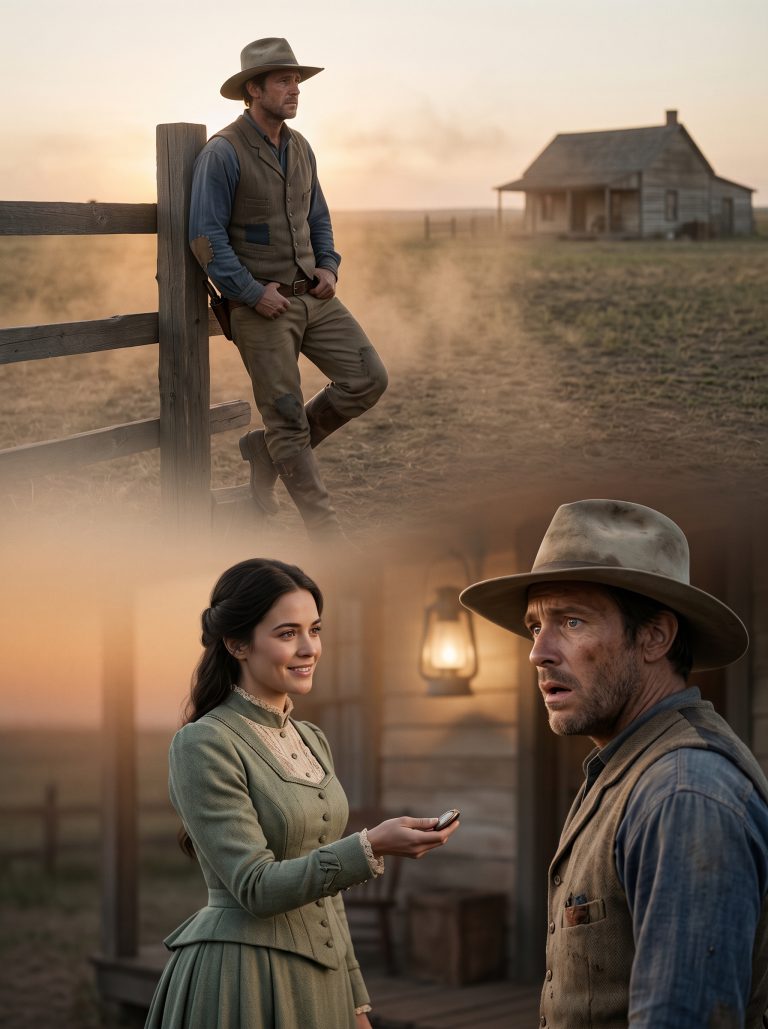
He filled the doorway the way weather fills a valley — total, absolute, impossible to argue with. Not merely tall. Built, like something the mountain had made on purpose. Dark coat dusted white at the shoulders. A scar running from temple to jaw, pale against wind-burned skin. Eyes the color of a storm that hasn’t decided yet whether it’s going to break.
At his knee stood a massive wolf whose shoulders nearly reached Elena’s waist, eyes the color of a lit lamp.
Elena stopped breathing.
The man took off his hat.
“Miss Marsh.”
His voice came from somewhere low in his chest, like gravel shifting under a wagon wheel.
“Mr. Colt,” she managed.
“Ruth tell you I’d look like something out of a bad dream?”
Elena blinked. Beside her, Ruth didn’t so much as flinch.
“She did.”
Something crossed his face. Not quite a smile. The idea of one, maybe, passing through on its way somewhere else.
“Good,” he said. “Storm’s coming down off the peak inside the hour. We go now, or you’re stuck in this town three more days eating Ruth’s biscuits.”
“They are excellent biscuits,” Ruth said, unbothered.
Elena looked past him to the window, where snow had begun to fall in slow, deliberate flakes, nothing like the wind-driven chaos she’d have expected.
“How can you possibly know a storm’s coming from that?”
Jonah Colt looked at her the way a man looks at a question he’s already decided isn’t worth arguing.
“Mountains tell you when they mean business,” he said. “You want to see it for yourself, we’d best go now.”
She had every reason in the world to stay in that warm little post office with Ruth Bennett’s tea and Ruth Bennett’s certainty. Every reason not to climb into a wagon with a scarred stranger and the wolf watching her as if he hadn’t yet decided whether she was a threat.
But she had already learned, at cost, that safe and free were two very different things, and that her father’s house had been full of the first and empty of the second.
“I’m ready,” she said.
Something shifted behind Jonah Colt’s eyes. Not warmth exactly. Closer to respect.
He shrugged out of his heavy coat and held it toward her without a word.
“I can’t take your coat,” she said.
“You can.” A beat. “You will.”
He didn’t say it unkindly. He said it the way a man states that the sun comes up in the east — a fact, not an argument.
She took it. It swallowed her whole, and it smelled like woodsmoke and pine and something wilder she didn’t have a name for yet.
Outside, his wagon waited, hitched to a draft horse built like a small mountain itself. The wolf melted into the tree line and kept pace alongside them as the trail climbed, a gray-white shape flickering between the trunks like something that wasn’t entirely real.
“Does he bite?” Elena asked, watching the animal.
Jonah’s gaze flicked toward her, and for the first time, the corner of his mouth actually moved.
“Only if trouble comes for what’s mine,” he said. “Ghost feels about the same.”
The word mine should have frightened her.
It didn’t. And that, more than the wolf, more than the scar, more than the five dead men, was the thing that scared her most.
Two hours later, the storm hit like something with a grudge. Wind screamed through the passes. Snow turned the trail to a wall of white. Elena gripped the wagon seat certain they’d go over the edge — and Jonah Colt didn’t so much as raise his voice, guiding the horse through the blindness with a calm that had nothing to do with recklessness and everything to do with a man who had made this exact climb a thousand times, alone, with nothing waiting for him at the top.
A cabin rose up out of the whiteout like a ship out of fog.
“Home,” he said.
Elena climbed down on legs that had gone numb hours ago, and they folded under her the second her boots hit the ground.
Hands caught her before she fell — hands big enough to break bone, gentle enough not to bruise.
“Easy,” he said.
Then he let go immediately, like he’d touched something hot.
Inside, the cabin was dark and bitter cold, and Jonah went straight back out to see to the horse, leaving Elena alone in front of a stone hearth she had no earthly idea how to light.
She broke three matches. Burned two fingertips. Had nearly given up, nearly let the tears come, when the smallest flame finally caught and held.
“Good,” said a voice behind her.
She spun. Jonah Colt stood in the doorway, snow melting off his shoulders, watching the fire she’d built instead of her.
“I wasn’t sure you’d manage that,” he said. “You did.”
Later, with lamps lit and the room slowly filling with warmth, he led her to a small bedroom — a quilt in blue and green, a washstand, and a door with a lock built into the inside of it.
He put something small and cold into her palm.
A brass key.
Elena stared down at it like it might change shape if she looked away.
“Put that in myself, last month,” Jonah said, not quite meeting her eyes. “Figured you’d want it.”
“You won’t—” Her voice failed her halfway through.
“No.” His voice, when it came, was quieter than anything he’d said all day. “I sleep by the fire. I won’t come through that door unless you’re the one who opens it.”
Her fingers closed around the key hard enough to hurt.
“I don’t understand.”
He looked at the flames instead of at her, uncomfortable in a way that made him seem, for one unguarded moment, almost young.
“I needed somebody to talk to,” he said. “Been alone up here too long to remember how. I don’t need you in my bed, Elena.” A pause, like the next words cost him something. “I need you at my table.”
For the first time since she’d run from Boston with a bruise under her powder and a lie in her letter, Elena Marsh felt something that frightened her far more than fear ever had.
She felt the first, faint edge of trust — and she had absolutely no idea, yet, how much that was going to cost either of them before the spring thaw came.
PART 2
The first week nearly broke her.
Not the cold — she’d expected the cold. It was everything else. She couldn’t split wood without the axe glancing sideways. She burned porridge into something closer to tar. She soaked her skirts to the knee fetching water and got chased half around the yard by a rooster that seemed to take her presence as a personal insult.
Jonah never laughed at any of it. He showed her once, corrected her without heat, bandaged her raw palms by firelight, and said only, “Better tomorrow,” like it was a fact and not a kindness.
Ghost trusted her even less than the rooster did. The wolf planted himself between Elena and Jonah every time she moved too close, a low sound building in his chest that needed no translation. Then, one night when sleep wouldn’t come, she sat by the dying fire and told the wolf everything — her mother, her father’s fists, the banker’s cold hands, the terror of being paid for like livestock. She woke at dawn with a blanket over her shoulders she hadn’t put there, and Ghost’s head resting heavy across her feet.
Something in the cabin shifted after that.
Jonah taught her to ride. When she slipped from the saddle, his hands caught her waist and released her a half-second later like he’d been burned. “Shouldn’t have touched you without asking,” he said, jaw tight.
“I don’t mind,” she told him. “Not when it’s you.”
Something passed between them that neither one said out loud.
Then came the second storm — worse than the first, cold enough that no number of blankets stopped her shaking. Jonah found her at midnight, lips gone faintly blue, and said the only thing that made sense in that moment: “We share warmth or you don’t make it till morning. I’ll lie over the blankets. Nothing else.”
She should have refused.
She didn’t.
In the dark, with the wind trying to peel the roof off the world, he told her about Sarah and little Maggie — his wife, his daughter, the men who’d taken them, the two years he’d spent making sure those men never hurt anyone again. She told him about Walter Grady, about the fifty thousand dollars, about a father who’d looked at his own daughter and seen only a number.
“Nobody touches you like that again,” Jonah said into the dark. “Not while I’m breathing.”
“Jonah.” Her voice was barely there. “Will you kiss me?”
He did — slow, giving her a hundred chances to stop him.
She used none of them.
For the first time in her life, being touched didn’t feel like something being taken from her.
Then the storm broke, and with it came a rider from Larkspur carrying a folded note in Ruth Bennett’s careful hand.
A man’s come asking after a red-haired girl from Boston, it read. Not family. He has the look of somebody paid to find things.
Elena’s hands went cold around the paper before she’d even finished reading it.
“They found me,” she whispered.
Jonah read the note twice. When he looked up, whatever softness had been building in his face over the last two weeks had gone somewhere else entirely — somewhere Elena hadn’t seen yet, and had a feeling she wasn’t going to like.
“Tell me everything about this Grady,” he said. “All of it.”
She did — every detail she’d been too ashamed, too frightened, to say out loud until that moment.
When she finished, Jonah stood, crossed to the mantel, and took down a rifle that had clearly not been touched in some time.
“Then we get ready,” he said.
Elena looked at the gun in his hands, then at the small brass key resting in her apron pocket — the first thing this man had ever given her, before he’d asked for anything at all — and understood, with a certainty that settled somewhere deep in her chest, exactly what she needed to ask him next.
“Teach me to shoot.”
What neither of them knew yet was that the man riding toward Larkspur wasn’t the worst of what was coming. And that before the snow melted, Elena Marsh was going to have to decide — with a rifle in her hands and her own father standing in the yard — exactly how much of the old Elena she was willing to leave behind on this mountain.
Part 3
The first time Elena fired the rifle, she screamed loud enough to send birds scattering off the ridge.
The recoil slammed back into her shoulder like a fist. The rifle dropped from her hands into the snow before the echo had even finished rolling off the mountains around them.
Jonah picked it up without a word, checked the barrel, and held it out to her again.
“No,” Elena said, breathing hard.
“Yes.”
“I can’t.”
“You can.”
Her shoulder throbbed. Her ears rang. Every lesson she’d ever been taught in Boston rose up inside her at once — ladies didn’t hold guns, ladies didn’t fight, ladies endured — and every one of those lessons had done exactly nothing to keep her mother alive, or her father’s hands off her, or Walter Grady’s contract from being signed in the first place.
Enduring hadn’t saved anyone she loved.
She took the rifle.
This time, when it fired, she stayed on her feet. The shot went wide, clipping a pine branch, dumping an avalanche of snow squarely onto Ghost’s head. The wolf leapt back with a look of profound, personal betrayal.
For one stunned second, nobody moved.
Then Elena laughed — a real laugh, the kind that surprised her as much as it surprised Jonah, who looked at her like she’d just done something closer to a miracle than a mistake.
Ghost shook the snow from his ears and stalked off into the trees with as much dignity as a wolf could manage.
“I believe he hates me again,” Elena said.
“He’ll forgive you by supper. Provided you burn something.”
“I don’t burn everything.”
Jonah’s eyebrow climbed a fraction of an inch.
“Most things,” she conceded.
The corner of his mouth twitched — the closest thing to a smile she’d gotten out of him yet, and she found herself keeping count.
They practiced every day after that. Loading. Aiming. Breathing through the recoil instead of flinching from it. Clearing a jam with hands that had stopped shaking quite so badly. Jonah never praised easily, which meant that when her shot finally clipped the edge of the target board and he said, simply, “Good,” it landed harder than every polished compliment she’d ever collected in a Boston ballroom.
But the danger Elena had been bracing for arrived early, and it did not wear Walter Grady’s face.
It wore her father’s.
Edward Marsh rode into the clearing nine days after Ruth’s warning, wrapped in a coat entirely too fine for the mountain wind, looking smaller somehow than Elena remembered — as if the peaks around them had stripped away whatever had made him seem so large in every room of her childhood.
Still, when he said her name — her real name, the one only Boston used — her body remembered fear before her mind had time to refuse it.
“Elena.”
She stood on the porch beside Jonah, rifle steady in her hands.
“Don’t call me that.”
Her father dismounted, his eyes moving over the cabin, the wolf, the enormous scarred man at her side, cataloguing all of it the way he’d once catalogued suitors.
“You’ve led me quite a chase.”
“How did you find me?”
“You’re not as clever as you think yourself.” His mouth curled, the old, familiar contempt sliding into place. “I paid enough station agents and boarding-house clerks between here and Boston to remember a frightened red-haired girl traveling alone. Money buys memory, Elena, same as it buys everything else.”
Jonah shifted his weight but didn’t speak. He was letting her stand on her own, and somehow that steadied her more than if he’d stepped in front of her ever could have.
“Go back to Boston,” she said.
Edward Marsh laughed, short and ugly. “Go back? Do you have any notion what you’ve cost me? Walter Grady paid fifty thousand dollars for you, and you ran off to marry some mountain animal.”
Jonah’s jaw went tight as stone. He said nothing.
Elena lifted the rifle a fraction of an inch.
“You had no right to bargain with my life.”
“I am your father.”
“You stopped being my father the night you hit my mother so hard she couldn’t rise from her bed for a week.” Her voice shook once, then steadied, the way it hadn’t in years. “You stopped being my father when you drank away everything she ever loved. You stopped the day you sold me to pay off a debt like I was a piece of your furniture.”
“How dare you—”
“How dare I?” She stepped down off the porch, snow crunching under her boots, closing the distance instead of shrinking from it. “How dare you ride up here and demand I come back to a life that was killing me slowly? How dare you act as though you have any claim left on me at all?”
“This is not your home,” her father spat, gesturing at the cabin, the crooked woodpile, the smoke curling honest and gray from the chimney. “This is a shack in the wilderness.”
Elena looked back — at the smoke, at the firewood she had learned, badly and then less badly, to split herself, at Ghost standing sentinel by the porch with his lamp-yellow eyes fixed unblinking on her father, at Jonah, silent and immovable, letting her fight this battle with her own words because he trusted her to win it.
“This is my home,” she said. “And you are not welcome in it.”
Her father’s eyes narrowed to something colder than the wind. “Grady is coming. He’s gathering men. He does not forgive an insult of this size.” Something flickered under the threat — fear of his own, poorly hidden. “He gave me ten days to bring you back. If I fail, he’ll ruin what’s left of our name — and he won’t much care what happens to me getting there. Come with me now, or what happens next will be far worse than anything you can imagine.”
“Then let him come.”
Jonah’s voice, when it finally came, was quiet — and it changed the entire temperature of the clearing.
Her father looked at him with a contempt that couldn’t quite disguise the fear underneath it.
“You think you can protect her from a man like Grady? He has money. Power. Hired guns.”
Jonah stepped down beside Elena, unhurried, unbothered by any of it.
“She’s my wife,” he said. “She stays.” His storm-gray eyes didn’t blink. “Go back to Boston, Mr. Marsh. Tell Grady, if he sets foot on this mountain, he’s riding to his own grave.”
For the first time in Elena’s entire life, she watched real fear move across her father’s face.
He left with threats still on his tongue and his hands visibly trembling on the reins.
When the trees swallowed him, Elena lowered the rifle. Her arms shook so hard she nearly dropped it.
Before nightfall, Jonah saddled his fastest horse and rode to the Delacroix spread two ridges over — the nearest neighbors he had — and asked them to send a hand down to Larkspur with a warning for the sheriff: armed men were coming, and there would be blood on the mountain before the week was out. Whether help arrived in time was another matter entirely, one neither of them could control.
Jonah’s hand settled on her shoulder, steady as bedrock.
“You did well.”
“He’ll bring Grady.”
“I know.”
“And you’ll fight, even without knowing how many men come with him.”
“I will.”
Tears slid down, freezing almost as fast as they fell. “I don’t want you to die for me.”
“Then I’ll try very hard not to.”
A laugh broke loose from somewhere underneath her fear.
“Jonah.”
“Yes?”
“When they come — will you stand beside me?”
His thumb caught a tear before it could reach her jaw.
“Darlin’,” he said, “especially then.”
She kissed him on that porch with the wind howling around them and Ghost watching from the doorway — no longer a woman running from her past, but one bracing to finally stand and meet it.
Part 4
The days that followed went quiet in the particular way the world goes quiet before violence — shutters reinforced, a trench dug behind the woodpile, every weapon in the cabin checked and checked again. Jonah showed her a shallow cave half a mile through the trees, a place to disappear to if the worst happened.
“I’m not hiding,” Elena said.
“If I fall, you run.”
“If you fall, I fight harder.”
His face tightened. “Elena.”
“I spent my whole life running,” she said, stepping close enough that he had to look at her instead of past her. “Running from my father. From Grady. From every room where men decided my future while I stood there and said nothing. Those days are finished, Jonah. All of them.”
“This isn’t pride. It’s survival.”
“What good is surviving,” she asked, “if I lose you doing it?”
The words left her before she’d fully understood she meant to say them.
Jonah went very still.
Snow drifted down between them, unhurried, indifferent to the moment it was falling through.
“I love you,” Elena said.
The confession frightened her far less than the silence that would have followed if she’d swallowed it.
Jonah crossed the space between them in two strides and pulled her into arms that shook — the fear, she understood, of a man who’d lost everything once and never expected to have anything worth losing again.
“I love you too,” he said into her hair, voice rougher than she’d ever heard it. “Think I loved you the moment you stepped off that stagecoach, looked at me like I was something out of a nightmare, and refused to run anyway.”
Elena laughed through the tears freezing on her cheeks. “You are a nightmare.”
His mouth curved against her temple.
“Yours,” he said.
They came at dawn.
Four riders broke from the tree line as pale light spread thin and cold across the snow. Walter Grady rode at the front — black coat, silver hair immaculate, the same pleasant, bottomless cruelty in his face that Elena remembered from every Boston parlor he’d ever charmed his way into. Behind him, three hired men with hard eyes and rifles slung across their saddles.
Elena stood on the porch, rifle steady, Ghost bristling at her side like something poured from smoke.
Grady’s eyes moved from Jonah, to Elena, to the wolf, and something like delight flickered across his face.
“My dear,” he called out. “You’ve led me on quite an adventure.”
“I am not your dear.”
“No?” He swung down from his horse with practiced grace. “And yet I paid fifty thousand dollars for the privilege of calling you whatever I please.”
“You paid my father. Not me.”
“Your father took my money and promised me your hand. The law may not call you property, Elena — but no judge in Boston will risk crossing me over a broken promise.”
“You bought a promise from a desperate man. You did not buy me.”
Grady’s smile only widened. “There’s that fire. The others were so terribly obedient.”
Something cold moved through Elena’s chest. “The others?”
“My previous wives. Delicate creatures, both of them. Neither survived long enough to disappoint me twice.”
“You killed them.”
Grady’s eyes went flat and hollow. “Prove it.”
Jonah raised his rifle. “My wife isn’t leaving with you.”
Grady sighed, almost bored, and nodded once.
The clearing exploded.
Part 5
One of the hired men fired first, splintering wood beside the cabin door. Jonah’s answering shot dropped him into the snow before the echo had even finished. Elena dove behind the water trough as bullets cracked through the cold air, and Ghost vanished into the chaos like something the storm had swallowed.
A second man broke for the barn, torch already lit.
Fire. They meant to burn them out.
Jonah was pinned behind the porch post, trading shots with the third gunman. Elena raised her own rifle, hands shaking, and fired — missed the man entirely, but close enough that he dropped the torch into a snowbank where it hissed and died before it could catch.
Then a hand closed around her arm like a manacle.
Grady.
He wrenched her wrist behind her back hard enough that pain tore white-hot up through her shoulder.
“Drop it,” he hissed against her ear, “or I break the arm.”
The rifle fell into the snow.
He dragged her backward, pistol pressed cold to her temple. Somewhere beyond the firelight, low and unseen at the tree line, Ghost circled — a shape Grady hadn’t accounted for, watching, waiting for an opening that hadn’t come yet.
“Colt!” he shouted across the clearing. “Stop shooting, or I put a bullet through her skull!”
Everything went silent.
Jonah stepped into the open, rifle still raised, his face carved from something far past rage.
“Let her go.”
“I think not.” Grady’s breath was hot and close against her ear. “I think I’ll take what’s mine and ride out. Then I’ll come back with enough men to burn this whole homestead down to the dirt.”
Fear hammered through Elena’s chest — and underneath it, something hotter rose to meet it. All her life, men had decided things for her. Her father. Suitors who studied her like livestock. Now this man, who thought fifty thousand dollars had bought him the right to put a gun to her head.
No more.
Her fingers crept, slow, toward the small knife Jonah had strapped to her thigh the very first day he’d taught her to shoot.
Grady’s grip tightened. “Did you truly imagine you could escape me?”
Elena didn’t answer with words.
She drove the knife back into his thigh with everything she had left.
Grady screamed. His grip broke. Elena tore free and threw herself sideways into the snow.
A white blur shot past her — Ghost, a hundred pounds of fury, lunging for Grady’s gun arm. Grady twisted at the last second and fired. The shot caught Ghost through the side a half-breath before the wolf’s jaws closed around his wrist, bone snapping under the bite.
Ghost yelped and went down.
“No!”
Elena scrambled for her rifle. Grady staggered upright, leg bleeding into the snow, wrist bent at an unnatural angle, eyes full of a hatred that had nothing human left in it.
“Put that down,” he snarled. “You don’t know how to use it.”
Elena aimed. Steadied her breath the way Jonah had taught her, over and over, in the cold, patient mornings that had led to this one.
She pulled the trigger.
The shot caught him in the shoulder and spun him down into the snow.
She stood over him, rifle level, voice steadier than she’d ever thought it could be.
“I will never belong to you,” she said. “I am not anyone’s property. I am Elena Colt. And I choose this life.”
Hoofbeats broke through the trees — Elena spun, bracing for more of Grady’s men.
Instead, the Larkspur sheriff rode into the clearing with two deputies at his back.
“Got your warning yesterday,” he said, breathing hard, his horse lathered from the climb. “Would’ve been here sooner, but the pass was near buried. We heard the shooting from half a mile below and rode the rest of the way hard. Looks like we’re still late enough as it is.”
Jonah crossed to Elena and gently took the rifle from her trembling hands.
“This man tried to take my wife by force and burn our home. His men fired the first shot.”
The sheriff looked down at Grady, writhing and cursing in the snow.
“This the banker from back east?”
“It is.”
“Walter Grady,” the sheriff said, dismounting, “you’re under arrest for attempted kidnapping, arson, and assault.” Grady spat threats until a deputy gagged him with his own silk cravat.
The man who’d gone for the barn lay dead near the tree line. The last of them had thrown down his rifle the moment the deputies rode into the clearing, both hands raised, blood soaking one trouser leg where a stray shot had caught him early in the fight. The deputies bound his wrists and walked him toward the horses without much argument left in him.
But Elena barely heard any of it.
“Ghost,” she said. “Where’s Ghost?”
She found him near the cabin steps, white fur dark with blood, eyes open but dim.
She dropped to her knees in the snow. “No — no, please—”
Jonah knelt beside her, hands moving fast and careful over the wound. “Bullet went clean through. Missed anything vital, I think, but he’s lost blood. A lot of it.”
“Will he live?”
Jonah’s face didn’t lie to her. “I don’t know.”
“He saved me,” Elena said, tears freezing on her face. “He saved my life.”
“Then we save his.”
They carried the wolf inside and laid him by the fire. For hours they worked — cleaning the wound, packing it, changing blood-soaked cloth again and again. Elena refused food. Refused sleep. Jonah sat beside her the whole time, one hand on her shoulder, saying nothing, because there was nothing soft enough to say to the fear behind her eyes.
As evening came down over the mountain, Ghost’s breathing steadied. His eyes flickered open.
Elena leaned close. “Hey, boy.”
A small sound came from him, almost a whimper.
“You’re going to be fine,” she whispered. “Do you hear me? You do not get to leave us after everything we’ve been through.”
His tail moved once against the floorboards. Weak.
But there.
Three days later, he stood — unsteady, thoroughly offended by everyone’s fussing, and alive.
Elena cried into his fur while Jonah watched from the doorway with a softness on his scarred face that would have shocked half of Larkspur.
“You know he can’t understand most of that,” Jonah said.
Elena scratched behind the wolf’s ears. “He understands enough.”
Ghost’s tail thumped the floor, and for the first time in longer than she could remember, Elena Marsh — soon to be, in every way that mattered, Elena Colt — felt something settle inside her chest that she didn’t have to brace against.
Part 6
Grady and his surviving men went first to Larkspur, then on toward Denver to stand trial — his money, it turned out, carried far less weight in Colorado than it had in Boston. With the contract exposed in open court, Ruth helped Elena file the claim herself, and within the year every dollar of her mother’s inheritance that Grady had tried to seize came back into Elena’s name, where it had always belonged. Word came weeks later that Edward Marsh had tried to deny any part in it, then fled Boston entirely before the sheriff’s letters could catch up with him. He never wrote to her again, not once, and Elena never learned where he’d gone. She let him go anyway, quietly, in whatever part of her heart still had room for him. Some doors, she was learning, didn’t need slamming. They could simply be left open behind you as you walked away.
Ruth arrived a week after the fight with supplies, news, and more tears than Elena had ever seen from her.
“Your mother would be so proud of you,” Ruth said, holding both her hands. “You have her courage, you know. All of it.”
For years Elena had believed courage belonged to loud people — the ones who shouted, who fought in public, who never seemed afraid of anything. Now she understood it differently. Courage could be a woman stepping off a stagecoach with a bruise hidden under powder. A man handing over a key before he’d asked for anything in return. A wolf choosing, on a cold night by a dying fire, to trust a stranger. A frightened bride lifting a rifle and finally, finally saying no.
On the fourth night after the fight, Elena and Jonah sat by the hearth, Ghost stretched between them with his head resting heavy across her foot, as if daring her to try leaving without his permission.
Jonah had gone quiet in a way that worried her — not his ordinary quiet, which simply sat comfortably in a room, but a quiet with a decision folded up inside it.
“I need to say something,” he said.
Elena set down the shirt she’d been mending. “All right.”
“The papers Ruth helped arrange only say you came here intending to marry me. They don’t bind you to anything — never did.” He rubbed a hand over his jaw, plainly uncomfortable. “We aren’t husband and wife unless you choose to become my wife. And I never asked you properly. Never stood in front of you and gave you an actual choice. You came here because you were running from something. That’s not the same as choosing me.”
Her needle went still in her hand.
Jonah rose, crossed to the cedar chest against the wall, and came back to kneel in front of her chair. When he opened his palm, a small silver ring sat there, set with a single blue stone.
“It was my mother’s,” he said. “Only thing of hers I’ve got left.”
“Jonah—”
“I know I’m not what you pictured when you answered that advertisement.” His gray eyes lifted to hers, steady despite everything. “This life is hard. Lonely, most winters. Cold clean through to the bone. You were raised for parlors and piano lessons, not axes and blizzards and a wolf bleeding out on the cabin floor.”
“I lied to you, you know,” Elena said. “In that first letter. I wrote that I wasn’t afraid of hard work.”
“Wasn’t much of a lie, in the end.”
“It was, the day I wrote it.” She almost smiled. “I’ve just spent five months making it true.”
Ghost huffed from the hearth, offended on principle.
Jonah glanced at him. “Mostly wolves,” he amended, and despite everything, Elena laughed through the tears already gathering.
His voice softened further. “But I know this much. You’re the strongest woman I’ve ever come across in my life. You showed up here terrified and you kept standing anyway. You learned a whole life nobody prepared you for. You stood up to your own father. You stood up to Grady with a gun to your head and didn’t flinch. You saved my barn, my wolf, and I’d wager whatever’s left of my soul.” His throat worked. “I love you more than I ever thought I’d get to love anybody again after Sarah and Maggie. But I won’t keep you here just because you’ve got nowhere else standing open to you.”
He took her hand in both of his.
“Will you stay,” he said, “not because you have to, and not because you’re afraid — but because you want to? Because you choose it?”
Elena was crying again — she seemed to do that often around this man, mostly, she suspected, because he kept building her safe enough places to let it happen.
“Yes,” she whispered. “Yes, a thousand times over. Yes.”
Jonah slid the ring onto her finger. It fit like it had been waiting on her for far longer than either of them had known each other.
He rose, drew her carefully to her feet, and kissed her — not tentative, not trembling like the first one in the storm, but a kiss that felt like a vow already spoken. Elena wrapped her arms around his neck and kissed him back with every part of herself that had once believed love was only ever another word for surrender.
When they finally broke apart, he rested his forehead against hers.
“Never thought I’d have this again,” he murmured.
“A wife who burns the porridge?”
“That especially.”
She laughed against his mouth. He closed his eyes.
“A reason to wake up warm on the inside,” he said.
Elena reached up and touched the scar along his jaw, gently, the same way he had always touched her — with permission asked and given in every motion.
“I choose you, Jonah Colt.”
His hand closed over hers, holding it there against his face.
“And I choose you, Elena Colt.”
Final Image
They married again, properly, in Larkspur when the spring thaw finally broke the mountain open — not because the law required it, but because Elena wanted to stand in plain daylight and choose him where the whole town could see her do it.
The entire town came. Ruth wept without any shame at all. The sheriff stood as witness. Ghost, still favoring one leg, sat by the church door and growled at anyone foolish enough to try moving him along. Jonah wore a clean black coat and looked more unsettled by the occasion than he ever had staring down Grady’s guns. Elena wore a simple blue dress she’d sewn herself, crooked seams and all, and wouldn’t have traded a single crooked stitch of it.
When the minister asked whether she took this man freely, her voice carried clear to the back pew.
“I do.”
Afterward, the town celebrated with more food and music and attention than either of them particularly wanted. Elena danced once with Jonah in the muddy street, laughing when he stepped square on her hem and apologized like he’d committed a hanging offense.
“You are terrible at this,” she told him.
“Warned you I’d forgotten how to do most civilized things.”
“Then I’ll teach you.”
His eyes warmed. “Fair trade. You still burn biscuits.”
“I’ll improve.”
“Eventually.”
She narrowed her eyes at him. “That was almost a joke.”
“It was a joke.”
“Not a very good one.”
“I’ll improve,” he said again, and this time she let herself believe him completely.
They rode back up the mountain at sunset, Ghost trotting easy alongside the wagon, snow melting off the high branches, the whole world rinsed clean and new.
At the cabin door, Elena paused.
The first time she’d stood here, she’d been frozen through, terrified, uncertain whether she’d escaped one cage only to walk straight into another one waiting up the mountain.
Now she carried a brass key in her pocket, a silver ring on her hand, and the plain, hard-won knowledge that choice — not rescue, not romance, not even love itself — was the thing that had changed absolutely everything.
Jonah stood beside her in the doorway.
“You all right?”
She looked at the cabin — smoke curling honest from the chimney, the barn Grady had failed to burn, the clearing where she’d very nearly been taken and had instead, finally, found herself.
“Yes.”
He waited, the way Jonah always waited, because he had learned, same as she had, that the best things were the ones you let a person arrive at on their own.
Elena took his hand. Her other hand found the key in her pocket, worn smooth now from months of carrying it, and for the first time she understood it had stopped meaning escape a long time ago.
It meant home.
“For the first time in my life,” she said, “I think I actually am.”
THE END