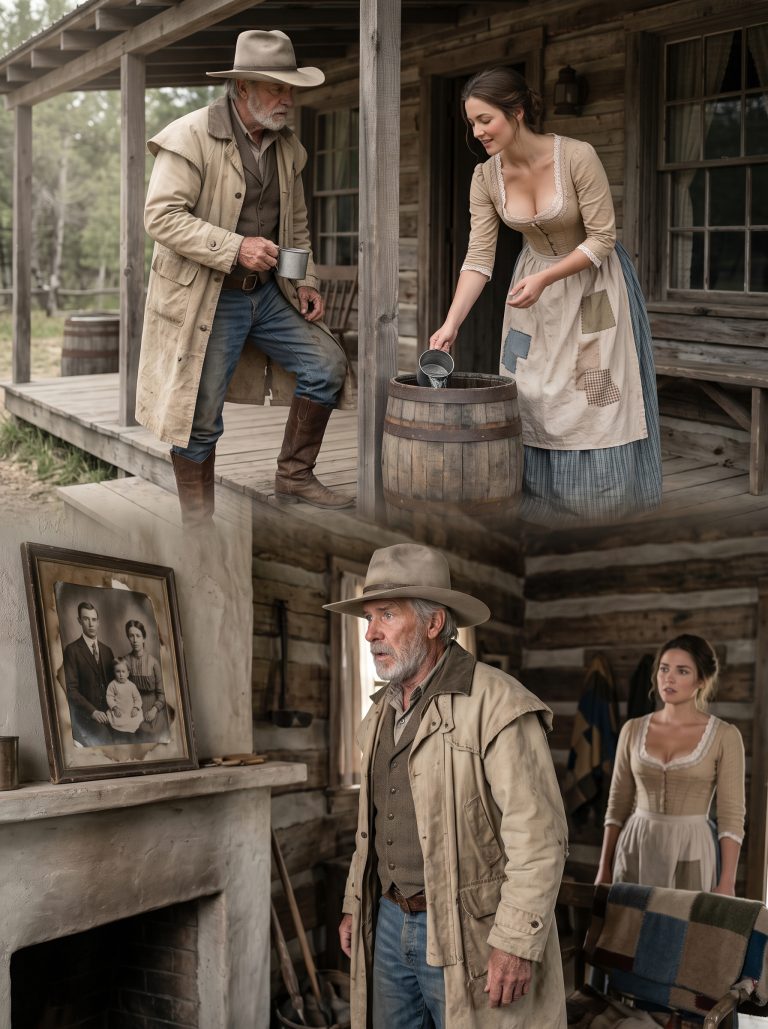
“I’m paying for him, no matter the cost,” the rejected girl said — and ruthless cowboy’s next move silenced everyone watching.

Part 1
The rope was already tight when the church bell struck ten.
Caleb Ashworth knelt on the gallows platform, wrists lashed behind him, the noose scratching his collarbone like a debt long overdue. Below him, the town of Widow’s Creek, Wyoming Territory, had gathered the way it gathered for everything worth watching and nothing worth stopping.
Silas Thorne was not, strictly, a man with the power of life and death. He was the circuit magistrate for three counties, which meant a great deal in a place where the nearest territorial courthouse sat four days’ ride away in Helena — and he was, more usefully, the man who held the mortgage on half the buildings on Main Street and the note on most of the cattle grazing south of it. A ruling of his could technically be appealed. An appeal took money most people in Widow’s Creek didn’t have and time a condemned man didn’t have either. That was the real shape of his authority: not a crown, but a debt nobody could afford to call.
“Caleb Ashworth,” Thorne intoned, unfolding a paper he didn’t need to read. “This tribunal finds you responsible for the death of Nathaniel Graves, cattleman of this county. No formal jury was convened, the matter being judged too urgent for delay.”
Caleb’s jaw was iron. He’d said his piece three days ago, when they’d first dragged him in front of Thorne’s makeshift bench: that he’d been twenty miles north at Stillwater Creek the week Graves died, trapping beaver alongside a Crow man named Joseph Redfeather. Nobody could find Redfeather to confirm it. The man kept no fixed camp and no fixed schedule, and three days wasn’t long enough to chase a trapper through country that size. Thorne had called the claim convenient and unprovable, and unprovable, in his courtroom, meant worthless.
The hangman set the knot. The crowd leaned in.
Then a voice cracked the morning open.
“I’ll settle his debt.”
Mercy Whitfield stood at the edge of the square, flour still pale on her sleeves from her father’s mercantile. She was broad-shouldered and unused to being looked at, and she hated how her voice shook even as she made herself walk forward, a leather pouch clenched in one fist.
Laughter rippled through the crowd. Buying herself a husband, is she.
She didn’t flinch. “Territorial statute allows a capital sentence commuted to indenture, provided the victim’s kin consent to restitution and a solvent bondsman posts security for the prisoner’s future conduct. I have three hundred dollars. I’m the bondsman.”
Thorne’s eyes went flat and calculating. “You understand the terms, Miss Whitfield? If he flees or reoffends under your bond, you forfeit every cent — and you’ll answer to a charge of your own, for aiding an escape. That’s a cell in Helena, not a rope. But it is not nothing.”
“I understand.”
He turned to the front row, where Elias Graves, the dead man’s brother, sat thin and uneasy in his mourning clothes. “Mr. Graves. The law requires your consent to the restitution. Refuse, and the sentence stands as written.”
Elias looked at the noose, then at Mercy, then at Thorne — and something in Thorne’s stare made him look down first. “I — take the money. I don’t care to watch a hanging today.”
Thorne counted the coins twice, slow, enjoying it. “Draw the papers.”
The clerk read the terms aloud: five years’ indenture, Caleb bound to labor under Mercy Whitfield’s roof and authority, the bond forfeit and a charge of unlawful aid brought against her if he fled or broke the law again.
“Do you accept, Miss Whitfield?”
“I do.” Her signature came out crooked.
“And you, Ashworth?”
“Don’t see I’ve got a choice.”
“No,” Thorne said, almost kindly. “You don’t.”
The noose came off. Iron manacles replaced the wrist rope. Thorne pressed the key into Mercy’s palm.
“He’s your liability now,” he said. “Manage him well.”
The Whitfield Mercantile sat on the corner of Prairie and Elm, two stories of faded paint and a sign nobody had fixed since Mercy’s father died the winter before last. She led Caleb into the storeroom and set the key down before she unlocked him, needing the space between them a moment longer.
“I didn’t do this because I think you’re innocent,” she said. “I don’t know if you killed Nathaniel Graves. I know Silas Thorne didn’t much care whether you did — he wanted you gone because you wouldn’t sell him your creek water. And I’m tired of watching this town decide who lives by who’s got money to spend on it.”
She turned the key. The manacles fell.
“You’ll work inventory, deliveries, repairs. You don’t leave without asking. I don’t answer questions I’m not ready for.”
He rubbed his wrists, watching her. “Why’d you really do it?”
She said nothing.
“You’re running from something,” he said quietly. “What is it?”
She didn’t answer that either. She only said, before locking the storeroom door behind her, “For what it’s worth — I believe you about Stillwater Creek.”
“Belief is easy,” he said. “Proof is expensive. And I’ve got a trapper nobody can find and three days that already ran out.”
“Then we find him,” she said. “And we find whatever else there is.”
Part 2
Finding Joseph Redfeather meant sending word, not fetching him — Widow’s Creek had no one who knew his trapping grounds well enough to ride straight to him. Mercy paid the mercantile’s delivery boy, Thomas, two silver dollars to carry a letter up the Stillwater trail and leave it at every line-cabin and trading post he passed, with no guarantee it would ever reach the man it was addressed to, or in time.
While they waited, they built what they could with paper. The land office clerk, a nervous young man named Whit Doyle who owed Mercy’s father a debt he’d never repaid, agreed — after two refusals and a long night of arguing — to let her into the record room after hours. There she found a letter denying Graves’s petition to seize Caleb’s claim under eminent domain, dated a month before the murder: motive, at least, on paper.
Jacob Merrill, the town’s newspaperman, had scrawled staged in pencil on his own clipping about Graves’s death and never dared print it. He refused Mercy twice, afraid of what printing it would cost him, before agreeing — not from courage, he admitted, but because he’d rather lose safely than lose quietly. The undertaker, Silas Green, needed convincing too; only when Mercy laid out exactly what she already knew about the wound did he confirm what he’d been sitting on: the skull fracture had bled wrong, dry, like the blow came after the man was already dead. Anne Pritchard, the hangman’s wife, came to the store at dusk on her own — not out of nerve, but because she had a son and had decided she wouldn’t raise him inside a lie she could still unmake.
Then Elias Graves rode in with an offer: $350 for the contract, no questions, Caleb remanded pending appeal.
“No,” Mercy said.
That same night, going through her father’s old accounts for anything tying Graves to Caleb’s land, she found a ledger page she didn’t recognize — her father’s hand, shaking, dated the week before he died. One line: S.T. knows I found the deed. Told me to forget it or forget everything.
Two days later, word reached Thorne — through Tom Ferris, the town constable — that Mercy had sent a letter up the Stillwater trail asking after a trapper. Ferris had worn the badge for three years and enforced every ruling Thorne handed down, but he’d also grown up owing his first job to Josiah Whitfield, who’d hired him sweeping floors when no one else would, and he’d never quite believed a man could crack his skull falling down a dry gully the way Nathaniel Graves supposedly had. He passed the word along because his badge required it. He didn’t say what he thought about it.
Thorne moved the hearing to six days out. Whatever Redfeather might say, he intended to rule before the man could say it.
Part 3
The courtroom was too small for what it held. No jury — Thorne had seen to that from the start — only the town packed shoulder to shoulder and a silence that felt like held breath.
Elias Graves’s lawyer argued procedural defect, a bondsman’s judgment clouded by sentiment. Thorne nodded along like a man agreeing with himself.
Then Mercy stood. She laid out the land-office denial to establish motive. Jacob Merrill testified to the wrongness of the wound. Anne Pritchard recounted her husband’s confession, made in shame, not drink — she’d decided the truth mattered more than his comfort. Silas Green described a fracture that had bled like a corpse’s, not a living man’s.
“Interesting,” Thorne said when she finished. “But testimony is not proof of an alibi.”
Caleb rose. “I told this tribunal I was at Stillwater Creek before I’d had three days to prove it. I’ve had nine since. If the man who can prove it isn’t here yet, that’s not proof I’m lying. It’s proof your court never gave me time to be believed.”
The courthouse doors opened before Thorne could answer.
Joseph Redfeather strode in, travel-worn, Mercy’s letter still folded in his coat pocket. He carried a trapping journal logging four days at Stillwater — dates, weather, forty beaver pelts split evenly between two men — and, tucked inside it, the dated receipt from the trading post at Elkhorn Pass where he’d sold half those pelts the same week Graves died, the postmaster’s own hand confirming the date beside his. Three separate records, three separate keepers, all pointing to the same four days.
“Your letter finally found me,” Redfeather said. “I rode as soon as I read it. I’m sorry it wasn’t sooner.”
“It’s sooner than I had,” Caleb said.
The crowd murmured. Thorne’s composure held, but only just.
Then Mercy played her last piece — the one she hadn’t shown anyone, because she hadn’t been sure until three nights ago that she could bear to.
“There’s one more matter,” she said, “concerning my father, Josiah Whitfield.”
Thorne went still.
“He died of a fever, the doctor said. But he left one line in his ledger the week before — that he’d found land-office records proving Nathaniel Graves’s claim to my creek’s watershed rested on a forged survey, and that you, Judge Thorne, told him to forget it or forget everything.” She set the ledger page beside her other documents. “I thought I understood grief. I understand now I understood silence. You’ve been buying it from this town for years — three hundred dollars from me, a fever that came too fast for my father, a rope for anyone who wouldn’t sell.”
“A dying man’s scribble,” Thorne said, too quickly, “proves nothing —”
“It doesn’t have to, alone,” Mercy said, and set down the last paper. “This does.” A bank record: five thousand dollars deposited to Thorne’s personal account twelve days after Graves’s death — the same week Graves’s land was auctioned to a Helena holding company on whose board Thorne sat.
Elias Graves, in the second row, had gone pale as paper. He hadn’t known any of it. That much was plain — a grieving man handed a story that let him keep believing his brother’s death had simply been bad luck.
The room broke into noise. Thorne rose fast, and Tom Ferris stepped between him and the door, not drawing a weapon, just standing there, refusing to move. He was thinking, he’d say later, of a man who’d once handed him a broom and a wage when nobody else would, and of how easily “fell down a gully” had always sat wrong in his mouth.
“I’m done doing what you tell me without asking why,” Ferris said quietly.
Thorne adjourned the hearing himself and promised a ruling within two days. Nobody believed he meant to give one that let Caleb live.
He was right not to believe it. The next morning’s ruling voided the indenture and ordered Caleb’s surrender by noon, alibi and evidence notwithstanding. An accusation was not a suspension. Until the territorial court in Helena formally stripped him of the bench, every ruling in Widow’s Creek still bore Silas Thorne’s seal — and he intended to use every hour of that authority he had left.
So Mercy did the one thing that hadn’t occurred to her three weeks earlier, when all of this had started with a pouch of coins and a shaking voice: she filed a formal appeal with the territorial court in Helena, using every document she had, and sent it by the fastest rider in town.
It turned out she wasn’t the first. Jacob Merrill, once he’d found his nerve, had spent two of the last nine days quietly writing to a newspaper contact in Helena. The territorial marshal’s office was already sitting on three unrelated complaints against Thorne’s land dealings from settlers further west. They’d been waiting for exactly this kind of paper trail to act on.
At noon, armed men came to the store on Thorne’s order. Mercy opened the door herself and stood in it.
“Caleb Ashworth is not a fugitive. He’s the subject of a pending territorial appeal.”
They told her to step aside. She didn’t.
Then Judge Silas Thorne appeared at the end of the street, alone, revolver raised — not at Caleb, but at Mercy, the one who’d made his silence too expensive to keep buying.
“This ends now,” he said.
The shot never landed. Ferris, closest to him, seized his wrist and wrenched it skyward; the bullet went into the sky instead of into her. Thorne struggled against a man who, for three years, had done everything he’d asked and had finally decided that this was the one thing he wouldn’t.
“It’s over,” Ferris said, and it was.
The territorial marshals arrived from Helena five days later, already investigating, Mercy’s appeal only confirming what they’d begun to suspect. Silas Thorne was taken east in chains to stand trial for the murders of Nathaniel Graves and Josiah Whitfield, and for years of land fraud the territory was only beginning to count. Elias Graves, shamed by how easily he’d been used, signed a statement against the man who’d handed him a story instead of the truth, then left Widow’s Creek that spring and didn’t come back.
Caleb’s indenture was struck from the record on the marshal’s order — no forfeiture, since he’d never fled and never reoffended, the bond simply void once the underlying sentence was. His land — the twelve acres of pine and creek water his mother had shown him as a boy — was restored outright, the forged claim against it struck from the county register by a newly elected sheriff, Elijah Okafor, a miner who’d lost his own brother to one of Thorne’s “accidents” and made sure the whole town knew why he’d run for the post.
Mercy reopened the mercantile. Business came back slower than it had left, but honest — people meeting her eyes now instead of sliding past them, the way you look at someone once you’ve watched her refuse to be quiet.
Caleb stayed. Not because any paper said he had to — none did, anymore — but because there was a kind of debt that had nothing to do with dollars, and he found he wanted to pay it anyway, in mornings spent fixing the crooked sign and evenings spent arguing with her over inventory counts.
“You could’ve taken Elias’s offer,” he said to her once, months later, on the store’s front steps at sunrise. “Kept your money. Kept your father’s store safe without any of this.”
“I’d have kept a store,” she said, “and lost the only thing my father actually left me — knowing when to stop being quiet.”
They didn’t marry. Mercy had spent too long learning to take up her own space to hand half of it away so soon, and Caleb understood, in the way of a man who’d fought for land of his own, that some things are worth more left unclaimed by anyone but yourself. He kept his cabin in the high country and came down each winter; she kept the store and grew it steadily, hiring a boy who’d lost his job in a mine collapse and a widow who needed steady wages more than she needed anyone’s pity.
Ten years on, Mercy Whitfield sat at the kitchen table above the store, writing in a ledger that had stopped being a record of losses and become, slowly, a record of a life built rather than merely survived. She no longer wrote letters to her dead father that she never sent. She’d found, in the end, a better way to answer him — by refusing to let his silence be the last word on anything.
Outside, the mountains held the last of the light. Somewhere beyond the dark pines, Caleb was already walking toward the lamp she’d left burning in the window.
The rope had been built to end a life. Instead, it had taught a whole town the real cost of everything it had agreed, for years, not to see — and the much smaller cost, it turned out, of finally saying so out loud.