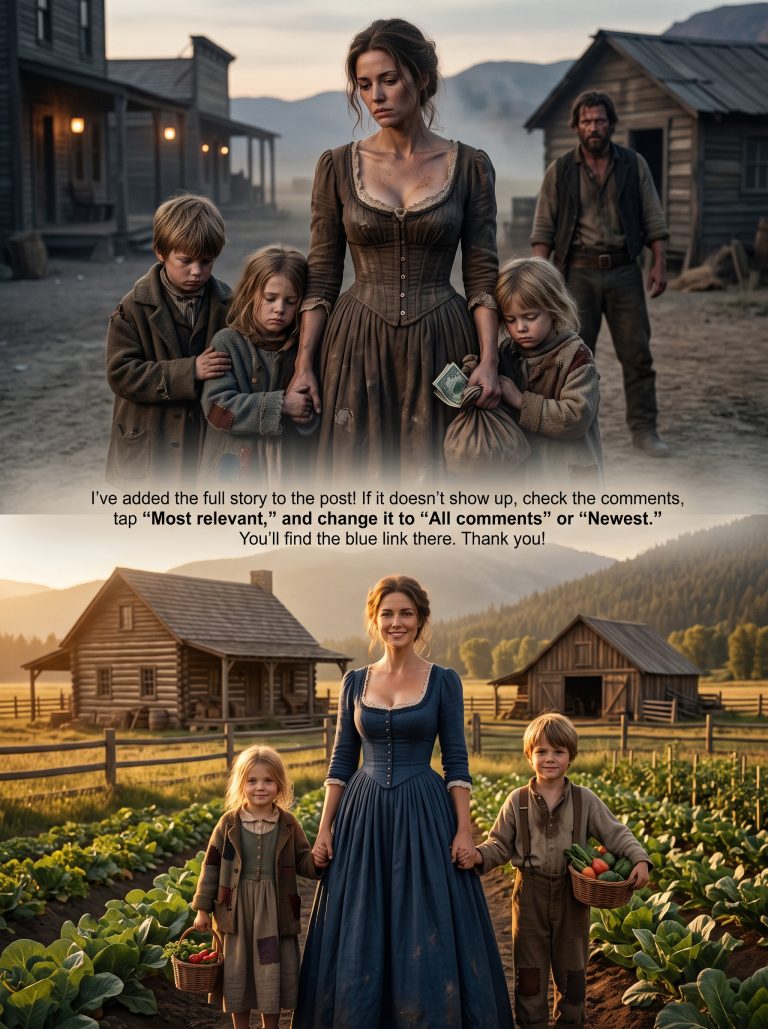
“Wait… You’re Really Going to Put That Inside Me?” the Nun Whispered — But the Mountain Man Didn’t Even Hesitate.

Part 1
The porch boards groaned under the rocking chair, a sound as old as the mountain itself. Caleb Whitfield sat wrapped in a quilt, watching fog crawl through the hollow like something alive. He was seventy-eight, his hair the color of ash, his hands still thick with the memory of axe handles and rifle stocks.
Beside him sat Daniel, sixteen, Patrick’s youngest boy, quiet in the way of boys who’ve buried too many people too young. A late wave of influenza had taken both his parents that spring, and three months earlier it had brought him to Caleb’s doorstep with a suitcase and a silence that hadn’t broken until today.
“Grandpa,” Daniel said, eyes on the wall inside the cabin, where a rosary of dark wood hung on a nail. “Why is that thing carved so rough? Doesn’t look like something a priest would bless.”
Caleb’s gaze followed the boy’s. “Because no priest ever touched it,” he said. “I carved it myself. In the winter of 1874.” He drew a slow breath, and the years fell away from his face like frost off a window. “It started with a storm. And a woman who wasn’t supposed to live through it.”
The Appalachians in December of 1874 were a country of knives — ice-knives on the branches, wind-knives down the hollows. Caleb was thirty-one that winter, though grief had aged him past forty. The war had left scars on his back that his father’s belt had started years before. Two graves sat under the oak beside his cabin — Rebecca’s, and beside it the small one for the infant son who’d never drawn breath — both dug by his own hands eighteen months earlier.
Inside, a fire cracked in the hearth. His daughter, Ruth, nine, sat on a bed of pine boughs, her eyes gone milky since a fever the winter before had clouded both lenses — a cataract, a country doctor had called it, one that might, in the right city surgeon’s hands, be cut away.
“Four squirrels out past the woodpile, Pa,” she said without turning her head. “Snow’s coming. I can feel it in the wind.”
Caleb pulled on his coat. “Checking the trap line. Back before dark.”
He found the twelfth trap holding a dead rabbit — and beside it, footprints. Small. A woman’s boot, wandering crooked toward the rock face. He followed as the first flakes fell, and two hundred yards on found her collapsed against a hemlock, a black cloak soaked through, hood fallen back to show hair the color of dying embers.
A nun.
Something cold moved in Caleb’s chest — the memory of a priest who’d wanted twenty dollars to bless his wife Rebecca as she bled out in childbirth, and who’d refused, after, to let her be buried in consecrated ground because the money never came. He’d heard once, secondhand and half-disbelieving, of some circuit-riding preacher up past Turner’s Gap who’d called that same priest a thief from his own pulpit — a story he’d dismissed at the time as tavern talk, the kind men invented to make themselves feel better about a church they couldn’t fight. He thought of walking away and letting the mountain finish it.
Then he thought of Ruth, waiting by the fire, and what kind of man he’d be teaching her if he did.
“Get up,” he growled, hauling her over his shoulder. A bundle wrapped in oilcloth slid from her grip into the snow. He shoved it in his coat and carried her home through air like broken glass.
The blizzard howled without pause, burying the hollow deeper by the hour. When the woman woke, her eyes — green as new moss — went wide with fear at the sight of him: six feet of buckskin and old scars, a saber mark running from brow to jaw.
“I don’t hurt women,” Caleb said. “Storm would’ve killed you in ten minutes. You’re safe here.”
“Am I?” she whispered.
Ruth’s voice drifted from the corner. “Is the lady awake, Pa?”
The nun’s face softened toward the blind girl. “Hello, sweetheart. I’m Sister Agnes.”
Caleb unwrapped the oilcloth bundle on the table — a reliquary of tarnished gold, set with dull green stones. “This what you stole from your church, Sister?”
“I didn’t steal it,” she said, tears cutting through the grime on her face. “The Mother Superior meant to melt it down and sell the gold to a trader in Lewisburg — money meant for the orphans in her care. But I found her account books first, in her own hand, proving where the money truly went. I couldn’t let her burn them, so I tore the pages loose and hid them, then took the reliquary itself so she couldn’t melt it down before I found someone who’d listen.”
Caleb’s laugh was hard as flint. “Your kind preaches mercy and practices cruelty. I’ve seen it firsthand.”
“There’s a laundress at the convent, Mrs. Bell — she’d seen the same numbers I had, long before I did,” Agnes added, quieter now. “Too afraid to say a word. I don’t blame her. I’m not sure I’d have found the courage myself if I hadn’t already had nothing left to lose.”
He threw the reliquary onto the bed. “Stay till the storm breaks. Then you go. I want no part of your church.”
She flinched at his tone but didn’t argue, pulling the bearskin tighter around her shoulders and looking past him, to the corner where Ruth sat listening, sightless eyes turned toward the sound of a stranger’s voice.
“You’ve a fine daughter,” Agnes said quietly. “She hears more than most folks with two good eyes.”
“She has to,” Caleb said. “World doesn’t slow down for the blind.” He busied himself with the rifle, working oil into the barrel with more force than the task required, and didn’t look up again until the fire had burned low and Ruth’s breathing had gone soft and even with sleep.
The blizzard itself broke after three days, the wind dying to a low moan. But the snow it left behind sealed the hollow just as surely — drifts too deep for a horse, the trail down to the trading post buried past finding — and it would be two more weeks, nearly seventeen days in all, before the way out opened again. In that forced isolation, something in the cabin’s air began, slowly, to change.
Part 2
Agnes’s hands blistered, then calloused, from hauling wood and water. She sang to Ruth in a low Irish lilt, and taught her the raised-dot writing she’d learned from a traveling teacher who’d once instructed the convent in caring for blind orphans. One evening, bathing behind a canvas curtain, her silhouette showed a back crossed with old scars.
“Who did that to you?” Caleb asked.
“Mother Superior,” she admitted. “She said pain purified the soul.”
“My father said the same, with a belt and a Bible verse,” Caleb said. “They use God like a weapon.”
Some evenings Caleb caught himself watching her instead of working, and told himself it was only gratitude — though he was thirty-one, had buried a wife, and knew better than to trust a feeling shaped like hope.
More than once, Agnes almost told him about the pages hidden in the reliquary, the words catching in her throat each time. A bitter man might sell such proof, or refuse to shelter a fugitive carrying evidence against a Church he already hated. She told herself the silence protected him. She wasn’t yet certain it didn’t only protect herself.
Two weeks later, once the trail was passable, he rode to a neighbor’s for supplies and came back with a bounty notice folded in his coat: three hundred dollars for the theft of a holy reliquary by one Sister Agnes Doyle. Enough to take Ruth to a city surgeon. The neighbor, old Jack Tolliver, mentioned a circuit preacher, Tobias Hook, expected back through the hollow come spring — the same one who’d passed through the winter before and left the priest at Turner’s Gap none too pleased. Caleb filed the name away, remembering, distantly, the tavern talk he’d once dismissed, and thought no more of it.
Through the window he saw Agnes guiding Ruth’s fingers over raised dots, heard his daughter laugh — a sound he hadn’t heard since her mother died — and walked to the fire pit and burned the poster instead.
Even that didn’t loosen her tongue. Burning a poster was a private mercy; naming the diocese would drag Caleb into a fight with the Church itself, not merely a tracker. She’d seen what the diocese could do to men with far more standing than a widowed trapper alone on a mountain — a word to the county judge, a claim of harboring a fugitive, and Caleb could lose more than his peace. Losing him meant losing Ruth’s home too, and Agnes had already watched one authority decide, on a whim dressed up as righteousness, who deserved to keep a child and who didn’t. Beneath even that reasonable fear sat a colder one she barely admitted: named as evidence, the reliquary could never be quietly sold, and Ruth’s chance at a surgeon would go with it. So she said nothing, and called it mercy, and didn’t ask herself whose.
That night Agnes woke to find him whittling by the hearth. “Why do you hate Him so much, Caleb? Not the church. Him.”
“Because He took everything,” Caleb said, and told her about Rebecca, the twenty dollars, digging two graves alone in the rain.
“That wasn’t God,” Agnes said, resting her hand on his scarred arm. “That was a cruel man wearing God’s collar.” She drew the pins from her veil. Copper hair spilled to her waist. “I’m not Sister Agnes anymore. Just Agnes Doyle. A woman who ran.”
Three days later, a bounty hunter named Silas Crowe rode into the hollow. He’d traced a red-haired woman’s trail from a trading post near Turner’s Gap, then followed Caleb’s own supply tracks up into the hollow — tracks no one had ever had cause to follow before.
“You have until first light,” Crowe said. “After that, I bring the sheriff. Get your affairs in order, Sister.”
Part 3
Caleb stepped onto the porch with the Sharps rifle loose in his hands, not yet raised. “She’s not going anywhere, Crowe.”
“Then you’re harboring a thief, and that makes you a thief too,” Crowe said, but his voice had a crack in it that didn’t match his colorless eyes. He didn’t reach for his sidearm. He just stood there, snow settling on his shoulders, looking past Caleb at the doorway where Agnes had appeared.
“Silas,” Agnes said, and the word came out broken. “You’d truly drag me back there?”
The name hung in the cold air. Caleb’s grip tightened on the rifle. “You know him.”
“He’s my brother,” Agnes said.
Crowe’s jaw worked like he was chewing on something bitter. “Mother Superior came to me a month back. Told me our mother’s bed in the almshouse in Lewisburg would go to someone else — someone whose family hadn’t embarrassed the Church — unless I brought you in. I didn’t take the bounty for money, Agnes. I took it because I didn’t have a choice. Or I told myself I didn’t.”
“You always have a choice,” Agnes said quietly. “You just don’t always like the ones in front of you.”
Something in Caleb went still, the old soldier’s instinct for a lie or a truth sharpening in the silence. He had spent a decade hating men in collars without ever once asking what might have driven a good man to serve a rotten house. He lowered the rifle an inch.
“Come inside,” he said. “Both of you. Before we all freeze arguing about God’s business on my porch.”
Crowe hesitated on the threshold, hand still hovering near his hip, old habit dying hard. “You’d let me sit at your table? After I rode up here intending to take the woman you’re protecting away in irons?”
“I’ve let worse men warm themselves at my fire,” Caleb said. “Man who won’t sit down and talk isn’t a man I need to worry about. It’s the ones who talk first and shoot second that keep me up nights.” He set the rifle in the corner, within reach but no longer in his hands, and something in that small gesture seemed to loosen the tightness in Crowe’s shoulders.
They sat. Ruth, unbothered by the tension thick enough to choke on, poured coffee for a man who’d come to arrest her new mother as though he were any other traveler come in from the cold. Crowe watched her do it with an expression Caleb couldn’t quite read — something between shame and wonder.
“Our mother’s in that almshouse because our father drank himself into an early grave and left nothing,” Crowe said at last, staring into his cup. “I’ve spent six years doing whatever work the Church tossed my way to keep a roof over her. I told myself the ends were clean even when the means weren’t.” He looked up at Agnes. “I’m not proud of what I came here to do.”
“Then help me undo it,” Agnes said.
“There’s something you both need to see,” Agnes said, rising and crossing to the shelf where Caleb had kept the reliquary locked away since the night of the storm. “I never showed you, Caleb, because until Silas rode up that porch, telling you outright might have made you a hunted man alongside me. There’s a false bottom. I cut it myself with a paring knife the night before I ran.”
Her fingers found the hairline groove along the base without hesitation, and pried it loose.
Inside, folded thin and dry, sat the torn pages she had hidden there weeks before.
Agnes unfolded them with trembling hands, and her face went the color of the snow outside. “The Mother Superior’s own hand,” she said. “Money marked for the orphanage, moved instead to a trader in Lewisburg, and to—” She stopped.
“Who got the money?” Caleb asked.
“A Father Marcus,” she read, “of the parish at Turner’s Gap. For services rendered.”
Caleb’s blood went cold in a way the mountain winter had never managed. Father Marcus. The same priest who had wanted twenty dollars to bless Rebecca as she lay dying, and who, when the money never came, had called her a sinner and turned his back. He had thought Marcus was simply one rotten man, a cruelty that began and ended with him. He had never imagined the rot ran through more than one house of God, fed by the same crooked river of money meant for the dying and the orphaned.
“He took blessing fees from families with nothing,” Caleb said slowly, “and skimmed church funds on the other end. Same rot, two ends of the same root.”
Crowe, silent until now, leaned forward and read the ledger over Agnes’s shoulder. His colorless eyes weren’t so colorless anymore — they’d gone hard with something that looked like shame curdling into resolve. “If this is true,” he said, “it isn’t a bounty matter anymore. It’s a matter for the bishop, and maybe the county judge besides.”
“You’d testify to that?” Caleb asked. “Against the woman who threatened your mother’s bed?”
“I’d rather lose that bed,” Crowe said, “than keep it built on my sister’s back.”
They rode out together three days later — Crowe, Agnes, and Reverend Tobias Hook, an itinerant circuit preacher who had passed through the hollow the winter before and had his own quiet history of disputes with the diocese. The ledger went into the hands of the county judge in Lewisburg, along with sworn statements from all three of them, and a fourth from a laundress at the convent who had long suspected the books didn’t add up but had never had proof enough, or courage enough, to say so alone.
The judge was a cautious man, more interested in avoiding a scandal that might embarrass the county than in justice for its own sake, and for a while it seemed the whole matter might be quietly buried the way so many things involving powerful men in collars tended to be. It was Reverend Hook, in the end, who broke the stalemate — riding two days to the bishop’s seat in Wheeling himself, ledger in his saddlebag, and refusing to leave the anteroom until someone with authority agreed to read it. Caleb never learned exactly what was said in that meeting. He only knew that within a month, men arrived from the diocese to interview the orphans directly, away from the Mother Superior’s hearing, and within two the whole rotten arrangement began to come apart at its seams like old stitching.
The county judge, when Reverend Hook finally forced the matter before him, admitted plainly that a criminal trial would likely fail — the only surviving witnesses were a fugitive nun, her brother the bounty hunter who’d once hunted her, and a laundress too frightened to testify in open court, and no jury in that county was inclined to take a runaway sister’s word over a Mother Superior’s. But the diocese, fearing exactly the kind of scandal a public trial would bring, moved faster and harder than any court might have. It would be eight months before the Mother Superior was quietly removed from her post, stripped of her authority, and ordered to repay the missing funds from her own family’s estate, and before Father Marcus was stripped of his parish entirely and sent to a remote posting with no congregation to prey upon. No headlines, no hanging, no trial by fire — just the slow, grinding machinery of an institution correcting itself once it could no longer look away, and a civil suit that dragged on for years afterward, recovering what money could still be found. It wasn’t the reckoning Caleb might have wanted with a rifle in his hands. But it was a reckoning all the same, and it left both men with nothing left to hide behind. Caleb never got an apology for Rebecca. He got something else instead: proof, at last, that her death had not been God’s judgment on her, but a man’s greed wearing God’s collar. It didn’t undo the grief. It untied a knot that had been strangling him for five years, and for the first time since he’d dug two graves in the mud, he found he could walk past the church in Turner’s Gap without his jaw clenching tight enough to ache.
The reliquary itself was sold, properly this time, its gold going exactly where it always should have — to the orphanage in Lewisburg, and, at Agnes’s insistence, a portion set aside for a surgeon in Charleston who specialized in restoring sight lost to fever.
Winter turned to a hesitant spring, and one evening, as new grass pushed up through the melting snow, Ruth spoke into the quiet of the cabin.
“Marry her, Pa.”
Caleb and Agnes both turned. “She’s not a nun anymore, and she’s not wanted anymore either,” Ruth said, with the plain logic of a child who saw clearer than most sighted adults. “So there’s nothing left in the way. Except you two being stubborn.”
Caleb looked at Agnes — really looked, the way he hadn’t let himself since the first night he’d carried her in from the snow. “I don’t have a ring,” he said. “I don’t have much of anything, come to that. Just this cabin, and a girl who needs a mother, and more scars than sense.”
“What about love?” Agnes asked, though she was already smiling.
“I don’t know if I remember how,” Caleb admitted. “But I trust you with what’s left of my heart. Maybe that’s where it starts.”
“Then it’s a fair start,” Agnes said, and took his hand.
The night before the wedding, Caleb sat alone by the fire long after the cabin had gone quiet, turning the half-finished rosary over in his hands. Fifty-nine beads, the same count as the one Agnes had once worn at her belt and left behind when she’d unpinned her veil — though every bead in this one had been shaped by his own hands instead of bought blessed from a church he wanted no part of. He thought of Rebecca, of the vows he’d meant with his whole chest at nineteen years old in a country church that no longer existed in his memory as anything but a place of ash. He wondered if a man was allowed to mean it twice.
“You’re not betraying her,” Agnes said softly from the doorway, startling him. She’d come to check on him, the way she’d taken to doing most nights since the storm, though tonight there was a different weight to it. “Rebecca. I know you’re thinking of her.”
“How do you always know?”
“Because you get the same look Ruth gets when she’s listening for something the rest of us can’t hear.” Agnes crossed the room and knelt beside his chair. “You loved her. That doesn’t go away because you love someone else now. It just makes room.”
“I don’t rightly know how to do this,” Caleb admitted. “Marrying. Not as a young man fool enough to think it’d be easy. As what I am now.”
“None of us know how,” Agnes said. “We just get up the next morning and try again. That’s the whole of it, I think. That’s most of faith too, if you strip away the buildings and the collars — just getting up and trying again.”
Reverend Hook married them in front of the hearth that Easter, with Crowe standing witness — the same man who’d come to drag his sister back in chains now stood to give her away, his eyes suspiciously bright throughout the whole short ceremony. Caleb had no gold band, so he gave Agnes the rosary he’d been secretly carving through the long spring evenings: fifty-nine beads of black walnut, sanded smooth by a soldier’s patient hands. Not a symbol of the church that had scarred them both, but of something they’d built themselves, bead by bead, out of a ruin.
“It’s not blessed by anybody,” Caleb said, fumbling the words as he pressed it into her palm. “Never had a priest lay hands on it. Just mine.”
“Good,” Agnes said, closing her fingers around the beads. “I’ve had enough of hands that only knew how to strike. I’d rather have yours — the ones that know how to build.”
Ruth, standing beside them in a dress Agnes had sewn from a bolt of blue calico traded off a peddler, pressed her face against her father’s coat and grinned so wide it nearly split her cheeks. “Told you,” she whispered, “there was nothing left in the way but stubbornness.”
That summer, the money from the reliquary paid for Ruth’s surgery in Charleston. The journey there took four days by wagon and rail, the longest Ruth had ever traveled from the hollow, and she spent most of it with her face turned toward the window, listening to a world rushing past that she’d never be able to picture the same way twice. The surgeon was a careful, soft-spoken man who warned them plainly that cataract surgery of this kind still failed as often as it succeeded, and that even a successful cutting could not restore vision if the fever had damaged more than the lenses themselves. Caleb had gripped Agnes’s hand so tightly in the waiting room that she’d had to pry his fingers loose one at a time.
When the bandages came off, ten days later, the room was kept deliberately dim, the surgeon explaining that the eyes would need time to remember how to bear light at all. Ruth blinked, and blinked again, and for a long, terrible moment Caleb thought it hadn’t worked — until her face crumpled, not with disappointment but with the particular shock of a person seeing color for the first time in three years.
She looked first at her own hands, turning them over as though they belonged to a stranger. Then she looked at Caleb, taking in the grey in his beard and the scar on his jaw with an expression somewhere between recognition and wonder, as if she’d been building his face out of sound and touch for years and was only now checking her work. Then she turned, blinking, toward the woman standing beside her, and reached for her hand before she reached for his.
“That’s Ma,” Ruth said, like it was the simplest fact in the world. “I already knew what she looked like. I just wanted to see it too.”
Agnes didn’t say anything at all. She just knelt down on the cold floor of the surgeon’s office and held her daughter, and Caleb stood over the both of them, a grown man who’d survived a war and a blizzard and years of buried grief, weeping without a bit of shame for the first time since he’d dug two graves in the rain.
Patrick was born the following spring, named for no saint in particular, just a name Agnes had always liked. Crowe visited twice a year, bringing news from Lewisburg and, eventually, a wife of his own — a schoolteacher with a sharp tongue and a soft laugh who took an immediate liking to Ruth and taught her, over several summers, to read printed English as well as she read Braille.
The cabin grew, board by board, room by room, as Caleb’s hands remembered how to build instead of only how to bury. He added a second window, then a loft, then a porch wide enough for a rocking chair. Agnes planted a garden where nothing had grown before but pine needles and regret, and by the third summer there were tomatoes and beans enough to share with the Tollivers down the ridge. The bitterness that had lived in Caleb’s chest since 1869 didn’t vanish all at once — old wounds rarely do — but it thinned, year by year, the way frost thins under a patient sun.
He never went back to church, not properly, not with a congregation and a collar at the front of the room. But some Sunday mornings, if the weather held, he’d walk with Agnes and the children up to the old oak where Rebecca and the baby were buried, and Agnes would say a few quiet words over the graves in a voice that had nothing of the convent left in it and everything of a woman who had simply chosen, every day since the blizzard, to believe in something worth believing in. Caleb came to understand, slowly, that this was its own kind of faith — not the kind that lived in buildings or collected in collection plates, but the kind that got up every morning and chose kindness anyway, even after it had been handed cruelty instead.
On the porch in 1921, the old man finished his tale. Daniel sat with the rosary in his lap, turning the worn beads over one by one.
“So the Mother Superior — she never came after you again?”
“Never had the chance. The truth got to the bishop before her lies could get to us.” Caleb’s eyes drifted, unbidden, to the third grave beneath the oak — fresher than the others, though two years had softened its edges. Agnes. “Your grandmother used to say the Church didn’t fail her. Certain men inside it did. She never stopped believing there was something worth keeping, underneath all the rot. Took me longer to see it her way. Some days I still don’t, not all the way.”
“What happened to Silas? Uncle Crowe?”
“Lived to be an old man himself, out past Lewisburg. Died two winters before your grandmother did. Sent his own children up here every summer for a spell, till they got too grown for that sort of thing.” Caleb allowed himself a small, tired smile. “Funny thing about a man who comes to your door meaning you harm — sometimes if you let him inside instead of shooting him off your porch, he turns out to be exactly the kind of family you didn’t know you needed.”
Daniel was quiet a moment, working that over. “I always figured stories like this ended with somebody getting shot,” he said finally. “The bounty hunter. Isn’t that how it’s supposed to go?”
“Could’ve gone that way,” Caleb admitted. “Came near enough to it, that first morning on the porch, rifle in my hands and his hand hovering by his belt. The easiest thing in the world would’ve been to pull the trigger first and never ask a question at all. I’d done it before, in the war, and told myself it made me strong.” He shook his head slowly. “Took me till I was near thirty to understand the harder thing, and the better thing, was setting the rifle down and asking a question instead of answering with lead. Any fool with a steady hand can end a man. Takes something else entirely to redeem one.”
“Was it worth it?” Daniel asked. “All of it — the storm, the bounty hunter, digging up all that trouble with the ledger?”
Caleb was quiet a long moment, watching the mist climb the ridge the way it had for fifty years. “Trouble was already dug up, boy. Been buried under lies since before your grandmother was born. All we did was stop looking away from it.” He reached over and closed Daniel’s fingers around the rosary. “Keep this. Not because it’s holy. Because it’s proof that a man can carve something new and honest out of the same hands that used to only know how to kill and grieve. Faith isn’t in the building or the collar. It’s in the choosing — to save a stranger in a storm, to tell the truth even when it costs you, to build a family out of what’s left when everything else has been torn down.”
The sun dropped behind the ridge, staining the sky the color of an old bruise healing. Caleb Whitfield closed his eyes and, for the first time in a long while, wasn’t listening for a storm at all.
He was only listening to the wind — and, somewhere under it, if he let himself believe it, the faint sound of an Irish lullaby.
THE END