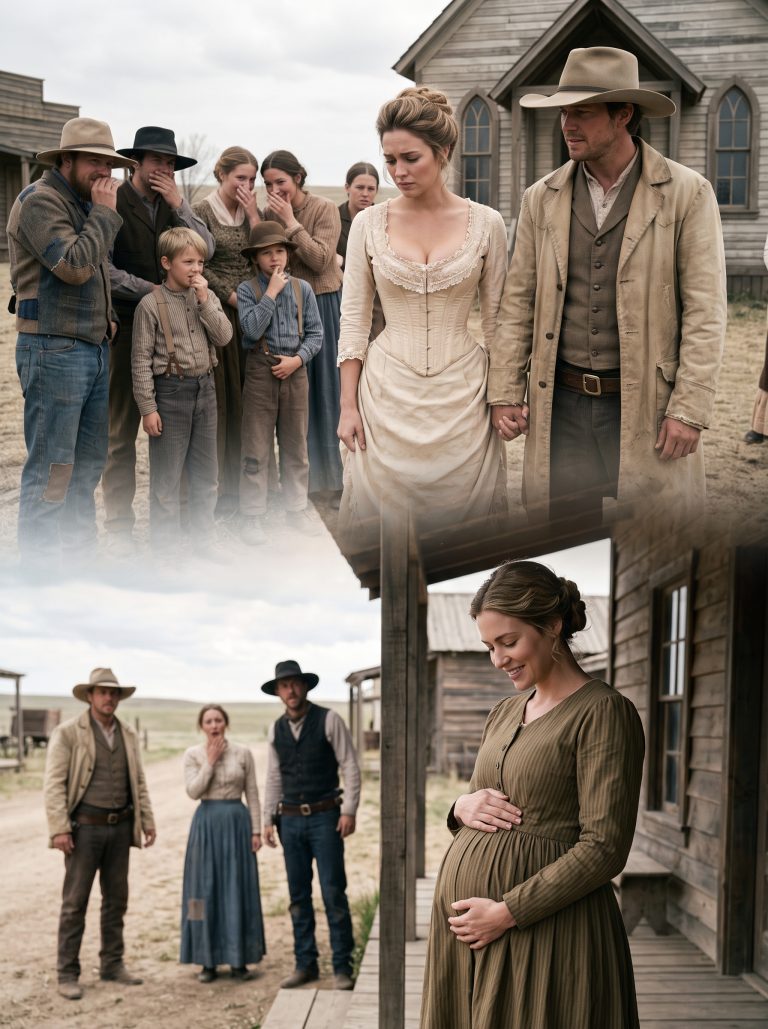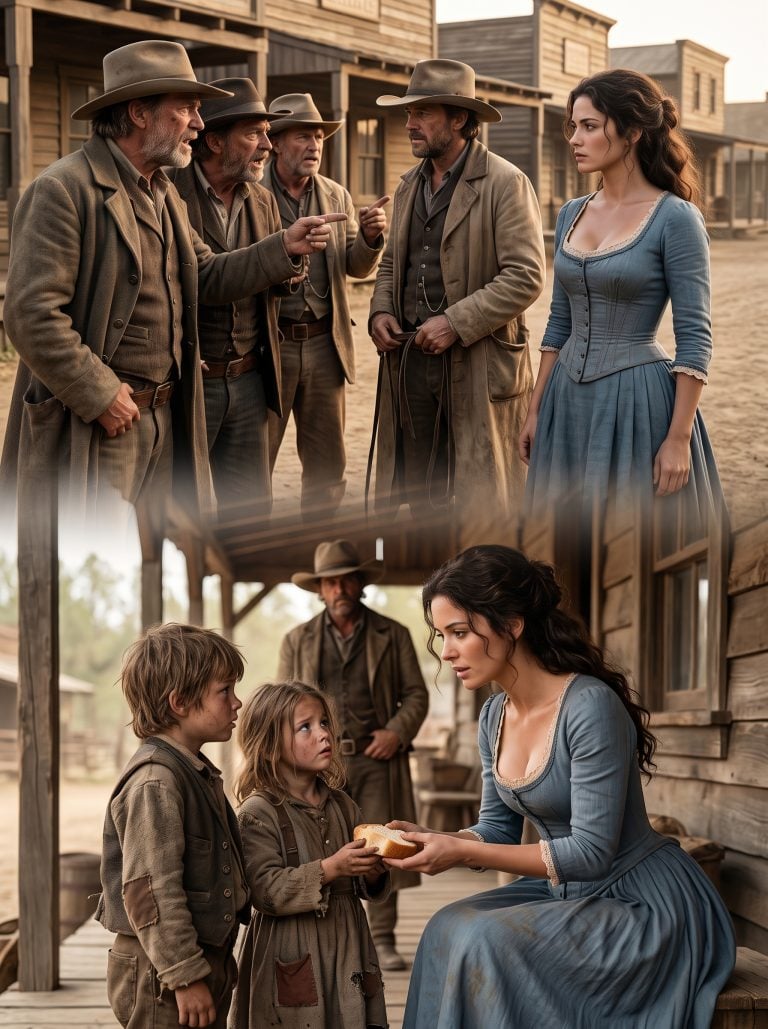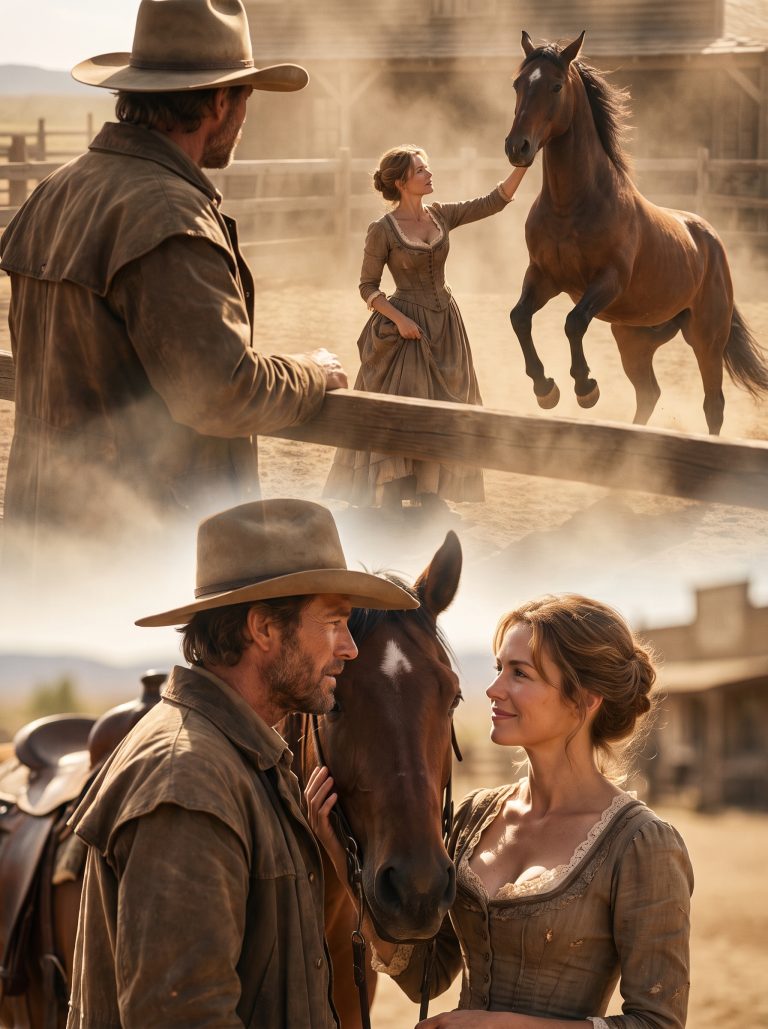
The Lonely Rancher Believed No Woman Could Love Him—Until the Town’s Most Beautiful Woman Asked Him to Marry Her

Part 1
Jacob Hartley owned two hundred head of cattle, a barn that leaned like a tired old man, a roof that argued with every hard rain, and no one who watched the road at dusk waiting for him.
He woke before the sun each morning, not from habit exactly, but because solitude had trained his body the way a trail trains a horse. He lay still for a few seconds, listening to wind against the eaves, to cattle shifting in the dark pasture, to the old house settling over its bones. No woman’s breathing beside him. No child turning over in sleep. He had learned to treat the quiet like weather — inconvenient, unavoidable, best endured without complaint.
The Hartley ranch sat five miles outside Redwater, Texas, on land that asked everything and promised little. Its one grace was the creek along the eastern edge, narrow but faithful, the only water for miles that never quit in a dry year.
Redwater respected Jacob. Respect was a clean, dry thing. It did not warm a chair across from a man at supper.
He had not courted anyone in seven years, not since Nora Ashby. She had come west with her aunt, worked at the boarding house, let him walk her by the creek one evening while the sky turned lavender. Then she had visited the ranch, looked at the patched roof and the empty rooms, and told him, kindly — which was worse than cruelly — that she needed more than dirt and distance. She married a banker from Waco the following spring. Jacob never offered himself for anyone’s consideration again.
Then Isabel Reyes broke a wagon wheel on the south road.
It happened on a cool October Tuesday. Jacob was riding back from the feed mill when he saw the wagon tipped in the ditch, one wheel sheared clean off its pin. Isabel stood beside it, arms folded, chin lifted against frustration rather than tears.
Everyone in Redwater knew Isabel Reyes. Her father, Mateo Reyes, owned the mercantile on Main Street. She kept its books, dealt with freight men, and smiled only when she meant it — dark-haired, dark-eyed, dignified in the particular way of people who had learned to hold their heads up while being underestimated.
“Miss Reyes.”
“Mr. Hartley.” Relief crossed her face before pride hid it again.
He said little while he worked — jacked the wagon, reset the wheel, checked the opposite pin for safety. She watched him with an attention that made him aware of his own hands in a way he disliked.
When he finished, he mounted without asking anything of her, and rode on without looking back.
That was the detail Isabel remembered later, when the whole town began talking: he had not looked back to see whether she was impressed.
Riding home past the mercantile that same evening, Jacob had seen Mateo Reyes slip a folded envelope into Sheriff Bragg’s hand at the side door, quick and shamed, the way a man pays a debt he never agreed to owe. Jacob said nothing to anyone. But he remembered it.
That evening, Sheriff Cole Bragg stood outside the Reyes Mercantile with his hat in his hand and his smile displayed like polished brass. For two years he had been bleeding Mateo Reyes — invented fines, threatened closures, “irregularities” that vanished the moment enough silver changed hands. Now, in front of half the street, he announced he meant to court Isabel before winter.
“Your father has given me leave to call,” he said, loud enough for the whole block to hear.
“No,” Isabel said.
His smile did not falter, which was worse than if it had. “A woman alone in this town should think carefully before refusing protection,” he murmured, low enough for intimacy, sharp enough for threat.
By the next afternoon, Isabel knew what she meant to do.
She found Jacob mending fence on the north pasture and rode out alone, dust marking the hem of her coat.
“I need to speak with you about something important,” she said, dismounting. “I’d rather not take long about it, so I’ll be direct.” She met his eyes. “I would like you to marry me.”
The pasture went very still. A meadowlark called somewhere beyond the tall grass.
“You’re serious,” he said finally.
“I do not ride four miles to make jokes, Mr. Hartley.”
She told him about Bragg — the extortion, the threats, the plan to court her publicly until refusal looked like ruin for her father’s store. “If I marry someone he cannot easily threaten, his leverage weakens.”
“There are richer men in town,” Jacob said. “Men with better houses.”
“I am aware of architecture, Mr. Hartley.” A flicker of dry humor, gone as quickly as it came. “I have watched you longer than you know. I watched you give away half your winter feed to a burned-out family and tell people you’d overbought. I watched you sit two silent hours with a frightened old man outside the doctor’s office. I watched you fix my wheel yesterday and never once look back to see if I admired you for it. You are the only man in Redwater who does good without making certain someone is watching. And I believe you are the only one who could stand against Cole Bragg without being bought, flattered, or broken.”
Jacob thought of Nora’s voice: I need more than dirt and distance. He thought of the empty porch at dusk.
“You don’t know me,” he said.
“I know enough. Many people know less and marry for worse reasons.”
He held her gaze a long moment.
“All right,” he said.
“You mean yes?”
“Yes.”
They rode to Redwater together under a sky going gold at the edges. By supper, the town knew. By dark, it had improved the story six different ways. Sheriff Bragg heard before supper, and his smile disappeared entirely.
Part 2
Mateo Reyes did not bless it easily. In the mercantile’s back room, hand pressed flat to the counter, he looked between his daughter and the quiet rancher and said, “No.”
“You think I hand you to fear,” he told Isabel, “the way I would hand you to a stranger’s mercy?”
“You are not handing me anywhere,” she said. “That is the point.”
He turned on Jacob. “You agree because she is beautiful?”
“She is beautiful,” Jacob said, feeling heat climb his neck. “That isn’t why. Bragg is using his badge to corner you both. I can stand between him and her in a way that makes his intentions harder to hide.”
“And what do you get?”
Jacob could have lied. “I don’t know yet,” he said instead. “I’ve lived alone a long time. Long enough to know loneliness can make a man selfish if he lets it. I won’t use your daughter’s trouble to fill my house at her expense.”
The honesty did more than any promise could have. Mateo sank into his chair. “Bragg will not stop because of a wedding announcement.”
“No,” Jacob agreed. “He won’t.”
“If she marries you,” Mateo said at last, “you do not silence her. You do not command her and call it protection. You do not touch her in anger. Ever.”
Jacob answered each condition with the same quiet certainty. “No.”
The engagement was announced from behind the mercantile counter that evening. Mrs. Calloway dropped a spool of thread. The livery owner said “Well, I’ll be” three times without finishing the thought.
Sheriff Bragg came in at closing, removed his hat with theatrical slowness. “How sudden,” he said.
“Some decisions become simple once one sees clearly,” Isabel answered.
“And you see clearly?”
“Yes.”
“Accusations made without proof can trouble a family business,” Bragg said softly.
“Threats made in front of witnesses can trouble a sheriff,” Jacob said — his first words.
The room went cold. Bragg laughed lightly, wished them joy, and left. “No,” Isabel said to his back. “You don’t.”
Part 3
The wedding was set for three weeks out. In that time, Isabel began visiting the ranch under careful propriety — with her father once, with a chaperone twice, alone only when the town’s gossip had grown too sluggish to notice. The first time she stepped inside the farmhouse, Jacob watched her take in everything Nora had once seen: the patched roof, the plain table, the single chair by the stove because he had never needed two. He waited for the old verdict.
Isabel removed her gloves slowly. “Your stove draws well.”
“Mostly.”
“That is a blessing.” She walked the room without recoiling from it, inspecting it the way one inspects an unfinished argument — critically, but with every intention of remaining until the sense was found. “This window frame leaks.”
“I’ve fixed it twice.”
“It remains unfixed.”
“That happens.”
“To windows, or to men?”
He didn’t answer, but he fixed it properly within the week — not because curtains needed civilized conditions, as she claimed, but because he’d noticed her rubbing her gloved hands together in the draft.
He built a second chair, too wide in the seat, and nearly hid it in the barn from embarrassment before she found it and ran her hand along the back. “It is very practical,” she said. “And ugly.” Her eyes danced. “I like it.”
She brought a tablecloth, a ledger book, two blue cups — “Drinking coffee from tin by choice suggests a troubling lack of ambition.” He objected on principle and drank from the blue cup anyway, solemnly, as though it had asked him to reconsider his whole life.
She began learning the ranch the way she learned freight manifests, by walking it end to end and asking questions until the answers made sense. He found himself talking more than he ever had, because work gave him language he didn’t otherwise trust himself with. She learned which steer pushed gates and which cow still checked the calving shed for a calf that had died the season before. “You know them,” she said. “I own them,” he answered. “That is not the same,” she said, and she was right, and something in him loosened at being caught in it.
But Jacob had already begun a private work Isabel did not yet know about. Weeks before she ever rode to his fence line, he had started a leather journal — names, dates, sums, the shape of Bragg’s extortion laid out in his own spare hand. He had seen Mateo pay the sheriff once through the mercantile window. He had seen Widow Calloway crying behind the dry goods store. He had no proof then. He decided to make some.
When cattle began disappearing from his north pasture — six head the first night, three the next — Jacob understood Bragg was no longer merely punishing him. He was building a case: a rancher, hard-pressed, newly engaged, moving stock under a false brand for cash. Sympathy would not stop a badge.
He showed Isabel and her father the journal at the cut fence line. Mateo read his own name on the page and went very still. “You did not tell me.”
“I didn’t want Bragg to know we were gathering anything.”
“How long?” Isabel asked.
“Since before I answered you.”
It was the detail that undid her — that he had already been fighting Bragg quietly, alone, before she ever offered him a bargain. “You foolish, quiet, impossible man,” she said.
He had also written, some weeks earlier, to a district judge in San Antonio he trusted from an old dispute over grazing rights — a compact, silver-haired man named Harlan Kane, who arrived in Redwater under a traveler’s alias and listened more than he spoke.
But the deepest piece of the case did not surface until Jacob, cross-referencing freight manifests Isabel had pulled from her father’s shelves, found a name behind the false cattle brand that was not Bragg’s at all. It belonged to a land speculation firm out of Waco — and the man who’d signed the incorporation papers was Andrew Whitcomb. He had begun as a banker, respectable and well-married; the land company was newer, quieter, and funded, Jacob would later learn, with money quietly drawn from his own bank’s ledgers.
Nora’s husband.
Jacob sat with that a long while before showing Isabel. Whitcomb, it turned out, had been quietly buying grazing leases upstream of Redwater Creek for two years, trying to consolidate water rights before drought season made them priceless. Every rancher who wouldn’t sell got “trouble” — inspections, fines, false liens — courtesy of a sheriff on retainer. Jacob’s refusal to sell his creek-front land, years earlier, was the one holdout the whole scheme couldn’t route around.
Mateo’s mercantile was the second piece Whitcomb needed and couldn’t buy outright. Every freight manifest for fifty miles passed through Mateo’s ledgers first — including the manifests for the false-branded cattle moving north to be sold as another man’s stock. As long as Mateo kept honest books and refused to falsify a single shipping record, no court could ever prove the scheme existed. Bragg’s courtship of Isabel had never been about affection. It was the fastest way to put the mercantile, and the evidence sleeping in its account books, under a friendly roof. Ruin the father, marry the daughter, and the ledgers would answer to Bragg alone.
In the beginning, it had never truly been about Isabel. Bragg’s pressure on the Reyes family had been a second front, opened only when Whitcomb realized that controlling the mercantile might finally put the one set of books capable of exposing the whole scheme into friendly hands. Isabel’s proposal — meant only to save her father — had walked her straight into the middle of a fight already years old.
“He never courted me for me,” she said quietly, reading the ledger by lamplight. “I was leverage against your creek.”
“You were never that to me,” Jacob said. “Whatever he wanted, I wanted you before I understood any of it.”
“How long have you known about Whitcomb?”
“Three days. The man behind all of it was married to the woman who once made me believe I had nothing worth offering — I couldn’t find words for that, so I brought you the papers instead.”
“You should have told me the moment you knew.”
“I should have,” he agreed, without excuse, and that plain admission did more to steady her than any apology dressed up in reasons would have. She read the manifests twice more, tracing the dates against the ones her father kept, until the shape of two years’ quiet siege sat whole in front of her — not romance, not rivalry, only a man in Waco who wanted water badly enough to buy a sheriff and nearly buy a marriage.
“Then we go to Judge Kane with all of it,” she said. “Not just Bragg. Whitcomb too.”
Judge Kane read the manifests by lantern light behind the livery, Jacob’s leather journal open beside them. “This is careful work,” he said. “He’ll try to discredit you first, then intimidate witnesses, then seize the story before the truth can breathe.”
“That sounds like him,” Isabel said.
“Fear takes men often,” the judge said. “But sometimes it returns when it sees company.”
The confrontation came on a Friday morning in the center of Redwater, Jacob reading testimony from his journal while half the town watched from boardwalks and wagon seats — Mateo’s forced payments, Widow Calloway’s seized sewing machine, the false road permits, the freight rider who’d seen stolen goods loaded into Bragg’s shed. Name by name, the sheriff’s confidence collapsed from amusement to offense to something uglier.
“You think a rancher with money trouble and a Mexican shopkeeper can turn this town against its law?” Bragg shouted.
Judge Kane stepped forward with a folded writ, a deputy marshal at his shoulder for the arrest itself. “Cole Bragg. By authority of the district court of Texas, I am suspending your office pending charges of extortion, fraud, and abuse of authority. Surrender your badge.”
Bragg didn’t reach for his holster. He lunged sideways instead and caught Mateo by the collar, hauling him backward toward the mercantile door. “Nobody moves,” he said, “or the old man answers for it.”
Isabel’s breath caught. Jacob took one step before Judge Kane caught his sleeve and held it, hard.
“Not yet,” the judge said, low. “Give him nowhere to run to first.”
Bragg kept backing toward the door, dragging Mateo with him, eyes flicking from face to face along the street as if counting who might still be loyal to him. No one moved to help him. Mrs. Calloway had gone white and silent. Mr. Boone’s hand had already found the shotgun behind the water trough but held it low, waiting. Somewhere behind Jacob, Isabel said his name once, quietly, not a plea to act but to stay — she had learned, by now, the difference.
Bragg’s voice climbed, thin at the edges. “You people don’t understand what happens to this town without me in that office.”
Nobody answered him. The silence seemed to unnerve him more than shouting would have.
The street went rigid. Then Bragg’s own deputy — a young man named Foss who had worn the badge only eight months and had spent most of them uneasy — stepped away from his sheriff’s side and leveled his rifle not at the crowd, but at Bragg.
“Let him go, Cole,” Foss said, voice shaking but steady enough to be heard. “I signed on to keep the peace. Not this.”
Bragg looked at the rifle, at his own deputy’s face, at the street full of people who had stopped being afraid of him sometime in the last ten minutes without his noticing. For a moment nothing in him moved at all. Then his grip loosened. Mateo pulled free and stumbled toward Isabel, who caught him and held on hard enough that Jacob could see her hands shaking from across the street.
Mr. Boone raised his shotgun the rest of the way. Two of Jacob’s hands stepped from the livery with rifles held low but ready. The sheriff’s hand fell to his side, empty.
By noon Bragg sat in his own jail cell. By evening, riders had gone to Waco with warrants naming Andrew Whitcomb as a co-conspirator in the false-brand cattle scheme — a fact that would, three weeks later, end his banking career and very nearly his marriage, though that story belonged to Nora now, not to Jacob.
The wedding went forward as planned, under a windless, bright morning. Isabel wore ivory muslin trimmed with her mother’s lace; Jacob wore a borrowed black suit and the solemn misery of a man unused to being watched by so many at once. When Reverend Hale pronounced them married, she kissed him before he could work up the nerve, and the church broke into applause it then remembered to be embarrassed about.
That night, Jacob carried her trunks to the back room and set the last one down.
“I’ll sleep out front,” he said.
She nodded, and something passed between them that felt more intimate than any vow spoken before witnesses — the small, private proof that marriage had not erased her choice.
For twelve nights the bedroom door stayed closed, not from lack of wanting but from two careful people learning not to frighten something new. On the thirteenth, a storm broke over the ranch and woke him to the sound of dripping — not outside, but in the back room, where he’d sworn the roof was sound.
“You repaired this roof,” Isabel said, holding a basin under the leak, more annoyed than frightened.
“I repaired the other leak.”
“This one has developed strategy.”
They worked together by lamplight, dragging trunks, wedging rags into the worst of it. He came back in soaked from patching the outside edge, and she thrust a towel at him and scolded the weather, the roofers of Texas, and him, in that order.
“You’re cold,” he said, noticing her shiver.
“I am irritated.”
“Cold too.” He wrapped a blanket around her shoulders, his hands brushing her arms through the wool, and did not step back first this time because she caught his sleeve before he could.
“I am tired of doorways,” she said.
“Are you sure?”
“I am sure I do not want you sleeping in the front room while the roof and I quarrel alone.”
He touched her cheek, asking without words before he asked aloud. “May I?”
“Yes.”
The marriage changed after that — not into ease, because neither of them was built for ease, but into something with roots. They still argued. Once he rode late into a storm chasing strays and came home to find her furious in the doorway.
“You said you’d be back by dark.”
“Cattle broke the south line.”
“You could have sent Ben.”
“This ranch doesn’t run on waiting,” he snapped, more sharply than he meant to, and saw her flinch — small, controlled, the kind only someone paying close attention would catch.
He noticed. His anger died at once. “I’m sorry.”
“I am not angry that cattle needed you,” she said. “I am angry that I spent an hour imagining you hurt in a ditch, because you think needing help is a character flaw.”
“It’s habit.”
“A bad one. Do you intend to keep it?”
“No,” he said, and meant it enough that she crossed the room and put her forehead against his chest instead of staying angry.
A man named Silas Crane, who had run errands for Bragg and lost his living when the sheriff fell, found Jacob at the stockyard that winter and leaned against the fence, chewing tobacco.
“Town thinks you’re a hero now,” Crane said. “Funny — took a pretty wife to make folks notice you. That one must like charity cases.”
Jacob’s hands stilled on the cinch strap. Men nearby went quiet, waiting to see whether the rumor of a temper would prove true. Jacob looked at Crane a long moment, then went back to his work.
“Nothing to say?” Crane pressed.
“No.”
“Too good to fight?”
“Too busy to waste one,” Jacob said, and that was the end of it, though the story reached Isabel embellished into a small legend before supper. That night she told him plainly: “When men like that say you are not enough, I need you not to help them by believing it in silence.” He didn’t have a clever answer. He only nodded, because she’d found the exact old wound and named it without cruelty, which was somehow harder to bear than if she’d been unkind.
By Christmas the ranch had filled in ways Jacob had stopped believing possible. Mateo came to stay for two nights, declaring the mercantile closed in honor of the Savior and his own exhaustion. Widow Calloway came with curtains she’d mended a second time, and the Greer children chased each other through rooms that had once held nothing louder than wind. Jacob stood in the doorway between kitchen and front room, watching Mateo teach a boy arithmetic with dried beans, watching Ben sneak a second slice of cake.
“Too much?” Isabel asked, coming to stand beside him.
“No,” he said. “Not too much.” Later, on the porch under hard winter stars, he told her his mother had once written him a letter that said loneliness was no proof a man was unloved — only proof the road between hearts ran long. “She said to put something kind in an empty room, and wait.”
“She was wise.”
“She would have liked you,” he said. “Because you are impatient with fools.”
In May, the district court summoned Mateo and Jacob to San Antonio to testify against both Bragg and Whitcomb, whose bank had collapsed under the weight of the false-brand scheme once auditors started pulling threads. Isabel went pale at the news, not of Bragg but of standing in a room and being made to explain, in front of strangers, how nearly her life had been arranged like merchandise on a shelf.
“You don’t have to go,” Jacob said. “Your father and I can testify.”
“And let his lawyers tell the story without my voice in it?” She shook her head. “You stand with me. Not in front of me.”
“Yes,” he said, and understood, finally, the difference between protecting someone and standing beside them.
She testified in a dark dress and her mother’s small cross, and did not look away when Whitcomb’s lawyer tried to suggest her marriage had been staged to entrap the sheriff.
“I married Jacob Hartley because he is an honorable man,” she told the judge. “I believed at first I needed his protection. I learned I wanted his partnership. Sheriff Bragg’s conduct forced the timing. It did not create the truth.” Bragg was convicted on multiple counts; Whitcomb, on lesser but still ruinous ones, enough to end his career and see his water-rights scheme dissolved by the court. Redwater rang its church bell when the news came home, though no one could say for certain who started it.
That August, Nora returned to Redwater — older, but still striking, her banker husband’s ruin now the subject of quiet talk two counties over, though neither Jacob nor Isabel spoke Whitcomb’s name aloud in front of her. She and Jacob spoke for a few minutes outside the mercantile, cordial and entirely without ache on either side.
“Do you believe her now?” Isabel asked afterward. “The woman who said you had too little?”
Jacob watched Isabel’s father lean over the counter to make Nora’s daughter laugh, watched his own wife standing easy and certain in the doorway of a house that was no longer merely his.
“No,” he said.
On the anniversary of the day she’d proposed, Isabel rode out to the same fence post and tied her mare to it as she had before. The barns still leaned slightly left, though less than they once had. The roof no longer argued with rain. A crooked sign that read HARTLEY RANCH, its Y tilted as though startled by its own good fortune, creaked gently near the porch.
“I need to speak with you about something important,” she said. “I would like you to remain married to me.”
“What are your terms?” Jacob asked, setting down his mallet with great solemnity.
“Respect. Coffee in blue cups. No unnecessary martyrdom. That when loneliness starts talking to you in your own head, you tell me before the room goes cold — and that when fear makes me sharp with you, you’ll tell me that too, instead of only enduring it.”
“I’ll try,” he said, and meant it, because trying, said honestly and kept at, was the only promise either of them had ever really needed from the other. He crossed the grass and took her hands. “I would like to remain married to you. Under those terms, and any others you invent later.”
“Then we are agreed.”
That evening they held a supper under lanterns strung between the porch posts, not grand, not called an anniversary by Jacob, who claimed he didn’t know whether anniversaries applied to a proposal made under threat of extortion. Isabel informed him that anniversaries applied wherever she said they did. Mateo came, and Widow Calloway, and the hands who’d once worked for wages and now worked, in some unspoken way, for something closer to family. Someone produced a fiddle of questionable tuning. Jacob looked, for a moment, as if he might flee toward the cattle.
“Mr. Hartley,” Isabel said, holding out her hand.
“No.”
“You said any terms I invented later.”
“That was reckless.”
“And binding.”
He took her hand.
Later, after the guests had gone and the lanterns had burned low, they stood together on the porch looking over land that would ask hard things of them again — dry years, sick cattle, tight money, grief someday, as it comes for everyone brave enough to love. But the house behind them no longer waited in silence for one person to return to it alone. It held her books on his shelves, his mother’s letter in her writing box, two blue cups washed and set out for morning, and the plain, hard-won proof that a man could be poor in land and still rich in the thing that mattered — someone who chose to stay, and kept choosing it, long after the danger that had first brought them together had passed.
“Do you ever regret it?” he asked. “Proposing to a man holding a mallet in a pasture?”
“Never,” she said. “You were already a good choice. You simply required notification.”
He laughed — a sound that still seemed newly discovered every time, as though joy hadn’t yet worn a path through him and was always a little surprised to be welcomed in.
“Isabel.”
“Yes?”
“I’m glad your wagon broke.”
She smiled into the dark. “So am I.”
They went inside together, leaving the porch empty and the ranch lit warm against the Texas night — a house that had once held only survival, now holding, plainly and without apology, a life two people had chosen to build rather than simply endure.