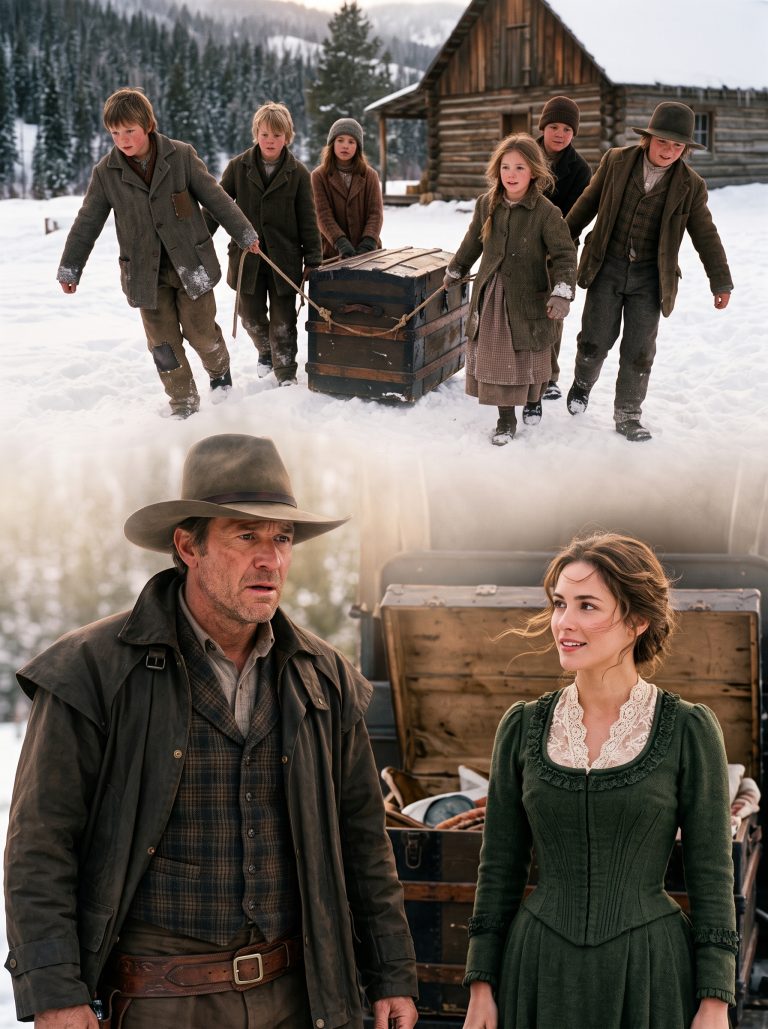
He Never Asked for a Bride Before Winter—But the Boston Woman Left on His Mountain Doorstep Refused to Leave His Wild Children Behind

PART 1
“Put her in the boardinghouse,” he told Barnes.
“With what money?” Mara asked.
Thomas’s jaw tightened.
A miner with a red beard muttered, “Told Tully she wouldn’t last three days.”
Thomas heard it. His face changed. It was not gentleness that decided him — it was pride, or hatred of being watched by men who had made sport of another person’s desperation. He swung down and stood before her, larger than any man she had ever been near.
“You understand this, Miss Quinn,” he said, low enough only she and the reverend could hear. “I did not send for you. My house is no place for a city girl who coughs at dust and looks like a wind could carry her.”
“Then you will be relieved to learn I am heavier than I look.”
He stared at her. At last he took her valise. Not gently, not rudely.
“You have one week,” he said. “When the next supply wagon goes toward Denver, I’ll pay your passage to a town with more sense than this one.”
“I did not ask you to pay my passage.”
“You will.”
“We shall see.”
The ride to the Reed homestead took three hours and all of Mara’s strength. The trail climbed through dense pine until Cedar Hollow became a scatter of roofs far below. Thomas did not speak. Mara did not hold his coat, though she wanted to. Pride sat straight in her spine.
At last the trees opened around a clearing beneath a granite shoulder. The cabin stood sturdy but neglected — sagging porch, collapsed woodpile, rusted traps, a garden strangled by weeds.
Three children stood on the porch.
The oldest, Caleb, held a piece of firewood like a club. Behind him stood a thin girl in a filthy dress, hair tangled, eyes watching without expression. A small boy clung to her skirt.
“Who’s she?” Caleb demanded.
“Town sent her,” Thomas said, untying the flour. “She’ll be gone in a week.”
Mara absorbed the words and looked at the children instead. “Good evening. I am Mara.”
“We don’t need you,” Caleb snapped. “Our ma’s dead.”
The little girl flinched.
“No,” Mara said. “I expect you don’t need a stranger. But you may need supper.”
Inside, the smell nearly drove her back out — old food, damp wool, unwashed bodies, ash, animal hide, and sorrow. The single main room held a table piled with dirty tin plates, a cast-iron stove crusted with grease, blankets tangled in corners, mud hardened on the floorboards, and a cradle missing one rocker shoved against the wall though no baby slept in it now.
This was not only neglect. It was a house that had stopped believing in morning.
Mara removed her gloves, her bonnet, rolled her sleeves. “Where is the well?”
“Out back,” Caleb said.
“Good. Fetch water.”
“I don’t take orders from you.”
“No. You take orders from your father, who is tired enough to let this house rot around you because grief has made him blind. If he tells you not to fetch water, I will fetch it myself.”
Thomas’s eyes had gone dangerously still. “Will he fetch water?” Mara asked him directly.
A long moment. Then one slow nod.
Caleb grabbed the bucket and went, furious.
Mara crouched before the little girl. “Your name?”
Silence.
“Hannah,” Caleb snapped from the doorway. “And the little one’s Toby. Hannah don’t talk.”
Mara did not react to the cruelty. “Hannah, take this cloth. Wash Toby’s face. Only his face. We will not fight the whole war in one minute.”
Hannah took it.
When the children were gone, Mara faced Thomas. “I am not here to replace your wife. I am here because I had no other safe place to go, and your children are living in filth. You have given me one week. In that week, I will make sure they remember what clean feels like.”
After a long silence: “Scrub brush is under the sink.”
That night, Mara did not sleep. She boiled water until the windows steamed and her hands blistered. She scraped plates, scoured the table, swept ash from the hearth, and scrubbed the floorboards on her knees until the water turned black. She found potatoes gone soft in a sack, cut away what could not be saved, and made a thin soup with salt pork and onion. She found a faded quilt in a trunk, shook it out in the cold, and laid it over the children’s sleeping place.
Caleb refused to help after the first bucket, but he did not stop watching. Hannah washed Toby’s face. Then his hands. Then, after Mara praised the neatness of her work without too much softness, the girl washed her own fingers one at a time as if remembering they belonged to her.
Thomas came in near midnight carrying a bundle of split wood. He stopped.
The worst of the smell was gone. The table stood clear. The hearth was swept. The children slept beneath a clean quilt, Toby curled against Hannah, Caleb pretending not to sleep but failing.
Mara sat in the wooden chair by the fire, head resting on folded arms, asleep from pure exhaustion. Her damp sleeves clung to her wrists. A shiver moved through her.
Thomas stood over her for a long while.
Then he took off his heavy wool coat and draped it over her shoulders.
Mara stirred but did not wake. The last thing she knew, somewhere beneath sleep, was the smell of pine smoke and cold wool, and the faint scrape of him setting another log on the fire.
PART 2
By the fourth day, Mara had learned the order of the house — not the order it should have had, but the order it made for itself in the absence of a woman who once knew where everything belonged. The flour scoop hung on its nail. The chipped blue cup was Thomas’s, though Toby used it when frightened. A small red shawl in the trunk belonged to Hannah, who touched it only when she thought no one saw.
Mara did not move Martha’s things without asking. Reaching for a mixing bowl once, Hannah made a small sound. “Was it your mother’s?” The girl’s eyes filled. “Then we will use another.”
Hannah followed her the rest of the morning, handing her potatoes, a spoon, Toby’s torn stocking. Each offering solemn as a treaty.
Caleb remained a wall of grief and suspicion. He refused stew until hunger betrayed him at midnight.
“It is better warm,” Mara said, setting a biscuit beside him.
“I don’t want your food.”
“Your mouth appears to disagree.”
“You think if you accept kindness from me, you betray her,” she said.
“You don’t know anything about my ma.”
“No. My own mother died when I was nine. Love is not a chair, Caleb. One person sitting down does not push another out.”
Thomas remained outside dawn until dark, mending roof, hauling wood. On the second evening, he paused after the first bite of apple tart. “It’s good,” he said, the words dragged from him.
The next morning a crooked shelf was straight. Mara understood: some men apologized with repairs.
On the fifth morning, the mountain tested her. Thomas had ridden down before dawn to haul timber. Caleb chopped kindling; Hannah and Toby played in the yard. Mara pinned sheets to a line.
The birds stopped.
Two men emerged from the trees — filthy, untrimmed, eyes carrying the restless hunger of men outside law. “House mouse has a voice,” the thin one grinned, drawing a revolver on Caleb when he raised a hatchet.
Hannah screamed — raw, torn, the first sound Mara had ever heard from her.
“Inside,” Mara shouted. The broad man caught her by the hair and jerked her backward. “Not you. You’re going to tell us where Reed keeps that strongbox.”
Mara bit him. He roared, struck her, and she fell. The world rang white.
She crawled toward the porch where Caleb had gotten Hannah and Toby through the door. The Winchester stood propped where Thomas had cleaned it. She seized it, heavier than expected, stepped onto the porch as the thin man came up the stairs.
“You ain’t going to fire that, little bird.”
She aimed down and pulled the trigger. The recoil slammed her onto her back. A scream tore the yard — the broad man clutching his thigh, blood darkening his trousers. The thin man stared.
Mara worked the lever, raised the rifle again. “Drop the gun, or I will try again, and I am learning quickly.”
The revolver fell.
PART 3
When Thomas returned at a gallop, rifle drawn, he found two men tied to a pine, Mara on the porch step bruised and bloodied with the Winchester across her lap, Caleb beside her.
“She shot Rufus Colter, Pa! Bit him first, then shot him in the leg!”
Thomas crossed the yard and caught her by the elbow as she swayed. “You’re hurt.”
“So is Mr. Colter.”
His jaw moved. “Inside.”
“No — let the sheriff hang his own rope. Do not put blood on this yard for the children to remember.”
His eyes stayed on the men, deep quiet rage held behind his teeth. Then he looked back at her. “All right.” Not surrender. Trust.
That night, after the children were fed and the prisoners secured in the barn under lock, Thomas sat beside the hearth with a tin of arnica salve and a face carved from guilt.
“Let me see your shoulder.”
“It is only bruised.”
“Let me see it.”
The words were rough, but not commanding in the way she had known command. They carried worry, not ownership.
Mara hesitated, then unbuttoned the top of her dress enough to bare her right shoulder. The flesh had already darkened, mottled blue and black from the rifle’s recoil.
Thomas hissed softly through his teeth.
“I held it wrong,” she said.
“You held it well enough to save my children.”
The words passed through her like heat.
He dipped two fingers into the salve. “May I?”
She nodded.
His fingers touched her shoulder with astonishing care. They were large hands, scarred and callused, capable of setting traps and splitting logs and carrying wounded men. Yet he rubbed the salve into her bruise as if she were something breakable and worth not breaking.
“Why?” he asked. “You could have run into the timber. They wanted the strongbox, maybe food. You owed us nothing.”
Mara thought of Hannah screaming. Caleb standing with the hatchet. Toby’s small face crumpling in terror. She thought of herself at nine years old, learning that locked doors did not always mean safety and that no one came simply because a child cried.
“Because no one came for me,” she said. “When I was small. When I was hungry. When I was afraid. No one came. And I promised myself if ever I stood between a child and terror, I would not move aside.”
Thomas’s hand stilled.
“They are not mine,” she said softly. “I know that. I have no right to claim them. But today they were under my care.”
For a long moment, he did not speak. Then: “A right can be earned.”
Mara’s eyes stung. She looked away.
He finished with the salve, then pulled her dress fabric gently back into place. His knuckles brushed her throat by accident. Both of them went still.
Thomas drew away first.
“I’ll take Colter and Pike down at dawn,” he said. “Rufus Colter has brothers. Hiram is the worst of them.”
“Will they come here?”
“Yes.”
Honesty. She had asked for it all her life and rarely been given it kindly.
“Then teach me to hold the rifle properly,” she said.
His eyes lifted.
“I do not wish to be knocked flat twice.”
Something like pride softened the hard line of his mouth. “Tomorrow.”
At dawn, Thomas loaded the prisoners into the wagon and drove toward Cedar Hollow. Before he left, he stood at the foot of the porch.
“Doors barred. Rifle loaded on the table. Caleb listens to you.”
“I know,” Caleb said, standing close beside her.
Thomas looked at his son, then at the way the boy stood near Mara. “Good.” His gaze shifted. “Do not go outside unless you must.”
“I will keep them safe.”
He nodded once. “I know.”
It was the first time anyone had ever said those words to her as if they were fact and not hope.
When Thomas returned at dusk, he brought ammunition, a second shotgun, and grave news. Sheriff Hayes had locked Rufus and Pike in Cedar Hollow’s jail, but someone had ridden toward Black Bear Creek where Hiram Colter’s gang camped.
“He’ll come for Rufus’s pride if not Rufus himself,” Thomas said.
Caleb swallowed. “Are we running?”
Thomas looked around the cabin: the scrubbed floor, the clean dishes, Hannah tucked against Mara’s skirt, Toby asleep in the chair, the quilt over the children’s bed, the first shape of home beginning to rise from ruin.
“No,” he said. “We prepare.”
The next two days turned the cabin into a fort. Thomas nailed planks across the lower windows, leaving firing gaps. He hauled water barrels inside in case of fire. He showed Mara how to hold the Winchester tight against the pocket of her shoulder, how to breathe out before pulling the trigger, how to keep both eyes open long enough to aim.
She practiced until her arms shook.
“Again,” she said.
“You’re tired.”
“So are you.”
“That ain’t an argument.”
“It is if both of us are still standing.”
Caleb watched in fascination. Hannah sat nearby with Toby, stroking the red shawl in her lap. She had not spoken again since that first scream, but she remained close to Mara, as if the sound she had given during the attack had frightened her and comforted her both.
On the second night, after the children slept in the loft, Mara tried to mend Caleb’s torn shirt by lamplight. Her shoulder throbbed with every stitch. Thomas watched from the hearth.
“Leave it.”
“It needs mending.”
“It’ll keep.”
“So will I.”
He crossed the room and took the needle gently from her shaking hand.
Mara looked up. He stood close enough that she could see the silver strands in his beard, the weariness around his eyes, the grief that had lived there so long it had worn grooves.
“You do not have to do every broken thing at once,” he said.
“Who else will?”
The question escaped before she could hide it.
Thomas’s face changed. “I will,” he said.
It was a simple answer. Impossible, perhaps. Too large for one man. Yet he said it as if he were willing to spend his life trying.
“I do not know how to be idle,” Mara said, looking at her empty hands.
“You ain’t idle. You’re hurt.”
“That never mattered much before.”
“It matters here.”
Her throat closed.
Before she could answer, Thomas bent and pressed a kiss to her uninjured cheek.
It was brief. Gentle. A question and apology together.
Mara sat very still.
He drew back at once. “Forgive me.”
She touched the place his lips had been. “No. Do not apologize for being careful.”
For the first time since she had arrived on Pine Ridge, Thomas Reed smiled.
Not much.
Enough.
Hiram Colter came on the third afternoon beneath an iron sky.
The birds vanished first. Hannah, leaning against Mara’s knees while having her hair combed, went rigid. “Ghosts,” she whispered — the word small and scraped raw, freezing every adult breath in the cabin.
“Cellar. Now,” Thomas said.
Mara lifted Toby, took Hannah’s hand. Caleb stood pale but steady. “I can help Pa.”
“You can help by keeping them quiet and alive.” She pressed a small derringer into his hand. “You are their brother. That is harder.”
When the cellar door closed, Mara took up the Winchester. Six or seven riders entered the clearing. At their center rode a large man in a buffalo coat, one eye clouded pale, a scar from temple to jaw.
Thomas stood by the door with the shotgun. “Stay inside,” he told Mara.
“No.”
He braced for command, for anger. Instead: “Stay low.”
“Reed,” Hiram called. “I hear my brother’s got a hole in his leg and your new woman put it there. Send her out. She walks down here, I take her, maybe your children grow up with a roof.”
Mara’s blood went cold. She took a step toward the door.
Thomas didn’t turn around, but he knew. “No, Mara.”
“Hear that? Woman’s got more sense than you.”
Thomas lifted the shotgun. “You misjudge the situation. She is not a thing to bargain with. She does not belong to Boston, to this town, or to me. If she walks out that door, it will be because she chooses it. And if you try to take her, I will stop you.”
The words shook her more deeply than any threat. Not because he called her his. Because he did not.
“Then burn them out.”
Gunfire cracked the clearing. Thomas fired once, scattering the front line. Flour dust burst white through the room as bullets struck the logs. Mara fired through the plank gap, missing a man by inches near the woodpile but making him reconsider.
A bottle shattered through the side window, flame spreading. Mara seized a wool blanket, beat the fire dead, leaving black scars across boards she’d scrubbed clean.
The back door splintered. Hiram came through with a knife. Thomas met him; they struck the wall, grappled across the table. Hiram drove his knee into Thomas’s side. The knife came up.
Mara swung the cast-iron skillet.
It struck Hiram behind the ear. He dropped, eyes rolling, collapsed across the floorboards.
Outside, the gunfire faltered, hoofbeats scattering toward the trees. Thomas fired into the air. “Next man who rides back meets the grave.”
No one tested him.
“Are you hurt?” Mara asked.
“Arm. Not deep.”
“You are bleeding.”
“So are you.”
She looked at her blistered palms, hadn’t felt them until now.
“Caleb. It’s safe,” she called toward the cellar.
Caleb climbed out first, derringer in hand, then ran not to his father but to her, arms around her waist so fiercely she nearly fell. Hannah came next, carrying Toby’s hand, wrapping both arms around Mara’s legs.
“Mama,” Hannah whispered.
Mara sank to her knees, gathering all three children against her, tears cutting through soot on her face. She had crossed half a country expecting duty, shelter, perhaps survival. She had not expected this terrible, beautiful claiming.
Thomas knelt beside them, one arm bleeding, the other reaching carefully, asking permission even now.
Mara leaned into him. His arm came around all of them.
—
The law came the next morning. Marshal David Cook from Denver took in the scarred but unburned cabin, the tied outlaws. “Looks like the devil walked into a buzz saw.”
“They came to burn us out,” Thomas said. “We defended the claim.”
Caleb stood by Mara through every question, glaring at any man who looked skeptical.
“There is another matter,” Cook said, removing a folded paper. “A telegraph from Massachusetts. Matron Ruth Gable claims Miss Quinn fled an indenture with three years remaining. She claims the proxy marriage is invalid, as Mr. Reed never signed the arrangement.”
The clearing went silent. Mara’s hands went cold.
“She is not going back,” Thomas said.
“The law does not bend because a man growls at it.”
“How much?” Mara asked.
“Four hundred dollars.”
The number fell like a door closing.
Thomas went into the cabin without a word. He returned carrying a rusted strongbox — coins wrapped in cloth, gold and silver saved over years of trapping and freezing and surviving.
“Take four hundred,” he said. “Pay the debt. Take fifty more to seal the papers so no woman in Boston can put her name on Mara again.”
“No,” she said. “It is your savings. For the children.”
“They need you more.”
“You cannot buy me.”
“No,” he said, fierce and immediate. “I am not buying you. I am buying the lock off the door. What you do after that is yours.”
When the posse took Hiram and the others down the mountain, Cedar Hollow’s men did not stare at Mara as they had when she arrived. They tipped their hats. Reverend Barnes tried to apologize and wept too soon to finish. Mrs. Miller pressed a basket of bread and preserves into Mara’s hands and said the women of town would come help repair the cabin if the snow held off.
“Will you allow them?” Mara asked Thomas.
“It’s your house too.”
“Not by law yet.”
“No,” he said. “By what happened before the law caught up.”
—
Winter buried Pine Ridge in white silence. Thomas rebuilt what the attack had broken — scorched floorboards, the back door, a proper cedar bed frame, placed in the small side room with a latch.
“For you,” he said, uncomfortable as a boy. “Door latches. I’ll sleep by the hearth.”
“You built me a place to leave you outside of.”
“Yes. Because staying only means something if leaving is possible.”
“I will take the room,” Mara said. “And tonight you will sleep in the chair instead of the floor, because I cannot marry a man foolish enough to freeze beside his own hearth.”
“Marry?”
“If Reverend Barnes can climb through the snow after the thaw.”
So they learned each other in winter.
Thomas learned that Mara hummed when kneading bread, not tunes exactly, but fragments from Boston streets and hymns half-remembered from childhood. He learned she feared locked doors but liked knowing a latch existed. He learned she could make soup from nearly nothing and turn old sacks into curtains that softened the hard cabin light.
Mara learned that Thomas woke from dreams of Martha’s fever with his hands clenched and his breath ragged. She learned he had loved his wife honestly and still had room in him to love again, though that frightened him. She learned his silences had meanings: one for worry, one for thought, one for tenderness he did not know how to speak.
At night, after the children slept, they sat by the fire. Sometimes they talked. Sometimes he sharpened tools while she mended. Sometimes he read haltingly from her Bible because Hannah liked the sound of his voice and Toby slept better to it. Caleb pretended not to listen, then corrected him when he skipped a line.
One January morning, Mara slipped on ice carrying ashes. Thomas caught her, but the old bruise tore hot with pain. By night she coughed. By dawn, fever had her.
Thomas became a man possessed — quilts, willow bark tea, heated stones. When her breathing worsened, he stared at the storm beyond the door.
“I’m going for Doc Harrison.”
“The snow—”
“I know.”
“You may die.”
“Then you understand how I feel sitting here watching you.”
He left before dawn.
The snow was waist-deep in drifts. The horse could not make the whole trail. Thomas broke path on snowshoes for miles, leading the animal, frost biting his cheeks and fingers until they went numb. He reached Cedar Hollow near morning and nearly collapsed through Doc Harrison’s door.
“My wife,” he gasped. “She’s dying.”
The old doctor came. So did half the town, though not all could climb the trail. Men broke path in relays. Women sent broth, mustard, clean linen, dried herbs, and prayers written on scraps of paper. Reverend Barnes came as far as the lower ridge and wept from cold before turning back, but he sent his good wool blanket.
For twelve days Mara lay between worlds. Sometimes she saw Boston gaslights. Sometimes the workhouse laundry steam. Sometimes Hannah’s face above her, lips moving silently. Sometimes Thomas’s bandaged hands holding hers as if he could anchor her to life by strength alone.
When the fever broke, sunlight lay pale across the cedar bed.
Mara opened her eyes.
Thomas sat asleep in the chair beside her, beard untrimmed, face gaunt, both hands wrapped from frostbite. His head rested near her hip, and even in sleep, his fingers clutched the quilt as if guarding against the moment she might vanish.
She lifted a weak hand and touched his hair.
He jerked awake. For one second, panic filled his eyes. Then he saw her looking back clearly.
A sound broke from him. Not words. Not quite a sob. Something deeper.
He buried his face against the quilt beside her and wept like a man whose heart had been held underwater too long.
Mara stroked his hair with all the strength she had.
“I am here,” she whispered. “I am not going back.”
—
Spring came late and glorious.
The thaw ran down Pine Ridge in silver streams. Snow retreated from the meadow, revealing flattened grass and then, day by day, green. Purple columbines appeared near the creek. Indian paintbrush brightened the slope. The garden patch, once choked by weeds, was turned by Thomas and Caleb, then planted by Mara and Hannah with beans, squash, onions, and marigolds because Mara insisted useful things and pretty things could grow in the same dirt.
On the first clear Sunday in May, wagons climbed from Cedar Hollow. Reverend Barnes came at the front, hat in hand, followed by Mrs. Miller, Doc Harrison, Marshal Cook on a fine black horse, and near half the town. They brought bread, quilts, nails, glass panes, two hens, and a sack of seed potatoes. They also brought a folded legal release from Massachusetts, signed and sealed, stating Mara Quinn owed no labor, debt, or obedience to Matron Ruth Gable or any institution under her authority.
Mara read it three times. Then she folded it carefully and placed it in her Bible beside her mother’s name.
The wedding took place in the meadow. Mara wore blue calico Mrs. Miller and Hannah had sewn in secret. Hannah wove columbines into her hair. “You’re pretty,” the girl whispered. Caleb stood beside Thomas, scrubbed and proud. Toby carried the rings in the cracked blue cup.
Thomas spoke his vows plainly. “I will not keep you by debt, or fear, or need. I will stand beside you, not over you. And when the mountain is hard, we will face it together.”
“I came here because I had nowhere else to go,” Mara said. “I stay because this is where my heart has made a home. I will love these children without stealing from the mother who loved them first. I will choose this house freely, each morning I wake in it.”
When Reverend Barnes pronounced them husband and wife, Toby shouted, “Now kiss her!”
The meadow laughed. Mara rose on her toes and kissed Thomas first.
—
Years later, people in Cedar Hollow still told stories about the Boston bride on Pine Ridge. They told how she arrived pale as paper and outlasted men twice her size. How she scrubbed a house grief had nearly swallowed. How she put herself between children and danger. How Thomas Reed, who had once come to town only for flour and bullets, began coming down with his wife beside him and children washed, fed, and laughing in the wagon bed.
But stories told in town never held the whole truth.
The truth lived in quieter things.
In curtains Mara sewed from flour sacks before she ever had blue calico. In the cedar bed Thomas built and the latch he gave her because love without freedom was only another kind of lock. In Caleb learning to read maps so he could one day guide freight through the passes. In Hannah’s voice returning word by word until songs came with it. In Toby falling asleep against Thomas’s shoulder while Mara read by firelight.
The truth lived in the garden, where marigolds bloomed among beans.
It lived in Martha’s quilt folded at the foot of the bed, honored but no longer the only softness in the house.
It lived in the day Mara received a letter from Boston addressed to Mrs. Mara Reed and felt no fear before opening it.
One autumn evening, three years after the stagecoach left her in the mud, Mara stood on the porch watching snow gather along the high peaks. Supper warmed inside. Hannah sang to the hens. Caleb split kindling with careful strokes. Toby chased a yellow dog through the yard, laughing so loudly the sound startled a flock of birds from the pines.
Thomas came up behind her, stopping near enough for warmth but not so near as to crowd. He still did that. Still gave her space before touch.
The valley below was turning purple with dusk. Smoke rose from their chimney in a steady line. The porch no longer sagged. The windows held glass. The woodpile stood straight.
Mara thought of the girl who had stepped from the stage with three dollars hidden in her hem and no place in the world that wanted her for herself.
She leaned back into him by choice.
“What are you thinking?” he asked.
“That the town was wrong.”
“About what?”
She turned in his arms and smiled. “I lasted more than a week.”
Thomas’s rare smile broke slowly over his face. “Yes,” he said, bending to kiss her beneath the first soft fall of snow. “You did.”
Inside, Hannah called, “Mama, Toby put the spoon in his boot again!”
Mara laughed against Thomas’s mouth, then took his hand and went into the warm, bright cabin, where the table was set, the children were waiting, and the mountain no longer felt like a place she had been sent to survive.
It was home.
THE END