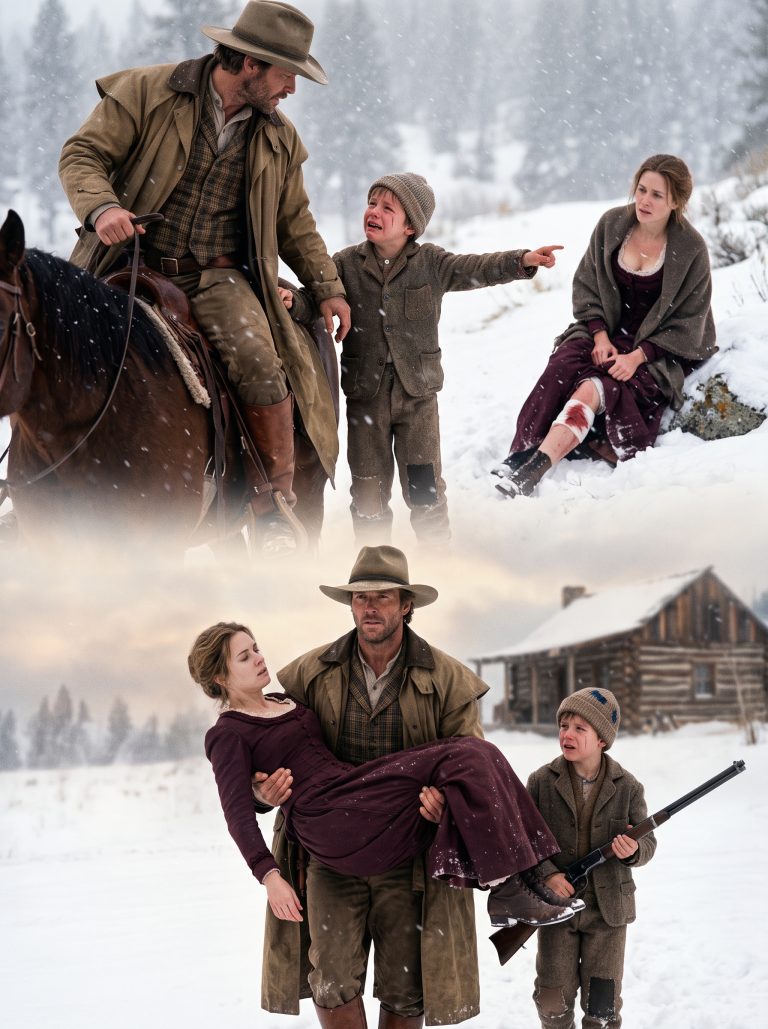
He rode to the spring for water before sunset — but left carrying a secret that would change the ranch forever after she refused to be anyone’s debt.

Part 1
Three words changed the shape of Maren Calloway’s life.
The August sun stood white over Cutter County, New Mexico Territory, and Widow Creek Ranch baked under it like a stone in a forge. The cattle had drifted to the cottonwoods by noon. The hens had gone quiet. Even the wind had quit by the time six riders came over the south rise.
Maren saw them from the stone basin where the spring ran cold no matter the season. Her father, Hollis Calloway, had lined that basin by hand and said it was worth more than gold, because gold could not water a herd through drought. He had died in June, and the letters from Byron Halstead had started before the dirt on his grave had settled.
She set her bucket down. Her father’s rifle leaned against the trough, close enough to reach.
Halstead’s foreman, Jesse Colton, rode at the front, lean and cold-eyed. Behind him came Grady, thick through the shoulders, and two more Consolidated Land riders. Sheriff Amos Teale came last on a gray gelding, and beside him, looking at his own hands, rode young Reverend Silas Ames.
“Miss Calloway,” Colton said. “Mr. Halstead sent an offer.”
“Mr. Halstead sends offers the way a wolf sends invitations,” Maren said.
Grady laughed and nudged his horse forward. He took her wrist before she could raise the rifle — not hard, just enough to prove he could.
“You ought to listen when men try to help you.”
Hoofbeats sounded on the south trail. A single rider came in at an unhurried walk: a rangy chestnut gelding, a man in a trail-worn duster the color of dust, a hat that had forgotten its original shape. He stopped at the edge of the yard and looked at Grady’s hand on Maren’s wrist, then at the sheriff’s badge, then at Colton.
“Let her go.”
His voice wasn’t loud. It didn’t need to be.
Colton’s hand moved for his gun before the stranger finished speaking. What followed took less than two seconds — a shot, a cry, Colton’s revolver spinning into the dust with blood already welling from his hand.
“He’s alive,” the stranger said. “That was on purpose.” He looked at Teale. “You want to do your job today, Sheriff, or keep doing his?”
Nobody argued. The riders left in a drag of curses and dust.
The stranger led his gelding to the trough and let it drink. He didn’t come near her. Didn’t ask if she was frightened.
“Who are you?” Maren asked.
“Nathaniel Kestrel.”
“Are you one of Halstead’s enemies?”
“Could be.”
“Mine?”
“No, ma’am.”
She studied him — the scar over one eyebrow, the stillness in his hands, the careful distance he kept. “You’ll want water for the horse. After that?”
“Depends whether those men come back.”
“They will.”
“Then I’ll stay a while. If you permit it.”
If you permit it. No man in six weeks of grief and threats had asked her permission for anything.
“You can sleep in the tack room,” she said. “You will not come into the house uninvited. And if you decide you know my business better than I do, you can ride out the way you rode in.”
“That’s fair.”
“It’s generous.”
“Yes, ma’am.”
Inside, over coffee, she told him about the letters, the cut fences, the bank’s sudden impatience, old Amos Kellerman’s barn that had burned after he refused to sell. Kestrel listened the way a man reads a map he intends to use.
“Your father keep records?” he asked.
Maren went still. “How did you know?”
“A man who understood what that water was worth would have written it down.”
She brought him the ledger, hidden beneath a floorboard, wrapped in oilcloth. Kestrel turned the pages with a care she hadn’t expected from a man who could put a bullet through a gunfighter’s hand before the gunfighter cleared leather.
“This is good,” he said quietly. Then he reached into his duster and drew out a tarnished badge and a set of worn papers.
“You said you were a lawman once.”
“Deputy U.S. Marshal. I’ve been tracking Byron Halstead four months — bribery, a federal survey commissioner, a bookkeeper in Silver City who disappeared before he could testify. I have pieces.” He tapped the ledger. “This may be enough to finish it.”
Outside, the light had begun to slant gold across the yard, and somewhere past the rise, Maren knew, word of Colton’s ruined hand was already riding toward Byron Halstead.
“He’ll come tonight,” Kestrel said. “Or tomorrow.”
“Then we don’t leave,” Maren said.
“No,” Kestrel agreed. “We get ready.”
Part 2
The days that followed took on a strange, taut rhythm. Kestrel mended the barn hinge, built Maren a shelf for her books without being asked, then apologized and offered to take it down. She let him leave it.
“You may sleep on the floor in the tack room,” she’d told him once. “You will not decide things for me.”
“Yes, ma’am,” he said — and meant it, which unsettled her more than if he hadn’t.
She learned he’d been a cowhand before a lawman, that his mother had taught school in Texas, that he carried a scar from a mining camp called Redstone Gulch where nine men had died because he’d argued for speed over caution and been wrong.
“I arrive too late,” he told her one night, when a dust storm had them trapped together in the kitchen. “That’s what I do.”
“You didn’t arrive too late for me,” Maren said, and watched the words land somewhere deep in him.
Sheriff Teale rode out alone to warn them Halstead had summoned a man named Marsh and six riders. Reverend Ames came too, ashamed and finally useful, carrying copies of the ledger north toward the federal marshal’s office in Santa Fe.
A letter came, tied to a stone through the kitchen window: Leave by dawn or the woman burns with the house.
“Pack what matters,” Kestrel said.
“No,” Maren answered. “This is my home.”
In the dark, with glass on the floor between them, he finally said it. “I love you. Since you told a hired gun you’d shoot his horse before you’d shoot him. Maybe before I had any right to notice.”
“I love you too,” Maren said. “Which is why you don’t get to decide for me.”
“Then what do we do?”
She looked at the broken window, the spring running on beyond it in the dark.
“We make them come into the light.”
Part 3
Before dawn, Maren sent riders to every neighbor who might still have the nerve to stand and watch. By nine, fourteen people had gathered at Widow Creek — not soldiers, just tired, sun-browned people done with looking away.
Mrs. Cobb, the county’s only notary, took her place at the porch table with her seal, her ink, and a fresh ledger of her own.
“I don’t ask anyone to fight for my ranch,” Maren told them from the porch. “I ask you to witness.”
Amos Kellerman spat in the dust. “Don’t thank us. We’re late.”
“Yes,” Maren said. “You are.”
Kestrel had been watching the northern road since noon. If Ames had reached Santa Fe in time, and if Reyes had ridden hard, they’d see dust before sunset. He said nothing of it to Maren, not wanting to hand her a hope that might not arrive.
Byron Halstead arrived at three that afternoon — smaller than his reputation, tidy, gloved despite the heat, riding a bay too fine for the country. He dismounted at the spring’s edge with the unhurried confidence of a man who had never once been told no and believed it.
“Miss Calloway. I came to settle a dispute.”
“You threatened to burn my house.”
“Did I?” His eyes flicked, amused, to Mrs. Cobb, her pen scratching steadily across the page at the porch table.
Then his gaze slid to Kestrel, and something shifted in his face — recognition, quickly smoothed over.
“Marshal Kestrel,” Halstead said, too easily. “You’ve come a long way to lose again.”
The word again hung in the air. Kestrel’s jaw tightened.
“Redstone Gulch,” Halstead said, almost gently. “Latimer never had the patience to time a payroll robbery to the hour marshals were due. Someone told him exactly when to move. You spent eleven years blaming yourself for trusting the wrong informant. Strange, isn’t it, that you never once asked who bought those nine mining claims two weeks later — cheap, from widows too grieved to bargain.”
The yard went silent. Maren felt the ground shift beneath her.
“That’s not public record,” Kestrel said slowly. “Nobody outside the marshal’s office ever knew Latimer had inside timing. I made sure of that myself, so the leak couldn’t cover his tracks by learning what we knew.” He looked at Halstead. “You just told me something only the man who sold that timing could know.”
For the first time, something behind Halstead’s composure faltered — a half-second too long before he answered. “A man hears things in Santa Fe.”
“You didn’t hear it,” Kestrel said. “You corrected it. I never said Latimer’s tip came from an informant inside the marshal’s office. I said we never learned who sold him the timing. You just told this whole yard it was someone who knew what we knew — which means someone close enough to the investigation to have heard it firsthand.” He let that sit. “That’s not a rumor from Santa Fe, Halstead. That’s a memory.”
For one terrible moment, Maren saw the old wound open in Kestrel’s face — saw the boy who’d blamed himself for a decade rediscovering that the man he’d hunted for bribery had also been the architect of his oldest grief. She saw, too, the temptation: to let fury answer for him, to become exactly the kind of man who arrived with smoke and left ashes.
“Nathaniel,” she said quietly.
He didn’t draw his gun. His hand, halfway to it, opened instead.
“You’re wrong about one thing,” Kestrel said. “I didn’t come here to lose again. I came for water. I stayed because a woman with a rifle and her father’s ledger taught me the difference between guilt and justice.” He looked past Halstead to the road. “And because federal marshals don’t need my temper. They need evidence. Which you just handed me, free of charge, in front of Mrs. Cobb, the county notary, and the other thirteen witnesses.”
Halstead’s confidence cracked half a second before the hoofbeats reached the yard — Deputy Reyes and three federal riders, with Sheriff Teale trailing behind, hat in hand, ready at last to stand openly against Halstead.
“Byron Halstead,” Reyes said, dismounting. “Federal warrant. Bribery, conspiracy, and — I expect we’ll be adding a Redstone Gulch inquiry to that list directly.”
It was not clean. One of Halstead’s younger riders panicked and drew a hidden derringer, aiming it not at Kestrel but at Maren. Kestrel moved without thinking, throwing himself into the path of it. The bullet tore through the flesh along his ribs, dropping him hard into the dust, while Reyes fired and brought the shooter down.
“I’m all right,” Kestrel said, which was such an obvious lie that Maren’s fear turned instantly to fury, which turned out to be more useful for stopping bleeding than tears would have been.
He survived the fever that followed, though it took a week and more of Maren’s patience than she knew she owned. Halstead was taken to Santa Fe to answer for crimes committed eleven years and four hundred miles apart — bribery, land coercion, and, at last, an old debt from Redstone Gulch he had never expected anyone to collect. Sheriff Teale testified against him, late but honest. Reverend Ames left for a mission near Taos, saying he’d rather teach children to read than teach grown men to look away.
Kestrel healed slowly, insisted on sleeping in the tack room out of some stubborn sense of propriety, and courted Maren badly and earnestly — wildflowers that were mostly weeds, a wooden box built to hold her father’s ledger, a habit of asking may I before he did anything at all, even after she’d stopped needing him to ask.
“Redstone Gulch isn’t yours to carry anymore,” she told him one evening, mending the curtain Halstead’s stone had torn. “You didn’t sell those widows their grief. A man who wanted it sold to him did that. You only believed, for eleven years, that guilt was the same thing as love. It isn’t. Staying is.”
“Then I’ll stay,” he said. “If you’ll have me.”
“Ask me properly.”
He did, at the first hard frost, with three stubborn wildflowers in a jar and his mother’s ring in his palm, and this time there was no gunfire to answer him — only the spring, running on exactly as it always had, and Maren’s voice, steady, saying yes.
They married that November beside the water her father had lined by hand. The ranch deed stayed in her name; Kestrel insisted on it in front of the lawyer from Santa Fe. “She had a ranch before she had a husband,” he said, and meant it as the truest kind of vow.
Years came after — a schoolhouse built from the county’s first honest water lease, two children who grew up knowing their grandfather had kept records when powerful men lied, and a father who had once mistaken guilt for penance until a woman with a rifle showed him the difference. The spring never went dry. Neither, in the end, did the two of them — not for each other, and not, at last, for themselves.
The line between guilt and justice is the space where a person finally lets themselves be forgiven. Maren Calloway understood that first. It took Nathaniel Kestrel eleven years and one honest woman to learn it too — and the water, patient as it had always been, simply waited for him to arrive on time.