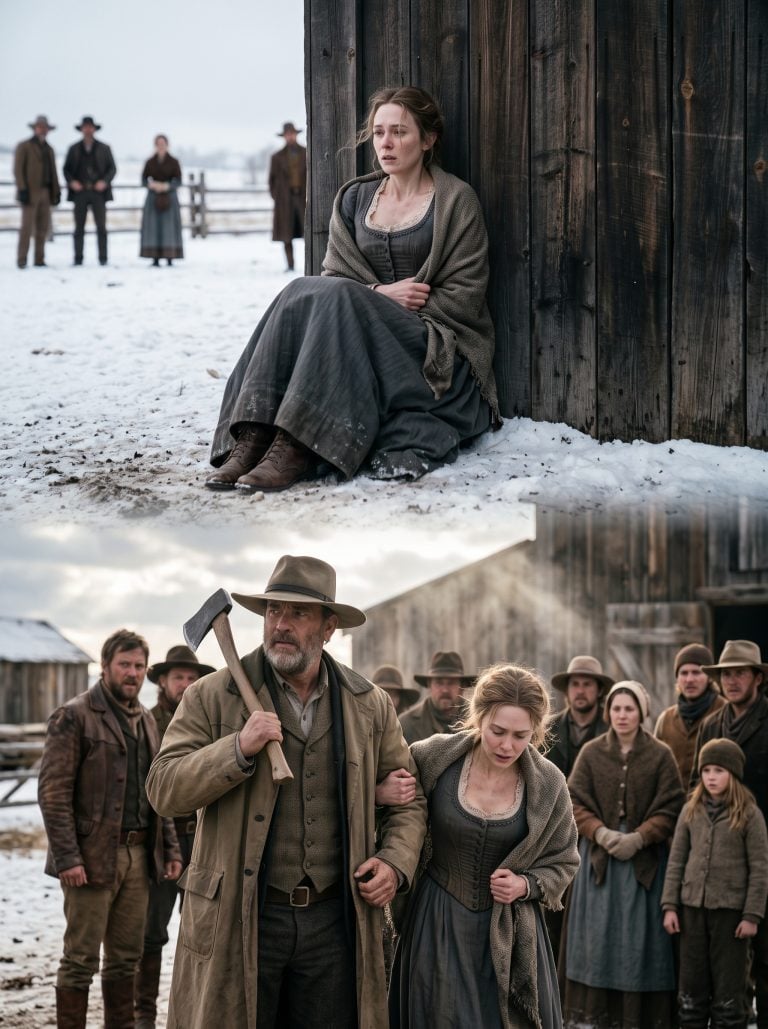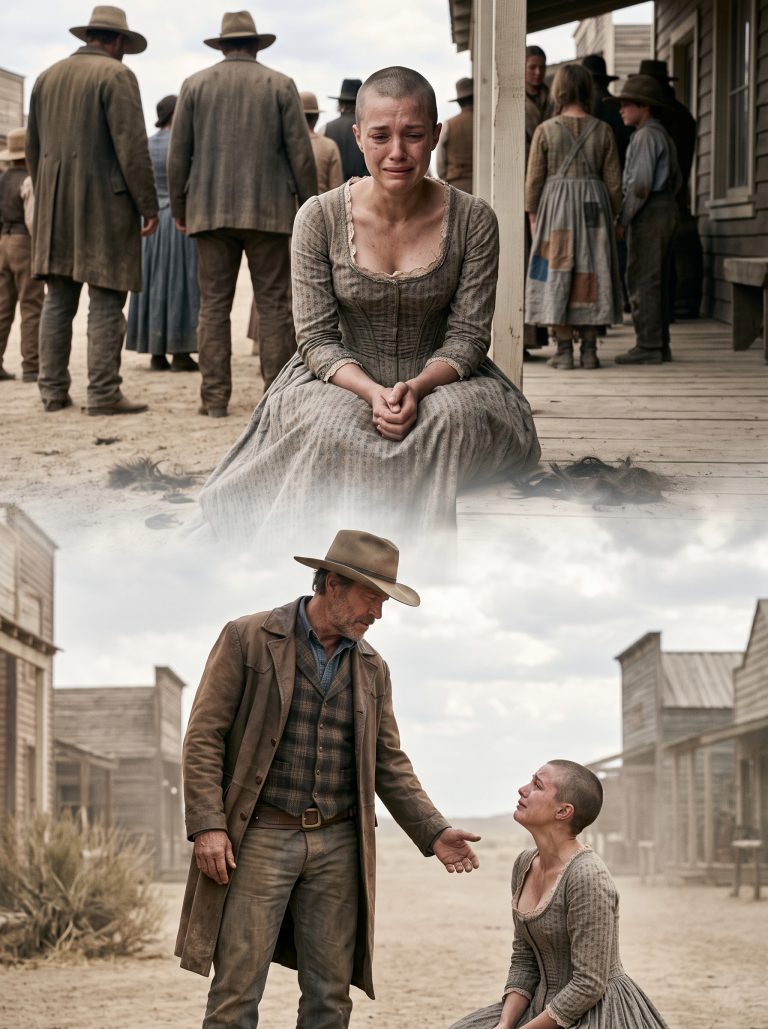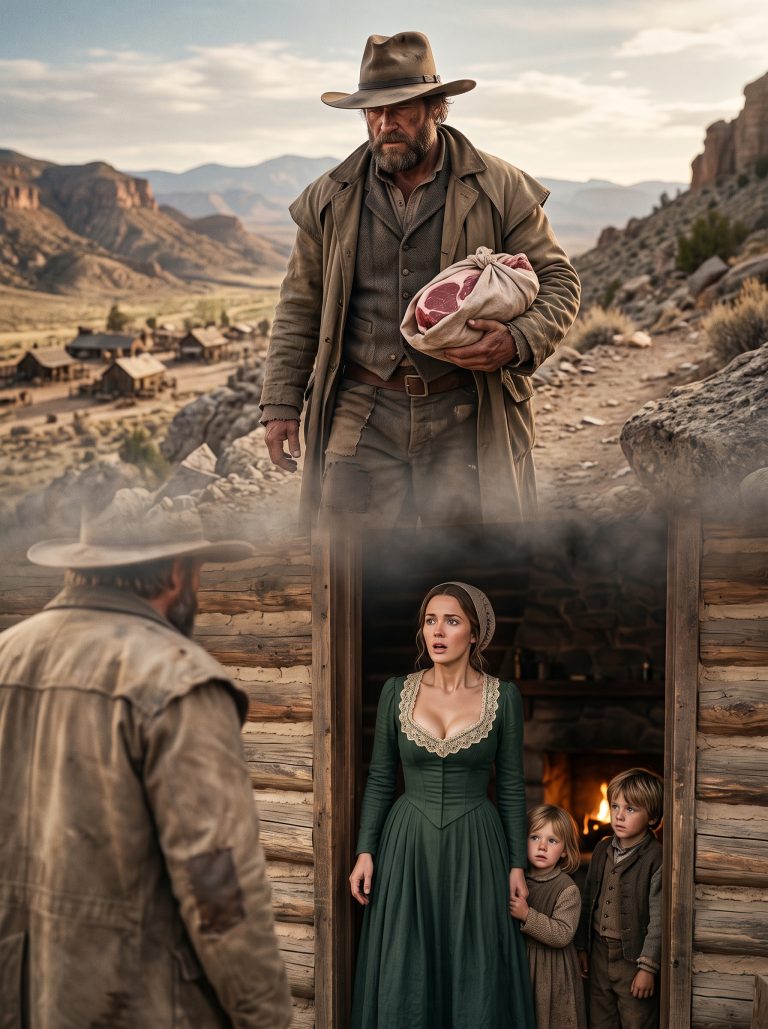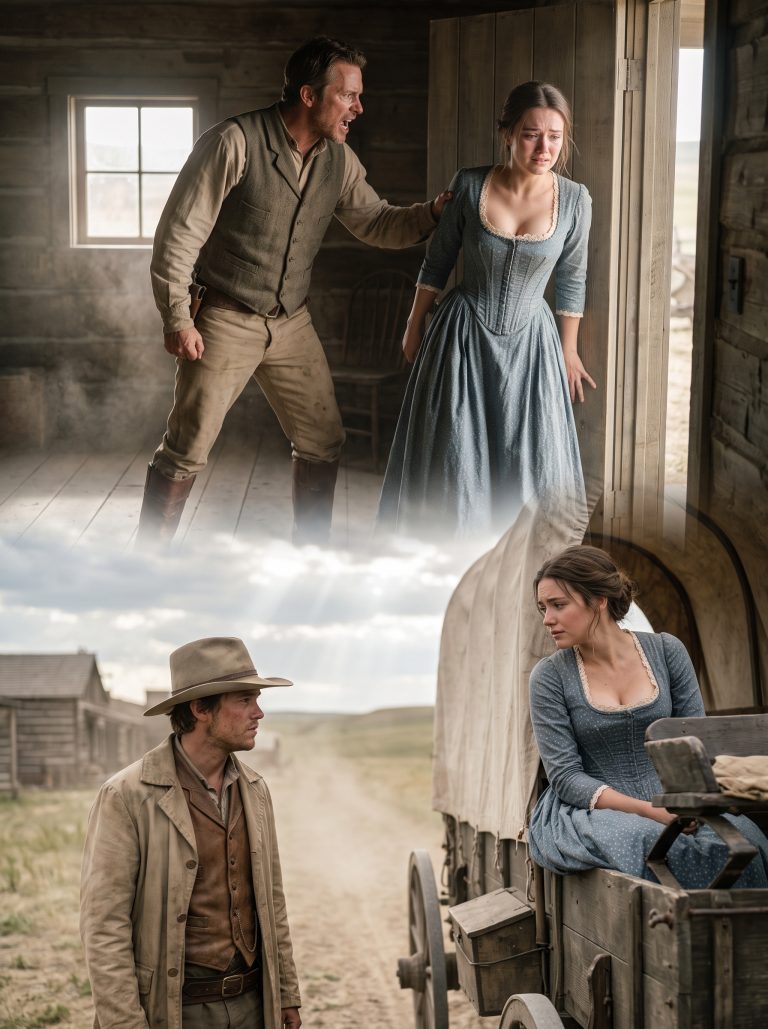
“Mama Can’t Walk Anymore,” the little boy cried—so the widowed rancher lifted her into his arms… but the truth she carried home was far more dangerous than her injury.

Part 1
The winter of 1889 came early to the Montana high country, and by the third week of November the road out of Cutter’s Ridge was nothing but a frozen scar through the pines.
Ruth Calloway walked it anyway, because there was nowhere else left to walk to.
She was twenty-eight, though the last two years had aged her the way a hard frost ages a fence post — quietly, from the inside. A canvas sack of cornmeal rode on her back, lashed with a leather strap that had already rubbed a raw line into her shoulder. Beside her, gripping the hem of her coat, trudged her son Silas, six years old, his boots two sizes too big, stuffed with newspaper to keep them on his feet.
“Mama, how much further?”
“Not far now,” Ruth said, which was what she had been saying for the last two miles.
Her left hip had been aching since the accident at the Larkspur claim eighteen months back — a beam had come down wrong, crushed nothing that showed but something underneath that never quite healed right. On good days she could hide the limp. This was not a good day. The cold had worked its way into the joint like a key turning a lock, and with every step the pain climbed a little higher, until her whole leg felt like it belonged to someone else.
She would not let Silas see it. She had gotten good at not letting Silas see things.
“You’re walking funny,” he said anyway. Children noticed. They always noticed.
“Just tired, love.”
He didn’t believe her. She could tell by the way his small hand tightened on her coat.
They had left Cutter’s Ridge that morning because staying had become impossible. The boarding house owner had raised the rent for the third time since Ruth’s husband died, and this time Ruth hadn’t had it, and the man’s patience had run out along with her coin. There was a homestead six miles north, an old trapper’s cabin folks said still had smoke in its chimney some nights. It wasn’t a plan so much as a direction. But a direction was more than she’d had in weeks.
The leg gave out a mile short of it.
She felt the hip lock, felt her knee buckle underneath her before she could brace for it, and she went down hard into the roadside drift, the cornmeal sack tearing at the seam and spilling a pale stain across the snow. She did not cry out. She had learned that too — that crying out only frightened Silas worse than silence did.
“Mama!”
“I’m all right.” She was not all right. Her hands, pressed flat against the snow to push herself up, would not hold her weight, and after the third failed attempt she stopped trying and simply sat there, back against a fence rail gone gray with age, breathing through the pain in slow, careful pulls.
Silas stood over her, his breath coming in frightened white clouds, his eyes darting down the empty road as if an answer might appear in it.
Then he saw the cabin.
It sat back from the road behind a leaning fence, smoke curling steady and dark from its chimney, and it might as well have been a lighthouse for how fast the boy moved toward it. He didn’t ask permission. He simply ran, small legs pumping through snow that came near to his knees, and hammered his fist against the door until it opened.
The man who filled the doorway was tall in the way mountains are tall — not for show, just because that was how he had grown. Dark-bearded, maybe thirty-five, with the kind of stillness in his face that came from a man who had long since stopped expecting good news to knock.
“Sir,” Silas said, chest heaving, “my mama fell down and she can’t get up. Please.”
The man’s eyes went past the boy to the woman slumped against the fence rail, and something in his jaw shifted — not surprise, exactly. Recognition of a shape he’d seen before.
He was outside and crossing the yard before Silas had finished pointing.
“I can walk,” Ruth said as he crouched beside her, pride flaring even through the pain. “I only need a moment.”
“You’ve needed a moment for the last quarter mile, from the look of that leg.” His voice was low, unhurried, entirely without pity, which was somehow the only thing that kept her from weeping right there in the snow. “Name’s Judah Marsh. I’m going to carry you inside now. You can argue with me about it once you’re warm.”
He did not wait for her to agree. He gathered her up as though she weighed nothing at all, one arm beneath her knees, the other bracing her back, and when Silas reached up uncertainly, Judah caught the boy’s small hand in his free one without breaking stride.
The three of them crossed into the cabin together, and the door shut out the wind behind them.
Inside smelled of woodsmoke and boiled coffee and something herbal drying from the rafters. It was a small room, but swept clean, and Ruth noted — the way a woman alone learns to note things — that there was only one chair pulled close to the fire, and only one set of boots by the door, though a second, smaller pair sat untouched beneath the window, dusted with the kind of stillness that comes from long disuse.
Judah set her in the chair with a care that surprised her, and only then did he turn to bank the fire higher.
“You’ll want to see to that hip,” he said, nodding at her leg without looking directly at it, a courtesy she understood and was grateful for. “I’ve got herbs for the swelling. Won’t fix what’s broken underneath, if something is. But it’ll ease the walk of it.”
“We can’t pay you,” Ruth said. It cost her something to say it plainly.
Judah paused with a log half-fed into the fire.
“Didn’t ask you to.”
He said nothing further. He simply went about the business of building the fire higher, and warming water, and finding a blanket thick enough for a shivering boy, and in all of it there was no question in his manner, no calculation of what a stranded widow and her son might cost him. Only the quiet, unhurried motion of a man doing what needed doing.
Silas, wrapped now in wool by the hearth, watched him with the frank, assessing stare of a child deciding whether a stranger could be trusted.
“Mister,” he said at last, “why do you got two pairs of boots by the door if you live alone?”
Judah’s hands stilled over the kettle.
For a long moment he didn’t answer, and the fire popped and settled in the silence, and Ruth, watching his back, understood that she had just watched a door close somewhere inside him — quietly, the way doors close in houses where something is being protected.
“Drink your water,” Judah said finally, and set the second mug in the boy’s hands, and the subject did not come up again that night.
Part 2
By the second morning, Ruth’s hip had swollen dark beneath her skirts, and the pain that had merely dogged her on the road now pinned her to the chair entirely.
Judah knelt to examine it without asking leave, the way he seemed to do most things — not out of rudeness, she was coming to understand, but because a lifetime alone had worn the manners off him and left only the necessary parts.
“Not broken,” he said, pressing along the bone with careful hands. “But it won’t carry you far for a week, maybe two.”
“Then I suppose I’m your burden a while longer,” Ruth said, more tired than bitter.
“Suppose you are.” He did not look up from his work. “I’ve carried worse.”
She laughed before she could stop herself — a short, startled sound, the first laugh to leave her in longer than she could easily count. Judah’s mouth twitched, not quite a smile, but close enough kin to one.
He packed the joint in warm herbs, wrapped it in clean linen torn from an old shirt, and through it all Silas hovered at his elbow, handing him strips of cloth one at a time as though the task had been assigned to him personally. When Judah finished, he let the boy tie off the last knot himself, guiding small fingers with his own.
“Good hands,” Judah said. “You’ll make a fine doctor, or a fine rancher. Haven’t decided which yet.”
Silas beamed like he’d been given a medal.
That evening, over cornbread and reheated venison, Silas worked up the courage he’d been saving since the first night.
“Mister Judah. Whose boots are those? The little ones.”
Ruth reached to hush him, but Judah lifted a hand, stopping her gently.
“My son’s,” he said. “Eli. He’d be near your age now, I expect.”
“Where’s he at?”
“Buried up on the ridge behind the barn. Him and his mother both, three winters back. Fever took them within a week of each other.” He said it plainly, the way a man reports weather, though his eyes had gone somewhere Ruth couldn’t follow. “I’ve kept his boots by the door ever since. Don’t rightly know why. Guess I wasn’t ready to put the door back to just one pair.”
Silas was quiet a long moment, working something over in his young mind.
“You could put my boots there,” he said finally. “Just till mine get too small. Then you’d still have two.”
Something moved across Judah’s face then — not quite pain, not quite relief, but the two of them tangled together the way grief and gratitude often are. He reached out and set his broad hand once, briefly, on the boy’s head.
“I’d like that,” he said, and his voice had gone rough. “I’d like that a good deal.”
Ruth turned her face to the fire, and did not try very hard to hide the tears that came.
Part 3
The rider came on the fourth day, while the sky sat low and gray and threatening more snow.
Ruth heard the horse before she saw it — a hard, unhurried clatter on the frozen road — and something in the rhythm of it made her blood go cold before she even reached the window. Judah was already at the door, rifle in hand, watching a man in a fine gray coat rein up at the edge of the yard.
“Ruth Calloway,” the rider called out, not bothering to dismount. “I know you’re in there.”
Ruth’s hand found the doorframe and gripped it hard.
“Who is that,” Judah said, low, not quite a question.
“Harmon Blythe,” Ruth answered. “He held the note on my husband’s claim. Said if I couldn’t pay it, he’d take the mineral rights instead — everything Thomas died for. I told him no. I told him I’d see a lawyer in Bannock before I signed it over. He told me I’d regret it.” Her jaw tightened. “Two days later, Thomas was dead in a collapse the foreman swore was an accident. I’ve never once believed that.”
Judah went very still.
“Blythe,” he repeated, and something in the way he said the name made Ruth look at him properly for the first time since the rider’s arrival. His knuckles had gone white around the rifle stock. “The Larkspur claim. That collapse was at the Larkspur.”
“You know it?”
“I worked it,” Judah said, and his voice had dropped to something Ruth had not heard from him before — flat, controlled, the sound of a man holding a door shut against something enormous. “Three years back. Before I built this place. Blythe owned a half-share then too, under a different company name. Told the crew the support beams were sound. They weren’t. My wife’s brother was on that crew. He didn’t come home either.”
Ruth felt the floor tilt slightly beneath her.
“That’s — that’s not possible. Thomas’s collapse was eighteen months ago. You said your family—”
“Anna and Eli died of fever,” Judah said quietly. “That part’s true. But it was fever that took hold because we’d lost everything paying off the debt Blythe said we owed after her brother died — debt that never should’ve existed, papers that turned up signed with a hand that wasn’t hers. We couldn’t afford the doctor by the time they took sick. I’ve had three years to turn that fact over in my mind, wondering how a man sleeps at night knowing what his greed costs other men’s families.” He looked at her, and something terrible and clear passed between them. “I never once thought I’d be standing in a room with the next family he did it to.”
Outside, Blythe called again, impatient now. “I don’t want trouble, Mrs. Calloway. I want the deed you took from the company office. You’re squatting on my land, and I’ve a writ that says so.”
Ruth’s hands were shaking, but not from fear alone now — from something sharper, something that had been building in her for eighteen months and had just found a place to stand.
“It isn’t your land,” she said, stepping into the doorway beside Judah, leaning hard on the crutch he’d carved for her. “It’s my husband’s claim, filed and paid, and the note you hold is built on the same forged paper you used to bury Judah’s family in debt before you buried mine.”
For the first time, something flickered across Blythe’s face that wasn’t confidence.
“You don’t know what you’re talking about.”
“I know the Larkspur beams were condemned twice before that collapse,” Judah said, stepping fully into the yard now, rifle low but steady. “I know because I filed the second complaint myself, and it disappeared from the company office same as every complaint before it did. I never could prove who buried it. Didn’t need to, until now.”
Blythe’s horse shifted under him, sensing the change before its rider did.
“There’s no proof of any of that,” Blythe said, though the certainty had gone out of his voice.
“There’s a lawyer in Bannock,” Ruth said. “I was walking to find him when the road took my leg out from under me instead. I expect he’d be very interested to learn there’s two collapses, two forged debts, and two families willing to swear to it in the same courthouse.”
The silence that followed was long and cold, broken only by the horse’s uneasy stamping.
Blythe looked between them — the widow leaning on a crutch she’d been carved by a stranger’s hands, and the stranger himself, a man he had wronged and never known it, standing now in the one place in the territory where his lies had finally run out of room to hide. Whatever calculation moved behind his eyes, it did not favor him, and after a long moment he wheeled his horse without another word and rode back the way he’d come, faster than he’d arrived.
Judah did not lower the rifle until the rider was well out of sight.
“He’ll come back with men,” he said. “Or with a different lie. His kind always do.”
“Then we’ll be ready,” Ruth said. “Both of us. Together, this time, instead of alone.”
Judah looked at her for a long moment — really looked, the way a man looks at something he has stopped expecting to find.
“Together,” he said, testing the word like a man testing ice before he trusted his full weight to it. “I don’t believe I’ve had that particular word in my house for some time.”
“Then it’s about time it came back,” Ruth said.
They rode to Bannock together within the week, once Ruth’s hip could bear the saddle, and the lawyer they found there turned out to already know Harmon Blythe’s name — had a drawer of complaints against him, in fact, going back further than either Ruth or Judah had guessed, families up and down the valley who’d lost claims to the same forged debts, the same convenient collapses. It took the better part of a year, and more courtroom mornings than Ruth cared to count, but the deed to the Larkspur claim was restored to her name by the following autumn, and Blythe’s company lost its charter not long after, buried under the weight of every family that finally spoke at once instead of alone.
Judah’s boy’s boots stayed by the door that whole year, and beside them, slowly, a second small pair — Silas’s — worn down and replaced twice over as he grew.
On a clear morning the following spring, Judah walked out to the ridge behind the barn where Anna and Eli were buried, and Ruth walked beside him this time instead of waiting inside, her hip healed enough now to bear the climb, and Silas ran ahead of them both, chasing nothing in particular, simply because the ground was dry and the sun was warm and running was, for once, a thing a child could do purely for joy.
“I used to think I was the only one Blythe ever ruined,” Judah said, looking down at the two small headstones. “Spent three years thinking my grief was mine alone to carry. Didn’t leave much room in me for anything else.”
“And now?”
“Now I think grief’s like a road,” he said. “Looks like it belongs to whoever’s walking it. But it runs through the same country everybody else is crossing too, whether you see them on it or not. I didn’t find you and your boy by accident, Ruth. I think we’d been walking toward each other a long while before that road ever put you in my yard.”
Ruth slipped her hand into his, and did not let go.
“Then I’m glad the road was as long as it was,” she said. “I don’t think I’d have known what to do with you, if we’d met before I understood what it cost to be given a door that opens without asking anything in return.”
Below them, Silas’s laughter rang out clear across the thawing field, and somewhere behind them, smoke rose steady from a chimney that no longer had room in it for only one pair of boots.
THE END