He Saved a Little Girl Seconds Before She Fell — Then Her Wounded Mother Whispered Who She Really Was

Part 1
The scream came out of Widow’s Gulch like the land itself had finally learned to beg.
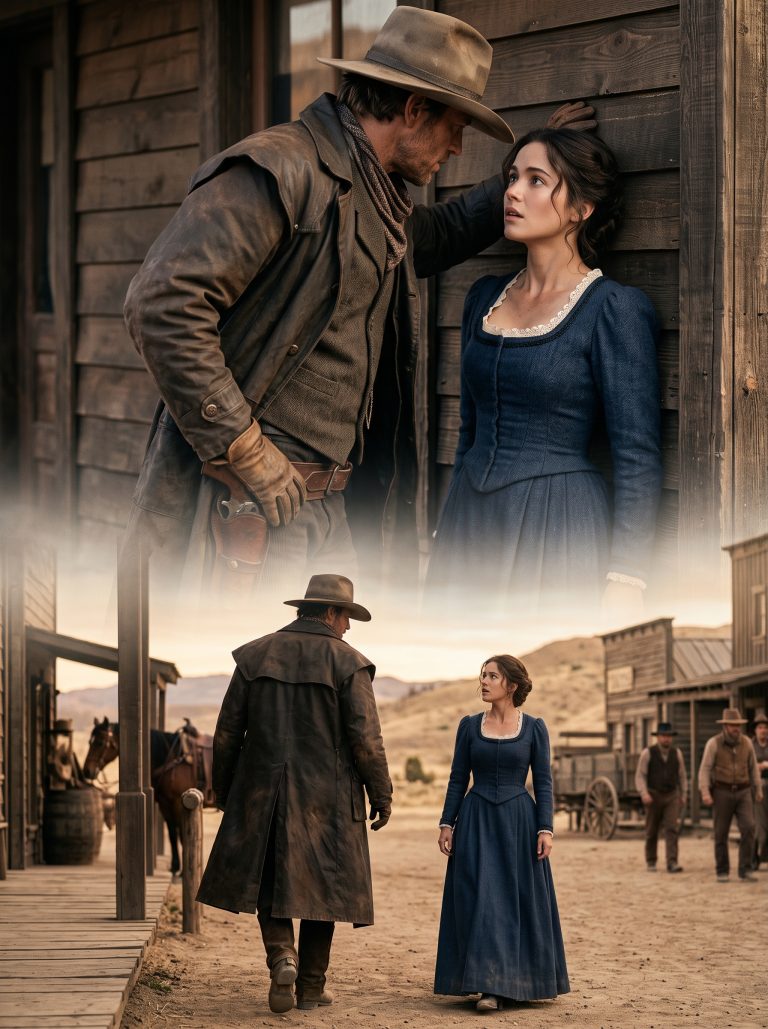
Jesse Calder heard it over the wind while riding the north fence of his solitary spread outside Cedar Flat, Colorado Territory. He had lived alone so long that most sounds no longer touched him — wire humming in the heat, a hawk turning above the bluff, his old roan breathing through dust. Those belonged to him.
This scream did not.
It was small, sharp, and human.
Jesse reined hard. The roan stopped before he asked, ears swiveling toward the red break where the land dropped into nothing. He swung down, rifle in hand, and heard it again.
“Help me!”
A child.
He ran, boots skidding on loose shale, pebbles scattering ahead of him into the drop. He went flat on his stomach at the rim and saw her — no more than six, barefoot, dust-caked, hanging from a juniper root that was already tearing free of the cliff face.
“Don’t let go,” Jesse called, steadier than he felt. “I’ve got you.”
Her small fingers slipped as he lunged. He caught her wrist a heartbeat before the root gave way, and for one long breath the whole canyon hung on his grip. Then he hauled her up and rolled clear of the edge, holding her while she sobbed into his shirt.
“You’re safe,” he said. “You’re safe now.”
A woman’s voice broke across the flats. “Nalie!”
She came stumbling through the sage — torn dress, blood at her temple, dark braids whipping loose. She ran like someone already past the end of her strength.
The girl twisted free and ran to her. “Mama!”
The woman fell to her knees at the ridge, and when she lifted her face, Jesse’s blood went to ice.
“Aiyana.”
The name tasted like smoke and seven years of grief.
Once, before soldiers and lies and a fire that ate half the valley, Aiyana had stood with him at Willow Creek and promised to follow him anywhere. Once he had ridden for help and come back to ashes, and buried the charred remains he believed were hers in a grave he had dug with his own hands, and never once let himself visit it again.
Now she knelt in front of him, alive, bleeding, and looking at him like love and accusation were the same expression.
“You,” she whispered.
He caught her as she swayed. She was lighter than memory, burning with fever.
“They’re coming,” she said, fighting for breath. “Men. The same kind of hate that burned Ash Fork.”
“Who?”
She didn’t answer. Instead she reached for the child, and when Jesse guided the girl closer, Aiyana pressed his hand flat against the small shoulder, as though forcing him to feel a truth through skin and bone.
“She lives because you pulled her out,” Aiyana said. “Not any man could have. Her name is Nalie.” She drew a trembling breath. “She is yours.”
The wind seemed to stop moving.
“I was carrying her the summer the fire took Ash Fork,” Aiyana went on. “I hid after. I waited for you until waiting cost too much. She was born when the first snow came, that same year. I told her stories about a man with steady hands.”
Jesse did the arithmetic without meaning to — seven years since the fire, a child born that first winter after, small enough still to be six — and it settled into place like a bone easing back into its socket. This girl was his.
“I came back for you,” he said hoarsely. “Aiyana, I rode back.”
Her face twisted. “Too late.”
The words hit harder than a bullet.
A sound rolled across the mesa behind her — hoofbeats, more than one horse, still distant but not distant enough. Aiyana’s whole body went rigid.
“They tracked me,” she said. “Please.”
Jesse looked at the horizon, then at the woman he had mourned for seven years, then at the daughter he had known for the length of one held breath.
“My place is three miles north,” he said, already lifting Nalie onto the roan. “Nobody’s getting past my door tonight.”
He helped Aiyana up behind the child, swung up after her, and turned the horse for home with his family — a family he hadn’t known he had an hour before — held close against the coming dark.
Part 2
By dusk he had Aiyana on the bed and Nalie wrapped in a quilt by the hearth, and the cabin that had known nothing but silence for seven years was suddenly, terrifyingly full.
Aiyana’s fever broke enough for her to speak in fragments. Three riders had chased them out of Ash Fork, she said. Maybe more behind those. She kept one hand pressed to the travel bag at her hip the whole time she spoke, as if it were a second wound, but she would not say why — only that it had to do with the fire, and with a name she refused to speak in front of the child.
Jesse fed them what he had. He watched Nalie eat like a girl who had learned not to trust the next meal, and something in his chest cracked that seven years of loneliness had never managed to touch.
Near midnight, hoofbeats circled beyond the creek — slow, deliberate, then gone, as if whoever rode out there only wanted him to know they’d found him.
He stood at the window until they faded.
“You watch like a man waiting for punishment,” Aiyana murmured from the bed.
“Maybe I am.”
“No.” Her voice was tired but certain. “Punishment already came, seven years ago. This is only choice.”
He turned that over and said nothing.
At first light he found the tracks — three horses, shod, one rider dismounted long enough to face the cabin square on, as if daring it to stay standing. When Jesse came back inside, Nalie sat at the table in one of his shirts, and Aiyana was braiding her hair with slow, careful fingers, and the sight of it struck him somewhere he didn’t know could still hurt.
“They’re deciding whether I’m worth bleeding for,” he told her.
“And are we?”
“You already know the answer.”
Before she could speak again, a rider stopped in the yard — broad-shouldered, black hat, a smile that belonged to no friend. Behind him came two more.
“Well, Calder,” the lead rider called. “Heard you took in strays.”
Jesse stepped onto the porch, rifle low. “Careful.”
“Town won’t like this. Woman from the old fire. Half-blood child.”
“My name got tangled by liars seven years back, and I mean to untangle it.”
The third rider — pale-eyed, unhurried — looked past him toward the window.
“Send the woman out,” he said. “We only want to ask questions. She’s carrying something that’s owed to me.”
Aiyana opened the door before Jesse could stop her, and stood behind him thin, wounded, and straight as a rifle barrel.
“I owe you nothing, Reeve Talon,” she said. “A debt built from a lie is no debt at all.”
Talon’s smile thinned into something colder.
And Jesse understood, with a cold that reached all the way to bone, that these men hadn’t come for a stray. They had come for something Aiyana had carried out of Ash Fork with her — something Talon had spent seven years trying to keep buried, and years before that trying to buy back from a woman he’d never had any real claim on.
Part 3
“What do you want?” Jesse asked.
“The papers you’ve been carrying,” Talon said. “And her, back where she belongs. Her uncle left a debt when he died — a debt I bought fair, same as any note. She’s been working it off in Ash Fork three years now. Then she ran.”
“There was no debt,” Aiyana said. “Only a threat you dressed up to look like paper.”
“Same difference, out here.” Talon shrugged, easy as a man discussing weather. “You’ve got until noon tomorrow. Church hall in Cedar Flat. Bring them, or half the county hears she was seen hiding under your roof, tied to the old massacre — and hears about the proof that certain respected men sold the raiders their maps and blamed the dead for it after.” His voice dropped, almost gentle. “Ask her about the letter, Calder. Ask her why she never sent it. Ask her who told her you’d never come looking.”
Then he wheeled his horse and rode out, the other two trailing him, and left Jesse standing in the ringing quiet of his own yard with seven years of assumptions caving in under his boots.
That night, by firelight, Aiyana finally told him everything.
Her uncle had found papers on a dead man near the river the night of the raid — maps, names, payments. Ranchers and a land agent had bought a clear path through Ash Fork’s grazing routes, paid raiders to open it, then let the blame fall where blame always fell. Her uncle had hidden the packet before he died in the fire, and it had passed to Aiyana. Talon had spent years afterward calling that inheritance a debt — a fiction he used to keep her close, watched, and afraid to run.
“My name wasn’t on any of it,” Jesse said, half a question.
“No. Never. But Talon told the valley you’d guided the raiders in. He knew people would believe it, because everyone knew you loved me.”
“Why didn’t you come to me, once you had the papers?”
“I tried.” Her voice cracked open. She reached beneath the torn lining of her dress and drew out a folded oilcloth packet, worn soft with years of carrying. “I wrote you a letter from the mission at Bell’s Ford, not long after Nalie was born. A woman there promised to carry it. She came back beaten, said men were watching your road, said if I came myself, they’d kill the baby.” She looked at him, eyes wet and furious and ashamed all at once. “I told myself I’d find a safer year to come. There was never a safer year.”
She handed him the letter from inside the packet. He read it there by the fire — her careful hand telling him she’d never believed he’d betrayed anyone, that their daughter had his stubborn mouth and his eyes when she watched flame, that she loved him and asked nothing of him but that he live, knowing it.
Jesse’s throat worked around words that wouldn’t come.
“There’s one more thing,” Aiyana said quietly, and something in her tone made him look up. “The woman who carried my letter and came back beaten — before she died last winter, she told me a name. The man Talon paid, the first year, to make sure you never went looking for me. Not Talon himself. Someone closer.”
“Who?”
“Amos Dell.”
Jesse went still as stone.
Amos Dell had been his own foreman, his oldest friend on the Calder spread — the man who’d told him, the week after the fire, that he’d seen a body himself and there was nothing left to search for.
They rode into Cedar Flat the next morning with the packet and a six-year-old girl holding both their hands.
Half the town had gathered by the church steps. Talon stood with Judge Harlan Voss and two of his men; Amos Dell stood a little apart, arms crossed, face carefully unreadable.
Aiyana laid the evidence out piece by piece — maps, names, payment marks, and a thin ledger page with Talon’s own hand on it. An old land-office recorder, brought forward by Mrs. Hale from the boarding house, examined the seal pressed into the corner of one map and confirmed it was the territory’s true stamp, not a forgery — the kind of seal only a man inside the land office could have gotten hold of. A rancher recognized a payment figure that matched, almost to the dollar, an entry in his own late father’s account book from that year. The crowd’s murmur turned uneasy, then ugly, aimed now at the men on the steps instead of the woman in front of them.
Voss tried to laugh it off as coincidence and old paper. Then, trying to explain away the ledger, he mentioned — offhand, careless — the exact stretch of river where the raiders had crossed that night, a detail that had never once been made public.
The crowd went silent. The old sheriff, retired six years but still carrying weight in that town, said it plain: only six men had ever known that crossing before the raid, and none of them still living had reason to speak of it — except one who’d helped choose it.
Voss realized his mistake a breath too late, and turned to run.
That was when Talon moved — not toward Voss, and not toward the crowd, but toward Nalie, standing near the wagon with Mrs. Hale. He caught the child’s arm and had a knife at her collar before Jesse could cross the distance, his whole plan of retreat collapsed down to one last, desperate piece of leverage.
“Nobody follows the judge,” Talon said, voice gone thin and fast, “and nobody touches me, or the girl—”
An arrow took him through the forearm before he finished the sentence. Aiyana’s bow was already lowering by the time he screamed and let go of Nalie, and three townsmen had him on the ground before he thought to reach for his pistol with his good hand.
In the scramble, Voss didn’t get ten yards.
Jesse swept Nalie up and back from the fighting, checked her over with shaking hands, found her only frightened, not hurt, and held her hard enough that she squirmed.
“Papa,” she sobbed into his shoulder, half question, half comfort, and it steadied him more than anything the doctor did an hour later, after a stray graze from the scuffle opened a shallow line across his ribs.
It was Amos who broke, in the quiet after, not from any weapon but from the simple, unbearable weight of Jesse looking at him and waiting.
“Talon paid me the first winter after the fire,” Amos said, voice raw. “Told me if I didn’t say I’d seen her body, he’d make sure you turned up dead chasing rumors, and he’d see to it my sister’s place burned next. I told myself the lie was mercy — keeping you alive, keeping you here. Then a year passed, and another, and admitting it meant admitting I’d taken blood money and let you grieve a lie for seven winters because confessing was harder than staying quiet. That’s the whole of it. There’s no kinder way to say it.”
Jesse didn’t strike him. He wanted to, and didn’t, and that restraint cost him more than the blow would have.
“You’ll answer to the territorial court for what you knew and hid,” he said finally. “Same as they will.” He nodded toward Talon, bleeding into the dust, and Voss, pinned under two furious ranchers. “I won’t spend what’s left of my life the way I spent the last seven — believing a lie because a friend found it convenient to tell.”
Talon and Voss were taken under armed escort to face the circuit judge at the territorial seat the following week; neither Cedar Flat nor any man tied to its own church-steps confession could be trusted to try them fair, and everyone in that crowd seemed to understand it without being told.
By sundown, the truth was no longer rumor. Jesse rode home beside Aiyana with Nalie asleep across his lap and the desert burning red at the edges of the sky.
“I wanted today to fix everything,” Aiyana said.
“Didn’t it?”
“It showed the wound.” She studied him. “That isn’t the same as healing it.”
“No,” he admitted. “But a wound shown clean can close. A wound kept hidden just festers — in a man, or in a whole town.”
She was quiet a long moment, then reached for his hand.
Winter loosened into spring, and spring into a full turning year. Aiyana planted beans and sunflowers by the creek; Jesse mended the roof and carved three small figures for the mantel — a man, a woman, and a child holding hands.
Jesse didn’t speak Amos’s name for months. It took most of that first winter before he could hear it without his jaw going tight, and longer still before he could picture the man’s face without seeing seven stolen years alongside it.
That spring, while serving a court-ordered term of labor rebuilding the homesteads Ash Fork families had lost, Amos Dell rode out under a deputy’s watch to the Calder place, hat in his hands, and asked simply to be let back in, not as a friend restored but as a man who owed a debt and meant to start paying it honestly. Jesse didn’t answer him that day, or the next time he asked. When he finally gave him fence work under supervision, it was with the plain understanding that trust was a thing a man had to earn back one honest day at a time, same as anybody, and some debts took longer than a season to settle.
More than a year after the day Jesse had first heard a child scream over the wind, at the river where he’d once made a girl impossible promises, he gave Aiyana a plain silver ring made from a melted spur and asked her, properly this time, to let him spend the rest of his days proving he knew how to stay.
“You ask like I haven’t already stayed,” she said, laughing through tears.
“I’m asking proper.”
“Then yes, Jesse Calder. Proper it is.”
They married by the cabin that following summer, sunflowers braided in her hair, Nalie standing between them holding both their hands and clapping before anyone remembered their cue.
That night, on the porch, Aiyana asked him the question that had followed them through the long months since their reunion.
“Do you think this country ever gives back what it takes?”
Jesse looked toward the dark ridge where he’d first heard a child scream, and thought of Amos Dell learning to be honest one fence post at a time, and of Talon and Voss answering at last to a court too far away for either man’s money to reach. He thought, too, of the empty grave he had once believed belonged to Aiyana, and of Ruth’s grave under the cottonwood — three winters gone now — both of which he could finally visit without flinching, because grief no longer had to compete with a lie to make room for love.
“No,” he said. “It takes plenty, and never once asks permission. But if a man’s willing to face the truth, even when it costs him people he loved, there’s still something worth picking back up out of the dust.”
“What did you pick up?”
He drew her closer, and inside the cabin their daughter turned over in her sleep and murmured his name like it had always belonged to her.
“Everything I thought this life had already taken from me,” he said. “And the plain, hard lesson that the truth, however late it comes, is still worth more than the comfortable lie that stood in for it.”
The End