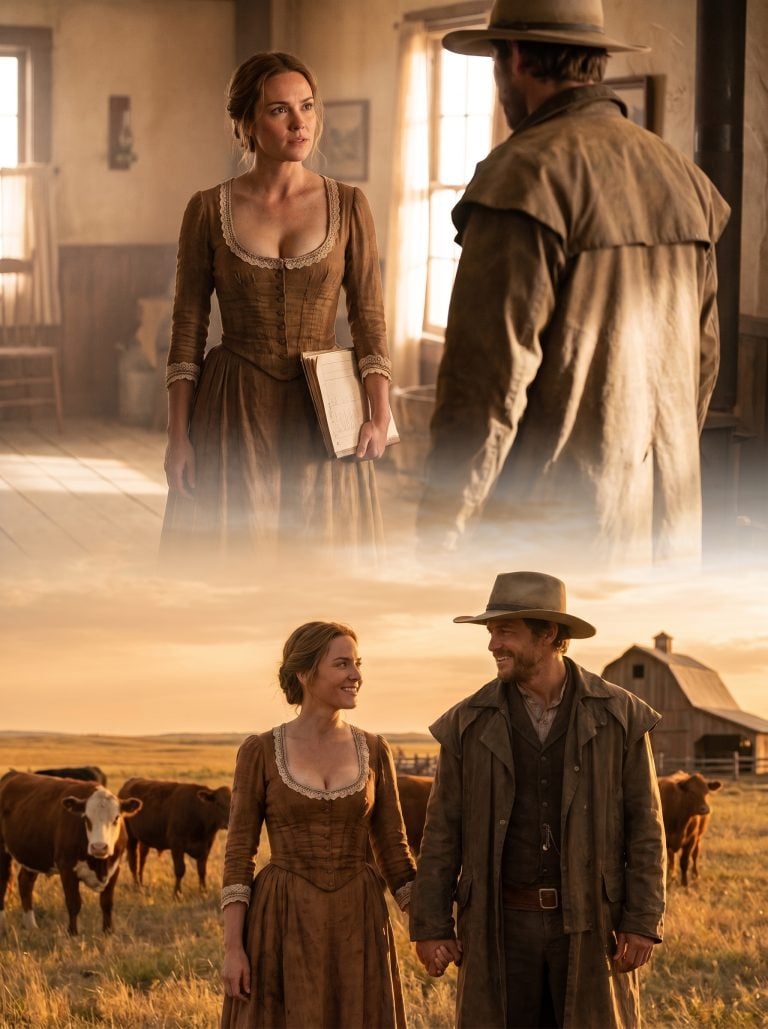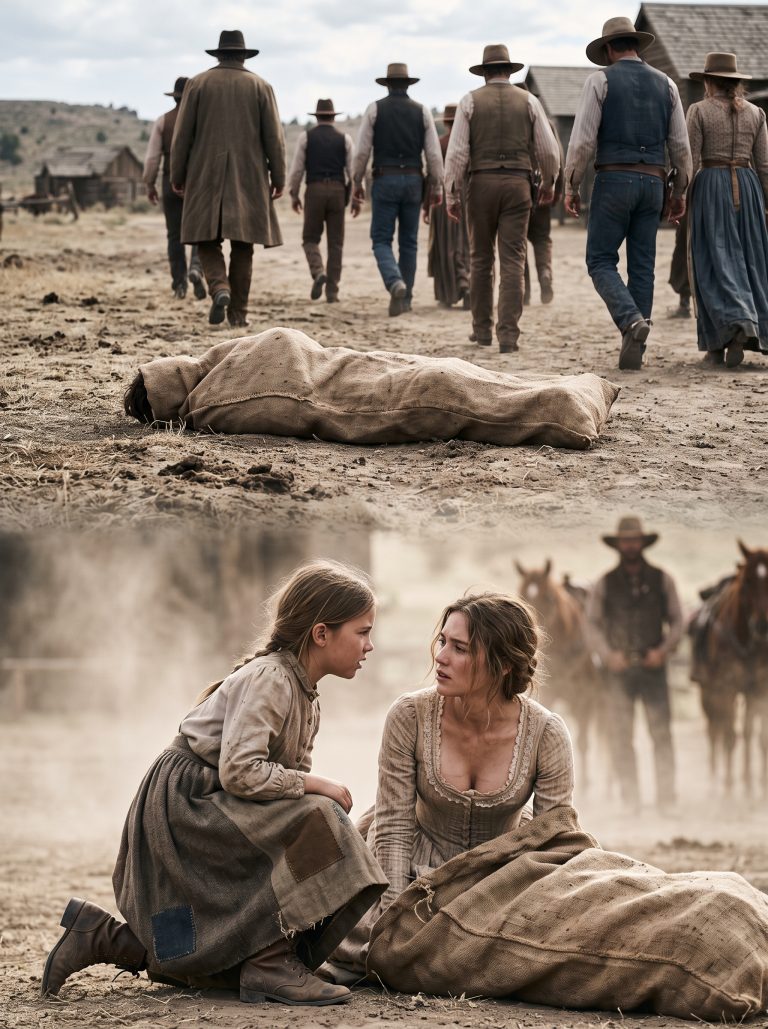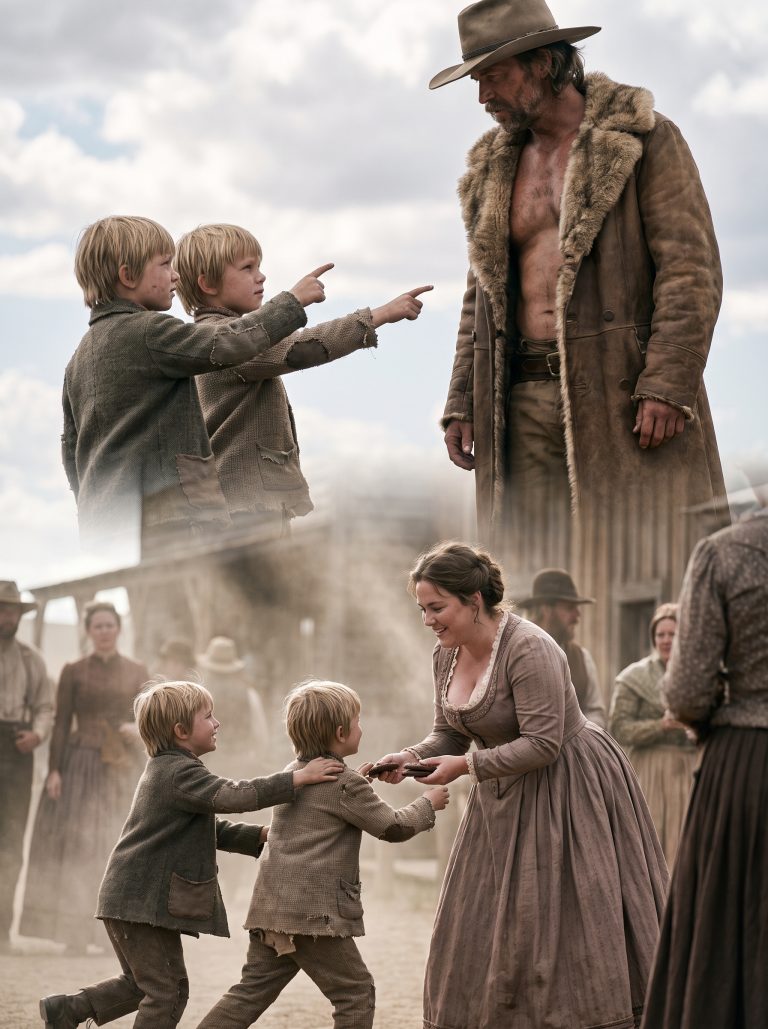
She Fell at His Feet Broken — He Stood Between Her and the Man Who Did It

Part 1
Eleanor “Nell” Whitfield learned the sound of trouble before she learned the sound of her own name spoken kindly. It was the scrape of a chair leg against raw pine floor, and by the time she turned twenty-three, she could tell from that single sound whether the morning would be survivable or not.
This particular morning it was not.
“You let the fire go out,” Silas Kane said. He hadn’t raised his voice. He never did at the start. That was the trick of him — the quiet always came first, patient as a snake deciding where to strike.
“I’ll have it going in a minute,” she said, keeping her back to him, keeping her voice flat the way she’d trained it to be. Flat didn’t provoke him. Flat was safe, or safer.
It wasn’t safe enough. It rarely was.
She’d married Silas Kane four years ago, believing the things a nineteen-year-old girl believes when her family has nothing left and a man with land and manners comes calling. Her father’s wheat farm outside Miller’s Bend had failed only weeks before, hard in the dead of that winter — failed suddenly, failed completely, in a way that still didn’t sit right in her memory, though she’d never had the leisure to examine why. Silas had married her within the month, before her grief had even properly settled. She’d thought it was kindness. She had been wrong about a great many things.
The cabin sat two miles from the nearest neighbor and six from town, on a stretch of Montana Territory that Silas called Bitter Creek and told her he’d chosen for the grazing. She’d learned since to distrust every reason Silas gave for anything.
That morning he crossed the room in the four steps she’d long since memorized, and the back of his hand caught her across the cheekbone before she’d finished her sentence. She went down against the stove’s iron edge, and the floor came up cold and hard under her palms, and she held very still — stillness kept things from getting worse, usually — and counted the seconds the way she always did, because if she let herself feel the whole of it at once, she wouldn’t be able to stand back up.
He rode for town an hour later, and she gave herself sixty seconds sitting on the floor before she made herself rise.
She’d been saving money for eleven months. Small amounts, shaved off the household reckoning at Hutchins’ dry goods — a penny here, two cents there — money that old Mr. Hutchins counted back into her palm without comment, looking somewhere over her shoulder while he did it. Thirty-one dollars now, folded into a pouch sewn into the lining of her second-best dress. Not enough. She knew the arithmetic of it better than she knew scripture.
She heard his horse come back into the yard early that afternoon, faster than she’d expected, and Silas came through the door without removing his hat, which was the only warning she ever got.
“Hutchins tells me you’ve been asking for cash back on your purchases,” he said. “For a while now.” He tilted his head, almost curious. “What does a wife of mine need cash for?”
She didn’t answer fast enough. The table went over. She went through the door before she’d decided to — her body deciding for her, eleven months of waiting finally spending itself all at once — and then she was running across the dry yard in her house shoes with Silas shouting behind her, gaining, always gaining, because she’d never once managed to account for how fast a furious man moved.
His hand closed on her arm and spun her down into the dirt just as hoofbeats sounded on the road. Unhurried. A single rider.
Silas went still the way a dog goes still at a sound past the fence line.
The rider didn’t keep going, though the road plainly wasn’t his to concern himself with. He reined in, swung down with the easy economy of a man who’d done it ten thousand times, and looked for a long moment at Silas Kane standing over a woman on her knees in his own yard.
“Afternoon,” he said. Low voice, no hurry in it. “Seems like maybe the lady ought to stand up.”
“This is my wife. My property. You’ve got no business here.”
“No,” the stranger agreed easily. “I don’t.” He took a step forward anyway.
What followed took less than a minute and ended with Silas face-first against a fence post and on his knees in his own dirt, more stunned than hurt. He made a sound Nell had never heard out of him before — small, winded, uncertain.
The stranger turned to her, giving her room, not crowding her the way every instinct in her body was braced for.
“Ma’am. You hurt?”
“My arm,” she said, and her voice came out smaller than she meant it to.
He crouched to steady her as she rose, and it was in that half-second, his attention fully turned to her, that Silas found his feet again. She heard the scrabble of boots in the dirt, the creak of the hitching post, and by the time the stranger looked up, Silas was already swinging onto his horse and driving it hard toward the road, toward town, toward every hard-drinking man in Miller’s Bend who owed him a favor.
The stranger swore under his breath — the first crack she had seen in his composure, brief as a struck match — and looked between the retreating dust and Nell’s ashen face, and made, visibly, the only choice a decent man could make in that instant: he stayed.
“Name’s Jonas Reid,” he said. “I’m bound for Bozeman. He’ll be back with company before dark, I expect you know that better than I do.”
“Is there somewhere you can go?” he asked her a moment later, once she’d caught her breath. “Family. A neighbor. Somewhere away from here.”
She thought of Mrs. Averill three miles east, kind but frightened, who looked away from bruises at church. She thought of the pastor’s counsel toward patience. She thought of thirty-one dollars and a sewn pocket and eleven months of careful theft.
“Not yet,” she said.
Something moved through Jonas Reid’s face. Not pity — she couldn’t have borne pity. Something steadier.
“All right,” he said, like it was the start of something rather than the end of it. “Then we’ll figure out what comes next.”