“Just Stay the Night,” He Said as the Snow Closed In—Months Later, He Was Asking Her to Never Leave His Side

PART 1
Snow doesn’t warn you. It arrives, and by the time you notice, the world has changed shape around you.
Wren Ashcombe felt the coach lurch sideways before she heard the wood splinter, and then she was thrown hard against the door, her shoulder taking the brunt of it while a leather satchel somewhere behind her burst open and spilled its contents across the floorboards. The horses screamed. The driver was already shouting something into the wind that nobody inside could make out. When the coach finally settled, tilted and useless in a drift at the base of Widow’s Notch, the silence that followed felt almost worse than the crash itself.
Wren stayed motionless for a long moment, her arm curled tight around the small wooden chest at her feet — the only thing left from a life that no longer existed. Paints. Two dresses. A ribbon-tied bundle of letters. A photograph gone soft at the edges. Everything else — the piano, the china, her mother’s writing desk — had been sold or left behind months ago, when her parents were still warm in the ground and the bank had started sending letters instead of condolences.
She was twenty-three, and for the first time in her life, no one was expecting her anywhere.
That should have felt like freedom. Mostly, it felt like being nobody’s concern.
The other three passengers were not so unmoored. Mr. Farraday, a peddler with a case of tin samples, was expecting to meet his wife in the territory capital, who carried their first child and couldn’t wait past this week. Mr. Voss, thick-shouldered and silent until it mattered, had a note coming due on his cattle spread that would ruin him if he didn’t sign it in person. And the widow across from Wren, silent nearly the whole way since Cheyenne, had two boys who needed her at a station further down the grade.
Wren had a letter. That was all. A single page from an aunt she’d met exactly twice as a child, written in a hand so careful it might as well have been chiseled.
Come, if there is truly no other roof left to you, the note read, dressed up in phrasing kinder than its meaning. A girl without income can still make herself of use, provided she’s willing.
She had been raised for drawing rooms and paint lessons, not for weighing which stranger’s need mattered more than her own. Grief, it turned out, taught a woman sums she’d never wanted to know.
Snow crusted the driver’s eyebrows by the time he came stamping back through it, and delivered the verdict like a man passing sentence. “Wheel’s broke past fixing. Storm’s closing the notch by dark. Relief sled from the Thorne place can only carry two, maybe three if we’re tight.”
Nobody spoke. Mr. Farraday stared down at his boots. Mr. Voss studied the ceiling like it owed him something. The widow kept her gaze fixed on nothing at all.
Wren looked at the chest between her boots and understood, with a strange, calm clarity, exactly what needed to happen.
“Take Mr. Farraday first,” she said. “His wife can’t wait on a storm to decide when a baby comes. And Mr. Voss needs to sign before that note ruins him.”
Farraday tried to argue. She didn’t let him finish.
The widow, it turned out, could manage the shorter walk down toward the station house if the storm gave her even an hour of grace — and by whatever mercy mountains occasionally allow, it did, just long enough. So the sled took the peddler and the rancher up through the closing notch, and the driver walked the widow toward the lights further down the grade, and Wren Ashcombe was left standing in the snow with two boxes and no plan at all, watching the storm seal off the road at her back like a door swinging shut.
She did not feel afraid. She felt, oddly, unburdened.
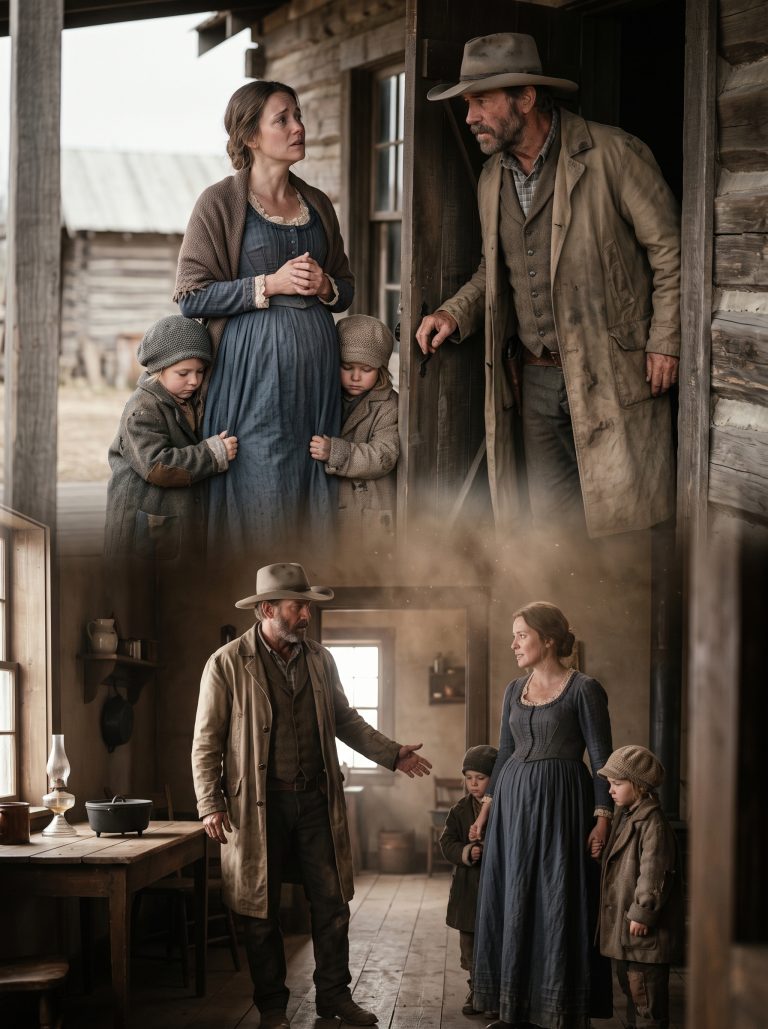
A man found her there less than an hour later. Not the driver — a stranger, tall and rawboned, with a beard cut by his own unsteady hand and eyes the color of turned soil after rain. His coat had double patches at each elbow, and he moved like someone who paid attention to wind before he ever paid attention to people.
He didn’t ask her name first. He took her in — once, briefly, noting exactly how cold and exhausted she was and how hard she worked not to show it — and said only, “You’ll want to come inside before the light goes.”
“I don’t intend to be trouble,” Wren managed.
“Trouble’s already in my yard,” he said. “No sense arguing with weather.”
His name, she would learn once the door shut behind them, was Silas Thorne, twelve winters alone under the Coldwater Range. He showed her to a small room off the main house — a door fitted with a bolt she alone could throw, nothing more — and told her, plainly, that he’d bed down with the animals through the cold months regardless, that he’d rap twice on the frame before stepping past it, and that he would not enter uninvited under any circumstance.
“You’re safe under this roof,” he said. “As near to safe as I know how to make it.”
Nothing since the funerals had come to her without a price tag of gratitude attached — until this.
She slid the bolt shut that night — not from fear of him, she realized, but because he had handed her the right to protect herself, and that alone nearly undid her.
Outside, the wind kept working at the mountain, sealing the pass a little more with every hour, and Wren Ashcombe fell asleep in a stranger’s house not knowing that the storm closing the road behind her was, in its own way, about to open something she hadn’t known was shut.
PART 2
Those early days had the particular clumsiness of two people who’d never shared a roof with a stranger before. Wren dumped too much salt in the stew. Silas left a trail of melting snow across floorboards she’d just scrubbed. Once, both their hands closed on the same coffee tin, and both let go just as fast, like the metal had scalded them.
A house sealed off by snowdrifts turns into its own small country soon enough. Silas was up and gone to the barn before first light most mornings, and Wren came to know the cadence of his return — boots on the step, a pause, a knock, then silence until she gave him leave.
Around the fire after supper, quiet gradually filled in with pieces of him. His parents, dead years back. A brother, Cass, gone south and never once sending word home. Neighbors who’d drifted off one hard season after another until there was nobody left near the notch but him.
“Doesn’t the solitude wear at you?” Wren asked one such evening.
“A body gets used to nearly anything,” he said.
“That’s hardly an answer at all.”
“No,” he agreed. “It’s not.”
On the ninth evening, she finally unlatched her paint case, having learned by then that sorrow only rooted deeper the longer she left it alone. She painted the view from the window first, dark pine against a pale gray sky, and said nothing to Silas about it. Come morning, she found the little board propped on his mantel, the first image that house had ever held.
Some nights later, aching for her parents badly enough to hurt, she pulled out their old photograph and began, by lamplight, mixing colors to bring their faces back from that fading square of paper. Silas came in carrying split wood, saw what she was doing, saw her wet cheeks, and quietly stacked the wood before retreating back into the cold, not saying anything at all.
Later, studying the finished piece, all he managed was, “You made them look kind.”
“They were,” Wren said.
“Never had anything like this,” he admitted. “No likeness of my folks. Nothing of Cass. Figured that never mattered much.” His jaw tightened. “Turns out I figured wrong. A face is the first thing memory drops.”
The next morning, unasked, Wren started a portrait of Silas himself — never posed, because he’d have refused outright. His fingers on a bridle strap. His shoulders hunched against a gust while hauling hay. When she set the finished board in front of him, he studied it so long she grew nervous.
“Never figured myself for a face worth keeping,” he finally said.
“Every face is,” she told him. “That’s the whole reason paint exists.”
Something shifted between them in that quiet — unspoken, but heavy as the snow still falling outside the glass — and neither one dared name it yet.
PART 3
It happened partway through a storm that lasted three full days, when a mare in foal ran into trouble she couldn’t manage alone. Silas hammered on the door well past midnight, frost stiffening his beard, and asked for help he trusted more than he wanted rest. Wren had her shawl around her shoulders before he’d even gotten the whole request out.
Inside the barn, the cold eased some but never disappeared entirely, and lantern light jerked wildly from its beam whenever wind found its way through a gap in the wall boards. The mare was down in the bedding, breath coming in hard, frightened gasps, her eyes wide and white-rimmed with something beyond simple pain. Silas crouched near her flank, outwardly steady, though his jaw had gone rigid as stone.
Wren spent the next two hours obeying him without question — steadying the light, fetching water she’d set to boil on the small stove tucked in the corner, murmuring low and constant to an animal too scared to understand comfort, while Silas worked with his arm buried to the elbow, fighting to turn a foal determined to arrive the hard way.
When the little thing finally slid free — soaked, shaking, drawing its first uneven breaths — Wren found herself both sobbing and laughing without any clear line between the two.
“Something wrong?” Silas asked, startled by the sound coming out of her.
“Nothing,” she got out. “Nothing at all — he’s breathing.”
Silas dropped back onto his heels in the straw, wrung out completely, and something behind his eyes eased in a way she hadn’t witnessed before that moment. Right there under the swinging lantern, he decided the colt would be called Ember, and when Wren teased him for going soft, his denial was so unconvincing it only made her laugh harder.
By February, that once-bare house had stopped being bare — small paintings crowding the flour bin, propped against shelves, tacked above the doorframe. By March, the eaves had begun weeping icicles through the afternoons, the barn path had gone soft and dark at its edges, and somewhere beneath all that remaining white, spring had started its slow crawl northward.
Wren stood one afternoon in the doorway of her room, looking at the bolt Silas had given her the very first night, and touched it lightly with two fingers.
“Something wrong with it?” he asked, coming up behind her, arms full of kindling.
“No,” she said. “I never once had to use it.”
He didn’t answer that. He only watched her, the way a man watches weather he can’t quite read yet, and for reasons Wren couldn’t name at the time, the thought troubled her far more than if she’d needed that bolt every single night of the winter.
The pass reopened in April, and the first thing to come through it wasn’t relief. It was gossip, dressed up as concern.
Word had traveled down from the notch that an unmarried young woman had spent an entire winter alone with Silas Thorne, and by the time that word made its way back up the mountain in a sleigh driven by a woman named Mrs. Pruitt, it had curdled into something uglier than the truth.
“You surely realize how this looks, dear,” Mrs. Pruitt said stiffly, seated in Silas’s parlor with a coffee cup she had no intention of drinking.
“I understand exactly how it looks to people who’d rather not see anything else,” Wren answered.
By the hearth, Silas looked down at the floor to hide what looked suspiciously like a grin.
“A whole winter, unmarried, alone with a man—”
“Mr. Thorne handed me a door I could latch myself and never once broke his word,” Wren said. “He spent every storm bunking with livestock rather than risk a night under this roof with me unchaperoned. I’ve felt more protected here than anywhere since I buried my own family.”
“That isn’t really the issue, is it,” Mrs. Pruitt said, two spots of color rising high on her cheeks. “Out here a woman’s reputation is the only currency she keeps. Once tongues start wagging the wrong direction, no locked door in the world buys it back.”
“Then perhaps this valley might spend less energy wagging tongues,” Wren said, calm as still water, “and a bit more energy finding out what actually happened before it settles on what to believe.”
Mrs. Pruitt returned her coffee cup to its saucer with a decisive little clink. “You’re remarkably brazen for a girl who has nowhere else to land.”
“I have a place to land,” Wren said. “I merely haven’t settled on whether I care to.”
Mrs. Pruitt departed considerably faster than she’d come, sleigh bells jangling off down the trail with more haste than the thaw called for. The valley, naturally, went right on believing exactly what it preferred.
Then a letter arrived from Aunt Cordelia — the handwriting narrow and severe, disapproval evident before the seal was even broken. Her aunt would still take her, the note promised, provided Wren came without delay, carried herself with sufficient thankfulness, and worked hard enough in that household to eventually earn back a name worth having.
Not family. Employment. A seat near somebody else’s hearth, hers only for as long as she stayed useful enough to keep it.
A second envelope showed up in that same delivery, addressed to Silas in a hand he hadn’t laid eyes on in years. He stood out in the yard reading it while snowmelt dripped steadily off the barn eaves, and he never did come in for supper until well past dark.
“Cass?” Wren guessed, once he’d finally set the folded page down between them.
“Cass,” he confirmed. “Laying rail somewhere two territories over. Writes that he’s been thinking of home more lately. Wanted to know if I was still up here by myself.” He turned his cup slowly without drinking from it. “First word from him in going on ten years.”
“Will you answer him?”
“Haven’t decided what I’d say.” His eyes went toward the mantel, toward her parents’ portrait sitting beside that first rough sketch of himself. “Might tell him he needn’t picture me quite so alone these days anymore. See if that’s enough to bring him the rest of the way home.”
Small as it was beside her aunt’s letter, that news settled into Wren all the same — the idea that a man who’d spent a decade convinced his own face was the last one his family would ever recall was, in his own careful fashion, beginning to hope for something again. She understood then just how much those paintings had asked of him to accept, and how much they’d handed back in return.
That evening, Silas got the offer wrong the first time, standing near the door with his hat crushed between both hands like a man readying a confession.
“Marry me,” he offered. “It’d put an end to the gossip. My name would settle whatever’s left for anybody to pick at. You’d still have your room. Your latch. I wouldn’t expect one thing more than what you chose to give.”
Something inside Wren turned colder than any snow left melting outside.
“No,” she said.
He raised his eyes, wounded.
“I won’t wed a man just to quiet Mrs. Pruitt’s mouth,” Wren told him, “and I won’t crawl back to my aunt to be grateful enough for a roof either. I’ve spent this whole winter learning to tell wanted apart from merely tolerated. I’d rather live with honest talk than convenient respectability.”
She turned for her room to start packing.
He let her walk away that time. But he found her minutes later, standing over a half-filled trunk, and stayed exactly where he was, refusing to step past the frame.
“I said that badly,” he said, low. “I framed it around the talk because if you turned that down, I could tell myself afterward it was just gossip you were refusing, not me.”
Wren froze where she stood.
“I’ve spent so many years by myself I mistook loneliness for my natural condition,” Silas went on, voice unsteady now. “Then an axle snapped on that mountain road, and somehow you landed here, and you covered every bare wall in this house with faces — my own included, back before I’d ever once believed myself worth keeping in memory. You gave my dead parents their color back using nothing but an old photograph. That colt lived, and you wept from sheer relief of it.”
His voice cracked on that last word.
“This isn’t about protecting my name,” he said. “It’s that I love you, Wren, plain and simple. The pass stands open now, and nothing keeps you here — except this house without you in it would be the loneliest thing I could imagine, and Lord knows I’ve had years of practice imagining lonely.”
Everything in front of Wren went soft at the edges.
“I told you once you could shelter here till the weather broke,” he said. “Well, it’s broken. So this time I’m asking it straight. Choose to stay. Not the gossip. Not any debt you think you owe. Just — I love you, and this house is yours too, if you’ll take it.”
Wren’s gaze traveled past him — to her parents’ likeness above the mantel, brought back from a photograph memory itself had nearly claimed; to the very first rough portrait of Silas by the hearth; to the window she’d painted blue with snow on the night she first stopped fearing winter.
She had traded away her spot on that sled because nobody on either end of the road held any love for her at all — and then, somehow, love had tracked her down anyway, in the last place on earth she’d have thought to search for it.
“Partway through that winter,” she said quietly, “I quit dreading the snow. Began dreading the thaw in its place.”
“Why’s that?”
“Because I thought spring only meant returning to being unwelcome, just under a different roof.”
“It doesn’t have to,” he said.
“No,” she agreed, stepping past the open trunk toward him. “It doesn’t.”
“Will you let me in?” he asked, still rooted exactly where the doorframe met the floor, never once having crossed it uninvited.
“Yes,” Wren said, half laughing now through the tears. “Yes — come in, Silas.”
He crossed it at last, and neither one moved for a long moment afterward, as though some part of each of them still braced for the floor to give way under happiness this plain and this undeserved. Past the window, the roof finally shed its last snow in one long, quiet slide.
“I have a single condition,” Wren managed, once her voice steadied.
Silas went rigid, bracing himself.
“You will sit for a proper portrait,” she said. “Just the one. However badly you hate every minute of it.”
Relief broke across his whole face, almost funny to watch. “That’s all?”
“That’s all.”
“I’d have said yes to worse.”
“I know,” she said. “Which is exactly why I only asked for something small.”
Their first kiss, when it finally came, was slow and careful, the kind shared by two people who both understood exactly how close fear had come to deciding things for them instead.
They married that May in the dooryard, under a sky rinsed clean by mountain spring, wild yellow blooms pushing stubbornly up through the last melting patches along the fence line. Mr. Farraday made the trip back, wife and baby daughter in tow, exactly as he’d sworn he would that dreadful day on the road, and he cried again at the ceremony — openly this time, with no storm around to take the blame. Mr. Voss showed up with two full flour sacks, a jug of something he insisted was plain cider, and a grin too broad for his usually grave face.
Word came from Cass three days before the wedding, too late for the trip but not too late to be read out loud at supper, Silas’s voice going rough partway through. Cass would visit come autumn, once the railwork slowed, and wanted, he wrote, to meet in person the woman who’d apparently taught his brother to smile again.
Even Mrs. Pruitt showed up, dutifully suffering right up until Wren pressed a tiny painted portrait into her hands, made from a church locket Wren had quietly noticed her wearing for months — a portrait of the daughter Mrs. Pruitt had lost years before and almost never spoke of to anyone at all.
Mrs. Pruitt sank onto a bench and wept outright, and not a soul in that yard thought any less of her for it.
There was supper laid across plank tables dragged out into the grass, more food than any valley had business producing that early in the season, and a fiddle showed up from somewhere, and Mr. Voss danced with his own wife in public for what felt like the first time in memory, clumsily and without a shred of embarrassment. Wren and Silas danced exactly once, stiff and careful and grinning like fools the entire time, and privately agreed afterward never to repeat the performance in front of witnesses again.
After that, the valley’s opinion righted itself the way frontier opinion tended to, the instant it wanted something enough. And what it wanted, as it turned out, was a faithful likeness of every face it was afraid of one day losing for good.
Riders came from three counties over just to sit a while in the Thorne front room, while Wren painted children before illness could claim them, mothers before hard seasons wore them down, sweethearts before the road pulled them apart for good, old men before another winter finished what the years had started. The very same women who had once whispered about her snowbound season now showed up in their finest dresses, hoping to be remembered kindly on a plain board of painted wood.
Wren painted every one of them. Not flattery — the truth, handled gently.
One frosty morning that first autumn, a young mother named Sara Kettering rode two hours to ask whether Wren might paint her son before a fever already circling the lower valley found its way to their door. The boy sat still purely because his mother bribed him with peppermint, kicking his boots against the chair legs, sneezing once mid-sitting and demanding to see the unfinished work before Wren judged it fit to show anyone.
“Looks like he’s about to bolt straight out of the frame,” Sara said, laughing despite herself as she studied the wet paint.
“He is,” Wren agreed. “That’s rather the whole idea. Better to remember him mid-run than remember him sitting still.”
The boy never did catch that fever, though two households further down the valley weren’t so lucky that hard season. Sara kept the little portrait above her own mantel for the rest of her days regardless, telling anyone willing to listen that the woman up at the Thorne place didn’t merely capture faces — she caught the exact instant right before something was about to happen, which was, in Sara’s estimation, the only instant genuinely worth saving.
Silas put up a proper studio along the south wall of the house, tall windows and everything, insisting it was purely practical since the parlor had grown too crowded. Wren said nothing back to that, only pressed a kiss to his bearded cheek amid the sawdust and grinned as a rough, solitary rancher went red clear to his ears.
Cass turned up that fall exactly as he’d promised, thinner than his brother remembered and quieter than either of them had expected, and he stood a long time studying the wall of paintings before he trusted his own voice enough to speak.
“You made all of this?” he finally asked Wren, unable to pull his eyes from a likeness of a woman he hadn’t laid eyes on in a decade — pieced together from fragments Silas had handed over one detail at a time across a dozen long evenings, since Cass had left home before anyone had thought to keep a photograph of their own mother.
“Your brother remembered a good deal more than he ever gave himself credit for,” Wren told him gently. “I only mixed the color. His memory did the rest.”
Cass didn’t answer that directly. He only nodded once, in exactly the manner that told Wren precisely where his older brother had picked up the habit.
He stayed the winter through, then the spring that followed, and eventually raised a small cabin of his own within view of smoke curling from Silas’s chimney — because it turned out a man could grow accustomed to being alone, but he needn’t remain that way once somebody proved he didn’t have to.
Every spring after that one, without exception, Wren painted Silas again — a shade more silver threading through his temples each time, a little more softness settling around eyes that had once studied nothing but weather and cattle. A whole line of Silas Thornes eventually filled the hallway, standing alongside a growing collection of neighbors, children, and the odd stubborn old rancher who’d sworn for years he had no use for portraits, right up until he saw what she’d managed with everybody else’s likeness.
“Most-painted man for three counties,” she liked to tease him. “Making up for all those years you had no likeness anywhere at all.”
“Paint whatever pleases you,” he always told her. “It’s your house, after all.”
“Our house,” she’d correct, without fail, every single time.
“Our house,” he’d agree, meaning it a little more with every passing season.
Sara Kettering’s boy grew tall and sturdy and eventually brought his own children back to sit for portraits, restless in that same chair his mother had once bribed him into occupying with peppermint. Mr. Voss’s cattle spread outlasted the note that had nearly finished it, and the Voss family sent word every single Christmas after, as if that first winter’s debt could never quite be settled in full. Mr. Farraday’s daughter grew up on the story of the broken axle and the mountain storm, told so often she could recite the whole thing herself, and half-joked that she owed her very existence to a wheel giving out at exactly the right moment.
Aunt Cordelia never wrote again, and Wren discovered, rather to her own puzzlement, that the quiet didn’t ache the way she’d expected. Some doors, once a person truly understood what waited on their far side, were better left shut than forced open out of old habit, or guilt, or obligation that had long since stopped meaning anything.
Two paintings hung together always in that front room, side by side above the hearth — one of a mother and father brought back from a photograph memory had nearly claimed, and one of a solitary rancher caught in firelight that first winter a stranded, grieving woman decided he oughtn’t go through life forgotten.
Years afterward, whenever an early storm sealed Widow’s Notch white again, Wren would stand at that same window with Silas’s arm settled warm across her shoulders, watching the road disappear beneath fresh snow the same way it had the very first day she’d arrived carrying two boxes and no plan whatsoever.
By then, children’s boots lined the doorway every winter, small and mismatched and forever underfoot, and the hallway held too many painted faces to add one more without shifting something else aside first. There was a rocking chair Cass had built with his own two hands one long, unhurried winter, positioned close enough to the fire that whoever sat in it would never have cause to wonder if she belonged there. And there remained a latch on a bedroom door that had never once needed using again — one that both of them had silently agreed, without ever discussing it outright, to leave exactly where it was. Not as a warning anymore. Simply as a reminder of the man Silas Thorne had chosen to be, long before there was any promise of a reward waiting for it.
“You ever think back on that old coach, and the exact spot where the wheel finally gave?” he asked her once, years on, the memory having long since softened into something almost fond to hold.
“Constantly.”
“Any regrets?”
She settled into him, watching the day’s last light drain slowly off the ridge, gold sliding into gray sliding into deep blue the way it always did up here in the final minutes before true dark took hold. “Only that the axle didn’t snap sooner than it did.”
He laughed, low and easy, the sound of a man who’d spent a lifetime learning what it meant to be found and had long since stopped being astonished by it. “Storm closing the notch by dark,” he murmured, echoing the old verdict from that very first afternoon. He pressed his mouth briefly against her hair, unhurried and sure of himself. “Best thing that ever happened to either one of us. I’ve had plenty of quiet years now to be certain of that.”
Outside, winter settled back over the road the same patient, total way it always had, indifferent to the small, warm lives passing beneath it.
Inside, the walls stayed full of faces — dozens of them by then, all painted by a woman who’d once believed there was nowhere in the world she was truly wanted. Every single one of those faces, in that particular house, had somewhere it belonged. Wren had once believed love meant staying useful enough to earn a spot beside somebody’s fire. She learned, eventually, that real love meant being wanted there anyway — on the one night a road broke apart beneath her and neither of them was ever quite the same again afterward.