“Please… Don’t Send Me Away,” The Widowed Mother Whispered—And The Lonely Farmer’s Answer Changed Everything

Part 1
“Please, let us stay the night.”
Caleb Hartley heard the voice before he saw the woman it belonged to.
Dusk had settled thick over the valley outside Millbrook Creek, the kind of hour when fence posts turned to black bones and every hollow in the fields looked deeper than it had by daylight. Caleb stood at his broken gate, hammer in hand, pretending to fix a hinge that had already been fixed twice. For three years now, since the fever took Rachel and left him a farm to run and a silence to keep, he had quietly stopped believing that broken things could truly be mended. He only knew how to keep his hands busy pretending otherwise.
He worked because the land did not care that his heart had gone quiet. It only asked to be plowed.
The voice came again from the road. “Please.”
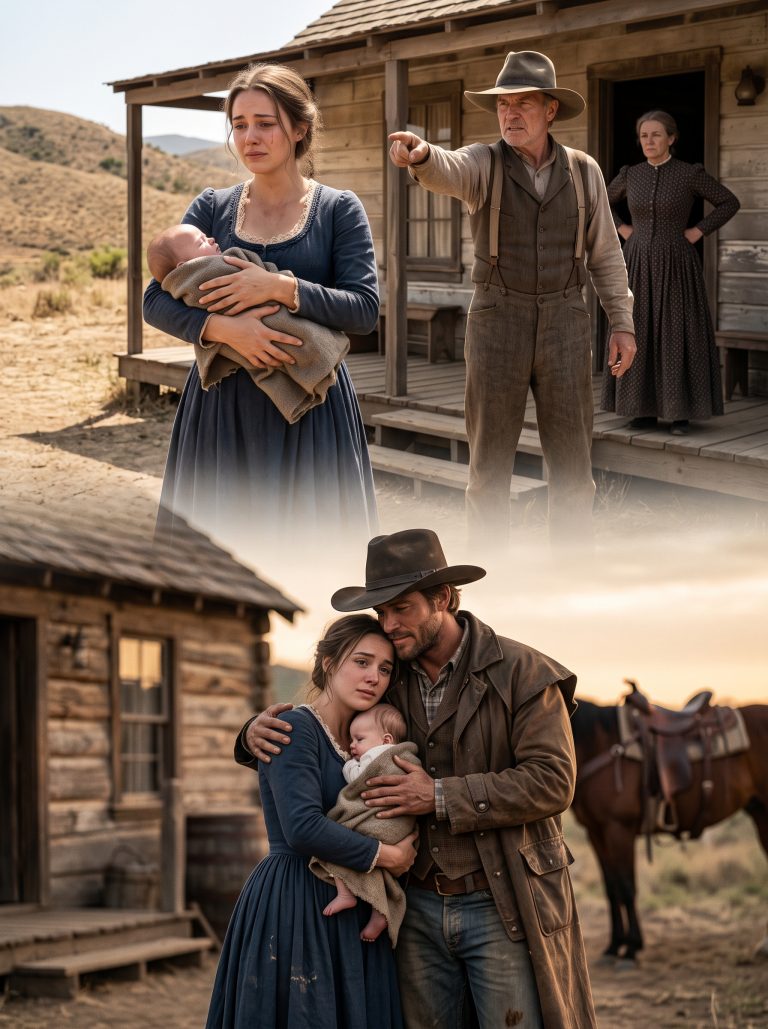
Sarah Langford stood at the edge of his land, one hand on the gatepost as if she did not trust her legs. A boy of seven clung to her neck, his breath rattling with a cough that had followed them, she would later say, since Boise. A small tin box hung from a cord at her wrist, gripped so tightly her knuckles had gone white — tighter, Caleb noticed, than she gripped the boy.
He knew her name the way any man in a small town knew the names of widows and debts. Her husband, Thomas Langford, a tenant farmer east of the county line, had died the winter before when a weakened barn beam gave way beneath him — a beam he’d been patching alone at night, folks said, because Josiah Calloway’s bank had turned down his request for a repair loan that same month. The bank had taken the land in spring. She’d been staying with the Dawson family since, sewing for her keep.
“What happened?” Caleb asked.
“Mr. Dawson said it was no longer suitable,” Sarah said. “Sheriff Calloway came by yesterday. After that, Mrs. Dawson wouldn’t look at me.”
Something hardened under Caleb’s ribs at the sheriff’s name. Wade Calloway wore his badge like a verdict, and his younger brother Josiah ran the only bank between Millbrook Creek and the county seat. Between the two of them, they had opinions about who deserved a roof.
“They turned you out with the boy sick?”
“He’s only tired,” Sarah said, though she didn’t set him down.
Caleb looked at the tin box at her wrist. She caught him looking and drew it closer to her body, the way a woman protects something dearer than herself.
“Just for tonight,” he said, and opened the gate.
The house took them in like a breath held too long. Caleb gave them the back room — once his wife’s sewing room, now full of seed sacks and a narrow bed. He fitted the door with a proper latch and gave Sarah the chair nearer the stove. He noticed she never once let the tin box leave arm’s reach, not even to eat.
“What’s in it?” he finally asked, not from suspicion, but because a man noticed things in his own kitchen.
“Papers. Thomas’s papers.” Her voice went thin. “It’s all I kept when they took everything else. I don’t rightly know what half of it means. I only know he told me, before he died, to never let the bank see it.”
Caleb didn’t press further. When Sarah reached for her small purse to offer him something, anything, for the trouble, only thirty-two cents lay inside. A woman who had walked four miles with a sick child and thirty-two cents had earned the right to her secrets. He closed her hand gently around the coins instead of taking them.
By morning, a rider named Saul Pickett passed slow on the road, saw the boy wrapped in a quilt on the porch, and rode on with his head turned too long. Sarah saw it too. Her shoulders straightened.
“We’ll go as soon as Micah’s eaten,” she said. “I’m grateful for the shelter.”
Caleb looked at the boy’s pale mouth, then at the dry lower field he’d let go to weeds because a man alone could only care so much.
“I could use help,” he said, surprising himself. “House. Garden. Chickens. I pay little, but I pay. There’s the back room. It latches.”
Sarah studied his face for a long moment. “Until I find somewhere else?”
“Yes,” he said, because he had no right to say otherwise.
She held out her hand. He shook it.
Micah smiled for the first time since the road — small, uncertain, and it changed the whole yard.
That was how Sarah Langford and her son came to stay at Hartley Farm. Not by promise. Not by romance. By a cold night, a child’s cough, and a farmer who needed more help than he admitted.
Part 2
Millbrook Creek began talking before Sarah had slept three nights under Caleb’s roof.
At Sunday service, she sat with Micah near the back while two pews stayed empty beside her. Caleb, who hadn’t set foot in church in a year, sat down in one of them. Mrs. Voss’s eyebrows rose to her bonnet brim.
The weeks that followed rearranged them both. With warm meals, steady rest, and the cough syrup Caleb fetched from the mercantile, Micah’s rattling breath slowly eased until it disappeared altogether, and the boy’s laughter began to outrun the chickens. Sarah scrubbed the kitchen until Caleb felt ashamed of how long he’d let it go, hung Rachel’s curtains washed but not replaced, and asked before clearing Rachel’s dead hollyhocks — “I can save the seed. Plant it fresh by the fence. That way it isn’t gone. Only moved where it can grow.”
Caleb turned so she wouldn’t see his face. “All right.”
Sheriff Calloway rode out in October.
“Town’s concerned,” he said, eyes moving to Sarah hanging wash.
“If the town needs something to occupy it, it can come plow my lower field,” Caleb answered.
“A widow with her reputation invites talk.”
Sarah crossed the yard before Caleb could speak. “Mr. Dawson suggested I might be grateful in ways no decent woman would mistake. When I refused, I became unsuitable. Did that reach town concern, Sheriff?”
Calloway’s jaw tightened. “That’s a serious claim.”
“It’s a serious memory.”
“You have proof?”
“My word — and I expect that’s worth less to you than my late husband’s papers were worth to your brother’s bank.” She said it lightly, almost carelessly, and did not see how the sheriff’s face went still as stone.
Caleb saw it, though. He filed it away without understanding it yet.
“She stays,” he said.
Calloway mounted. “This won’t end clean, Hartley.”
“Not much does,” Caleb said.
That night, Sarah sat across the table from him, rain on the roof. “I don’t want to be a cause you take up because you’re tired of being alone.”
“You ain’t a cause,” Caleb said. “You’re Sarah. You hum when you knead bread. You argue with my mule like he’s a church elder.” He swallowed. “I want you to stay.”
Her hand moved halfway across the table. He covered it with his own.
A week later, Sarah noticed a rider pause too long at the fence line at dusk, watching the house rather than passing it. It was not the first time. Twice before she had caught the shape of a stranger lingering near the yard after dark, and both times she had told herself it was nothing. She said nothing to Caleb that night either, but the next morning, while he was out with the plow, she carried the tin box to the barn and pried up a loose board in the tack room, the small side chamber where saddle leather and harness oil were kept. She no longer trusted leaving the papers anywhere inside the house. She wrapped the box in oiled cloth against the damp and settled it beneath the board.
“Safer with the tools than with the teacups,” she murmured to no one, and told herself it was only caution.
Part 3
The barn burned on the coldest night of January.
Caleb woke to Micah’s shout. Smoke pressed against the windows — sharp, wrong, starting on the east wall where no honest spark belonged. He ran into cold that struck like a slap, Sarah already ahead of him, hair unbound, shawl over her nightdress.
“Fill buckets, only to the trough,” Sarah told Micah, and then she was in the smoke beside Caleb, pulling her shawl over the terrified mule’s eyes while Caleb cut the mare loose. They freed the chickens together. When a calf bawled from the rear pen, Caleb reached for the axe himself this time — no arguing about who ran toward the fire and who ran from it. They cut the boards together and dragged the calf clear a heartbeat before the roof caved.
Neighbors came at dawn. Saul Pickett said he’d seen a rider on the road near midnight — dark, but the horse had a white blaze. Everyone in Millbrook Creek knew Deputy Silas Crane rode a sorrel with a white blaze, and that he’d told Caleb once in the mercantile that a farm with “a loose widow” was bound to invite cleansing trouble.
Sheriff Calloway arrived last, coat buttoned wrong. “Bad accident,” he said, looking at the ruin.
“No accident,” Caleb answered. “We smelled kerosene at the east wall.”
It was then that Sarah went still, staring at the collapsed east corner — the tack room, the fire’s clear point of origin, though no one else had thought to ask why that particular wall, why that particular corner of a barn otherwise full of hay that would have burned just as eagerly from any direction. She pushed through the smoking ruin before Caleb could stop her, dropped to her knees at the scorched floorboards, and pried up what was left of the loose board with her bare, blistered hands. Beneath it, the tin box was buckled and black, but the oiled cloth had held.
She unfolded the papers with shaking hands in front of everyone.
They were not sentimental keepsakes. They were copies — in Thomas Langford’s careful hand, made in the last months of his life — of loan documents bearing Josiah Calloway’s signature, showing the Langford farm’s debt had been forged higher than the note Thomas himself had signed, the difference pocketed quietly by the bank before foreclosure. Thomas had discovered the fraud weeks before the barn collapse that killed him. He’d told no one but his wife, and told her only to keep the papers safe until he found a lawyer he could trust.
He never got the chance.
The yard went silent. Every neighbor who had ever whispered about “the widow’s arrangement” now understood, all at once, why Sheriff Calloway had wanted her gone from the start — not for propriety, but because as long as Sarah Langford had a roof and a reason to trust someone, she was a woman who might someday show those papers to the wrong person. Someone had been watching the house closely enough to guess where a widow with no belongings of her own might hide the one thing she’d carried out of her old life — and had gambled, wrongly, that torching the tack room would end the matter along with the evidence.
“You shouldn’t have disturbed those papers,” the sheriff said, too fast, too sharp.
“I saved them,” Sarah said. “From your deputy’s fire.”
Caleb stepped beside her — not in front, beside — and felt the last three years of careful, cowardly quiet burn away easier than any barn. “You’ll do your office, Sheriff. Or the county marshal can ask why Millbrook Creek’s law set fire to a widow’s barn to protect his own brother’s bank.”
By evening, Deputy Crane had fled town, riding west with his tack and little else. The county marshal wired a warrant before sunrise, and two counties over, a stationmaster who recognized the sorrel’s white blaze held him for the county sheriff to collect three days later. After two days of questioning, Crane finally admitted that Josiah Calloway had ordered him to burn the barn, hoping the confession might buy him a leniency it did not.
Sheriff Wade Calloway did not go quietly. He called the fire an accident twice more, in writing, before the marshal’s own inquiry into the ledgers made that position impossible to hold. There was not enough evidence to prove he had ordered the fire himself — only that he had known his brother’s fraud, and had used his badge for a month afterward to keep it buried. That alone was enough to end him. He resigned before the county could remove him, and left Millbrook Creek before the spring thaw, unmourned.
Josiah Calloway was arrested for fraud and for falsifying loan records. The court could not return the Langford farm itself — the land had long since been resold to a family two valleys over who’d farmed it in good faith — but it ordered the bank to pay Sarah the land’s full value, with the interest wrongfully collected from Thomas’s estate, and it was enough, with what Caleb already had, to rebuild the barn twice over.
The marshal also looked again at how Thomas had died. He found no proof of a hand in it — only what the town had half-known all along, that Thomas had been patching that same weakened beam alone at night because the bank had refused him a repair loan, weeks after he’d found the forged notes. Whether it was accident or a debt collected more cruelly than paperwork, the years had erased too much to say for certain, and the marshal wrote it down honestly as such. Sarah found she could live with that uncertainty better than she could have lived with never asking at all.
None of it undid a death in a collapsed barn. But it meant Sarah Langford stood in Millbrook Creek for the first time not as a woman the town had taken pity on, but as a woman the town owed.
The barn was rebuilt through the spring, wider doors, a corner for Micah’s carving bench, a south wall for Sarah’s climbing beans. “Beauty need not ask permission from usefulness,” she told Caleb, and he thought it sounded like something Rachel would have said, and told her so. The memory still ached, but for the first time in three years, the ache felt warm instead of hollow.
In April, a letter came from Thomas’s cousin in Idaho, offering Sarah and Micah a respectable home, no gossip, no burned barns.
“You’re free to choose,” Caleb made himself say, hanging his hat slowly on its peg, though what he meant was no, don’t go.
“Then ask me to stay,” Sarah said.
“Will you stay, Sarah?”
“Yes.”
He held her in the kitchen where she’d first sat exhausted over bread and coffee, and told her he loved her — the noise she put in his house, the seeds she planted like she was arguing with the whole world, that she let him remember Rachel and never made Thomas’s memory a wall between them.
Micah found them kissing in the doorway and asked, scandalized and delighted, “Are you marrying Mama?”
Caleb went down on one knee to the boy first. “I’d not replace your pa. No man could. But I’d stand with you both, if you’ll have me. Can you still talk about him?”
“Yes.”
“Can you keep his knife?”
“Yes.”
Micah considered this with great seriousness. “Then yes.”
They married in June beneath the hollyhocks Sarah had grown from Rachel’s saved seed — pink, yellow, deep red, blooming along a fence that had once held nothing but grief. The town came, some from affection, some from having finally learned which stories they’d been wrong about. Saul Pickett apologized awkwardly for an old joke. Caleb accepted it the way a man learns which boards can be reused after a fire, and which have to be thrown out for good.
Years later, Caleb found Sarah kneeling again at the garden’s edge in late dusk, pressing seeds into soil that had once been called poor ground.
“Do you ever wish you’d gone to Idaho?” he asked.
“No.”
“Do you ever wish I’d been easier?”
She laughed. “Often.”
He kissed her forehead. She slipped her arm through his, and they looked back down the road that had once brought her to his gate with a sick child, thirty-two cents, and a box of papers she hadn’t known yet would save them both.
“I had nowhere to sleep that night,” she said.
“I remember. I thought I was giving you shelter.”
“You were. But it turned out shelter wasn’t the only thing worth giving.” She squeezed his arm. “You gave a stranger’s truth room enough to survive the fire meant to bury it. That’s rarer than a roof, Caleb.”
Caleb looked back down the road that had first brought her to his gate. He had believed, that night, that he was only offering shelter until morning. Instead, the door he’d opened for one cold hour had given a stranger’s truth somewhere safe to survive — and given all three of them, slowly and without either one planning it, a home.
Inside, Micah called that supper was ready, though he’d only set bread on the table and felt proud of it. Sarah smiled and opened the door. Warmth came out to meet them, and they went in together, no longer afraid of what a living house might still ask of them.
The End