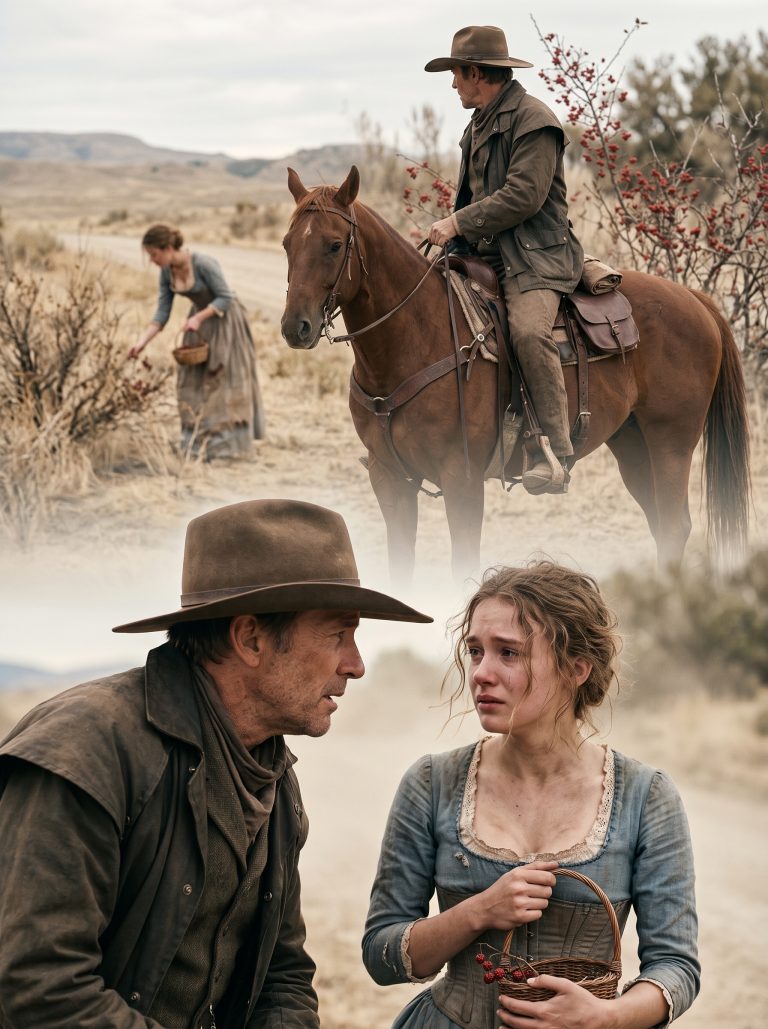
“Kill me,” she whispered—He lifted her skirt & saw the horrific secret branded into her flesh.

Part 2
Over the next two weeks, she told him the rest in fragments while the raw wound slowly began to heal.
Not a farm accident. Not a runaway wife with a debt to a bad husband. A place. A real place, with a name that made her hands shake when she said it out loud for the first time — a stockyard, she called it, though it never held a single head of cattle.
“Women who couldn’t pay debts,” she said one night, staring into the fire instead of at him. “Women whose men died in the war. Women nobody would come looking for.”
She said marked us the same flat way she’d say fed us — like it was one more chore on a list, not the worst thing that had ever been done to her.
“Fire took the place two weeks back,” she said. “I ran. Been running since.”
Elias asked the only question that mattered.
“Whose place was it?”
And that was when she said the name that would follow both of them out of that cabin and into a fight neither of them had asked for: Jonah Bakesley. A man, she said, who wore a sheriff’s badge like it was decoration and called what he did to women lawful debt — like there was a courthouse anywhere in Texas that would sign off on iron burned into skin.
Elias thought that was the whole shape of the danger. A man with a badge and a grudge and some hired guns.
He was wrong about that too.
Because three days later, in the general store in Bandera, a drunk with a bruised jaw looked at Mave’s auburn hair a beat too long, and said the word reward out loud in a street full of listening men — and somewhere behind that word was a number. A specific number. Big enough that half the town went quiet doing the arithmetic in their heads.
Elias put the drunk in the dirt with one punch. That wasn’t the part that scared him.
The part that scared him was the silence that came after — the way three or four faces in that street didn’t look horrified. They looked interested.
Before any of it turned uglier, at the general store, Mave had stood a long moment with her fingers on a bolt of sky-blue cotton printed with tiny white flowers. She hadn’t asked for it. Elias bought it anyway, without asking what she meant to make of it, and set it in her arms like it weighed nothing. It was the first new thing anyone had given her in two years without expecting ownership back in return.
By the time he rode alone into Bandera to face Bakesley himself, and heard the man say, calm as reading a grocery list, that Mave’s mother had signed proper contracts — that the debt came to three thousand dollars, and at standard rates that came to fifteen years of a woman’s life — Elias understood that this wasn’t a fight about one wounded girl by a creek anymore.
It was about whether a piece of paper with a forged signature on it could turn a human being into a possession, and whether anyone in that country was willing to say no to a man wearing a badge.
On his way out of town, he stopped at Samuel Cross’s ranch. Cross had served beside him in France, and had come home to a spread just outside Bandera and a standing habit of writing letters to men he still knew in Austin. Elias laid out what he knew — the badge, the burn, the stockyard that had burned down two weeks before Mave ran from it — and asked Cross to find out whether any of it would hold up to daylight.
“I’ll send word tonight,” Cross said. “Can’t promise Austin moves fast.”
Bakesley gave Elias twenty-four hours to bring her back.
Elias rode home in the dark already knowing what his answer was going to be — and knowing, too, that the men coming for it wouldn’t be riding in alone, and that whatever Cross could do for them might not arrive in time to matter.