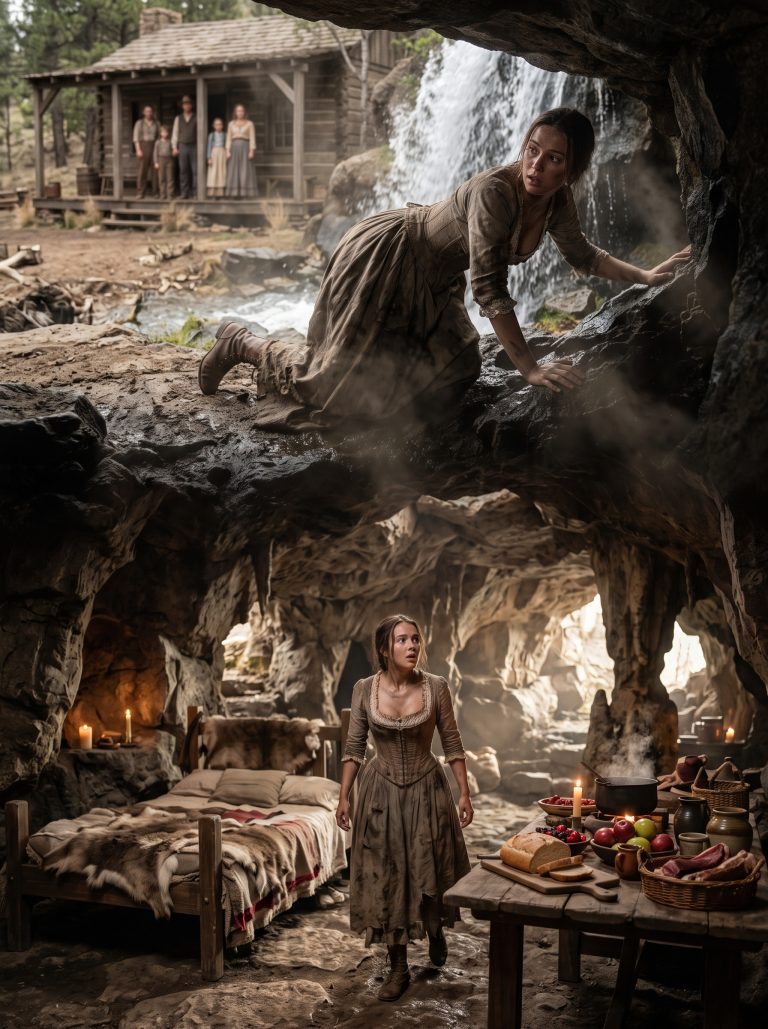
The town mocked the mountain man for marrying a blind widow — until she built an empire that destroyed their pride.

Part 1
Silas Cole heard the laughter before he saw the woman.
It rolled out from the back of Harlan Cobb’s mercantile, low and pleased, the kind men used when they wanted cruelty to sound like common sense. Silas paused inside the doorway, snow melting off his shoulders.
Every head turned. Then every head turned away.
That was how Coldwater Ridge greeted him, twice a year, when he came down from the high country with pelts bundled tight across his packhorse. The town liked his furs. It did not like him — too large, too silent, too marked by country respectable people preferred to fear from a distance.
He had come for coffee, salt, and lamp oil. Nothing else concerned him.
Then he heard the cane. Tap. Sweep. Tap.
A woman stood near the flour sacks, a gray shawl around narrow shoulders, her face turned toward the laughter though she could not see its source. Anna Whitfield. Everyone in the valley knew the name. Her husband, Daniel, had drowned in the Coldwater three years back, chasing a mill he never finished. A fever took her sight the winter after.
Pity had soured into something meaner once it lasted too long.
Elias Thorne, the bank manager, stood before her now in a fine wool coat, his voice pitched for the whole room. “The penalty is due, Mrs. Whitfield. Fifty dollars by noon, or the bank files seizure on the claim.”
“I have twenty,” Anna said. “I can bring the rest from my weaving orders.”
“Weaving.” Thorne’s smile widened, inviting the room to share it. “You cannot see the thread, Anna.”
Someone by the cracker barrel snorted.
Silas crossed the room before he decided to. His boots struck the floor heavy and slow, and the laughter died in pieces ahead of him.
“Fifty clears it?” he asked, not to Thorne, but to her.
Anna’s head turned toward the unfamiliar voice. “Who’s speaking?”
“Silas Cole.”
Something crossed her face — not relief, not yet. Caution. “Fifty clears the penalty.”
He counted the notes onto the banker’s ledger without another word. Thorne’s mouth worked, but he wrote the receipt, and he left the store faster than dignity required.
Silas folded the paper and held it toward her, then remembered, and tucked it carefully into her shawl pocket instead.
“Why?” she asked.
“I dislike Thorne,” he said, which was true, though not the whole truth. The whole truth had a name he had not spoken aloud in three years.
Anna’s hand found his sleeve, steady despite the moment. “Then we have a bargain, Mr. Cole. Nothing more.”
By Friday, the bargain was a scandal. Reverend Hale found Silas loading his wagon and delivered the town’s verdict in one sentence: an unmarried man could not shelter under a widow’s roof, however honorable his reasons. Marriage, or nothing.
The word landed between them like an axe finding grain.
“I won’t force it on you,” Silas said.
Anna’s fingers tightened on her cane. “No one is forcing anything,” she said, with a flatness that meant the opposite. “But wood is dear, and breath is cheap. Let them talk.”
They married that afternoon in the vestibule of the small clapboard church, a dozen townsfolk come to watch, Amos Pruitt laughing outright when Silas set a plain iron ring on her finger. Anna’s hand closed hard around his wrist.
“Let them,” she whispered. “I did not marry a man for his manners.”
He did not kiss her. No one had asked whether she wanted that, least of all him.
He only offered his arm. After a long moment, she took it.
The road out to the Whitfield claim followed the river a mile from town, mud holding the wagon wheels like a grudge. When the property came into view — a sagging cabin, a leaning chimney, and beyond it the blackened skeleton of Daniel Whitfield’s failed mill sunk in the flood mud — Silas pulled the team up short and said nothing at all.
“It’s bad,” he finally admitted.
“I know,” Anna said. “I was blind, Mr. Cole. Not absent.”
She had him unload her tools before her trunk, and led him — cane sweeping, boots certain — straight to the rotted mill frame. Her palm traveled the grain of the main support beam the way another woman might read a letter.
“Too close to the floodline,” she said. “Daniel used pine where oak was needed. He built like hope could replace measurement.”
“You know how to build a mill?”
“I know how this one failed.” She drew a ball of twine from her pocket. “Take the end. Walk fifteen paces inland from the old hub. Tell me when your boot strikes stone.”
He obeyed, more from curiosity than obedience, and at the fifteenth pace his boot rang against granite under the moss.
“Tie it low and tight,” she said, and by dusk the riverbank was crossed with a web of string that was not a shack, not even a simple mill, but a plan — drawn entirely from memory and the sound of water she had spent three winters learning by heart.
What surprised him was how easily his own hands fell into the work — pacing distance without needing to count aloud, setting a stake so true that Anna’s fingers found no error in it. A trapper had no cause to know a surveyor’s tricks.
“You measure like a man who has done this before,” she said, not quite a question.
“Some,” he said, and did not offer more. She did not press, though she filed the answer away as carefully as everything else she could not see for herself.
“They laughed because you chose me,” Anna said, facing the river she could not see. “But I was not waiting to be chosen. I was waiting for someone strong enough to lift the beams, and sensible enough to listen.”
Something in Silas Cole, clenched tight since a winter three years gone, loosened half a turn.
“What do you need first?”
“Timber.”
He rolled up his sleeves though the cold bit his forearms. “Then we start with timber, Mrs. Cole.”
Part 2
The axe began before dawn and did not stop for two weeks. Silas felled pine on the ridge with brutal precision while Anna worked the clearing beside him, her hands finding knots and rot his eyes sometimes missed, scoring cut-marks into stripped logs with an iron nail and mallet.
The first time she corrected his mortise — “the left wall is a quarter inch too shallow” — he went still, then shaved the joint true without a word of protest. He had spent years among men who mistook correction for insult. Anna simply knew the work, and honored it by being exact.
At night the cabin held them uneasily — Silas on a bedroll by the hearth, Anna in the narrow bed, the marriage a legal shape with no life in it yet. But life crept in anyway: the rail he built for the crooked porch steps, the low laugh that startled them both, the evenings she learned the sound of him — the hitch in his breath before a hard truth, the way his silence changed between thinking and hurting.
“You should say amusing things more,” she told him once.
“I’ll see what can be done.”
He told her, in pieces, about a brother named Eli, lost in a slide in the high country when Silas was twenty-one and certain he knew the mountain well enough to challenge it. He did not tell her the rest — that two winters after burying Eli, he had taken a season’s paid work for a bank out of Helena, marking mineral claims onto a survey map for men he never met. That the work had brought him along the bend of the Coldwater the same spring Daniel Whitfield was raising a foundation in ground Silas could see, at a glance, was wrong — too close to the floodline, set on pine where the current wanted oak. He had said nothing, telling himself a paid man’s silence was the same as a stranger’s courtesy, since the terms of his work forbade him from speaking of what he’d found buried in the rock nearby. He rode on. Two weeks later the river took Daniel Whitfield exactly where Silas had known it would.
He carried that the way he carried the scar under his collar — silently, and alone.
The mill rose through the mud and cold, board by board, until Tobias Fowler rode out one afternoon wrapped in arrogance and a red scarf.
“Thorne’s got a private note,” he called. “Signed by Daniel before he drowned. Eighty dollars due December first, against the deed.”
Anna’s shoulders sagged for the first time since Silas had known her.
“It may be true,” she said. “Daniel signed too much when he was desperate.”
“We have no money,” she added, when Silas said nothing.
“Then we build until we must pay,” he said. It was not an answer. It was the only one he had.
Part 3
He sold the Hawken rifle that had fed and defended him for twelve years, and did not tell her until the receipt was already in Thorne’s ledger. When she found the empty sling, her ruined, healing hands rose to his shoulder as if the rifle’s absence were a wound she needed to bandage herself.
“You sold your life for my debt.”
“I bought us time.”
She was quiet a long while after that, sitting by the fire with her bandaged hands turned palm-up in her lap, as though she could weigh what he had given away by the shape of the empty air where it should have hung. “Daniel never once told me what a thing cost him,” she said. “Only what it would become. I used to think that was faith. Now I think it was only a way of never having to hear me say no.” She turned her face toward Silas. “Tell me what this cost you.”
“Twelve years of not going hungry,” he said. “And every night before this one, not needing anybody.”
“And now?”
“Now I need the note paid, and I need you not to catch cold arguing with me barefoot on this floor about a rifle already sold.”
She laughed despite herself, and did not mention the Hawken again — though after that, he noticed she kept the empty sling hanging where her hand could find it by the door, and touched it sometimes on her way past, the way another woman might touch a rosary.
The great oak for the axle took two days to fell and three to drag to the riverbank, a monster of a log, heavy as grief. Setting it into the stone cradles that would carry the wheel’s turning weight meant swinging it out over the half-frozen Coldwater on a derrick of two lashed poles, and wading into the current himself to guide it home.
“Tension!” he shouted, waist-deep in water sharp enough to steal his breath.
On the bank, Anna braced the hoist rope around both forearms. “I have it!”
“Lower two inches!”
The rope paid out clean and even under her grip — until the lashing at the derrick’s crown gave way with a crack like a rifle shot. The axle swung wild and caught Silas across the chest, driving him under.
He came up choking, one arm hooked over the log, current dragging hard at his boots. Above him, the whole weight of the oak had not fallen — because Anna was holding it, both hands locked white-knuckled around a rope that was tearing through her gloves as fast as she could brace against it.
“Drop when I say!” he shouted, shoving the axle toward the cradle stones.
“Now!”
She let go. The oak slammed home with a boom that shook water off the bank. The collapsed derrick went into the river behind it.
Silas dragged himself onto the mud and found Anna already on her knees beside him, her hands searching his chest and shoulders before he’d caught enough breath to tell her he was whole.
Her palms were wet — too wet, and not with river water. The hemp had torn straight through her gloves and the skin beneath. Blood ran dark in the dusk light and had already begun to freeze along her wrists.
Winter closed in cruel and precise after that. Anna’s hands healed slow and left pale ridges across her palms — ridges Silas learned to read the way she had once taught herself to read grain and current. He changed her bandages each night, asking each time before he touched her, “May I?” and she answered, each time, “Yes,” until the asking itself became a kind of vow neither of them had spoken in church.
By the time the saw first sang through green pine, and the Cole Mill turned its wheel against the current for the first time, Coldwater Ridge had learned to stop laughing and start paying its bills. Reverend Hale came for siding and left having paid full price, in silver, without another mention of Christian charity. Harlan Cobb came for joists after his own roof caved under snow, and haggled with a blind woman who quoted him a fair price and did not move a cent from it.
Neighboring homesteaders came for barn boards. Ranchers came for bridge planks. A freight agent from the northern spur came for railroad ties, and paid in advance once word spread that the Cole Mill delivered true to the inch and never once short a board. Anna kept the ledger in her own system — knots on cord for orders placed, notches carved for accounts settled — and made Silas read every incoming letter aloud twice before she trusted her memory of its terms over his voice.
The cabin grew with the business. Silas built a second room before the spring thaw, not for propriety — no one troubled them about that anymore — but because Anna needed space for her ledgers, her patterns, the small wooden gear models she carved from scrap to test a ratio before it ever touched the real mill. He set shelves at the height of her reaching hand, laid a rail from cabin to mill she said she did not need and then used every single day, and cut notches into the porch post to mark direction: cabin, mill, road, garden, river.
“You are turning the whole world into a handrail,” she told him once, not unkindly.
“Only our piece of it,” he said, and heard himself say our before he’d decided to, and saw the way it changed her face when she heard it too.
It was in March, with the river high and vicious and the mill running twelve hours a day, that Elias Thorne rode out with a county deputy and a folded injunction, certain at last that he had found the ground to stand on.
“Interference with a navigable waterway,” Thorne announced. “A judge has ordered the mill closed.”
“The Coldwater above the gorge is not navigable,” Anna said, and lifted her cane to point, unerring, toward the granite ridge beneath the structure. “And the mill itself is not on Daniel’s original section in any case. When Silas and I set the new foundation, we moved fifteen paces inland — onto federal land I filed for the day my tax debt was cleared. The mill stands there, on the federal parcel. Daniel’s original acreage, the land he deeded and paid taxes on until the day he drowned, remains mine outright, untouched by any injunction a judge could write.” She drew a folded envelope from her coat. “The approval on the federal claim came back a month ago.”
The deputy read it, and looked at Thorne with open disgust. Thorne rode away with nothing.
That should have been the end of it. It was not.
Three nights later, Amos Pruitt and two other men came at the mill with a sledgehammer and a can of coal oil, and Silas caught them in the dark before the first blow landed. He did not kill anyone. He lifted Pruitt by his coat front until his boots left the mud.
“Who sent you,” Silas said. Not a question.
“Thorne,” Pruitt gasped. “Said — said there’s more than money in it for him. Said he’d pay double if the mill burned before the note came due, on account of a paper he don’t want folks reading closer.”
“What paper.”
“I don’t know! I don’t ask him what I don’t want to answer for in court.” Pruitt’s boots scrabbled uselessly in the mud. “He just said the note’s the whole reason, not the money. Said if the mill stands past spring, he’s ruined worse than she ever was.”
Silas let him go and stood a long moment listening to the wheel turn in the dark, the words “worse than she ever was” turning over in his mind, slower than the water. No man feared losing fifty dollars the way Thorne feared losing that mill. A man only feared like that when something far larger lay buried underneath it.
He went straight to Ezra Reed’s forge before dawn, not for iron this time but for memory. Reed had cosigned half the notes in that valley as a witness of trade, and kept his own dog-eared ledger of every signature he’d watched pressed onto paper for a decade, out of a smith’s plain habit of trusting nothing he hadn’t hammered himself.
It was there, laying Daniel Whitfield’s old purchase receipts for nails and hinges beside the note Thorne had waved at the mill door, that the truth surfaced — the twist Silas had not seen coming, though it had been standing in plain sight since the day he arrived.
The eighty-dollar note bearing Daniel Whitfield’s signature had not been signed by Daniel Whitfield at all. The hand was close, practiced, but wrong in the loop of the D — a forgery Thorne had drawn up himself the winter after the drowning, banking correctly that a grieving, newly blind widow would have no way to examine a signature, and that no one in town would think to doubt a banker’s paper. It was never about the debt. It was about the land Daniel had unknowingly staked over a vein of galena ore that a surveyor’s report, buried in Thorne’s own files, had flagged two years before Daniel ever set a single post in the mud.
Thorne hadn’t wanted the widow gone because she was a burden. He had wanted her gone because she was sitting, unknowing, on something worth twenty mills.
Silas rode back with the forged note and a fistful of Daniel’s genuine receipts from Ezra’s ledger, and it was Anna — not Silas, not the deputy, not any man in that valley — who did the work of proving it. Ezra laid the papers side by side and described each stroke aloud while Anna traced the grooves the pen had pressed into the paper, comparing them one by one against the shape of a signature she still remembered from three years of watching Daniel sign their own household accounts by her side before the fever took her sight. The forged D pressed too hard at the start and broke in the middle, where Daniel’s hand had always moved in one unbroken line.
“He built his whole scheme on the belief that I couldn’t check his work,” she said quietly. “That is the last mistake men like Thorne ever learn not to make.”
Word of the forgery reached town before the deputy did. Harlan Cobb, of all people, rode out to fetch the circuit judge two weeks early, muttering that he had sold Thorne his good ink and had no wish to be remembered as a man who’d stood by twice while a blind widow was cheated on his own floorboards. Reverend Hale preached a sermon that Sunday on the sin of false witness and did not once look toward the Cole pew, which the congregation agreed was its own kind of confession.
Amos Pruitt, having given up Thorne’s name in the mud that night, took work at the mill that spring — not because Anna forgave easily, but because she told him plainly that a man’s usefulness was worth more to her than his shame, provided he kept both where she could see them. He became one of the mill’s steadiest hands, and never laughed at anything Anna Cole said again.
But it was the surveyor’s report itself — the one Thorne had buried rather than filed — that turned Silas’s private guilt into something written down and undeniable. The report was dated the spring before Daniel Whitfield drowned, and it named the man who had walked that claim and first flagged the ore seam for the bank’s private ledger.
The signature at the bottom was his own, in a cramped, younger hand he barely recognized. He had known, of course, that he’d marked the seam that season — he had carried that knowledge alone for three years. What the report told him now, in Thorne’s own careful filing, was the rest of it: that the bank had known exactly what lay beneath Daniel Whitfield’s land since before Daniel ever set a single post in the mud, and had simply waited for the widow to be alone and unable to check a signature before moving to take it.
He had not caused the forgery. He had not caused the drowning. But he had, without knowing it, drawn the very line on the map that made Daniel Whitfield’s land worth stealing in the first place — and Thorne, patient as rot, had simply waited three years for the right moment to use it.
He told Anna that night, expecting the ground to shift beneath the marriage the way it had once shifted beneath a mountainside above the Bitterroots. Instead she sat with the report’s edges under her fingers for a long while, tracing the indented writing as though it might soften with enough patience.
“You marked a seam in the rock,” she said finally. “Thorne marked a widow for ruin. Those are not the same hand, Silas, whatever paper they both happen to touch.” She folded the report closed. “I have spent three years learning that a thing built in darkness is not the same as a thing built in bad faith. You did the first. He did the second. I will not let you carry his sin because your name sat closer to it than you knew.”
Thorne did not get the chance to flee. Ezra Reed had already ridden the surveyor’s report and the forged note to the territorial bank examiner in Helena — a man Reed had once shod horses for and trusted more than any judge in Coldwater Ridge. Federal marshals took Thorne off the noon stage three weeks later, his trunk already packed for Butte. The examiner’s audit turned up two more forged notes besides the Whitfield one, both written against widows with no kin nearby to check a signature. Thorne’s bank charter was revoked before summer. He was convicted that autumn of forgery and fraud and sent to the territorial prison at Deer Lodge, and Coldwater Ridge got a new bank manager who made a point, that first week, of reading every note aloud twice to anyone who couldn’t read it themselves.
Anna heard the verdict read at Cobb’s counter and said only that some men needed the whole weight of the law to teach them what a widow’s cane had already made plain.
The land, and the ore beneath it, stayed exactly where Daniel Whitfield had accidentally set it — in his widow’s name, worth more now than his failed mill ever would have been. Anna never once treated the ore as anything but a fact to be managed, the same as timber or grain. She leased the claim to a company out of Butte on terms she dictated herself, insisted on a royalty rather than a lump sum, and used the first payment to build a proper schoolhouse on the ridge road rather than add another room to her own house.
“You could have kept it for us,” Silas said, when she told him.
“I did keep it for us,” Anna answered. “There is more than one way to be rich, Silas Cole, and I have already buried a husband who never learned that.”
Spring turned to a long, easy summer, and for a while Silas let himself believe the worst of it was behind them — the note burned, Thorne in irons, the ore leased on Anna’s own terms. But some nights he still woke reaching toward the empty sling by the door, forgetting for half a breath that the rifle was gone.
Anna always woke when he did. She never asked what he’d dreamed. She only found his hand in the dark and held it until his breathing matched the river outside.
“You still carry it,” she said, one such night. Not a question.
“Some.”
“Then carry it beside me instead of alone. That is the only part I ever asked to change.” She did not press further, and he did not offer more, and the silence between them settled into something easier than either had known before — not forgiveness spoken aloud again, since it had already been given once and did not need repeating, but simply two people learning to sleep through the same dark without flinching from it.
By the following autumn, the Cole Mill ran with twenty men on its payroll and orders backed up to the railroad spur. Children came up from the valley so Anna could teach them sums by knot and string, and to close their eyes and listen to water the way she had, and to understand — she told them plainly, the way she told everyone — that darkness was not the same as emptiness, and that pity dressed up nicely was usually just laziness wearing its Sunday coat.
Coldwater Ridge never turned kind all at once. Towns rarely do. But it learned to pay its bills on time, and to stop mistaking a quiet man for a foolish one, and a blind woman for a helpless one.
Years later, when people told the story down at the mercantile, they liked to say Silas Cole had saved the widow Whitfield.
That always made Anna laugh — a low, rusty sound she’d once thought she’d lost for good.
He hadn’t saved her. He had simply stopped walking past what needed fixing, and stayed long enough to listen to a woman who had spent three dark years drawing a whole world in her head, waiting only for someone patient enough to help her build it.
On the first snow of their third winter, Silas came home with sawdust in his beard, and Anna stood at the stove with one hand resting on the counter he’d built to the exact height of her wrist.
“You are late,” she said.
“Gear tooth cracked. Fixed it with the oak peg.”
“Good.” She smiled, faint and certain. “Do you regret any of it? The rifle. The town. Any of it?”
Outside, the wheel turned steady in the dark, its rhythm carrying up through the frozen ground and into the warm, lit house.
“Not once,” Silas said, and meant it the way a man means the truest thing he owns.
She turned in his arms to face him, though facing him had never meant seeing him, only knowing exactly where he stood. “Do you know what I have learned, these three winters?”
“Tell me.”
“That the town was wrong twice over. They thought I was helpless because I could not see, and they thought you were dangerous because you would not talk. Both of us were simply waiting to be measured by someone patient enough to do it properly.” She rested her scarred palm flat against his chest, over the old scar at the base of his throat, the one usually hidden beneath his beard and collar from anyone who didn’t already know to look for it. “You were never the mountain man who saved the blind widow, Silas. You were only the first man honest enough to admit the widow already knew how to build.”
He had no answer polished enough for that, so he gave her the only kind he owned — true, unhurried, and without apology — and told her, board by plain board, exactly what the ridge looked like under the first snow, the black seam of the river cutting through white, the mill’s dark shape standing solid against the mountain they had both, in their own ways, refused to let defeat them.
“That is poetry, Silas,” she said.
“No,” he said. “It’s only what’s there.”
“It is poetry,” she said, “when I can finally see it.”
And in the small, warm house on the ridge, with bread cooling under a cloth and coffee ready by the fire, Silas Cole held his wife and listened to the sound of home working steadily all around them — proof, if either of them had still needed it, that some things built carefully enough in the dark come out true.