“Let Me Stay, I’ll Raise Your Son,” She Begged—What She Did Next Changed His Life Forever

PART 1
The baby had been crying for an hour, and Ethan Walker had run out of ways to make it stop.
He walked the porch boards in slow circles, little Noah pressed against his shoulder, one big calloused hand cupped around the back of a head so small it frightened him every time he touched it. The Wyoming sky had gone the color of a dying fire, gold bleeding into rust bleeding into the first bruised purple of night, and somewhere past the tree line a coyote was answering his son’s cries with a howl of its own.
Three months. That was how long Sarah had been gone. Three months since the midwife had come out of the bedroom with her apron soaked red and her eyes refusing to meet his. Three months of learning, badly, how to be a father and a widower in the same breath.
He could gentle a wild mustang in an afternoon. He could set a fence post in frozen ground. He could drag felled timber for six miles, go three days without proper sleep, and still be first up at dawn. None of that mattered here. Here, on this porch, with this crying, starving, furious little person who had his wife’s eyes and nothing of her calm — here, Ethan Walker was just a man failing.
That was when he saw her.
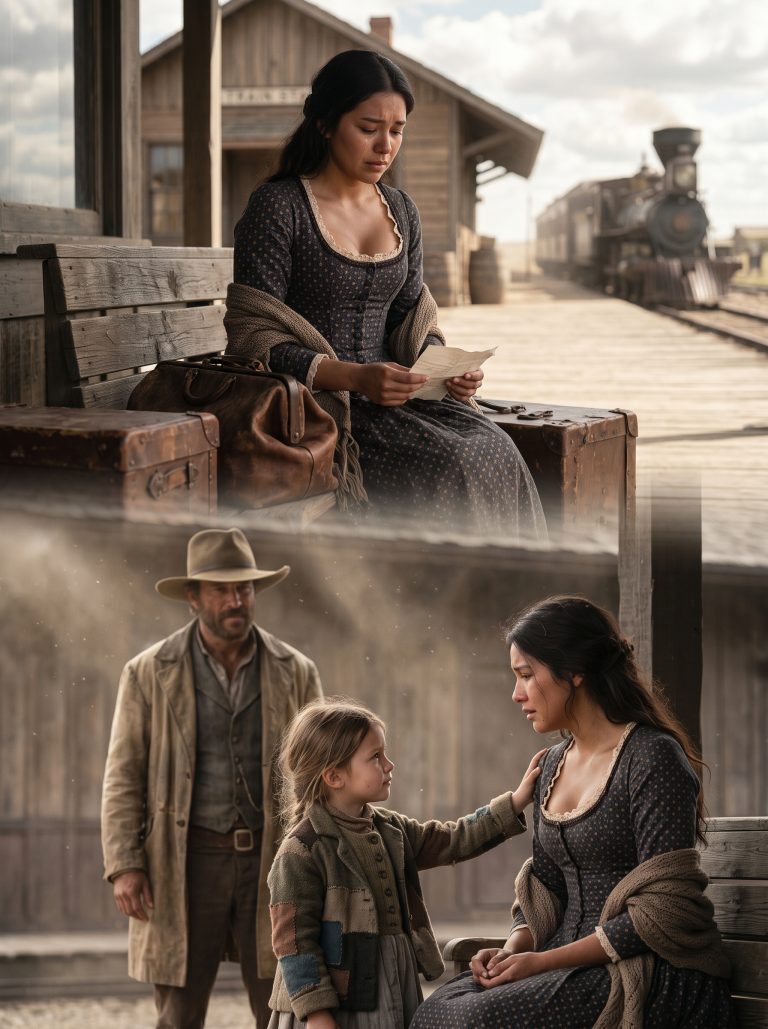
A shape on the road, small against the darkening hills, moving with the particular unsteadiness of someone who has walked farther than her body wanted to go. No horse. No wagon. A faded dress the color dust turns everything eventually, a red headscarf gone the color of old brick, and a bundle of cloth slung over one shoulder that could not have held more than a change of clothes and whatever pride she had left.
She stopped at the gate. Not at the porch — at the gate, like she already knew she hadn’t earned the right to come closer.
“I’m sorry to trouble you.” Her voice had the careful evenness of someone who has learned that begging sounds different from asking, and has trained herself never to beg. “I haven’t eaten since yesterday.”
Ethan’s arms tightened around his son, some old instinct rising before he could question it. “I don’t have much to spare.”
“I understand.” She nodded, already turning to go — and stopped.
It was Noah’s crying that stopped her. Ethan watched something shift in her face, watched the exhaustion in it sharpen into something closer to recognition.
“You’ve been alone with him. Haven’t you.”
It wasn’t a question. Ethan found himself answering anyway. “How could you know that?”
“The way you’re holding him.” She took one step back toward the gate, no more. “You’re not doing anything wrong. You’re just… out of hands.” A pause. “You’re exhausted, and you don’t have anyone to hand him to when you are.”
The wind came up through the yard, carrying the smell of woodsmoke and horses and the particular emptiness of a house with one too few people in it. Ethan said nothing, because there was nothing true he could say that wouldn’t undo him standing there in front of a stranger.
She came closer. Not fast. The careful, deliberate pace of someone approaching something that might startle.
“I’m not asking for charity.” Her voice shook on the last word, and she seemed to hate that it had. “I’m asking for work.”
Still he said nothing. What was there to offer a woman with no references, no family name, nothing but a few meager belongings and a hunger she was clearly trying to hide better than she was managing?
She looked at him then, really looked, the way people rarely do, like she was reading something written on the inside of his face, and said the seven words that neither of them would ever be able to unsay.
“Let me stay. I’ll raise your son.”
The wind seemed to hold its breath along with him.
“I can cook,” she said, quickly now, like she’d been rehearsing this on the long walk up the trail and needed to get it all out before her nerve failed. “I can clean. I can mend clothes, milk cows, work from sunrise to dark and never once complain about it.” Her chin lifted, some last scrap of dignity refusing to let her voice break entirely. “I don’t need wages. Not yet. Just a roof, and let me care for him.”
And then, as if the ranch itself had decided something Ethan hadn’t yet agreed to, Noah stopped crying.
He reached one small fist toward her, fingers opening and closing on air, and the stranger, after one breath of hesitation, one look at Ethan as if asking permission with her eyes because her mouth had already asked too much, lifted the baby from his arms.
Noah’s cries thinned into hiccups, then softened further, his small body slackening against her shoulder like he had finally, after three months of grief passed hand to hand between strangers, found somewhere that felt like rest.
Ethan stood on his own porch and stared at his son settling in the arms of a woman whose name he did not yet know, and felt something give way inside him that he had spent three months holding shut with both hands.
“What’s your name?” he managed.
“Grace.”
It felt, absurdly, like the only word that could have fit.
He did not know yet that this was only the beginning — that somewhere behind her, in a town she’d left at a dead run with nothing to her name, a man was already telling lies about why she’d gone. He did not know that the peace settling over his porch that evening had a price still waiting to be called in. All he knew, standing there in the dark with his son finally asleep, was that for the first time in three months, his house wasn’t only full of grief.
It was full of something else now too. And he wasn’t ready to name it yet.
PART 2
Grace stayed that night in the small room off the kitchen that had once held Sarah’s sewing things, and by the time the sun cracked over the eastern ridge, she was already awake, already dressed, already moving through the kitchen like she’d lived in it for years instead of hours.
Ethan came down to the smell of biscuits and the sound of his son laughing — actually laughing, a high delighted sound he hadn’t heard since before Sarah’s last month, when even the baby in her belly seemed to know something was wrong. He stood in the doorway for a long moment before either of them noticed him, just watching Grace bounce Noah on her hip with one arm while she turned biscuits with the other, humming something low and half-remembered under her breath.
“You’ll never be treated like a servant here,” he said finally, because it needed saying before either of them got used to something less. “If you work this land, you eat at my table.”
Something moved behind her eyes — surprise, and beneath the surprise, a wariness so old it had become part of her posture, the look of someone bracing for the kindness to have a hook in it. When she found none, her shoulders came down half an inch.
“That’s more kindness than I’ve known in a long while.”
Days folded into each other after that, each one a little less like grief and a little more like a life. Grace repaired the cradle Sarah had once painted with wildflowers, working the old wood back into shape behind the barn with a patience Ethan found himself watching longer than he meant to. She tended the garden Sarah had planted and never lived to harvest. She sang to Noah in a voice too soft to have an audience, and somehow Ethan was always close enough to be one anyway.
“He doesn’t need expensive things,” she told him one evening, watching Noah grip fistfuls of grass on a blanket in the yard like they were the finest toy ever made. “He just needs to know someone’s always going to be there.”
Ethan didn’t answer. He’d stopped trusting himself to answer her plainly, lately. There were things forming in his chest that he had no right to feel about a woman he’d known less than a month, a woman who slept in his dead wife’s sewing room and had appeared out of the dust with no history he could name.
The valley noticed before he let himself admit it.
“That drifter’s been at the Walker place three weeks now.” He heard it secondhand, the way you always hear the worst things — filtered through a neighbor’s careful concern. “Nobody knows where she’s from. You’d think a man raising a motherless child would be more careful who he lets near him.”
“She’s probably after the land,” someone else offered. “Women like that always are.”
He should have expected the knock at his gate. He hadn’t expected it to come from someone he’d called a friend for a decade.
“Send her off before the talk gets worse, Ethan.” No malice in it — that was almost the worst part. Just the tired conviction of a man who believed he was being helpful. “For your sake. For the boy’s.”
Ethan looked past him, to where Grace sat in the yard clapping Noah’s small hands together, teaching him the rhythm of it, laughing when he got it wrong and laughing harder when — on the third try — he got it right.
“They’re free to talk,” Ethan said, and something in his own voice surprised him with how sure it sounded. “I’m free to be grateful. If loving my son makes her family, then this ranch is exactly where she belongs.”
His friend had no answer for that. He rode off with his warning unclaimed, and Ethan told himself the matter was settled.
He didn’t know Grace had heard every word of it from the well, where she’d frozen mid-step with a bucket in each hand. He didn’t see the way her eyes filled — not from the gossip itself, she’d weathered worse — but from the astonishing, unfamiliar fact of someone standing between her and it.
For the first time since losing everything, she thought, setting the buckets down with hands that would not quite stop shaking, I’m not just surviving here. I might actually be home.
She’d mentioned her past to him only once, in the vaguest terms — a ranch out past the county line, a man named Whitmore she’d worked for before landing here, nothing more — and the name had cost her enough to say that Ethan let it pass without another question. Months later, he’d remember it.
Seasons turned over the ranch after that. Noah took his first wobbling steps by midsummer, one hand fisted in Grace’s skirt the whole way. By the time the aspens had gone gold and dropped their leaves and come back green again, he’d started stringing sounds together that might, if you loved him enough, already be mistaken for words. Grace had been part of the rhythm of that house for so long by then that neither of them could easily picture the shape of a day without her in it.
It was in the hush of a new spring, nearly a year after she’d first stopped at that gate with nothing to her name, that the peace finally broke.
A man rode into town that Grace recognized from a hundred yards off, recognized by the set of his shoulders in the saddle before she could even see his face, and every hard-won inch of ground she’d built on the Walker ranch went cold in her chest like a held breath.
He was asking about her by name before he’d even dismounted. And what he was telling people, in a voice pitched to carry across the whole street, was that Grace had stolen from him. That she’d vanished from his ranch in the dead of night with money that wasn’t hers. That whoever was sheltering her now had no idea what kind of woman they’d let into their home.
The town believed him almost instantly — because money had always spoken louder than a maid’s word, long before Grace had ever set foot in Larkspur Hollow.
By the time word reached the Walker ranch, Grace was already standing in the yard with her worn satchel in her hands again, exactly like the day she’d arrived, and Ethan didn’t yet know whether he was about to lose her to the same road she’d walked in on.
PART 3
Grace didn’t run.
That was the first thing Ethan noticed when he came around the barn and found her standing in the yard with the worn satchel clutched to her chest — she wasn’t running, though every part of her stance said she was braced to. Her feet were planted. Her chin was up. Only her hands betrayed her, twisting the strap over and over like she was wringing something out of it.
“You heard,” he said.
“The whole valley’s heard.” Her voice was steady in the way that costs something to keep steady. “Callahan Whitmore rode into town an hour ago telling anyone who’d listen that I stole from him. That I ran off in the night with money that wasn’t mine.” She swallowed. “He’s not wrong that I ran. He’s wrong about everything else.”
“Then tell me the truth.” Ethan kept his voice low, kept his hands loose at his sides, because he understood — without being told, the way you understand weather — that if he moved wrong right now she would disappear down that road exactly the way she’d come up it. “Not for them. For me.”
For a long moment the only sound in the yard was Noah, babbling to himself in the shade of the porch, entirely unaware that the ground beneath his small world had just tilted.
“I worked for Whitmore for two years,” Grace said finally. “Housekeeping, mostly. Cooking. I never had a complaint filed against me in all that time — you can ask anyone who was there, if any of them will still speak plain with a rich man’s name hanging over their heads.” Her jaw tightened. “His foreman decided somewhere in the second year that I belonged to him the way the cattle did. He didn’t ask. He informed me. Said I’d marry him or I’d be sorry I hadn’t.”
Ethan felt something go very still and very cold inside him.
“I refused.” Grace’s eyes had gone somewhere else, somewhere back on that ranch, in that kitchen, on that night. “So he made sure I couldn’t stay. Money went missing from the strongbox the same week — I never touched it, I never needed to see it to know what he’d done — and by the time Whitmore came looking for someone to blame, the foreman had already told him it was me. I left before they could decide what to do about it. I didn’t have proof. I didn’t have anything but the clothes on my back and a direction to walk in that wasn’t toward him.”
“And you never told anyone.”
“Who would have believed a maid over a foreman with two years of the owner’s trust behind him?” Something almost like a laugh escaped her, entirely without humor. “I’ve learned which stories people are willing to hear, Ethan. Mine was never going to be one of them.”
He crossed the yard before he’d decided to. Took the satchel gently out of her white-knuckled hands and set it down on the porch step, like a small ceremony of refusal.
“You’re not leaving,” he said. “Not today. Not because of a man’s word against yours.”
“It’s not that simple —”
“It is exactly that simple.” His voice hardened, not at her, but at the shape of everything closing in around her. “I’ve watched you for the better part of a year now, Grace. I’ve watched what you do with an hour nobody’s paying you for. I know what kind of person you are better than any story Callahan Whitmore is telling in town right now, and I intend to say so to every last one of them.”
She hesitated, like she wasn’t sure the offer was real yet, still waiting for the part where it turned out to have a cost after all.
“They’ll turn on you too,” she said quietly. “For standing beside me.”
“Then let them.”
She studied him a moment longer, as if checking the offer for a seam she could pick at, some place where it might come apart under pressure. She found none.
“You don’t know what you’re agreeing to,” she said. “Whitmore has money. He has a name people bow to before they’ve even decided whether he’s earned it. I have a name that means nothing outside this ranch, and a story nobody in that town has any reason to believe over his.”
“I know exactly what I’m agreeing to.” Ethan crouched, picked up the strap of the satchel from where he’d set it, and held it out to her — not as a dismissal, but as something closer to a promise, returned rather than refused. “I’m agreeing to stand next to a woman I trust more than a man whose actions have already told me enough. That’s not a difficult decision, Grace. It only feels difficult because nobody’s ever made it on your behalf before.”
Something in her face came apart, just slightly, at that. She took the satchel back but didn’t move toward the road with it. She only held it, the way a person holds an old habit they’re not yet ready to set down even when it’s no longer needed.
That night, after Noah had finally settled and the cabin had gone quiet around them, Grace told him the rest of it, the parts she hadn’t managed in the yard, with the whole afternoon’s fear still sitting raw in her chest.
She told him about the Whitmore ranch before the foreman had ever turned his attentions toward her — two years of ordinary work, scrubbing floors and hauling water and learning which of the household’s small routines kept the peace. She told him about the housekeeper, Mrs. Odell, who’d shown her more kindness in those two years than her own family had managed in twenty, teaching her to read a ledger and keep accounts steady even when nobody expected a maid to need such things.
“She used to say I had a mind for numbers wasted on a mop,” Grace said, something like a smile finding its way briefly into her voice. “I think she meant it as comfort. I took it as one, anyway.”
She told him, more haltingly, about the night the foreman had cornered her in the pantry with an offer dressed up as a kindness: marry him, and she’d never have to scrub another floor in her life. She told him about the flat, cold fury in his face when she’d refused him plainly instead of finding some gentler way to let him save face, and about the two days after, watching him grow quieter and more deliberate, until the morning Whitmore himself had summoned her to the study with the strongbox standing open and empty on the desk between them.
“I knew before he said a word,” she told Ethan, staring into the low fire instead of at him, because some part of this was still easier to say to flame than to a face. “I knew exactly what had happened and exactly who’d done it. I also knew there wasn’t a person on that ranch who’d take my word over his, not even Mrs. Odell, not with him standing right there ready to swear I’d done it.”
“So you ran.”
“I ran,” she confirmed. “Not because I was guilty. Because staying meant proving my innocence to people who’d already decided, and I didn’t have it in me to lose that fight in front of an audience.” She finally looked at him. “I’ve been running since I was young enough that running feels less like fear and more like breathing. This is the first place I’ve stopped in longer than I can remember.”
Ethan didn’t offer comfort in words. He simply reached over and took her hand where it lay against the arm of the chair, and let the silence between them carry what neither of them had the language for yet.
The town square in Larkspur Hollow had never held so many people who weren’t there to buy anything.
Word of the accusation had spread the way word always did in a valley this size — faster than truth could keep pace with it — and by the time Ethan rode in with Grace beside him, Noah bundled against her chest, half the town had already gathered outside the mercantile where Callahan Whitmore stood holding court like a man who’d already won.
He was younger than Ethan expected, and better dressed than anyone in Larkspur Hollow had reason to be, his coat cut in a city style that made every homespun shirt around him look like an apology. He saw Grace before she’d even dismounted, and something in his face did a slow, satisfied thing that Ethan didn’t like at all.
“There she is.” Whitmore’s voice carried easily across the square, pitched for an audience. “Didn’t think you’d have the nerve to show your face, Grace.”
“I have more nerve than you’d like,” Grace said, and did not look away from him, “since you’re the one who’s been lying to a whole town for the better part of a morning.”
A murmur went through the crowd. Ethan stepped down from his horse and came to stand at her shoulder, not in front of her, not speaking for her, just present, a wall she could lean her back against if she needed one.
“She stole two hundred dollars from my strongbox,” Whitmore announced, turning to play to the gathered faces now instead of to Grace directly. “Vanished in the night rather than answer for it. And now she’s worked her way into this rancher’s home, no doubt with an eye toward doing the same thing again, once she’s learned where he keeps his money.”
“That’s a lie,” Ethan said, before he could weigh whether it was his place to say it. “And I’d think carefully before you repeat it in front of me again.”
“You’d take the word of a drifter over a landowner you’ve known for years?”
“I’d take the word of a woman who’s shown me exactly who she is every single day since she arrived,” Ethan said, “over the word of a man who rode two days out of his way just to make sure I heard the worst version of her before I could hear the true one.”
Whitmore’s composure flickered — not much, but enough that Grace saw it, and something in her straightened.
“I never stole a single dollar from you,” she said, loud enough now that it carried the way his had. “I left because your foreman decided I belonged to him whether I agreed to it or not, and when I refused him, he made certain I’d have nowhere left to stand if I stayed. You believed him because it was easier than believing me. It’s still easier. That doesn’t make it true.”
The square had gone motionless. Somewhere behind the crowd, a wagon creaked to a stop, its wheels grinding against gravel, and a voice — older, cracked with the particular authority of someone who has outlived the patience to be polite about the truth — cut through the hush like it had been waiting its whole ride into town for exactly this moment.
“It is true.”
Every head turned. An elderly woman was climbing down from the wagon bed with the careful stiffness of someone whose joints had opinions about the journey, clutching a worn leather ledger against her chest like it weighed more than it looked like it should.
“Mrs. Odell.” Grace’s voice cracked on the name — the first crack in her composure all morning. “You still work the house?”
“I still work the house,” the old woman said, “which is more than I can say for the man who used to run it alongside me.” She turned, and her eyes found Whitmore with a directness that made him take an unconscious half-step back. “You’ll want to hear this before you say another word in this square, Mr. Whitmore, because I intend to say it whether you want to hear it or not.”
She held up the ledger.
“Your foreman came to me three weeks past, dying of the fever that’s been through the bunkhouse this spring, and men do strange things when they know the end’s arrived and there’s no more use in lying.” Her voice didn’t waver, though something in her face suggested the memory cost her something to revisit. “He confessed it to me plain. Said he’d taken the two hundred dollars himself, out of spite, after Grace turned down his offer of marriage and made the mistake of telling him so to his face instead of pretending she hadn’t heard him. Said he framed her for it because he couldn’t stand the idea of her walking away clean when he couldn’t have her at all.”
A ripple went through the crowd — the particular sound of a story rearranging itself in real time, dozens of people recalculating what they thought they knew.
Someone near the front, a rancher’s wife who’d been among the first to whisper about the “drifter” living at the Walker place, pressed a hand to her mouth. Another man shifted his hat in his hands, suddenly finding the brim of it more interesting than the scene in front of him. It was a peculiar thing to watch, Ethan thought, the way certainty could drain out of a crowd all at once, like water finding the lowest point in a field after rain: quick, and a little humiliating for everyone it passed through.
“Read it,” someone called from the back. “Read what he wrote.”
Mrs. Odell didn’t need to be asked twice. She settled a pair of wire spectacles onto her nose, found the ribboned page, and read the foreman’s confession aloud in a voice that didn’t waver once — the plain, unhurried voice of a woman who had already sat with these words in private and had nothing left to fear from saying them in public. She read of the pantry, and the offer of marriage dressed up as rescue, and the fury that followed its refusal. She read the foreman’s own admission that he had lifted the money from the strongbox with his own hands the same night, and placed the blame where it would do her the most damage and cost him nothing at all.
By the time she finished, the square had gone still in a different way than it had at the start — not the hush of an audience waiting for a verdict, but the discomfort of people who had just watched one delivered, and didn’t much like what it said about themselves.
“He wrote it down, at the end,” Mrs. Odell continued, opening the ledger to a page marked with a strip of ribbon, “because a dying man wanted at least one true thing behind him when he went. I have his confession here in his own hand, signed before two witnesses from the bunkhouse who are willing to say the same to any judge who asks.” She looked, finally, at Whitmore — not with anger, but with the flat disappointment of someone who has worked for a man long enough to have expected better of him. “I’ve had this confession locked in a drawer for three weeks, not knowing where in creation you’d gone to find you and set it right. I only learned where you’d landed when word came that Mr. Whitmore himself had ridden out looking for you. I left within the hour. I won’t have an innocent woman’s name ruined on my watch, drawer or no drawer.”
Whitmore said nothing. For a long, suspended moment, he simply stood there under the weight of an entire town’s rearranged attention, his mouth working around words that had nowhere left to go.
“I believed him,” he said finally, quieter now, some of the performance gone out of his voice. “He’d worked for me eight years. I had no reason to think —”
“You had every reason,” Mrs. Odell said, not unkindly, which somehow made it land harder. “You just didn’t want to look for it. It’s easier to believe the man who looks like you than the woman who works for you. It always has been. That doesn’t make it right, and it never did.”
The mood that followed had a different texture to it now — not the eager, hungry hush of people waiting for a scandal to unfold, but the discomfort of people realizing they’d been part of one.
One by one, faces that had been hard toward Grace an hour earlier found somewhere else to look. The neighbor who’d ridden out to warn Ethan away from her stood near the back of the crowd, his hat in his hands, unable to meet either of their eyes. Someone murmured an apology. Someone else echoed it. It moved through the square like weather clearing, slow and then all at once.
Ethan didn’t wait for the apologies to finish. He crossed the small distance to Grace and took her hand — not a private gesture anymore, not something meant only for the two of them, but something he wanted the whole square to see.
“She came here with nothing but an honest heart,” he said, loud enough to reach every corner of Larkspur Hollow. “She saved my son. She brought peace back into a house that had forgotten what peace felt like. She reminded me how to live again, after I’d half convinced myself I only knew how to survive. No one in this town will ever drive her away. Not while I have breath to say otherwise.”
Grace’s eyes filled, and this time she didn’t try to hide it.
And then, from the shade of the wagon where he’d been set down in his basket, Noah — who had spent the whole confrontation chewing happily on his own fingers, indifferent to the fate of adults — reached both small arms toward Grace and said, clear as anything, the first true word of his life.
“Mama.”
The square went utterly silent for a different reason now.
Grace made a sound that wasn’t quite a laugh and wasn’t quite a sob, crossed to the wagon in three unsteady steps, and lifted him into her arms like she’d done a hundred times before — except this time the word hung in the air between them, undeniable, and nobody in that crowd, not even Callahan Whitmore, seemed inclined to argue with it.
That evening, once the crowd had thinned and the wagon wheels had carried the last of the gossip back toward home, Ethan and Grace sat together on the porch steps with Noah asleep between them, worn out from a day too big for a boy who’d only just learned to walk.
“I keep waiting to feel like it isn’t real,” Grace admitted, watching the last color drain out of the sky over the western ridge. “Like tomorrow someone rides in with a different story and it all comes apart again.”
“It won’t.” Ethan said it simply, without the need to convince her of it — the way you state a fact rather than argue a point. “Mrs. Odell didn’t ride two days with that ledger for it to mean nothing by morning. And a town doesn’t apologize the way that one did today and then quietly take it back next week. People might be slow to trust. They’re not usually eager to be wrong twice about the same thing.”
Grace was quiet for a while, turning something over. “I spent so long believing the story people told about me was the one that would win, no matter what actually happened, that I don’t quite know what to do now that it didn’t.”
“Get some rest,” Ethan said, with a faint smile she could hear more than see in the dark. “You can figure out what to do with the truth tomorrow. Tonight, it’s just yours to keep.”
She let out a breath that had been sitting in her chest, it seemed, for longer than the single day just past — something closer to years than hours — and for the first time since she’d walked up that dusty road with nothing, she let herself believe, fully and without reservation, that she had somewhere to set it down.
The weeks that followed unspooled slower than any Ethan could remember.
Whitmore left Larkspur Hollow within the day, his reputation not quite in ruins but permanently dented in a way that would follow him longer than he’d like. Mrs. Odell stayed three more days as Ethan’s guest before returning home, and left behind a promise that she’d write, and that if anyone ever again tried to speak ill of Grace within her hearing, they’d regret troubling her for the conversation.
The gossip that had once traveled so easily through the valley found itself with nowhere left to land. What replaced it, slowly, was something closer to respect — the kind that comes not from an absence of scandal but from watching someone survive one and come out the other side unbent.
Ethan found himself, in the quiet hours after Noah was asleep, unable to stop noticing things about Grace that had nothing to do with gratitude anymore. The particular tilt of her head when she was listening to something carefully. The low hum she didn’t seem to know she was doing while she worked. The way she’d started meeting his eyes and holding them a half-second longer than politeness required, like she was testing whether he’d look away first.
He never did.
There was an afternoon in late summer when a storm rolled down off the mountains faster than either of them had judged it would, and they found themselves caught halfway between the barn and the house with Noah shrieking with delight at the sudden rain while the two adults carrying him got soaked through in seconds. Grace laughed — really laughed, the unguarded kind Ethan hadn’t yet heard from her, head tipped back and rain running down her face like she’d forgotten, just for a moment, that she’d ever had reason to hold anything back. He found he couldn’t look away from her even as the thunder rolled directly overhead, and when their eyes met through the downpour, neither of them pretended not to notice what had passed between them.
There was another evening, weeks later, when Noah had spiked a fever in the night and the two of them sat up together until dawn, trading turns holding him against a cool cloth, saying almost nothing because there was nothing that needed saying — only the shared, wordless vigilance of two people who had each already lost enough to understand exactly what they stood to lose again. When the fever finally broke with the sunrise and Noah slept peacefully at last, Grace had put her head down against Ethan’s shoulder without seeming to decide to, and he had let her stay there long after there was any practical reason to.
Little by little, the ranch stopped feeling like a house one grieving man and his borrowed help were keeping standing between them. It became, instead, something neither of them had a word for yet, though both of them had started building their days around it without quite admitting as much aloud.
It was October, with the aspens gone gold along the ridge and the first bite of real cold arriving in the mornings, when he finally said the thing he’d been carrying since the night she first stepped through his gate.
“I don’t want you to stay because you have nowhere else to go anymore,” he told her, on the porch, in the particular blue light of an evening neither of them wanted to end. “I want you to stay because I can’t imagine this house — or this life — without you in it. I should have said as much a long time before now.”
Grace didn’t answer right away. She looked out at the ranch — at the barn she’d swept clean with her own hands, at the garden she’d coaxed back to life from a dead woman’s forgotten planting, at the cradle she’d repaired for a child who now called her by a name she’d never dared to hope for.
“I came up that road with nothing,” she said finally. “I didn’t come looking for a home. I came looking for one more day I could survive.” Her voice caught, and steadied. “I never expected to find a family instead.”
“Is that a yes?”
“It’s a yes to whatever you’re too nervous to actually ask me.”
He laughed — a real laugh, the kind that had been rare in his chest since Sarah — and got down on one knee right there on the porch boards, ignoring the ache in it from a day spent mending fence.
“Marry me, Grace.”
“That’s not much of a question.”
“I’ve never been much good at asking for things I want,” he admitted. “I’ve spent most of my life just working for them instead. But I’m asking now, because I don’t know how to work my way into deserving you, and I’d rather just ask.”
She crouched down to his level instead of waiting for him to stand, so that for a moment they knelt there together on the porch, eye to eye, with the whole ranch gone quiet and gold around them in the last of the evening light.
“Yes,” she said, before he could find some other way of asking it. “Yes, Ethan Walker. A hundred times over, yes.”
He kissed her there on the porch boards where she’d once stood as a stranger with nothing but a bundle of cloth, and somewhere behind them Noah, woken by the sound of his father’s laughter, toddled out onto the porch and threw his arms around both their legs at once, as if he’d understood, in whatever way a small child understands such things, that whatever had just happened belonged to him too.
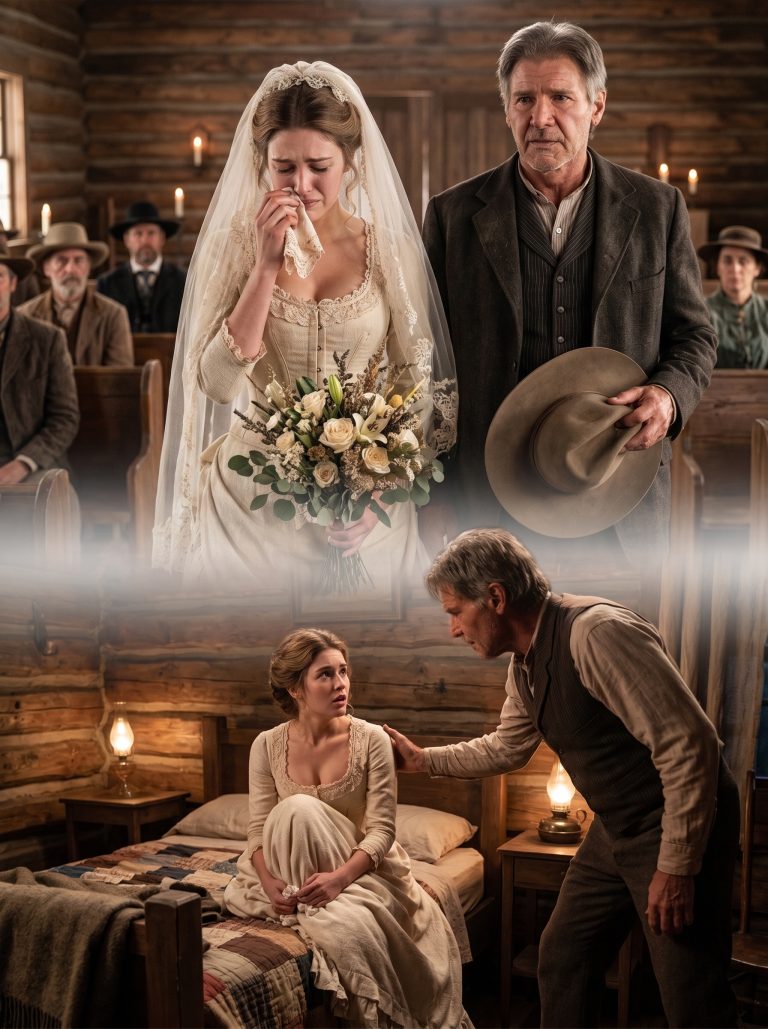
They were married the following spring, beneath the old oak tree at the edge of the ranch — the same tree Sarah had once planted wildflowers around, which Grace had tended every season since without ever being asked to.
The whole valley came. The same neighbors who’d once warned Ethan to send her away stood among the guests now, no longer strangers to the truth of who Grace was. Mrs. Odell made the journey back for it, sitting in the front row with the same ledger tucked in her bag, as if she meant to keep it close for good measure.
Noah, walking now, spent most of the ceremony trying to catch the wildflower petals someone had scattered along the aisle, laughing every time one escaped his small hands, entirely uninterested in the solemnity of the occasion and entirely certain of his place within it.
Grace wore a dress Mrs. Odell had sent ahead by post weeks earlier, plain but carefully made, with a note tucked into its folds that read only: You were never anyone’s to blame. Wear this like you always knew it. Grace had cried reading it, alone in the sewing room that had once been her first shelter on this ranch, and had not been entirely able to explain to Ethan afterward why a few sewn stitches of cloth had undone her so completely. He hadn’t needed her to explain it. He understood well enough what it meant to receive, finally, the thing you’d stopped believing you were owed.
The neighbor who had once ridden out to warn Ethan away from her stood near the back with his hat pressed to his chest the whole ceremony, and when it came time for well-wishes afterward, he was among the first in line, offering an apology Grace accepted with more grace than he likely expected, and more than, if she was honest with herself, she’d have managed a year earlier.
When the preacher finally pronounced them married, Ethan looked at Grace — at the woman who had walked up his road with nothing but a bundle of cloth and seven unforgettable words, who had rebuilt a broken house one small act of care at a time, who had weathered a stranger’s lie and an entire town’s doubt without once losing the steadiness that had drawn his son to her in the first place — and understood, finally, that the emptiness he’d felt on that porch, back on the evening she first arrived, hadn’t been waiting for time to heal it.
It had been waiting for her.
The cabin that had once echoed only with a baby’s grief-worn cries became, from that spring onward, the kind of home people spoke of for miles around — not because nothing hard had ever happened within its walls, but because it had held together through every hard thing that had.
Grace would say, in later years, that a gate she’d once stopped at out of hunger had turned out to be the one place in her life that never asked her to prove she deserved to stay. Ethan would say, when asked, that he’d stopped believing in miracles the week he buried his wife — until one walked up his road, dust on its boots, asking for work instead of pity.
Some doors open because someone knocks. Others open because someone chooses not to close them.
Ethan had almost sent Grace away that first evening, before Noah ever reached for her.
The rest of his life existed because he didn’t.
THE END