The widow was humiliated by everyone—until a mountain man sat beside her carrying secrets that froze the valley

Part 1
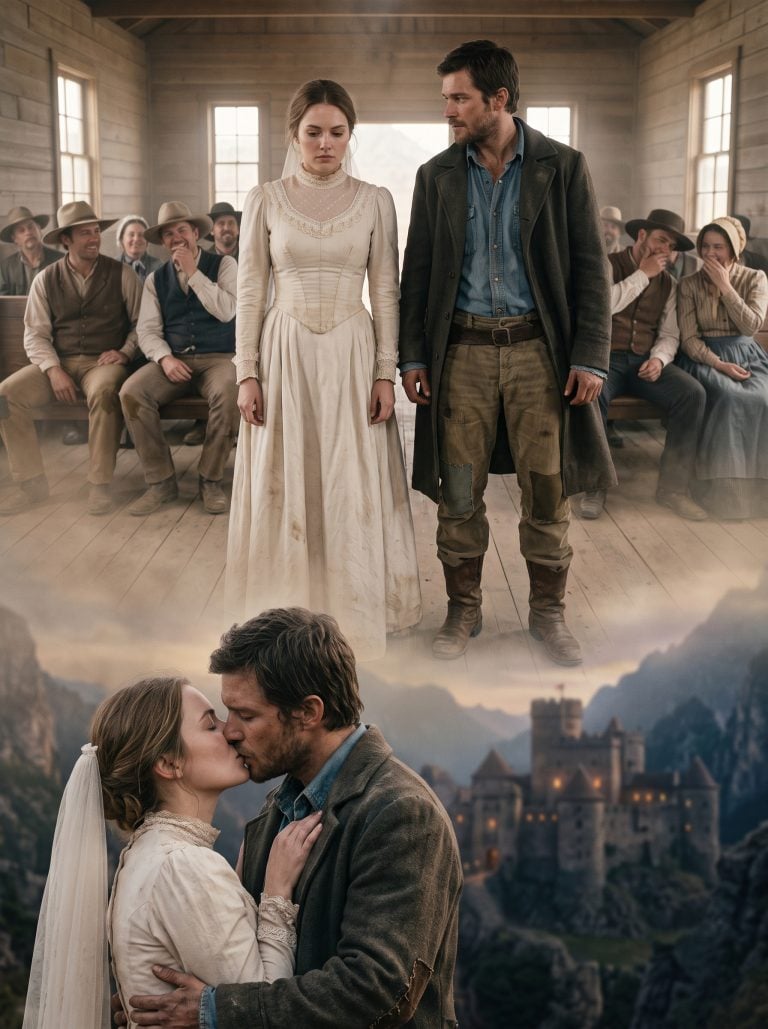
Elena Vance had learned to measure disgrace in feet of empty bench.
At the autumn harvest supper in Sable Creek, Colorado, it was six feet — the distance between her chipped plate and the nearest respectable woman. It was a spoon nobody had bothered to polish, and beans gone cold because every time she reached for the basket, someone watched to see whether a thief’s widow ate differently than other women.
Five months earlier, her husband Daniel Vance, bookkeeper for the Sable Creek Mining Cooperative, had vanished with three thousand dollars in company gold. Two weeks after that, Sheriff Roy Dalton found his body at the bottom of a ravine the miners called Raven’s Fall. The gold was never recovered. Daniel was buried at the edge of the cemetery under a marker nobody visited but Elena, and the town decided, with the particular cruelty of people who enjoy being right, that she must have known.
She had come to the supper because staying home would have looked like guilt. She sat where no one wanted to sit and told herself she could endure one meal.
Then the church doors slammed open.
A man filled the frame — tall enough to duck the lintel, weathered, dark-bearded, smelling of pine and cold trail. Elena knew him by reputation only: Caleb Whitlock, a trapper who came down from the high country twice a year and left before anyone could civilize him. Children told stories about him. Grown men stepped aside.
His gray eyes moved once across the room — the mayor, the sheriff, the pinched faces at the head table — and stopped on the empty space around Elena.
He crossed the hall. Chairs scraped back from him without anyone asking them to. He pulled out the chair across from her.
“Save me a place at your table,” he said.
Elena managed a nod. He sat, took the cornbread basket from Agnes Doyle’s guarding hand, and set it between them.
“You shouldn’t sit here, Mr. Whitlock,” she whispered. “It won’t help your standing.”
“I don’t have any standing to speak of.”
“They’ll talk.”
“They already were.” He said it without heat, buttering cornbread as if the whole room weren’t staring. “A woman shouldn’t have to eat alone in a hall full of Christians.”
He served her before himself all through the meal — small, ordinary courtesies that landed like stones in still water. Sheriff Dalton watched from the head table, and beside him, Mayor Silas Crane leaned close to whisper something behind his napkin.
“You came down for trade?” Elena asked, because the silence between them had grown too full to hold.
“Partly.” His eyes found hers and held something that wasn’t quite pity. “Some truths keep better in cold weather. Not forever, though.”
Before she could ask what he meant, Reverend Abbott rose to lead a hymn nobody was in any state to sing.
Afterward, slipping out the side door with her shawl pulled tight, Elena found Sheriff Dalton blocking her path. He was handsome in the polished way of a well-kept knife.
“A word, Mrs. Vance. You ought to be careful of the company you keep.”
“I sat at a public table.”
“With a dangerous man.”
“The dangerous men I’ve known wore cleaner coats,” Elena said, and hated herself for the fear that followed the words out of her mouth.
Dalton’s smile thinned. “You’re in a delicate position in this town. Folks have been patient — the Reverend asks it of them, Mayor Crane asks it of them, I ask it of them. Your husband left debts. Debts don’t vanish because a man falls off a cliff. If you want to keep that scrap of land by the creek through winter, I’d behave in a manner that reassures respectable people.”
“Is that all?”
“For now.”
Elena walked home alone under a sky already deciding how much snow the passes would get. Her cabin sat near Sable Creek itself, on land Daniel had loved for the sound of running water. She lay awake that night beneath two thin blankets, thinking not of rescue — she did not want to think of rescue — but of a stranger who had looked at an empty bench and understood, in one glance, everything the town had spent five months arranging.
Morning came with frost on the window and the woodpile down to a mean scattering of sticks. Elena stepped onto the porch with her axe and stopped.
A neat cord of split pine stood stacked against the wall. Beside it hung a dressed deer, wrapped clean and tied high out of reach of scavengers.
A horse snorted from the trees. Caleb Whitlock stepped into view, leading a packhorse, hat already coming off.
“Did you do this?” Elena asked, gripping the axe handle.
“Yes.”
“I can’t pay for it.”
“I didn’t ask payment.”
“That’s charity.”
“That’s winter sense.” Something almost like a smile moved beneath his beard. “Coffee and ten minutes, Mrs. Vance. In exchange I’ll tell you something that may cost us both more than comfort.”
Elena studied his face and found no tricks in it. Only gravity, and the particular stillness of a man who had already decided to become part of her trouble.
She lowered the axe. “Coffee,” she said. “Then plain speech.”
Part 2
Inside, Caleb turned the small cabin quieter than it had been in months. He drank from her one chipped cup as if she’d offered him porcelain, and when hoofbeats sounded in the yard, he only asked, “Do you want me inside?” — not I’ll protect you, simply a question, which undid her more than any promise could have.
“Yes,” she said. “For now.”
Sheriff Dalton dismounted, eyes cataloguing the woodpile, the deer, the second horse. Caleb stepped onto the porch behind Elena with a coffee cup in one hand and no rifle in the other.
“Your kind isn’t wanted in Sable Creek,” Dalton said.
“Show your paper, then. Warrant. Debt order. Anything that gives you cause to trouble her before breakfast.”
Color rose under Dalton’s collar. He rode off with a warning about respectable protection becoming difficult to arrange, and only after he vanished did Elena notice her hands shaking.
“He’s more afraid than angry,” Caleb said.
“He hides it well.”
“Cowards usually do.” He reached into his coat and unfolded a scrap of cloth. Inside lay a flattened bullet. “I was trapping above Raven’s Fall this spring. Found this lodged in a spruce trunk, shoulder height. Old blood in the bark beneath it.”
“My husband fell.”
“I don’t believe he did.” Caleb drew out a second thing — a folded, water-stained page. “Found this in a hollow log fifty yards off. Hidden in a hurry, by a man who didn’t have much time left.”
Elena knew the handwriting before she read a word of it. It was not an official cooperative ledger, she realized, but one of Daniel’s own private audit notes — the kind he kept in a locked drawer when figures troubled him enough to double-check them alone. Dated eleven days before he died: Transfer of cooperative funds, three thousand dollars, authorized by S. Crane and R. Dalton. Destination unrecorded. Reverend Abbott aware.
The last three words sat crooked on the page, added in a different, hastier hand — as though Daniel had learned something new the moment before he ran.
“He knew,” Elena whispered. “He wasn’t running with the gold. He was running from the men who took it.”
“I wasn’t certain of any of it until I saw his handwriting,” Caleb admitted. “The blood and the bullet told me a man died who shouldn’t have. The note only confirmed what I’d already started to suspect — that whoever killed him wore a badge or sat behind a desk in this town, not a stranger passing through.”
Elena looked at the ledger page, then at the mountains beyond her window, white already at the peaks. Fear told her to burn the page and keep her head down through another winter. Something colder and steadier told her no.
“We go to Silverton,” she said. “We find the marshal.”
“They’ll come after us the moment they know it’s missing.”
“Then we’d best not be here when they look.”
Part 3
They rode out before noon, Elena carrying nothing but Daniel’s pocket watch, a photograph of him with one corner of his mouth rebelling against the photographer’s orders, and the folded ledger page against her heart. Half a mile up the ridge, Caleb raised a hand and they went still among the spruce.
Below, torches moved into the yard. Sheriff Dalton and Mayor Crane, with four riders behind them, tore through the cabin and found nothing.
“Burn it,” Dalton said.
Elena watched the curtains she’d mended three times catch fire, watched Daniel’s crooked shelf blacken and fall, and made no sound at all, because sound belonged to a woman who still had something left to lose that fire could take.
She wanted to cry. Instead she watched until the roof caved in on itself with a sound like something breathing its last, and then she turned away and did not look back again.
“They’ve shown their hand,” Caleb said quietly.
“And burned mine.”
“No. They burned the place they thought kept you small.”
They climbed for three days through hardening snow. Caleb built fires small enough to hide in the rocks, gave her the warm side of every shelter without ever saying so, and told her, in the sparing way of a man unused to being listened to, about a mother lost to fever, a father lost to a mine collapse, a sister named Ruth who hadn’t lived past eight. Elena told him about a husband who apologized to furniture he bumped into and believed numbers told the truth if you respected them enough to listen. Caleb heard Daniel’s name without jealousy, which she had not expected and could not stop noticing.
On the third evening, mending a tear in his coat by firelight, her fingers brushed his shoulder and he went still in a way that had nothing to do with cold. She placed her hand over his. He turned his palm up beneath it, giving her every chance to take hers back.
She didn’t.
The trail on the fourth day cut past Raven’s Fall itself. Elena dismounted at the edge and spoke to the wind, to the ravine, to five months of grief and doubt she was finally allowed to lay down. I’m sorry I wondered. I’m taking your truth where it can breathe.
A rifle cracked before she’d finished the thought.
Caleb hauled her behind a boulder as a second shot chewed ice from the rock above them. Below, Dalton’s voice rang up the slope: “Send her out with the paper, Whitlock, and I’ll let you die quick!” Mayor Crane stood further down the trail, pale, his rifle hanging useless at his side, making no move to raise it.
“How many?” Elena breathed.
“Five, maybe six.” Caleb checked his revolver’s cylinder. “If I fall, take Moses east to the split pine. Trail’s marked three cuts to a tree. Don’t stop for me.”
“No.”
“Elena—”
“I said no.” Another bullet whined off stone. Elena drew the small pistol he’d given her three nights before, the one she’d hated learning to load. Then she stood, just high enough to be heard, and called down words that surprised her with how steady they came out: “My husband didn’t steal from this town. You did, Sheriff — and you had help wearing a collar most of you were too afraid to question.”
The slope went silent.
It was young Deputy Nathaniel Briggs — the one who’d brought her a jar of milk after Daniel’s funeral and never quite found the courage to say why — who lowered his rifle first. “Sheriff… what’s she talking about?”
“Shut her mouth,” Dalton snapped, and raised his own weapon.
Caleb fired first. The bullet struck Dalton’s gun hand; his revolver spun off into the ravine, and the force of his own backward step sent him sliding over the icy edge. He caught a low branch with his uninjured hand and hung there, sobbing, while the men who’d ridden up with him threw down their rifles rather than die for a sheriff who couldn’t even keep his footing. Mayor Crane dropped his reins and raised both hands without being asked, already talking — about how none of it had been his idea, about how he’d only come along to make sure nobody got hurt.
Nobody believed him. Nobody stopped him from surrendering, either.
They hauled Dalton up alive, because Elena asked for it. “I want him to answer,” she told Caleb. “I want a marshal’s mouth to say the true words, not mine, so no one in Sable Creek can call it a widow’s grudge.”
It took three days to reach Silverton and a telegraph office that smelled of ink and wet wool. Marshal Owen Hale arrived within the week — a man whose face looked permanently disappointed in the human race, and whose questions were hard but never cruel.
The confessions, once Dalton’s nerve broke in a cold jail cell, came apart faster than the town expected. Mayor Crane had proposed the theft. Dalton had arranged the killing. But it was the third name on Daniel’s ledger page that turned Elena’s stomach cold all over again.
When Marshal Hale rode into Sable Creek to search the church records, he found what Daniel must have discovered shortly before his death: for six years, Reverend Abbott had been quietly bleeding the cooperative’s charity fund into a private account, a little at a time, always covered by a sermon about sacrifice.
Daniel had not stumbled onto the stolen gold first. During a routine audit of the very donation box Elena had dropped her coin into at the harvest supper, he had uncovered Reverend Abbott’s years of embezzlement instead.
Terrified that a careful bookkeeper would eventually find the larger crime, Abbott went to Crane and Dalton with a proposal of his own. Together, the three men decided Daniel would disappear — and that a single, smaller theft, blamed on a dead man, would cover for all of them.
The man who had stood at the pulpit and spoken of human frailty over Elena’s bowed head had been the reason her husband was murdered.
He did not run. He simply stopped speaking, the way men do when the shape of a lie has finally outgrown them, and let the marshal’s deputies lead him out past the same cemetery where Daniel’s plain wooden marker still stood.
Sable Creek changed its face with the particular speed of a town ashamed of itself. Agnes Doyle brought a pie to the church steps and wept about how misled everyone had been. Elena accepted the apologies that sounded like apologies and refused the ones that sounded like performances.
“You might have thought kindly until the truth required otherwise,” she told Agnes, who cried harder and did not argue.
Daniel’s new marker went up on a clear morning: Beloved Husband. Honest Man. Caleb waited at the cemetery gate rather than stand beside her, and when she thanked him for it afterward, he said only, “I was trying not to mistake anything with you,” which she decided was the wisest thing he had ever said.
Winter set in. Elena took work keeping accounts for merchants who remembered, rather suddenly, that she’d always had a fine hand for numbers. Caleb found reasons to be in town more than trapping required — a bundle of kindling here, a jar of preserves there, a battered personal ledger he claimed needed correcting though his memory for pelts and debts turned out to be more exact than any bank clerk’s.
“You’re not poor at accounts,” she told him one evening, snow ticking against Miller’s store windows. “You just invented your own language and expected paper to learn it.”
“Can you teach it?”
“The paper, or you?”
“Both, if it’s needed.”
In February she rode up to see his cabin — her own horse, her own choice, daylight both ways. He’d built a second room onto it months before, empty shelves, a window facing east.
“You built this before knowing whether I’d come,” Elena said.
“So the wanting wouldn’t turn into pressure.”
She touched the bare shelf. “It needs books.”
His breath went out of him slow and grateful.
“And curtains,” she added. “Blue, I think. And a proper chair — I refuse to keep accounts on a stump.”
“Yes, ma’am.”
They married in May. Reverend Abbott’s replacement, a younger man with less polish and more honesty, performed the ceremony. Marshal Hale attended in a clean coat and kissed Elena’s hand with grave courtesy. At the wedding supper, she stood at the church hall door and looked down the long pine table to the far end — the six feet of empty bench where disgrace used to sit.
“Where do you want to sit?” Caleb asked.
“There,” she said, and crossed the room to it.
He pulled out her chair. He took the seat across from her, as he had the first night. Miller sat down beside them, then his wife, then Nathaniel Briggs — sworn in that spring as Sable Creek’s new deputy on Marshal Hale’s own recommendation, the badge sitting a little straighter on him than it ever had on the man before him — and finally a miner who had once repeated every cruel rumor in town, standing awkwardly with his plate, asking if the seat beside her was taken.
Elena looked at Caleb. His eyes asked nothing but whether she wished it.
She turned back to the miner. “It isn’t.”
The table filled slowly, imperfectly, honestly. Not every wound in Sable Creek healed that year, or the next. But Elena had learned something in the ravine wind above Raven’s Fall that the town’s harshest whispers had never taught her: that respectability and goodness were not the same coin, that the loudest condemnations often came from the guiltiest mouths, and that a single person willing to pull out a chair — publicly, without asking permission from anyone’s opinion — could undo months of manufactured shame in the time it took to sit down.
That autumn, stacking wood against a cabin with blue curtains glowing in the window, Caleb asked if she remembered his first words to her.
“Save me a place at your table,” Elena said.
“I was asking for a seat.”
“At a ruined woman’s table.”
“At the only honest one in the room.”
She took his rough, cold hand in both of hers. “I’ve saved you one. For as long as you want it.”
“Always?” he asked, the way a man asks a question he already trusts the answer to.
“Always,” she said, and meant it the way Daniel had once meant that numbers, respected enough, would always tell the truth in the end.