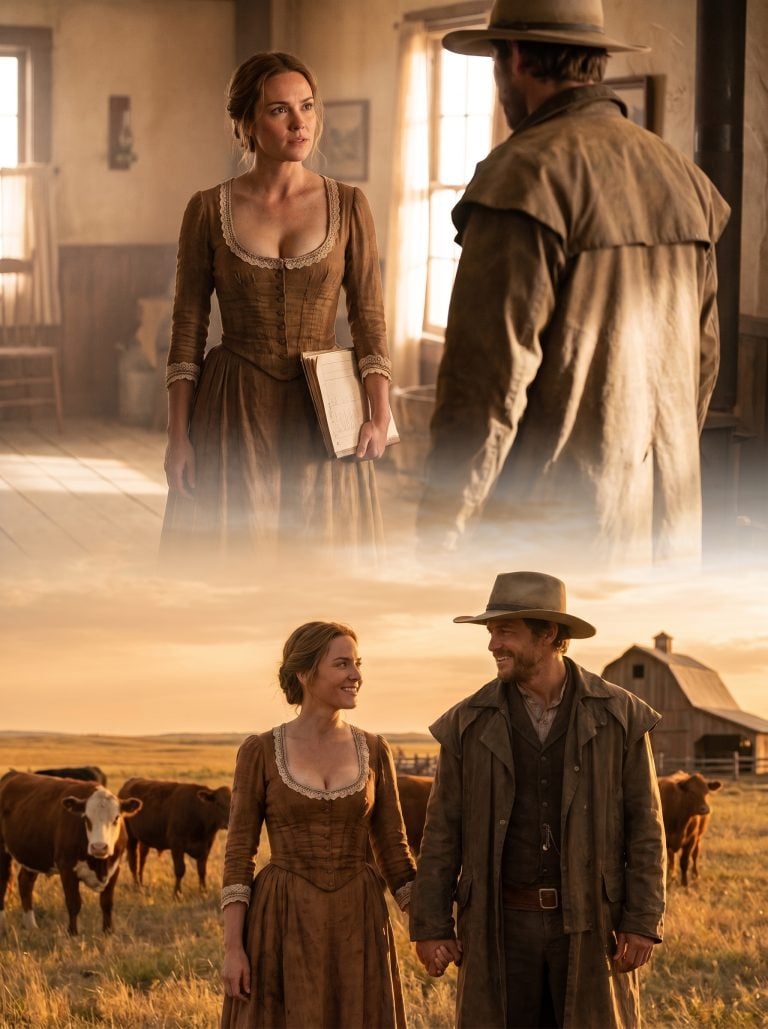
Rejected for Her Lakota Blood, the Mail-Order Bride Was Left at Sweetwater—Until a Little Girl Called Her “Mama”

Part 1
Clara Doyle stood alone on the platform long after the train had pulled away, her carpet bag sitting in the mud like something already given up on.
The man who was supposed to meet her — a shopkeeper named Otis Pruitt who had found her name in a matrimonial paper and written her three letters full of promises — had taken one look at her from across the station, murmured something to the stationmaster, and left without ever crossing the tracks. She had heard the word Indian in his mouth before he turned. She had heard it enough times in her twenty-six years to know exactly what it meant when a man said it like an excuse.
Her mother had been Cheyenne. Her father had been a schoolteacher from Ohio who died before Clara turned ten, leaving her a surname that fooled no one who looked at her face for longer than a breath.
Rain needled down. Two ranch hands leaning against a hitching post laughed behind their hands. Clara kept her chin level and her eyes dry, because crying in front of men like that was a gift she refused to give.
That was when the wagon stopped.
“You waiting on somebody?”
The man who asked was broad-shouldered, weathered, maybe thirty-five, with a small girl bundled beside him on the bench, dark eyes peering out from under a wool cap.
“Not anymore,” Clara said.
He studied her a long moment — not the way Pruitt had studied her, weighing and discarding, but like he was doing arithmetic with a debt only he could see.
“Nathaniel Reeves,” he said. “This is my daughter, Wren.”
“Clara Doyle.”
“You got somewhere to sleep tonight, Miss Doyle?”
“No.”
“Then get in the wagon.”
It wasn’t a proposal. It wasn’t even kindness exactly — more like a man settling an account with his own conscience. Still, it frightened her more than Pruitt’s rejection had. Rejection she knew how to survive. Hope was a stranger’s language.
She climbed up. His hand was calloused, and he let go of her the instant she was steady, like touching too long might cost something neither of them could afford.
The ride out of town was quiet but for Wren’s humming and the creak of wheels through slush. Snow had softened the ruts in the road. Larkspur Hollow disappeared behind them, taking Pruitt and the laughing men with it, though Clara could still feel both pressed under her ribs.
“Why’d you stop for me?” she finally asked.
Nathaniel kept his eyes on the road.
“My wife died two winters back. Left me with Wren and a town that figured a half-Cheyenne girl belonged in an orphanage more than with a father who didn’t know the first thing about braiding hair.”
Clara glanced at Wren, asleep now against his side.
“I told them no,” he said. “She’s mine. I know what it costs to watch somebody you love get looked at like they’re less than a person. Wasn’t about to let it happen twice in one lifetime, even to a stranger.”
The cabin, when they reached it, was smaller than she expected — one room of hewn logs, a stone hearth, three mismatched chairs, and a shelf above the bed holding a beaded dress, a pair of small moccasins, and a medicine pouch gone soft with age. The ranch itself spread farther than the cabin let on — barn, corral, a fenced pasture running down toward the creek — though most of it had gone quietly neglected in the two winters since Aiyana’s death, kept standing more by stubbornness than by money.
“My wife’s things,” Nathaniel said, following her eyes. “Aiyana. Southern Cheyenne. She’s been gone two winters.”
“I’m sorry.”
“Everybody says that like it changes something.”
“It doesn’t,” Clara admitted. “But sometimes it’s all there is to offer.”
Something in his face shifted, like a door easing off a stuck hinge.
They ate rabbit stew while Wren chattered about a fox she’d seen near the barn. Afterward the girl brought out charcoal drawings — a horse, a bird, a woman with long dark hair.
“That’s Mama,” she said. “I’m starting to forget her face.”
Nathaniel’s hand tightened around the bowl he was drying, but he said nothing.
Later, when Wren begged for a story, Clara told her about a girl who walked between two worlds and belonged fully to neither, but carried pieces of both stitched into her like a quilt. Wren fell asleep before the ending.
“That story yours?” Nathaniel asked from the rocking chair.
“Maybe.”
“You should know something, if you’re thinking of staying past tonight. This town doesn’t forgive people for not fitting its shape.”
“Nothing in my life has fit anyone’s shape, Mr. Reeves.”
“Nathaniel.”
“Nathaniel.”
It came too easily off her tongue. He noticed. And then he said the thing that made the small cabin feel smaller still.
“Wren’s already fond of you. If you mean to go, best do it before she gets more ideas.”
Clara looked at the sleeping child, one fist curled in the quilt.
“And if I wanted to stay a few days?”
The fire popped twice before he answered.
“Then you’d be welcome. But only if it’s what you want. Not pity. Not because you feel cornered.”
“And if I don’t know yet what I want?”
“Then I suppose you’ve got a few days to find out.”
Part 2
By the eighth night, Wren had taken to falling asleep with her head in Clara’s lap as though she’d always belonged there.
“Do you think Mama likes that you’re here?” the girl asked.
Clara glanced at Nathaniel, whose face had gone carefully still.
“I think your mama would want you happy. If I help with that, I believe she’d be glad.”
He looked away, but not before Clara saw the grief pass through him like weather.
On the tenth morning, Wren woke burning with fever.
Nathaniel went white as bone. “Not again,” he whispered, already reaching for his coat.
“The roads are barely passable,” Clara said, laying a palm to the child’s forehead. “She’s burning now, Nathaniel. I can help — my mother’s people taught me medicine, and the mission sisters taught me more. But you have to trust me.”
He stared at her, fear and memory warring across his face. Then he nodded once. “Tell me what you need.”
By midnight the fever had climbed high enough that Nathaniel could barely watch. Clara bathed Wren with cool cloths, steeped willow bark, hummed half-remembered songs her mother used to sing.
Wren’s eyes fluttered open once. “Miss Clara?”
“I’m here.”
“Are you my mama now?”
Clara’s vision blurred. The word sat too large and too soon in the small room, and some old, careful part of her wanted to turn it aside gently, the way she’d learned to turn aside every promise that felt too good to be safe.
“If you still want me when you wake up,” she whispered instead, smoothing the damp hair from Wren’s forehead, “I’ll be here.”
It seemed to satisfy the child, who murmured something wordless and slid back under.
Nathaniel stood frozen in the doorway, water bucket forgotten in his hands, his face stripped bare in a way she hadn’t seen before.
“You didn’t have to say even that much,” he said hoarsely.
“I know.”
“She’ll remember it. However you meant it.”
“I know that too.”
He knelt beside the bed, and up close Clara saw what the long night had carved into him — the shaking hands, the grief that had never fully slept since his wife died.
Near dawn, Wren’s skin began to cool. Her breathing steadied. Color crept back into her cheeks.
“The fever’s broken,” Clara said. “She’s going to be fine.”
Nathaniel dropped his head and did not make a sound, but Clara saw the tears fall anyway. She rested a hand on his shoulder, and he covered it with his own like a drowning man closing his fist around a rope.
Three days later Wren was demanding bacon and complaining that her father kept checking her forehead too often. On the fourth evening, once the girl was steady enough to sit up and eat a full bowl of stew by herself, she looked at Clara across the table with the frank, unhurried curiosity only children manage.
“You said if I still wanted you when I woke up.”
“I did.”
“I still want you.”
Clara set down her spoon. Across the table, Nathaniel had gone very still, watching her the way a man watches weather he can’t yet name.
“Then I want you too,” Clara said, and found, to her own surprise, that it was no longer a thing she had to talk herself into. “I’ll be your mama, Wren. Not because you were sick and frightened, and not because I have nowhere else to go. Because I’ve decided it, wide awake, with my whole mind.”
Wren beamed and went back to her stew as though the matter were now simply settled, the way children file away the promises that matter most without any ceremony at all. But Clara caught Nathaniel’s eyes over the girl’s bent head, and something passed between the two adults that neither of them had words for yet.
But peace, Clara was learning, never lasted long in Larkspur Hollow. On the first clear afternoon, two riders appeared on the trail from town — the same men who had laughed at her on the platform — and this time they had not come to laugh.
Part 3
“Reeves,” the taller rider called, reining in at the fence line. “Council sent us. Word is you’re harboring the woman Pruitt turned away.”
“What I do on my own land isn’t the council’s business.”
“It is when a man owes the bank what you owe.” The rider’s smile was thin. “Send her packing, marry her proper, or start explaining yourself to Mr. Bramwell directly. He asked us to remind you — history has a way of repeating on this ranch.”
Nathaniel’s jaw tightened at the name, and something in his stillness told Clara this went deeper than town gossip. She had heard Bramwell twice now, always spoken the way men speak of weather they can’t argue with.
That night, once Wren was asleep, Clara finally asked the question she’d been circling for a week.
“Who is Silas Bramwell to you?”
Nathaniel turned a tin cup in his hands a long moment before he answered. Then, for the first time, he told her everything.
Aiyana had not simply taken sick and died, as the town liked to say when it wanted the story shorter. She had been found beaten in the yard while Nathaniel was two days gone buying seed, accused of theft and curses by men who wanted a cleaner name for their hatred than the truth would allow. Wren, three years old, had watched from beneath the table. She hadn’t spoken a full sentence for two months afterward.
“I always told myself it was just meanness,” Nathaniel said. “Small men needing somebody smaller to hate. Easier to live with than the alternative.”
“And the alternative?”
“Last spring I was mending fence along the north boundary and found an old surveyor’s stake I didn’t recognize. Followed the line of it clean through my property, out past the creek bed, right up to a claim marker with Bramwell’s name notched into it. I asked around quiet. Turns out an assayer came through this valley the same autumn Aiyana died — found color in the creek gravel. Silver, maybe more. The report went straight to the territorial land office. And straight to Bramwell, who sat on the recording board that year.”
Clara felt something go cold and still inside her. “You’re saying he knew what was under your land before anyone else did.”
“I’m saying he knew, and he let a town that was already looking for a reason to hate my wife go on looking. Eleven days after that report was filed, somebody started saying Aiyana had cursed the Hollcomb boy’s cattle. I don’t believe Silas rode into my yard that night, or told any man outright to raise a hand against her. I don’t think he needed to. He just never said a word to slow it down — and a man who holds half this valley’s debts doesn’t stay that quiet by accident.”
“Can you prove any of it?”
“Not the whispering. Not the silence. Every man who actually rode into my yard that night has scattered to three different counties, and grief made me slow enough that the trail went cold before I thought to walk it.” He set the cup down. “But there’s one thing I can prove, if I’m not a coward about it. Bramwell holds the note on this ranch. Bought it off the bank quiet, years back, when they got nervous lending to a man with a Cheyenne wife. There’s a clause buried in the fine print — if I lose standing in the community, his words, written right into the paper, the whole note comes due at once. He’s owned the ground under my feet since before Wren was born. He’s just been waiting for a reason ugly enough that decent folk wouldn’t ask questions before he called it in.”
“And now he has one. Me.”
“Now he has one. You.”
The words sat between them like a held breath.
In the days that followed, before Otway’s visit and before the fire, something quieter grew between them that had nothing to do with Bramwell at all.
They spent an afternoon patching the roof together, Clara handing up shingles while Nathaniel worked above her, and somewhere between the third and fourth board he told her, without being asked, about the nights he still woke certain he’d heard Wren cry out and found her only sleeping. “I check the road for riders before I check anything else most mornings,” he admitted, not looking down at her. “Been doing it so long I forget I’m doing it. I’m always waiting to fail her the way I failed her mother.”
“You didn’t fail Aiyana,” Clara said. “You weren’t the one who came into your yard with hate in his hands.”
“I wasn’t there to stop it.”
“Neither was God, if you’re handing out blame that way.”
That got, for the first time, something close to a real laugh out of him.
She told him things too, that week — how she’d answered Pruitt’s letters not out of desperation but because his third letter had mentioned, almost as an aside, that he wanted children someday, and Clara had spent so many years being told her blood made her unfit for exactly that, that the plain wanting in his words had felt like a door left open a crack. “I didn’t come out here for a husband,” she admitted, sanding down a chair leg that had wobbled since before she’d arrived. “I came because somebody, even a stranger who turned out to be a coward, wrote down that he thought I could be somebody’s mother. I’d never let myself want that out loud before.”
Nathaniel was quiet a moment. “You are somebody’s mother. Whatever happens with Pruitt, or Bramwell, or any of it.”
“I know that now.”
“You’re free to go, if this gets dangerous,” he said later, low, the two of them sitting on the porch steps while Wren chased fireflies in the last of the light. “Whatever’s between us, I won’t hold you to a debt you didn’t ask to owe. But I’d be lying if I said I wasn’t hoping you’d choose to stay anyway.”
“I know that too,” Clara said, and let her shoulder rest, lightly, against his.
But the quiet didn’t last. One night not long after, Clara lay awake listening to Wren’s even breathing and thought of every door that had ever closed on her — not from cruelty exactly, but from men deciding, quietly and at a distance, what she was worth to their ledgers. Pruitt had done it on a train platform. Bramwell was doing it from behind a desk, dressed up as scripture. She was tired of being a debt other men called due.
“Then we don’t run,” she said at breakfast, before she’d fully decided to say it. “We take the truth to somebody who can’t be bought.”
They found their chance in Reverend Combs’ brother-in-law, a circuit lawyer named Elijah Otway who rode through Larkspur Hollow twice a year settling estates and land disputes for the territorial court. Clara spent two days going through the papers Nathaniel had kept hidden beneath a loose floorboard — a copy of the original note, the assayer’s report Nathaniel had finally paid a clerk in the county seat to find for him, and a single page from the bank’s own ledger that Aiyana had once copied out by hand in her careful, second-language script. She hadn’t understood what the numbers meant, only that her husband had asked her to keep it safe, folded inside the lining of the beaded dress now resting on the shelf above their bed.
Otway read it all by lamplight without speaking. When he finally looked up, his face had the particular stillness of a man doing arithmetic he didn’t enjoy.
“This clause is void on its face,” he said. “The territorial code that governs recorded notes doesn’t allow a debt to be called due for anything but nonpayment or fraud on the borrower’s part — a man’s marriage isn’t grounds under any statute I’ve read, and I’ve read most of them twice. Bramwell’s lawyer knew that when he wrote it in. He was counting on nobody ever taking it to a judge to find out.” He tapped the ledger page twice. “And this shows the note was recorded a full year later than the date on Bramwell’s copy. That’s not sloppy bookkeeping, Mrs. Doyle. That’s forgery, plain enough for any court in the territory.”
“Will it undo what happened to Aiyana?”
Otway’s face softened, just slightly. “No, ma’am. Nothing I can carry into a courtroom will do that. But it can stop him from doing it again with somebody else’s family.”
They did not have three quiet days to prepare, as it turned out.
Two nights after Otway rode off toward the county seat with the borrowed papers tucked in his saddlebag, Clara woke to the smell of smoke.
For one terrible, disorienting moment she thought she was back in her father’s schoolhouse, the year it burned, the year that had taught her how fast a life could turn to ash around her. Then Wren’s scream cut through the smell, high and real, and Clara was moving before she finished waking — dragging the girl out of bed, wrapping her in the nearest quilt, shouting for Nathaniel, who was already at the door with his rifle in one hand and his boots half-laced.
The barn was burning. Not the house — someone had been careful about that, careful in a way that told its own story — but the barn, where three horses stood screaming against their stalls and where a season’s worth of hay would go up like kindling if the fire reached it.
“Get her to the well and stay there,” Nathaniel barked, already running.
Clara did not stay there.
She got Wren settled at a safe distance with a blanket and a firm instruction to move for nothing, and then she ran for the barn, because two hands fighting a fire were better than one, and because she had spent too many years being told to wait safely on the sidelines of her own life.
They got the horses out. That was the whole of the mercy the night offered them — the horses, and the fact that the wind, for once, blew the flames away from the house rather than toward it. By the time neighbors from the Palmer place saw the glow and came riding with buckets, the barn was a smoking ruin and Nathaniel’s hands were blistered raw from the well rope, and Clara’s lungs ached from smoke in a way that would keep her coughing for a week.
They found the empty coal-oil tin half-buried in the frost near the fence line the next morning, tossed carelessly enough that whoever left it hadn’t much cared whether it was found.
“He’s not even trying to hide it anymore,” Nathaniel said, turning the tin over in his blistered hands. “He knows Otway’s already gone. This isn’t a warning meant to change my mind. This is a man trying to burn the evidence before it reaches a judge — and not much caring if a child burns with it.”
Clara felt something in her go very quiet and very cold, the particular calm that comes only after fear has finished having its say. “Then we don’t wait for Thursday.”
They rode into town that same afternoon, soot still in Nathaniel’s hair, and stood together in the sheriff’s office while Clara laid out, plainly and without flourish, what had been done to her family in one night — and what, she suspected, had been done to another family two winters before.
Sheriff Garrity didn’t answer right away. He was a tired, decent man who had spent years looking the other way rather than cross the council, and Clara watched him weigh it the way she imagined he’d weighed every hard thing that had ever crossed his desk — slowly, and against his own tiredness. He looked at Clara first, then at Wren asleep against Nathaniel’s shoulder, then at Nathaniel’s blistered hands wrapped in linen. He was quiet long enough that Clara thought he might send them home with nothing but sympathy, the way she suspected he’d sent Aiyana’s neighbors home two winters before.
“I was the one who found her,” he said finally, not looking at either of them. “Aiyana. I told myself there wasn’t enough to go on, and maybe there wasn’t. I’ve told myself that most nights since.” He looked up, and something in his face had settled, like a man who has finally stopped arguing with himself. “I’m not telling myself that twice.” He glanced out the window at the smoke still hanging over the Reeves place, and decided, finally, that there were some things a badge couldn’t keep looking past.
He rode for the county seat himself the next morning, a full day ahead of Bramwell’s men, carrying a signed statement and a promise to bring Otway back faster than anyone expected.
It was in the shadow of that fire, not despite it, that Nathaniel and Clara married three days later — not to outrun the council’s decision, but because neither of them wanted to spend one more morning pretending the truth wasn’t already settled between them, and because Clara had decided, watching her new husband’s hands wrapped in linen at their own small ceremony, that she would rather stand publicly beside a burned barn and a burned man’s courage than hide safely and alone.
Bramwell was waiting outside the church, flanked by two councilmen and the same riders from the trail. He looked, Clara thought, like a man who had rehearsed his own righteousness so many times he no longer noticed the seams.
“The council has voted,” he announced to the small crowd that had gathered. “The woman does not belong in Larkspur Hollow. Not as your wife. Not as anything.”
“Funny,” Nathaniel said, loud enough to carry, “since it isn’t the council’s name on the deed to my land. It’s yours. Has been for six years.”
Silence dropped over the churchyard like snowfall.
“I don’t know what foolishness you’ve been told—”
“Elijah Otway rides for the territorial court Thursday,” Nathaniel said, “carrying your note, your altered recording date, and a ledger page in my late wife’s own hand — the wife you let this town believe died of nothing but bad luck and fever. You’ve been sitting on an assayer’s report about silver in my creek bed since before she was killed, Silas. You needed an excuse ugly enough that nobody would look past it to the money underneath. She was the first excuse. Clara was going to be the second.”
Bramwell’s face drained to the color of old paper. “You can’t prove a word of that.”
“I don’t have to prove it to you.” Nathaniel’s voice didn’t rise. It didn’t need to. “I have to prove it to a judge. And I intend to.”
Clara stepped forward, Wren’s small hand gripped tight in hers, and felt something in her chest that had spent twenty-six years folding itself smaller finally stand up straight.
“You told this whole town that loving someone the wrong color was a sin against God’s order,” she said, her voice carrying across the churchyard. “But I’ve read that note, Mr. Bramwell. God’s name isn’t written anywhere on it. Yours is. You didn’t need scripture. You needed a hymn ugly enough to sing over a land grab, and this town was kind enough to learn the words.”
For the first time since she’d stepped off that train, Silas Bramwell had no answer ready.
It was Reverend Combs who broke the silence, stepping down from the church steps in his good black coat, still smelling of the wedding incense. He was not a bold man by nature — Clara had marked him, these past weeks, as someone more comfortable quoting scripture than arguing with the men who funded his church roof — but he planted himself between Bramwell and the newly married couple all the same.
“I married these two not an hour ago, Silas, in front of God and this whole congregation,” he said, his voice unsteady but carrying. “If the council wants to unmarry them, it’ll have to come through me first, and I’ll want that in writing, with the council’s names on it, so the bishop can read it same as I will.” He turned to the crowd, some of whom shifted uncomfortably under his gaze. “I’ve preached the Good Samaritan in this church more Sundays than I can count, and not one of you asked what color his hands were before I got to the part where he stopped to help. I’m ashamed it took a fire and a wedding for me to say so from anywhere but a pulpit.”
Bramwell’s mouth worked, but nothing useful came out of it.
The territorial judge who finally heard the matter, a spare, unhurried man named Whitcombe who had ridden circuit through three counties for twenty years and had grown allergic to theatrics of any kind, did not care in the slightest about the color of anyone’s late wife. He cared about dates.
Bramwell had hired a lawyer up from the capital, a sharp, unhurried man named Reed who opened by arguing that the ledger page in Aiyana’s hand proved nothing at all — a dead woman’s private notes, he said, copied who knew when, from who knew what, could not be trusted to overturn a properly recorded note. He spent the better part of an hour walking the court through banking custom, recording delays, and the ordinary sloppiness of frontier clerks, building a case that the mismatched dates were nothing more than an honest man’s paperwork catching up to itself months late — the kind of thing, he said, that happened on half the notes in the territory if a judge cared to go looking.
Otway answered him point for point. He walked the court through the county recorder’s own logbook, which showed every other note filed that same month arriving within a week of being written — every one but Bramwell’s. He produced the assayer’s report and asked Reed’s own witness, the bank’s clerk, to explain under oath why Bramwell had paid a personal visit to the recording office the same week the report crossed his desk. The clerk’s answers grew shorter and less certain with each question, until Judge Whitcombe himself asked him to speak up twice.
Then it was Clara’s turn. Reed rose slowly, and for a moment Clara thought he meant to ask her nothing at all — until his questions turned, one after another, away from ledgers and dates and toward her mother’s people, her marriage to Otis Pruitt that never was, whether a woman with her history might have reason to want a wealthy man ruined regardless of the truth of it. Clara answered each question plainly, refusing to let her voice climb, though her hands stayed folded tight enough in her lap to whiten the knuckles.
“Mr. Reed,” Judge Whitcombe said at last, before Clara had to defend herself a third time on the same ground, “I am trying a case of fraud, not a wedding, and not a woman’s ancestry. You have dates in front of you. Confine yourself to them, or sit down.”
Reed sat down. He did not stand again except to hear the ruling.
Whitcombe laid the forged note beside the ledger page in Aiyana’s careful handwriting, compared the recording stamps under a magnifying glass borrowed from the county clerk, and said, without any particular heat, that he had seen men sentenced to years in the territorial prison for less convincing forgery than this. Sheriff Garrity’s signed statement about the coal-oil tin went into the record beside it.
He tried to leave the territory before the judge’s formal ruling was even read aloud, but Sheriff Garrity had wired ahead to the county line, and a warrant for fraud went out before Bramwell’s wagon crossed it. He was never charged with what had happened to Aiyana — Judge Whitcombe said plainly, on the record, that suspicion and coincidence, however damning, were not proof a court could hang a murder charge on, and the men who had ridden into that yard two winters before had already scattered too far to be found and made to answer. It was not the ending Clara or Nathaniel wanted. It was, Otway told them gently, more justice than most families like theirs had ever been given in this territory, and it would have to be enough for now, with the case left formally open in case any of those scattered men ever surfaced with a confession to trade for a lighter sentence of their own.
What Bramwell could not talk his way out of was the fraud itself. His remaining property was seized pending the charges against him, and he sold off what little the court hadn’t already frozen at half its worth to a buyer two counties east who had never heard his name attached to anything but money. The forged note against the Reeves ranch was voided that same week, the fraud plain enough on paper that even his old allies on the council stopped saying his name above a mutter, as though it might still be listening.
Otis Pruitt sat in the back of the courtroom for most of the trial, and did not once try to speak to Clara. She heard, secondhand and months later, that he’d sold his shop and left Larkspur Hollow before the following spring, though nobody could say for certain where he’d gone. Clara found she didn’t much care. He had given her, without meaning to, the one thing that mattered — a wagon that stopped when his refusal to cross the tracks left her standing alone in the mud — and she let the rest of him go without another thought.
Larkspur Hollow did not become a paradise overnight, and Clara had lived too long to expect miracles from people who’d simply run out of a convenient excuse. But something in it loosened, the way ice loosens before anyone would call it spring — an apology in a basket of apples she didn’t rush to accept, a boy who’d once thrown a stone at Wren growing fond of the horses he’d been sent to muck as punishment, the Palmers sending for Clara at midnight when their well ran foul with fever, because mercy, she’d decided long ago, was never a debt, only a choice offered freely enough times that it stopped being remarkable.
Clara didn’t wait for the town to finish deciding what it wanted to be without Bramwell telling it what to fear. She rebuilt the barn herself, alongside Nathaniel, through a summer of raw lumber and blistered palms, and hung an ordinary tin lantern by the door — nothing remarkable about it except that it burned every night, visible from the road, saying without a word spoken: there are people here, and they are not hiding.
Wren grew taller through that first year of the marriage, then the next, remembering Aiyana more clearly rather than less, because Clara and Nathaniel had stopped speaking of her only around the edges of a wound and started speaking of her the way you speak of someone still welcome at the table. The beaded dress stayed on the shelf above the bed, the medicine pouch beside it, and Clara’s own mother’s songs joined the words Nathaniel still murmured at bedtime in Aiyana’s language — until Wren grew up carrying pieces of both families, the way children do when the adults around them finally stop being afraid to let them.
Every autumn, when the first snow reached Larkspur Hollow, Nathaniel drove Clara and Wren to the station — not to relive the morning Pruitt had walked away without crossing the tracks, but to stand on the exact platform where a stranger’s small, unglamorous kindness had turned three lives out of their old orbits and into new ones.
“Do you ever regret it?” Nathaniel asked her once, years later, watching a nearly-grown Wren chase her own daughter through the season’s first snowfall on the platform.
“The train leaving?”
“No,” he said. “Staying.”
Clara looked down the tracks, vanishing white into distance, then back at her husband, then at the child who had once asked the question that changed everything.
Are you my mama now?
“No,” she said finally. “I only regret the years I spent believing that being unwanted by the wrong people meant I was unwanted by everyone. It took me a long time to learn that people who love you for what you’re worth on paper were never going to love you at all.”
Nathaniel kissed her forehead, weathered now, both of them, in ways that suited them better than youth ever had.
“You were wanted here,” he said. “Long before I found the courage to say it out loud.”
“Not at first.”
“By Wren, at first. By me not long after.”
Clara smiled, and something that had ached quietly in her chest for most of her life finally settled, the way a house settles once it’s been lived in long enough to trust its own foundation.
“Yes,” she said softly, watching her family in the snow. “By Wren.”
She had learned, in the end, what no hopeful letter from a stranger in a matrimonial paper and no clause in any banker’s ledger could have taught her: that belonging was never a thing handed down by men with money and grudges, however loudly they dressed their greed up as God’s order. It was built, patiently and in plain sight — one healed fever, one honest truth dragged into daylight, one hand held in front of a whole watching town that had not yet decided whether to be kind. It hadn’t come because a husband arrived on a wagon to rescue her, though she loved him fiercely for arriving.
It had come because a child took her hand first, and asked for nothing but the truth of what she already was — and Clara, after a lifetime of making herself smaller for people who never once deserved the effort, had finally been brave enough to hold on.
The End