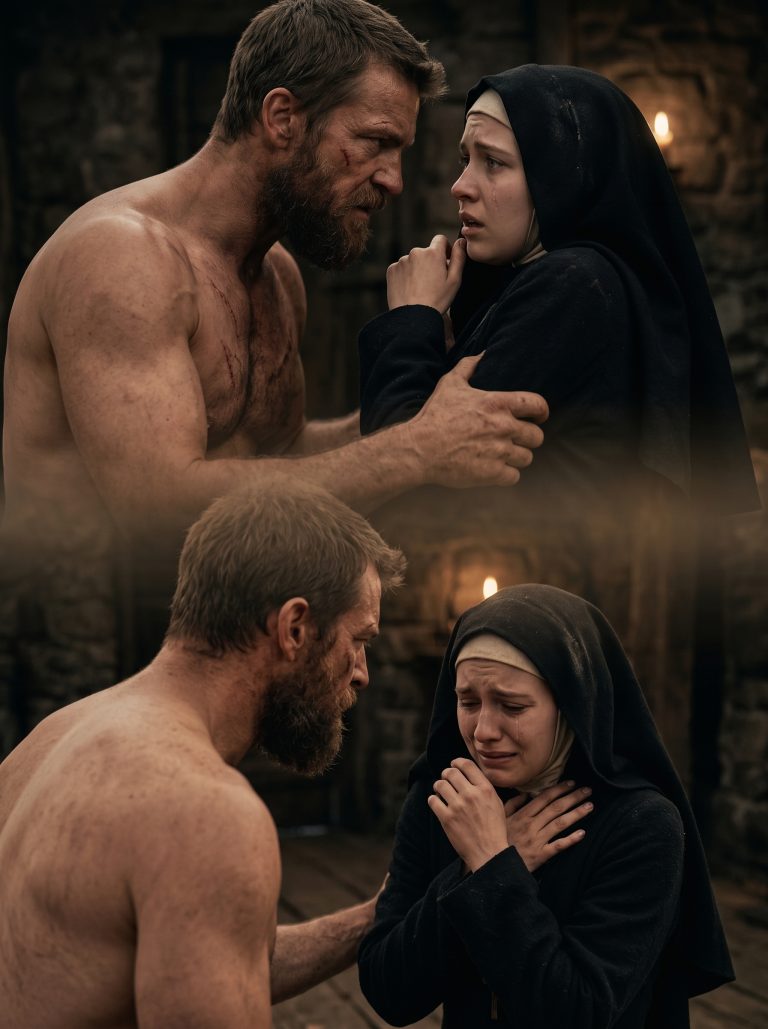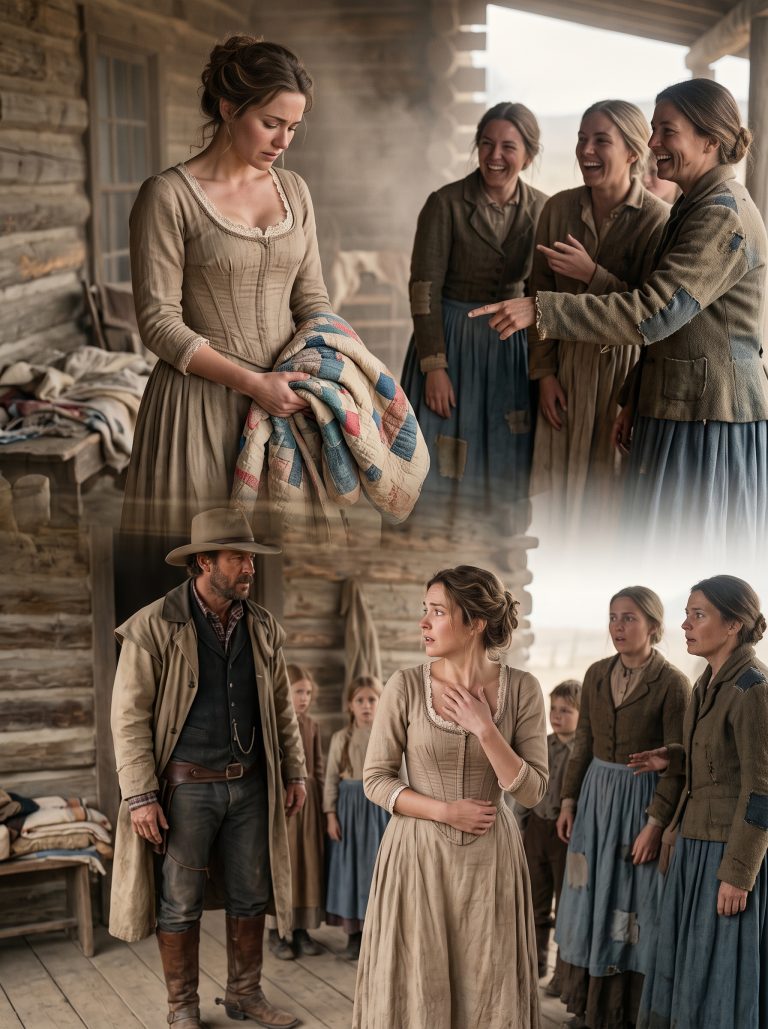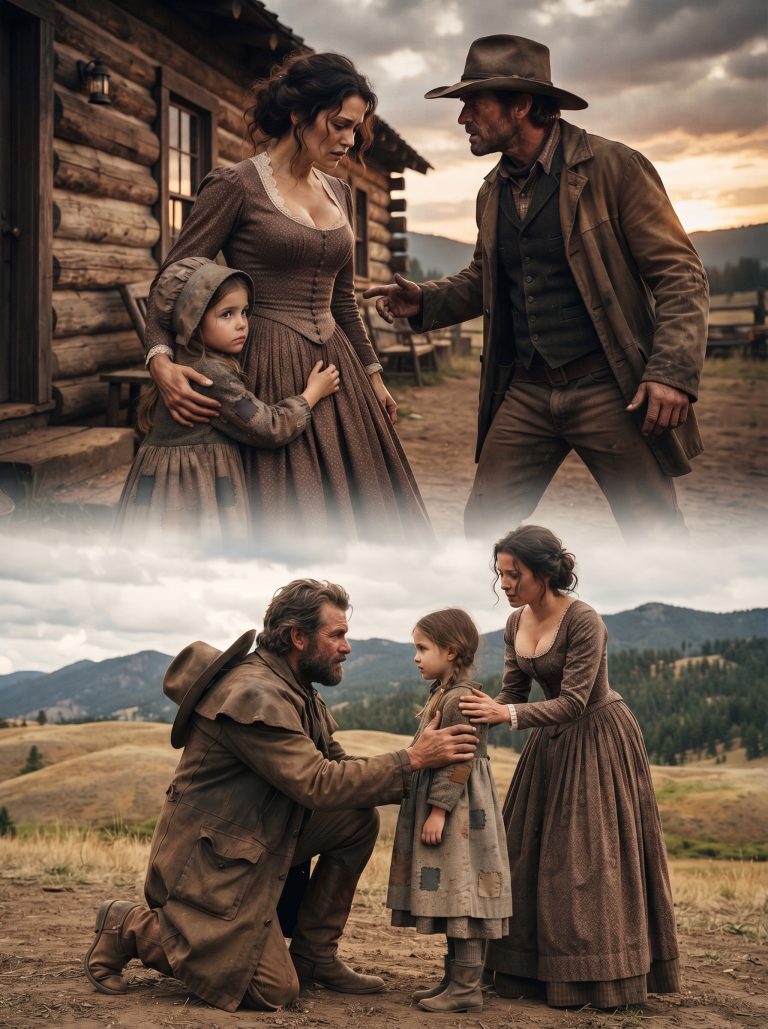
Mail Order Bride Rejected for Being “Too Small” — Until a Rancher Saw Strength Others Missed

Part 1
The train exhaled its last breath of steam onto the platform at Larkspur Junction, Montana Territory, and Adeline Winthrop stepped down into a world that smelled of dust, horses, and heat.
She was twenty-four, and small — small enough that strangers often spoke to her the way they spoke to children, small enough that her trunk, battered from the journey, looked almost too heavy for her to have carried alone. But she had carried it alone, all the way from a Boston boarding house where the walls were thin and the winters were thinner, and she had no intention of setting it down now.
In her gloved hand she held a letter, read so many times the creases had gone soft as cloth.
Miss Winthrop — your notice in the Matrimonial Gazette speaks of a woman of sense and industry. I am a man of standing in this territory, with land enough for a dozen families and a house that wants only a wife’s hand to make it a home. Come, and you shall not regret it. — Warren Ashcroft.
She found him near a black lacquered carriage, unmistakable from the photograph he’d sent: broad-shouldered, sandy-haired, dressed like a man who wanted the whole platform to believe he’d never once worried about the cost of a coat.
“Mr. Ashcroft.” She lifted her chin, the way she always did when she meant to look taller than she was.
His eyes swept over her, and something in his face closed like a door.
“The photograph didn’t—” He stopped, seeming to search for the words and not finding ones he liked. “There was nothing in it to judge you against. No doorway, no chair beside you. I didn’t think to ask.”
“The likeness was honest,” Adeline said. “You simply never asked its subject to stand beside a yardstick.”
“You’re the size of a girl of twelve.” His voice rose enough to draw eyes from across the platform. “I need a wife who can run a household staff, sit a horse, stand beside me at gatherings without looking like my ward. This is Montana, Miss Winthrop, not a Boston parlor.”
The crowd had stopped pretending not to listen. Adeline felt every pair of eyes on her like hands pressing down.
“You judged my worth in the space it took to look at me twice,” she said, keeping her voice level though her heart hammered. “That says a great deal more about you than it does about me.”
Warren’s jaw tightened. He drew bills from his coat — his hand not quite steady, a tremor she wouldn’t understand the meaning of for months — and held them out like scraps to a stray dog. “Return fare. There’s a boarding house on Cedar Street. The eastbound leaves at dawn.”
She looked at the money. She thought of the tenement, the needle-pricked fingers, the parents in the ground and the brother lost to a coal seam in Pennsylvania. She thought of how easy it would be to take the bills and disappear back into a life that had already tried once to swallow her whole.
“Keep it,” she said. “I’d rather find my own way in this territory than take charity from a man who buys and returns people like they’re goods that didn’t fit.”
She turned and walked, valise in hand, into a town she knew nothing about, with no plan beyond away.
She had not gone fifty yards before footsteps caught up to her.
“Miss.” The voice was rougher than Warren’s, without any of its polish.
She turned to find a man holding his hat against his chest, sun-weathered, built like something the land itself had shaped rather than something a tailor had dressed. He wasn’t handsome the way Warren Ashcroft was handsome. He looked durable.
“I imagine you’ve had your entertainment for the day,” she said.
“Wasn’t entertaining. Was ugly, what he did.” He turned the hat in his hands. “Name’s Silas Whitfield. Got a place eight miles north. Six hundred acres, more cattle than I’ve got hands to manage, and a cabin standing empty.”
“You’re offering me work.”
“I’m offering you honesty. It’s hard work, harder than anything you’ve likely done. Pay’s fair, not generous. I won’t pretend it’s charity, and I won’t pretend it’ll be easy.”
“Why me?”
He was quiet a moment. “Because I watched you refuse that money. Man who can do that has got more backbone than half the ranch hands I’ve hired and fired.” He met her eyes. “Question is whether you still want to find out what you’re made of, now that you know the answer isn’t going to come easy.”
Behind them, the train released a long whistle, and Warren’s carriage rattled away down the street. Adeline looked at the town waiting to see what the small woman from Boston would do, and found, for the first time since her parents died, that she was not afraid of the unknown.
“Lead the way, Mr. Whitfield.”
As they walked toward his wagon, she heard a voice in the thinning crowd mutter, “That little thing won’t last a week out at the Whitfield place.”
Another answered, “Warren Ashcroft may have just made the worst mistake of his life.”
A third voice, quieter, almost sympathetic: “Man’s not been himself since the bank started calling in his notes. Wouldn’t surprise me if he doesn’t know what he wants anymore.”
Adeline didn’t know which prediction would prove true. But she walked toward the wagon anyway, valise in one hand, and something new and stubborn in the other.
Part 2
The work nearly broke her, and then it didn’t.
Silas taught her to read a spooked horse before it reared, to stand her ground when a steer charged the fence, to split wood without losing a finger to her own inattention. Her hands bled and then calloused. Her arms, built for needlework, found new muscle in hauling feed and water.
“You’re not trying to be someone else,” Silas told her one evening, as she nursed blistered palms by the fire. “You’re trying to be the best version of what you already are.”
She learned the names of the mountains, the way storms gathered over Cedar Ridge two hours before they broke, the particular stubbornness of a mare named Clover. In the evenings, when the ranch accounts needed sorting — a skill no one had thought to ask her about, but one she’d kept for a Boston milliner before the boarding house — she began putting Silas’s scattered paperwork into order: deeds, tax receipts, survey marks, each filed away in a strongbox she’d asked him to buy in town. Silas found it tedious. Adeline found it necessary.
She learned, too, that respect in this territory wasn’t given — it was built, the same way a fence was built, post by post, in weather that didn’t care whether you succeeded.
One night in late autumn, after a day spent driving cattle down from the high pasture, they sat together on the porch step, passing a single tin cup of coffee back and forth, their breath fogging in the cold. “You’ve gone and earned yourself mountain calluses,” Silas said, nodding at her hands.
“Ranch calluses,” she corrected.
He laughed — an easy, surprised sound she’d started listening for without quite admitting it to herself — and reached over to look at a blister still healing across her palm. He didn’t let go right away. She didn’t pull her hand back. Neither of them said anything about it, then or the next morning, but something between them had shifted its footing, quietly, the way ground settles after a hard frost.
Word of “Ashcroft’s reject” spread through Larkspur Junction faster than the autumn frost. Some rode out under thin excuses just to see whether she’d quit yet. She hadn’t.
On a supply run into town that October, Adeline caught sight of Warren himself outside the assay office, locked in a hushed argument with a man in a banker’s coat. When he noticed her watching, his expression smoothed over so fast it was like a curtain dropping — he touched his hat to her with a courtesy that didn’t reach his eyes, then turned sharply down a side street.
Then came a piece of gossip that snagged in Adeline’s mind like a burr. Ruth Delaney, who ran the general store, mentioned it while measuring flour: Warren Ashcroft had been seen twice that month riding out to the Hale ranch — home of Prudence Hale, only daughter of Josiah Hale, who held the paper on more ranches in the territory than any man ought to.
“Courting?” Adeline asked, surprised at her own curiosity.
“Courting his own debts, more like,” Ruth said dryly. “Everyone knows the Ashcroft cattle business owes Hale more than it’s worth.” She set down the flour sack. “Sold off half his herd this fall, too — at a price no sensible man takes unless he needs the cash fast and quiet. A man doesn’t reject a bride without a reason. Question is whether the reason he gave you was the one he was really working from.”
Adeline turned that thought over for days, the way she’d learned to turn over a fence post before setting it, checking for rot. Warren hadn’t looked at her like a man disappointed by a photograph. He’d looked at her like a man relieved to find an excuse.
She said nothing of it to Silas — not yet. But she began, quietly, to watch.
Part 3
Winter came hard that year, and with it, Warren Ashcroft’s true campaign began.
First it was small cruelties — fences cut, a well pump broken, cattle scattered across frozen prairie. Then fire took half the winter hay, the flames visible from town like a signal flare announcing the Whitfield ranch’s vulnerability. Adeline woke each morning expecting to find Silas packing to leave. Instead she found him rebuilding, jaw set, refusing to hand over land he’d bled into for anything less than everything.
“He wants us broken,” Silas said, surveying the scorched barn. “So we’ll sell cheap and disappear.”
Even now, his pride nearly cost them. He waved off the first two neighbors who rode out offering help, insisting he’d rebuild the barn himself before the next freeze — a stubbornness Adeline recognized as the same quality that had once impressed her at the train station, and now, aimed at his own exhaustion, looked less like backbone and more like a man too proud to be saved. It took her the better part of two days, and a blunt reminder that pride wouldn’t keep cattle from freezing, before he let Nathaniel Rourke’s sons pick up a hammer.
“Then we don’t break,” Adeline said. “But we can’t fight him with fences and rifles alone. We need to know what he’s really running from.”
She rode into town and found Ruth Delaney at the store.
“I need to know about Prudence Hale,” Adeline said. “Everything.”
What she learned took three days to gather, and it finally straightened the crooked timeline that had bothered her since the flour-sack conversation. Warren had placed his notice in the Matrimonial Gazette and exchanged letters and photographs with Adeline more than a year earlier, back when the ranch’s debts were only beginning to trouble him and a mail-order marriage seemed a sensible, unglamorous fix. Around that same time, Josiah Hale had started proposing a different fix — his own daughter’s hand, and the debt forgiven outright. Warren had resisted at first; he preferred a stranger from Boston to a marriage brokered like a mortgage. But through the summer Hale tightened his terms, calling notes due, until resisting cost more than Warren could afford. By the time the engagement contract was finally signed — barely three weeks before Adeline’s train was due — it was too late to reach her by post and call off the journey. Hale’s lawyers had written one condition into the contract in his own hand: no scandal, no complications, no bride arriving from a newspaper advertisement while the Hale courtship was underway.
Warren had needed a reason, any reason, to send Adeline away the moment she stepped off the train — and her size had simply handed him one, ready-made and impossible to argue with in front of a crowd.
Her size hadn’t been the failure. It had been the excuse.
“He used me to cover a debt he was too proud to admit,” Adeline said slowly, and felt something long-clenched in her chest finally begin to ease.
She brought what she’d learned to Silas that night, and together they brought it to Nathaniel Rourke, the rancher whose land bordered Warren’s, and to Ruth Delaney, and to anyone in Larkspur Junction who’d ever been quietly ruined by Ashcroft debts. The following Saturday, at the church social, Adeline and Silas arrived together — not as employer and hand, but announced, deliberately, as a courting pair, a decision that turned the town’s whispered rumors about “impropriety” into something respectable, and drew every eye in the room.
Warren found them by the punch bowl, his composure thinner than it had been at the station. “Charming performance,” he said. “I hope it was worth the rehearsal.”
“Less trouble than yours will be,” Adeline replied, “once Mr. Hale learns his future son-in-law auctioned off a stranger’s dignity to hide a debt he was too proud to admit.”
The room went silent. Prudence Hale, standing near her father, went pale and then furious — not at Adeline, but at Warren, whose secret courtship had just become the evening’s entertainment for an entire territory that already distrusted him.
Warren’s ruin, once begun, moved quickly. Josiah Hale, humiliated and unwilling to marry his daughter into scandal, called in every note Warren owed within the month. Cornered, Warren played his last card: a legal challenge to Silas’s land title, claiming that Amos Whitcombe, the elderly homesteader who’d sold Silas the land years before, had never properly filed his claim.
It was a bluff, and it rested on the assumption that eight years of hard, unglamorous ranch work had left no time for paperwork.
Warren had assumed wrong. Adeline’s strongbox held the original homestead certificate, stamped by the county recorder the year Silas took the land, along with signed statements from two neighboring ranchers who’d stood witness to the boundary survey. Warren’s lawyer withdrew the challenge inside a week.
The territorial marshal, called in at Silas and Adeline’s request once the challenge was filed, did not stop there. He began asking where a man as deep in debt as Warren Ashcroft had found the money to mount a court case at all — questions that led, within the month, to falsified ledgers and older debts Warren had spent years hiding behind a rancher’s good name.
Warren was arrested on the courthouse steps. He did not go quietly, but he went.
He was not seen in the territory again. Years later, a letter arrived from California — from Warren himself, humbled by ruin and a decade of hard, honest labor on someone else’s land — apologizing, in halting words, for a cruelty he said he’d spent years trying to understand in himself. Adeline read it once, filed it away beside the original letter that had brought her west, and did not write back. Some doors, she’d learned, could be closed with forgiveness instead of anger, and still stay closed.
Silas and Adeline married the following spring, in the same church where they had once pretended to court. Old Pete, the town’s self-appointed conscience, hollered his objection from the back pew — “that it took the two of you this long to see what the rest of us saw months ago” — and the whole congregation laughed.
They raised cattle, and later, children — a daughter first, small and fierce, whom Adeline named Wren, for the bird that survives Montana winters other creatures three times its size cannot.
“Why Wren?” Silas asked, the night she was born.
“Because everyone doubts a wren,” Adeline said, “right up until they watch her build a nest that outlasts the storm.”
Above the gate of the ranch, they hung a sign Silas carved himself: Whitfield Ranch — Where Small Things Grow Strong.
Years on, Adeline liked to stand at the porch rail in the last light and watch her daughter cross the yard — barely tall enough to reach the top rail of the corral fence, and utterly unbothered by it, hauling a bucket twice her own size toward the barn with the same stubborn tilt of chin her mother had once worn stepping off a train, a lifetime and a territory away. Beyond her, the Cedar Ridge peaks caught the sunset the way they had every evening since Adeline first learned their names — indifferent, permanent — and the carved sign over the gate turned once on its chain in the wind, and then went still.
The End