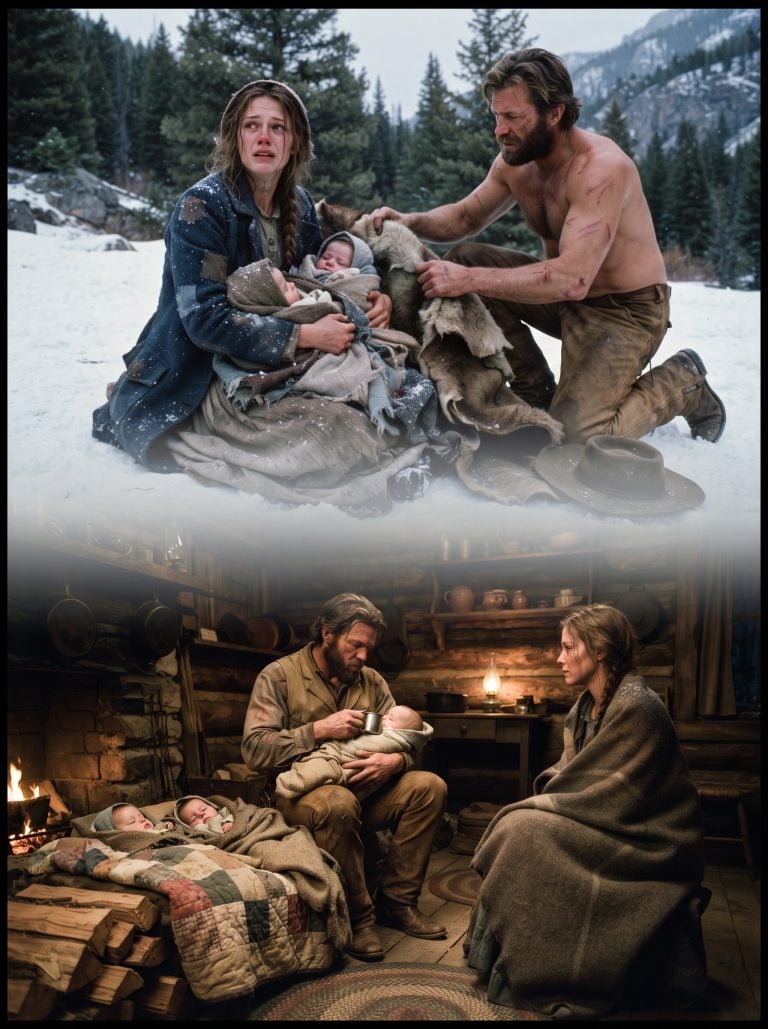
“You’re worthless for giving me a daughter,” he spat—until a mountain man stepped in, lifted her from the dirt, and said she was already his everything.

Part 1
The blizzard came down on Copper Hollow like a fist closing.
Inside the Marrow cabin, Clara Bennett gripped the bedpost and screamed into a night that had already lasted eleven hours. Old Bess Dunmore, the camp’s midwife, wiped sweat from Clara’s brow with a rag gone gray from use, murmuring the same words she’d murmured since dusk. Almost there. Almost there, child.
Silas Marrow paced by the cold end of the room, boots striking the floorboards like a countdown. “It’s a son,” he said, not for the first time. “I’ve told every man at the assay office it’ll be a son.”
Clara no longer answered him. She had learned, in three years of marriage, that silence cost less than words.
She had met Silas in St. Louis, where he’d worn a fine coat and told finer stories — of a claim in the Rockies that would make them rich, of a cabin he’d build with his own two hands, of a love that would never grow cold. She had believed him the way a girl believes a warm fire is the whole of winter. By the time she understood that Silas loved nothing so much as the sound of his own certainty, the Mississippi was a thousand miles behind her.
“Push,” Bess said. “Now, Clara. Now.”
Clara pushed with everything a body had left.
The cry that answered was thin, furious, and utterly alive.
For one unbroken moment, Clara forgot the cold, forgot Silas, forgot the bruises she kept high on her arms where sleeves could cover them. She reached for the sound. “Let me hold her — him — let me hold my baby.”
Bess wrapped the infant and went still. Her face, weathered by forty winters, folded into something careful.
“It’s a girl, Silas,” she said. “A fine, healthy girl.”
The room went the kind of quiet that comes before a slap.
“A girl.” Silas said it like a curse learned in another language.
“She’s beautiful,” Clara whispered. “She’s ours.”
“She’s nothing to me.”
Bess stepped between them, sharp as a drawn knife. “This woman is bleeding bad and needs binding. Fetch wood, Silas Marrow, or so help me —”
He did not fetch wood.
He crossed to the peg by the door, took his coat and his saddlebag, and began filling it with the coin tin, the dried meat, the flask he kept hidden from Clara’s notice. When Bess seized his sleeve to stop him, he shoved her through the door and into the storm, then barred it behind her.
“Silas!” Clara struggled up on arms that would not hold her. “The baby is cold — Silas, please —”
He kicked the banked coals apart, scattering the last of the fire’s heat across the stones. “You made a fool of me,” he said. “Told every man in this camp I’d have an heir.”
“She is your heir.”
“She’s nothing.” He shouldered into the wind. “You were never the wife I bargained for, Clara Bennett. Find out for yourself what a Wyoming winter does to fools who can’t keep a man happy.”
The door stood open behind him. Snow came through it like something hunting.
Clara did not remember deciding to move. She remembered only the floor beneath her knees, the broken basin, her own blood cooling beneath her palms as she dragged herself toward the foot of the bed where Bess had laid the child before being thrown out into the dark. She gathered her daughter against her chest and curled her body around the small, shivering weight.
“I’m here,” she breathed. “I’m here, little one.”
The cold stopped hurting after a while, which frightened her more than the pain had.
Then the doorway filled with a shadow the size of a bear.
He came in on a gust of white, rifle in one hand, snow thick in a dark beard, and took in the room in a single sweep — the dead fire, the open door, the blood on the floor, the woman curled around the child.
The rifle dropped to his side. He crossed the room in two strides and knelt.
“Easy,” he said. His voice was low, rough, and entirely without cruelty.
“Please,” Clara whispered, not certain what she begged for anymore. “Don’t let him come back for her.”
“No one is taking this child anywhere.” He drew the blanket back just far enough to see the small red face, then looked at Clara with eyes the gray of river ice. “Not tonight. Not ever, if I have any say.”
Clara’s vision closed to a pinpoint and went dark.
The man barred the door, coaxed the coals back to a flame, and bound Clara’s wounds with strips torn from his own shirt. He tucked the newborn inside his coat, against his own chest, because there was no time for anything gentler than his body’s heat. Then he carried them both out into the storm on a big gray horse that never once broke stride, though the wind tried twice to erase the trail beneath them.
By the time his own cabin rose black against the coming dawn, he had already decided he would not be handing either of them back to the world that had thrown them away.
His name was Gideon Hale, and he had not planned, that night, to become anyone’s reason for living.
Part 2
Gideon did not ask about the husband.
That, more than the warmth of his hearth, was what began to loosen something tight in Clara’s chest. Men who offered help usually wanted the shape of her suffering laid out first, so their kindness could feel earned. Gideon simply tended to what was in front of him — fever, milk, wood, silence — and let the rest wait.
She named the baby Ruth, for the woman in scripture who chose a hard road over an easy lie. Gideon said the name over slowly, as if testing whether it would hold weight, and seemed satisfied that it did.
Weeks passed inside snowbound walls. Clara noticed things she hadn’t let herself notice in years: that Gideon set her cup within reach before she asked for it; that he turned his back without being told when she needed privacy; that his hands, scarred and enormous, went perfectly still whenever Ruth’s fingers closed around one of them.
She also noticed what she was not seeing.
No trapper she had ever heard of kept a shelf of law books beside his traps. No mountain man wrote in a cipher she couldn’t read, in a ledger he kept locked beneath a floorboard, and grew quiet whenever she asked how he’d come to be riding that particular ridge on that particular night.
“You said you were tracking an elk,” she said one evening, watching him clean a revolver with the same care he gave the Winchester.
“I was.”
“For three days? In a blizzard, on the one night you happened to pass an open cabin door?”
Gideon’s hands stilled over the gun. For a long moment the fire was the only sound in the room.
“Not exactly an elk,” he admitted finally. “Get some rest, Clara. That part of the story isn’t done yet, and I’d rather tell it whole than in pieces that might frighten you before there’s cause.”
She should have pressed. Instead, exhausted and warm and holding her sleeping daughter, she let the mountain keep its secret one more night.
It would not keep it much longer.
Part 3
The truth came out on a night in February, delivered by a stranger half-frozen on Gideon’s doorstep.
He was a thin man in a Pinkerton coat, half-buried in drifts, who called Gideon by a name Clara had never heard — Agent Hale — before he collapsed against the doorframe. Gideon dragged him inside, thawed him by the fire, and only then turned to find Clara standing with Ruth on her hip and a question in her eyes that could not wait for morning.
“You’re a Pinkerton,” she said.
“Was.” Gideon did not look away from her, which she had come to understand was his particular kind of honesty. “Left the agency two years back. Some things a badge lets you see that it won’t let you fix.”
“Then why were you on that ridge?”
He exhaled slowly. “Because I never fully left. Not the last case. Silas Marrow’s real name is Elias Corbin. Four years ago, in the Dakota Territory, his first wife died of a fall down a stairwell that had no business killing a healthy woman. I worked that case for the agency and never proved a thing — Corbin vanished before charges could be filed. I’ve been following whispers of him for two winters. Yours was the third cabin on that trail I’d meant to pass that night. I wasn’t hunting an elk, Clara. I was hunting him. I just didn’t expect to find you first.”
The thin agent by the fire, recovering enough to speak, filled in the rest. The bank in Laramie had wired the agency weeks before: Harrison Bennett, Clara’s father, had not died of a weak heart as the telegram to Clara had claimed. He had died after discovering that his business partner — a man who had quietly financed Silas’s move west years earlier — had been draining the Bennett accounts for a decade. The partner’s silent partner, it turned out, was Silas himself, working under the Corbin name, positioning himself to inherit through Clara the moment her father was gone.
Silas had not wanted a son to carry his name.
He had wanted a widow’s daughter to carry his fraud, quietly, through a marriage no one back East would think to question.
The girl-child he’d called useless was, in truth, the one detail he hadn’t planned for — an heir whose birth made the estate’s inheritance law tangle in ways his lawyers hadn’t anticipated, delaying the very money he’d killed to secure.
Clara sat down hard in the chair by the hearth. “He left us to die over a legal delay.”
“He left you to die,” Gideon said quietly, “because cruelty was cheaper to him than patience. The fraud gave him a reason. It was never the reason he needed.”
Three days later, Silas came for what he believed was still his.
He arrived at dusk with four hired men and Deputy Higgins, whose loyalty, Gideon said flatly, could be measured in dollars. Clara had learned enough by then to load a revolver herself, and she did, her hands steadier than she expected as Gideon shuttered the windows and banked the fire low.
“Cora — Clara!” Silas’s voice came thin through the storm, stripped of the charm that had once fooled a whole ballroom. “Come out with the child and the estate papers, and I’ll forget what’s happened between us.”
“There is no estate for you,” Clara called back. “The agency has your ledgers, Elias. They have the partner’s confession. They have everything my father found before you had him killed.”
The silence that followed was worth more to her than any apology he might have offered.
Then the gunfire started.
It was short and it was ugly. Gideon fought like a man who had done this before and hoped never to again — economical, unhurried, devastating. The Pinkerton agent, recovered enough to stand, took the deputy down from a window with a single shot that ended Higgins’s brief, borrowed courage. The hired men, seeing money and law both fail them in the same minute, rode back into the storm they’d come from.
Silas alone did not run. He broke through the rear shutter with a crowbar, snow gusting in behind him, and found Clara standing between him and the cradle where Ruth had begun, inevitably, to cry.
“Give her to me,” he said. “She’s the last piece I need.”
“She was never a piece,” Clara said, and shot him through the knee before he closed the distance.
He went down screaming into the wreckage of his own plan.
Spring came late to the Wind River country that year, but it came.
Silas Marrow — Elias Corbin — stood trial in Laramie on charges that spanned two territories and two dead spouses, the second charge resting on evidence Gideon had spent two years gathering and one winter nearly dying to confirm. The estate, once the disputed prize of a marriage built on lies, passed cleanly to Clara and, through her, to Ruth.
Clara did not go back to St. Louis. She had spent years being told that safety meant belonging to someone. What she wanted now was land no one could remove her from, a name she chose rather than one that had chosen her, and a house with windows that faced the mountain where a stranger’s honesty had once mattered more than his silence.
She built it that summer, with Gideon’s hands and her own ledgers doing equal work. He did not ask her to marry him until the roof was finished and the last debt paid — not because he doubted his feelings, but because he understood, better than any man she had known, that a woman who had been claimed like property needed to watch a man wait.
“I love you,” he told her at last, on a porch gold with September light, Ruth asleep against his shoulder. “Not for what you survived. For who you were underneath it the whole time.”
“I know,” Clara said, and found, to her own surprise, that she could laugh while she said it. “You’re a terrible liar and an honest man. I’d rather have the second.”
They married in October under a sky the color of the mountain’s granite. Ruth, too young to understand vows, laughed loudly enough during the ceremony that even the circuit preacher smiled.
Years later, people in that valley would say the Hale ranch was proof that a hard land could still be kind, if the right people worked it together. They would talk about Clara’s fair wages and sharp accounts, about Gideon’s quiet skill with cattle and quieter skill with grief, about a daughter who grew up knowing her birth had been celebrated, not endured.
What they rarely understood — what Clara herself only came to see in full over the years — was that the mountain man’s rescue had never been an accident of fate. It had been the slow, deliberate result of one man’s refusal to let a lie finish what it started, arriving just in time to meet a woman’s refusal to let cruelty finish what it started.
Luck had brought them into the same storm.
Courage was what kept them out of it.
And on winter nights, when snow came hard against new glass, Clara would sometimes wake and listen for the old fear the way a person checks a wound long since healed. She never found it. Only the hearth, breathing low. Only Ruth’s soft breathing down the hall. Only Gideon’s hand, open and unclaiming, in the dark beside her own.
No door in that house was ever barred against the two of them again.