Two Years After He Kicked Her Out, a 4 AM Phone Call Shattered the Mafia Boss’s World: “Your Son Is Dying.”

PART 1
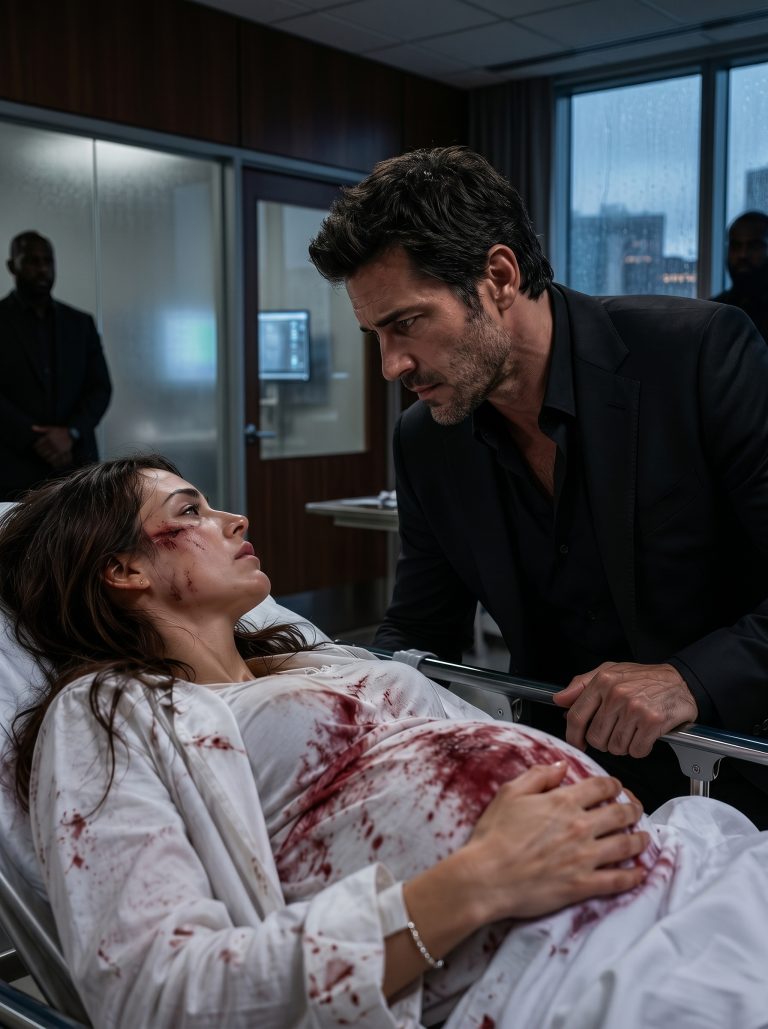
I made the most dangerous decision of my life at 3:47 a.m. in a hospital parking lot, standing under fluorescent lights in scrubs still stained with a stranger’s blood, holding a phone I had promised myself never to use.
My son was dying.
Not technically. The doctors used better words. Critical. Stable. Meningitis. Words that tried to sound professional about the fact that Gabriel’s fever had climbed to 104 and he had stopped talking except to whisper one word through an oxygen mask.
Papa.
He had never even met his father.
St. Catherine’s Children’s Hospital in Chicago had the particular cruelty of being built well—clean lines, good lighting, machines that beeped reassuringly while they monitored the slow failure of small bodies. Fourth floor intensive care meant I got a chair that did not fold properly and silence that never stopped humming with the sound of kids fighting for breath.
Gabriel had been fine on Tuesday.
By Wednesday he was burning alive from the inside.
The attending physician used phrases like “bacterial infection” and “unusual strain” and “we’ll need to discuss some possibilities.” What he meant was: someone did this to your son.
The pediatric infectious disease specialist said it without the safety net of medical language.
“The strain profile suggests deliberate introduction,” she told me in a consultation room with bad art and worse news. “I can’t determine criminal intent, but medically speaking, this does not look accidental.”
My brain refused the sentence.
It hung there like a foreign language.
Deliberate.
Introduction.
Someone had hurt my child on purpose.
That was when I called Lucian.
I had sworn I would never. Two years of keeping that number off my phone, out of my life, out of the story I had built without him. Two years of telling myself that Morning Glass—my bakery, my dream, my sanity—was enough to be a complete woman.
But completeness was a lie I could no longer afford.
Because my son was asking for a father he had never met, and the fever was climbing, and I had finally run out of versions of myself that could survive alone.
Lucian’s security chief answered.
I almost hung up.
Instead, I heard myself say: “Tell him his son is critical. Tell him to come now.”
The silence on the line lasted three seconds.
Then a different voice. Low. Controlled. Unmistakable.
“What hospital?”
And that was how Lucian Valdez ended the two years I had spent learning to live without him.
He arrived at 4:18 a.m. in an elevator that seemed to part people with his presence alone. Charcoal suit. Black tie. The kind of composed that most men imitated with loudness and failed. He moved as if the building understood him before he entered.
His eyes found me.
“Elena.”
My name in his voice hit like memory. Too familiar. Too dangerous.
“He’s been asking for you,” I said, because anything else would have splintered me. “He doesn’t know who you are, but—”
“Take me to him.”
We went together into a room that smelled like antiseptic and the particular loneliness of sick children. Gabriel lay swallowed by white sheets, oxygen mask over his nose, dark lashes against fever-flushed cheeks. One small hand curled near his chin.
Lucian stopped like he had forgotten how to move.
Then Gabriel stirred.
His eyes opened the smallest bit. Heavy with medication. Clouded with sickness.
But when they landed on Lucian, something shifted in his face.
He lifted his fingers weakly.
“Daddy,” he whispered.
Lucian’s head turned to me so sharply it was almost a wound.
I saw the question bloom. The accusation he wouldn’t voice. The arithmetic he was doing at ruthless speed.
Behind all of it, something worse.
Hope.
“His name is Gabriel,” I said quietly. “He turned two in October.”
For a long second, Lucian only stood there.
Then he walked to the bed and sat down with the care of a man approaching something sacred. Gabriel’s tiny hand slid into his with absolute confidence.
The first lie I had believed for two years died that moment.
I had told myself that men like Lucian could command fear, desire, obedience. But not tenderness.
I had been wrong.
Around dawn, the specialist returned with a look I had already learned to fear.
“The complication,” she said, “is that this strain doesn’t normally appear in children without direct exposure.”
Lucian’s voice was calm. “Someone introduced it deliberately.”
“Medically speaking, yes.”
He stood. Every line of his body became weapon.
“Who knew about the boy?”
I laughed once, a broken sound. “Everyone. My neighbors. The daycare. Parents from playgroup. The city, Lucian. He’s a child.”
“No,” he said with terrifying softness. “He is my child.”
By noon, his men had secured the floor. By evening, I was in a car driving north to an estate I had hoped never to see again.
Lake Forest. Stone walls. Iron gates. The kind of old money that had learned how to hide. It should have felt cold.
Instead it felt inhabited.
There were fresh flowers on the entry table. Children’s books. A woman named María who took one look at Gabriel and said, “That boy needs soup. And you need feeding.”
I almost liked her, which felt like betrayal of my anger.
Gabriel loved her in under an hour.
He loved Lucian in under two days.
That part nearly undid me.
I watched my son, who approached men with polite suspicion, reach for Lucian from across a room with absolute certainty. Lucian took him awkwardly at first, too careful. But by the fourth time, he had learned Gabriel liked to rest his head on the left shoulder.
One evening I came downstairs and found them in the library. Gabriel cross-legged on Lucian’s knee, handing him blocks one by one with solemn authority.
Lucian was letting himself be instructed.
That was when I understood the war really wasn’t what I thought.
Three nights in, I found Lucian alone in the kitchen at midnight.
“Why did you do it?” I asked.
He didn’t pretend not to understand. “Someone brought me evidence you sold information to Gregory Stone.”
Stone. The name landed cold. Lucian’s rival. Less businessman than scavenger.
“I never met Gregory Stone.”
“I know that now.”
“Do you?” I stepped closer. “Because two years ago you seemed incredibly sure.”
Lucian set down his glass. “My father’s consigliere brought me documentation. Meetings. A shipment detail only three people knew. Stone moved on it within forty-eight hours.”
“And you came to me?”
“I came to a conclusion.”
The honesty hurt worse than any excuse.
I laughed, because the alternative was crying. “You detonated my life on a conclusion. Then when I tried to call you back, someone told you not to put me through.”
Lucian’s expression changed. “I never gave that order.”
The room shifted.
“Then someone lied to both of us,” I said.
His jaw tightened. “Antonio Romano. My father’s consigliere.”
The name meant everything to him and nothing to me.
“He raised you,” I said softly.
Lucian nodded once.
The realization moved across his face like shadow on water.
Antonio hadn’t just advised him. He had been family. Guardian. Until loyalty curdled and he had wanted everything Lucian touched to break.
“Someone in your house wanted me gone,” I whispered.
Lucian looked at the floor, then at me.
“I’m sorry,” he said.
Two words. No defense. No justification.
If he had tried to explain it, I might have hated him more cleanly. But he didn’t.
He just stood there and let the truth stay ugly.
PART 2
The first attack came two days later during dinner.
The south-facing window shattered inward.
Not a gunshot—something faster. A crack like the room itself had split.
Before I understood what happened, Lucian was there. One hand swept me backward. The other pushed Gabriel’s high chair toward María.
“Interior corridor,” he said.
His voice was calm.
That was the worst part.
Ten minutes later, the estate was locked down. One man dead. Another captured. A third running and not getting far.
It should have made me feel safer.
Instead it made everything more real.
That night I found Lucian in his office with blood on his wrist.
“You’re hurt.”
“Graze.”
“Sit.”
He did. So I cleaned the cut under yellow desk light while he watched my face with that searching intensity that used to make me feel seen and later made me feel cornered.
Now it did both.
“You always did this when you were frightened,” he said quietly.
“Keep my hands busy?”
“Build structure out of damage.”
That almost broke me, because it was the kind of thing you only notice about someone when you have loved them carefully.
The second attack was worse.
Rosa caught the blast from a car bomb meant for Lucian’s convoy when a town car left the pharmacy parking lot. She survived with a concussion and a dislocated shoulder. Nobody died.
That was somehow what made it unbearable.
I went to Lucian’s office.
“I’m staying,” I said.
He looked up slowly.
“You understand what that means?”
“Yes.”
“No,” I said. “You don’t. I’m not staying because I have nowhere to go. I’m staying because Gabriel is yours, because whoever did this isn’t done, and because I’m tired of living inside decisions other people made for me.”
Something in his face softened then hardened again, like even relief had to pass through discipline.
“Then I tell you everything,” he said.
He did.
Then I got taken.
It happened at a market in Highland Park because real disasters arrive in ordinary places. Marco was fifteen feet away. Three minutes later, a hand clamped over my mouth. A needle hit my neck. The world went black.
When I woke, I was in a stone basement with one table, one chair, one window too high to reach.
There was a canvas bag with water, bread, a pocketknife.
That was when I understood I wasn’t about to die.
Gregory Stone came in three hours later.
Elegant. Predatory. Silver at the temples.
“Elena Hart,” he said. “Lucian’s ghost.”
“What do you want?”
“Information.”
“You won’t get it.”
“I know.” He smiled. “But Vincent did so much work keeping you apart. It seems wasteful not to enjoy the result.”
My blood went cold.
“Vincent,” I whispered.
Stone’s smile widened. “Seven years ago, Lucian signed off on an operation that killed Vincent’s son. Wrong warehouse. Wrong night. Wrong boy. Vincent wants symmetry. Lucian loses what he loves.”
I stared at him.
“He poisoned Gabriel to force contact,” Stone said. “I helped with logistics. But the idea was his.”
For a moment the world stopped.
Then I moved.
Forty minutes later, hands bleeding, I had the vent grille loose. The shaft led to a service tunnel. The tunnel led to an alley behind the building.
When I pulled myself into open air, shoeless and filthy, a black SUV screeched into the alley.
Marco jumped out.
“You’re already outside,” he said blankly.
“Drive faster.”
On the way back, I told him everything.
Lucian met us at the estate gate before the SUV stopped.
He yanked the passenger door open, froze, then put both hands on my face.
Inventory.
Not romantic. Not possessive. Just utterly, perfectly certain.
“You’re hurt?”
“No.”
His forehead dropped against mine for one brief, wrecked second.
Then he became Dante again.
“Marco,” he said. “Get Antonio into the east office. No one speaks to him.”
That night, Lucian confronted Vincent.
Vincent didn’t deny the calls. Or the fabricated meetings. Or the poison.
“Now you know,” he told Lucian, “what it is to lose a son.”
Lucian’s answer was the calmest Marco said he’d ever heard him.
“I did lose him,” Lucian said. “For two years.”
Then he called his attorney.
By morning, Antonio Romano and Gregory Stone were both part of a federal case so thoroughly documented that no private punishment could have been more final.
PART 3
The weeks after felt stranger than the danger.
Morning Glass reopened. Julia, who had handled the bakery alone with the competence of a saint and the bitterness of a woman who had dealt with three bridal emergencies, hugged me so hard I nearly dropped a tray of scones.
The wedding cake got remade. The bride cried. I cried. Julia threatened to lock me in the walk-in if I became “one of those emotional owners.”
Gabriel got stronger. Hungrier. Louder.
Lucian came into the bakery one Friday afternoon carrying Gabriel like he had been doing it his whole life. Every woman at table three forgot what she was saying. Every man looked like he valued his survival.
Gabriel leaned over and pointed.
“Daddy, cake.”
By Christmas, Lucian was spending more evenings at my apartment than his estate. By February, there were green socks in both houses and Gabriel called the estate “the big house with María pancakes.”
By March, I had stopped pretending I wasn’t in love with him again.
One cold night, after Gabriel was asleep on my couch, Lucian found me in the kitchen shaping bread dough I did not need to make.
“You do this when you’re thinking,” he said.
“I do this when I’m alive.”
He came closer. Put a small velvet box on the counter between the flour and the olive oil.
Inside was a ring. Old gold. His mother’s. Beautiful in the quiet, durable way useful things are beautiful.
“I’m not asking you to erase what happened,” he said. “I’m asking if we can build something that tells the truth about it and survives anyway.”
I looked at the ring. Then at him.
“And if someone tells you something ugly about me again?”
He didn’t hesitate.
“I come to you first.”
“And Gabriel?”
His expression softened. “Gabriel is my son. That is not conditional. It is not negotiable. It is not attached to whether you forgive me on a given day.”
I picked up the ring. Slid it onto my own finger.
“Okay,” I whispered.
For the first time in my life, I watched Lucian Valdez smile without restraint. It reached his eyes fully, and in them I saw every version of him—the ruthless one, the wounded one, the father, the man who drove through the dark at 4 a.m. because our son was dying.
We got married in April at the courthouse with María crying into tissues she denied needing and Marco taking photos like he was documenting a ceasefire.
A year after the hospital, on a warm June afternoon, I fell asleep in the garden behind the estate.
When I opened my eyes, Lucian was sitting beside me on the bench.
“You were out for twenty minutes,” he said.
“In the garden?”
“In the garden.”
I pushed hair off my face. “You’re doing the thing again.”
“What thing?”
“The look. Like I broke something in you.”
He glanced toward the stone wall where Gabriel was crouched in the sunlight, showing a worm to his stuffed rabbit with enormous solemnity.
Then he looked back at me.
“You always trusted me in places where you shouldn’t have,” he said. “Before I earned it. Even after I failed it.”
I leaned my head against the back of the bench. “You earned it later.”
“Later than I should have.”
“Yes.”
He reached into his shirt pocket and pulled out a folded white handkerchief.
I laughed softly. “My eyes are dry.”
“I know.”
He held it out anyway. I took it.
Gabriel looked up, spotted the handkerchief, and came racing over. “Mine.”
Before either of us could stop him, he tied the cloth clumsily around his own small wrist, then held it up with satisfaction.
Lucian looked at him, then at me.
“He has your stubbornness,” he said.
“He has your certainty.”
Gabriel, pleased with both diagnoses, ran back to his worm.
The sun was warm. The house behind us was quiet in the safest way I had ever known. Lucian’s hand found mine on the bench, and I let it stay there because there was no reason in the world not to.
I thought about the hospital at four in the morning. The cold chair outside the ICU. The moment Gabriel whispered “papa” and changed everything.
None of what came after had been simple.
We did not survive cleanly.
There were still nights when I woke too fast from dreams of glass breaking. Still days when the past pressed at the edges like weather.
But there was also this.
A garden in June.
A little boy with his father’s eyes.
A man who had finally learned that love was not control, not assumption, not power, but the courage to ask and the discipline to stay.
Lucian squeezed my hand once.
“Elena.”
Just my name. Nothing dramatic.
But in his mouth now it sounded like a vow.
I smiled and looked toward our son.
“I know,” I said.
And for the first time in a long time, there was nothing in me bracing for the next disaster.
Only sunlight.
Only laughter.
Only home.
THE END