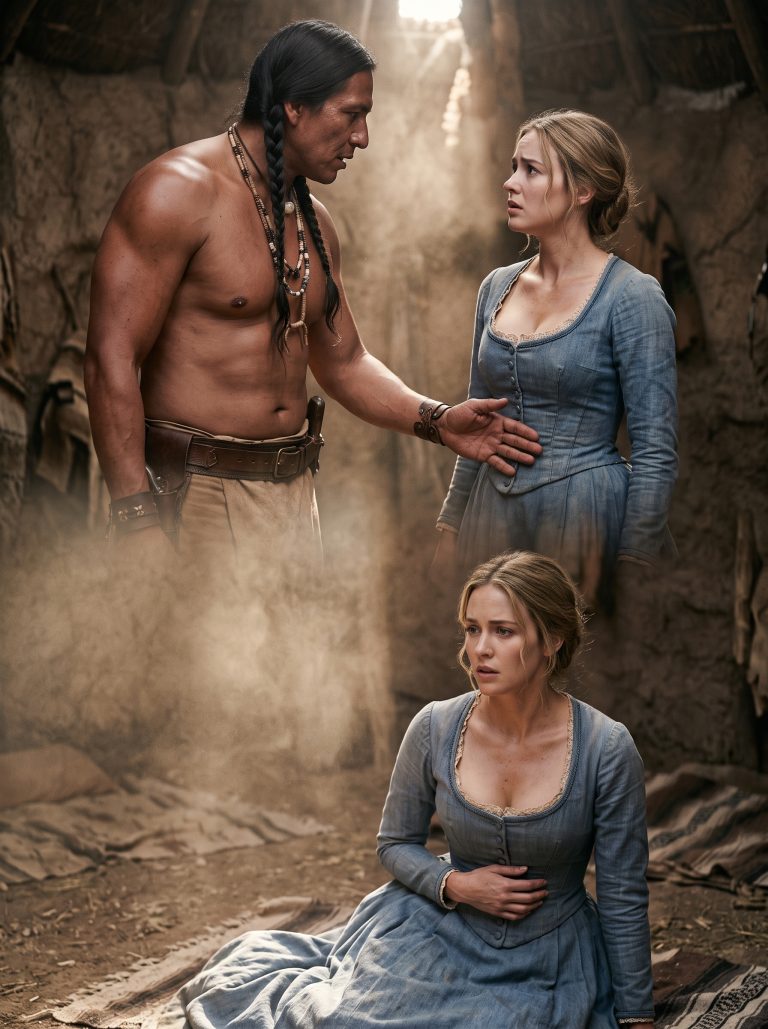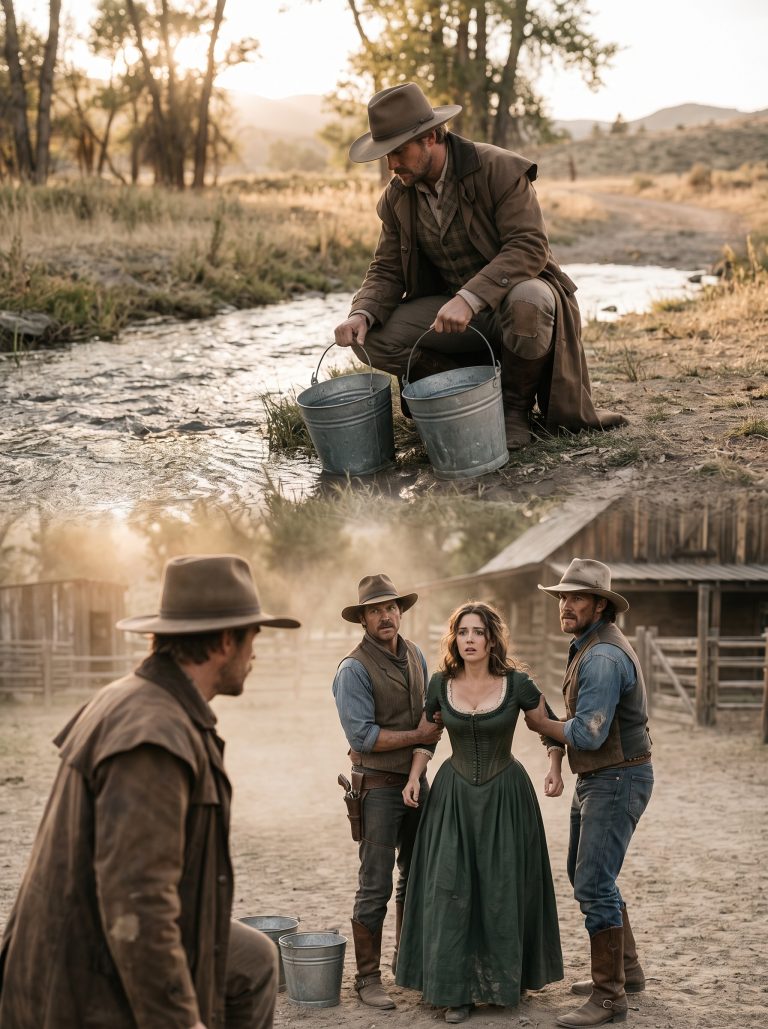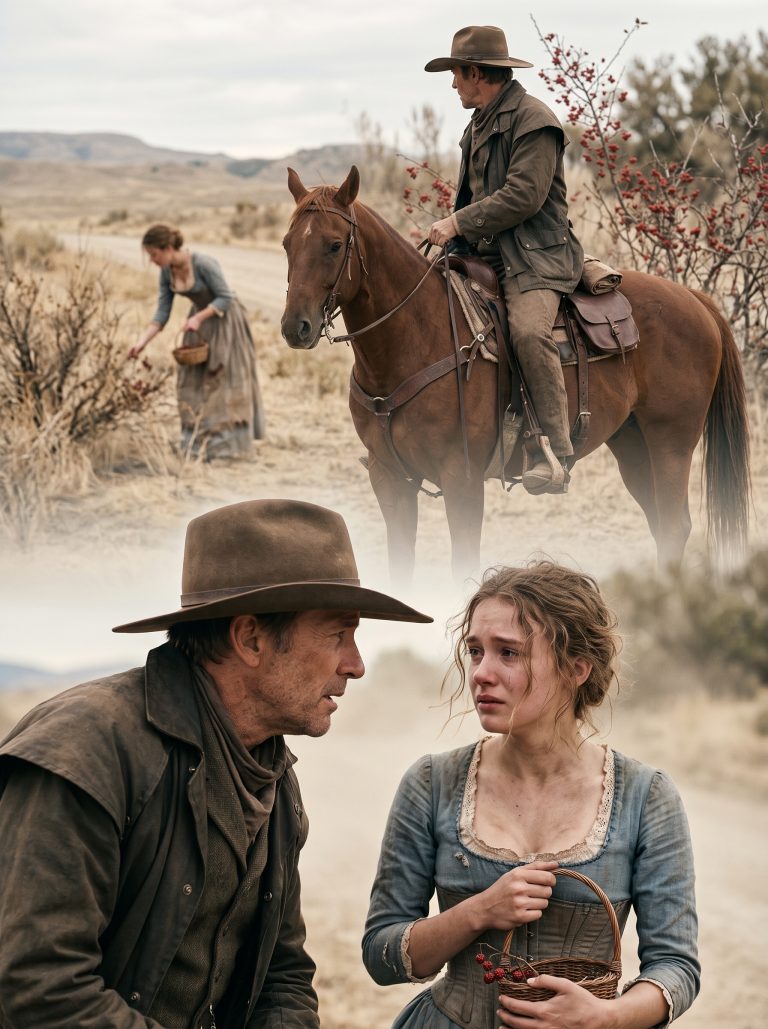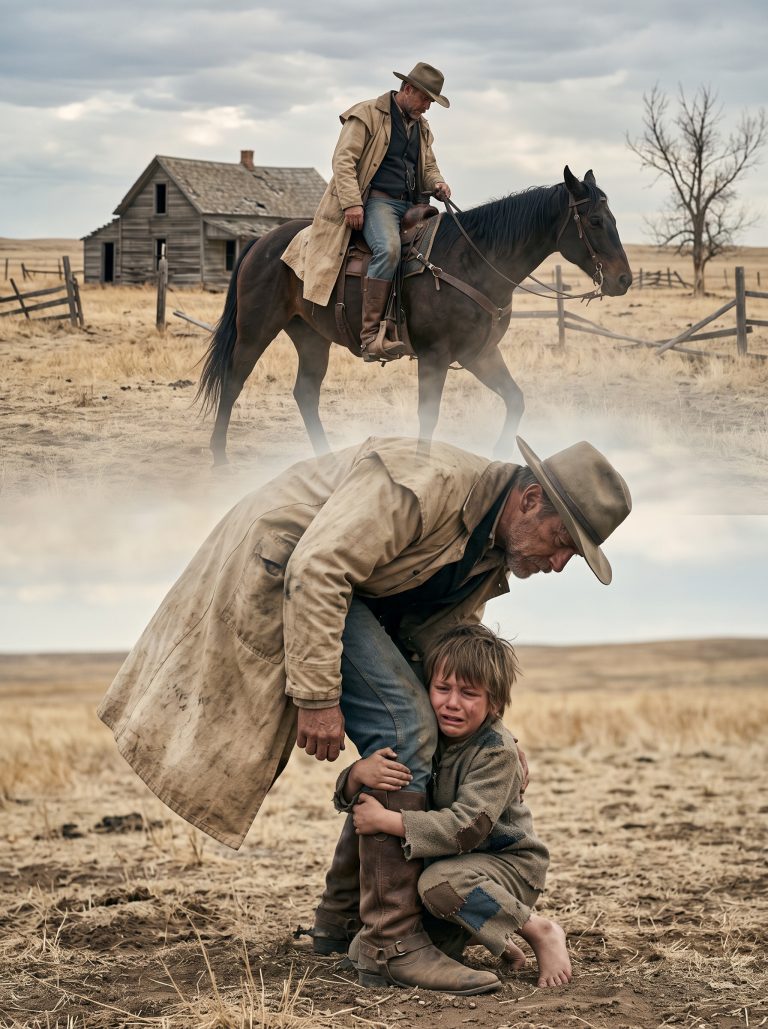
They sent a “worthless” bride to bankrupt a cowboy — but she rebuilt his dying ranch into the richest land in the territory and shattered everything he believed about love.

Part 1
The letter arrived with the noon stage, sealed in blue wax, and Caleb Whitfield knew before he broke it that his five years of borrowed time had run out.
He was mending a gate hinge when Widow Hargrove — his housekeeper since before the drought — walked the whole length of the yard to hand it to him instead of waiting for him to come in for dinner. That alone told him it was bad.
“From Boston,” she said, as if the word itself were an accusation.
Caleb set down his hammer. At forty-two he’d built the Whitfield spread out of nothing but two hundred head and a debt he refused to name out loud. Twelve thousand acres now, good water, better cattle. Men in three counties knew his brand. None of them knew what he’d signed to get it.
Five years back, in a summer so dry the creek had shown its bones, he’d taken a loan from Augustus Ashworth, a Boston shipping man with more capital than patience. The condition had been a marriage — Ashworth’s eldest daughter, Vivian, for the debt forgiven. Vivian had come west exactly once, taken one look at the wind and the horizon, and gone home on the next train. Caleb had expected the Ashworths to sue.
Instead they’d offered a second chance, colder than the first: marry any unmarried daughter of the house, and the debt would still be void. Young and desperate, Caleb had signed it without reading past the word forgiven.
He broke the seal now with a thumb gone stiff from work.
Dear Mr. Whitfield,
Your bride will arrive on the twentieth by the Union line, three o’clock, at Miller’s Crossing. She is our youngest, Eleanor, twenty-two, gently raised and unaccustomed to any hardship. We trust you will be patient with her limitations.
A. Ashworth
Caleb had heard of Eleanor Ashworth the way a man hears of weather two counties off — secondhand, exaggerated, always trouble. The daughter too sharp-tongued to marry well. The one who corrected bankers at dinner parties. The one nobody wanted.
Sent to him. Not as a wife. As a punishment neither of them had chosen.
He went to Miller’s Crossing anyway, because a signed name was a signed name, and the frontier had taught him that a broken word cost more than a full purse.
The platform was thick with steam and shouting when the train came in. He watched for silk and servants and found instead a woman in a plain traveling dress, one carpetbag in her gloved hand, no trunks, no maid. She found him before he found her.
“Mr. Whitfield.” Her voice didn’t shake.
“Miss Ashworth.”
Up close she was not what the whispers had promised. Her eyes were a clear, assessing gray, and she looked at him the way she might look at a ledger with a column that didn’t balance.
“I assume you were told I’m difficult,” she said.
“More or less.”
“Good. Let’s not waste time pretending otherwise. I don’t intend to sit on your porch being decorative, and I don’t intend to be sent home in disgrace either. If we’re going to survive this arrangement, I’d rather we were honest with each other from the start.”
Caleb found, to his own surprise, that his anger had nowhere to land.
“Ground rules,” he said slowly. “All right. This everything?” He nodded at the bag.
“I didn’t want much to carry back, if it comes to that.”
He looked at her a long moment. A woman dragged west in tears would have brought trunks enough to prove she meant to stay unhappy. This one had packed for either outcome and betrayed nothing about which she expected.
The ride to Cold River took the rest of the day. She asked about his herd size, his debt, his hands’ wages, and when he balked at the last question she said simply, “If I’m to be your wife, I need to know what we’re standing on,” and something in the we settled a small, unfamiliar weight in his chest.
They married the next afternoon, a circuit preacher, no flowers, Widow Hargrove and six hands for witnesses. That night, instead of resting, Eleanor asked to see his account books.
By midnight she’d found nine places the ranch was bleeding money it didn’t have to.
“You’ve been running this alone too long,” she said, tapping a column with her pen.
“I’m a rancher,” Caleb said. “Not a bookkeeper.”
Eleanor looked up, gray eyes steady in the lamplight.
“Tonight you’re both.”
Outside, the wind came down off the ridge and pressed against the glass, and Caleb Whitfield sat across from the wife sent to ruin him, beginning to suspect she was the first honest thing Boston had ever sent him.
Part 2
By the second week, the hands had stopped laughing when Eleanor crossed the yard. She’d renegotiated the feed contract in Helena herself, cutting the price by a fifth. She’d redrawn the corral layout so hauling water took half the time. She fell off a green-broke mare in front of six men, stood up with dust in her teeth, and said only, “Again.”
Caleb watched her learn to rope with blistered hands and never once ask to be spared the work.
One evening he found her on the porch, ledger closed for once, watching the sun bleed orange over the grass.
“You expected me to fail,” she said, not quite a question.
“I expected you to leave.”
“I didn’t come here to be rescued from a life I already hated in Boston.” She looked at him sideways. “I came here to build something that was mine.”
“And is it? Yours?”
“Ask me again in a year.”
He almost smiled. Almost reached for her hand, and didn’t, not yet — but something had shifted between them that no contract had written down, something neither of them had a name for.
Then, far down the road, a rider came on hard, pushing a spent horse through the dusk like trouble itself had sent him ahead of a storm.
Part 3
The horse was lathered white by the time it reached the yard, and the rider nearly went down with it.
Caleb was off the porch before he’d decided to move. “Whitfield?” the man rasped, already fumbling a folded paper from his coat. “Lawyer’s office in Helena. Had to reach you tonight.”
Eleanor came down the steps behind him, her face going pale in the lantern light before she’d even read a word.
The notice was short and cold: Augustus Ashworth had filed claim against the Whitfield ranch, alleging the marriage failed to satisfy the terms of the original agreement. A representative would arrive within two days to inventory the property pending seizure.
Caleb read it twice. Then he looked at his wife, and saw something worse than fear on her face.
Shame.
“What aren’t you telling me,” he said. It wasn’t a question either.
They went inside, and for the first time he shut the study door between them and the rest of the world.
“My father never meant for this marriage to hold,” Eleanor said, once the door was closed. “He told me the night before I left. He said if I went west and made myself unbearable, you’d send me home in a month, and then he’d have grounds to call the whole contract broken and take the ranch instead of forgiving the debt.”
“And you came anyway.”
“I came because I was tired of being spent like a coin.” Her hands were folded so tightly the knuckles had gone white. “I thought if I told you the truth from the start, you’d assume I was part of his plan and never trust a word I said afterward. So I decided to simply — not fail. I thought that would be enough.”
Caleb’s jaw was a hard line. “It isn’t the same as telling me.”
“No. It isn’t.” She met his eyes without flinching, which was somehow worse than if she’d looked away. “I’m sorry. I should have trusted you before your father’s lawyer forced my hand.”
He wanted to be angrier than he was. Instead there was only a tired, aching recognition — the same fence-down feeling he got every spring after a hard freeze, checking for damage before he knew yet how bad it was.
“Is that everything?” he asked.
She hesitated, and the hesitation told him it wasn’t.
From the bottom drawer of the desk she drew a second document, sealed in the same blue wax as the letter that had started this whole business two days ago. But older. Softer at the folds, as if it had been read many times by someone who was gone now.
“This isn’t from my father’s office,” she said quietly. “It’s from my mother’s.”
Caleb frowned. “Your mother’s been gone — ”
“Four years. She died before the ink on my father’s contract with you was dry.” Eleanor’s voice thinned but didn’t break. “She never trusted him with any of us. She was ill a long time before she died, long enough to see exactly what he intended to do with her daughters — spend us, one by one, to secure his shipping contracts. So she wrote her own instrument. A trust, drawn separately from his estate, naming whichever of her daughters married outside of Boston — married for a life of her own choosing, not his — as sole heir to her private holdings. Wharves. Warehouse shares. Money my father has never been able to touch, because it was never his to begin with.”
Caleb went very still. “You knew this when you married me.”
“I suspected it. I found the document itself only after the wedding, hidden in the lining of the bag I brought west — she must have put it there herself, before she died, trusting one of us would eventually need it and find it. I didn’t fully understand what I was carrying until three nights ago.” She set it on the desk between them, next to the seizure notice, and for a moment the two papers sat side by side like opposing armies. “My father’s claim depends on convincing a judge that our marriage doesn’t satisfy the terms he wrote. But it was never his contract to control in the first place. Not entirely. My mother’s trust makes this union — any daughter marrying west, in good faith — sufficient on its own, regardless of what he claims afterward. If this is genuine, he has no claim to file at all. He’s been trying to seize a ranch he was never owed, using a debt he already lost the right to collect the moment my mother’s will was read.”
“Then why hasn’t he simply told you this himself.”
“Because he’s spent four years pretending her trust doesn’t exist. If he acknowledges it now, to fight you, he hands Vivian and me both the very independence he’s spent our whole lives trying to prevent.” Her mouth curved, faint and bitter. “My father built an empire on other people’s signatures. He forgot his wife could write one too.”
Caleb looked at the document a long while, and then at his wife, and felt something in his chest that was not quite anger and not quite relief — closer to the moment a fence you thought was ruined turns out only to be leaning, still standing, still his to fix.
“You should have told me the day it arrived,” he said.
“I know.”
“You’ll tell me the next time. Whatever it is.”
“I will.”
He took her hand, careful of the ink still staining her fingers from the ledgers. Outside, thunder rolled somewhere over the ridge, and neither of them moved to close the shutters.
Augustus Ashworth arrived two mornings later in a hired carriage too fine for the mud it sank into, his lawyer beside him looking ill even before he’d stepped down. Vivian came too, veiled against dust that hadn’t touched Boston in her memory, her eyes finding her sister’s with something that wasn’t quite triumph and wasn’t quite regret.
“Mr. Whitfield.” Augustus surveyed the yard as if pricing it for auction. “I trust my daughter has proven as much trouble as I warned you.”
“She’s proven considerably more useful than you warned me,” Caleb said. “Which seems to be the trouble.”
Eleanor stepped down from the porch, steady, unveiled, dressed for work and not for her father’s benefit.
“I know why you’re here,” she said. “You’ve come to argue that our marriage fails the terms of your contract. I’d like you to explain that argument in front of the man you’re accusing of fraud, and in front of the trust Mother left behind — the one you’ve spent four years pretending was never read aloud.”
Something in Augustus’s face went very carefully blank.
“I don’t know what you mean.”
“You know exactly what I mean.” Eleanor held out the second document, and Caleb watched her father’s eyes catch on the seal before his composure caught up with them. “Judge Halstead is riding out this afternoon at my request, not yours. He’ll want to know why a claim was filed against a marriage a private trust already validates — and why the man filing it never once mentioned that trust to the court, though he’s known of its existence since the week Mother died.”
Vivian had gone very still beside the carriage.
“Father,” she said slowly, “is this true?”
“It is a private family matter — ”
“It is my inheritance,” Vivian said, and something in her voice cracked open that Caleb suspected had been sealed for a very long time. “You told me there was nothing left of Mother’s. You told me the wharves went to creditors.”
“They very nearly did,” Augustus snapped, “because your mother’s meddling nearly cost this family everything —”
“Or,” Eleanor said quietly, “it saved us from you.”
The yard had gone as still as it had the day Caleb brought his bride home, every hand pretending to work and failing at it. Augustus looked between his daughters, and for the first time Caleb saw something other than command in the older man’s face. Something closer to a man watching a ledger he’d falsified come due all at once.
“You have no proof this document is genuine,” he said, but the words came out thinner than he meant them.
“Judge Halstead has handled my mother’s affairs before,” Eleanor said. “He’ll recognize her hand and her seal faster than any of us. And when he asks why you filed a fraudulent claim against a marriage her own trust already protected, I expect you’ll find the answer harder to give than the question.”
Augustus’s lawyer had gone the color of old snow.
By the time the judge’s cart came up the road that afternoon, Augustus Ashworth had already climbed back into his carriage, Vivian beside him, the two of them not speaking, the silence between them louder than any argument could have been.
Judge Halstead read both documents at Caleb’s desk with the patience of a man who had seen every trick wealth could dress itself in. When he finished, he took off his spectacles and set them down with a small, final click.
“The trust is genuine,” he said. “I drew up papers for Eleanor Ashworth’s mother myself, four years past, and recognize both hand and seal. It supersedes any claim her husband believes he retains over the marriage contract. Mr. Ashworth’s filing against this ranch is not merely without merit — it was made in full knowledge that it was without merit, which is a different matter entirely, and one I intend to raise with the territorial court.”
He looked at Eleanor over the rim of his coffee cup.
“Your mother,” he said, “was a considerably better businesswoman than your father, Mrs. Whitfield. It seems she knew exactly which of her daughters would need the paper most, and precisely when.”
Eleanor’s eyes shone, but she didn’t look away.
“She always did,” she said.
Augustus Ashworth did not return to Cold River again. The territorial court’s inquiry cost him more in Boston circles than the ranch ever would have, and within the year his shipping contracts had been quietly absorbed by rivals only too glad to point out, in every drawing room that mattered, exactly what kind of man falsifies a claim against his own daughter’s marriage.
Vivian wrote twice that winter — first a short, formal note, and then, in spring, a longer letter that arrived with less ceremony and more honesty than anything Caleb had seen come out of that family. She had taken her share of their mother’s trust, quietly, and moved to Chicago to manage a share of the warehouse business herself. I used to think Mother’s paperwork was a burden she left us, she wrote. I understand now it was the only inheritance she trusted us to actually use.
Eleanor read that line aloud by the fire one night, twice, before she set the letter down.
“She built something for us that even he couldn’t touch,” she said. “Not because she had more power than him. Because she was patient enough to hide it where he’d never think to look — inside the daughters he’d already decided were worthless.”
Caleb watched the firelight move over her face and thought of the carpetbag she’d carried off the train that first day, light enough to carry back to Boston if things went wrong, and heavy enough, it turned out, to hold the one document that mattered more than his whole ranch.
“Your mother didn’t just save you,” he said slowly. “She built the fence around you before she ever knew whose land you’d need protecting on.”
Eleanor looked at him a long moment, something soft moving behind the sharpness she never fully put away.
“That’s the part he never understood,” she said. “He thought a woman’s worth was whatever he could spend her for. She thought a woman’s worth was whatever she chose to build once no one was spending her at all.”
By the second harvest, Whitfield beef brought the best price at the Helena yards three years running, and men gave Caleb the credit for it out of habit.
He corrected them every time.
“My wife drew the plans,” he’d say. “I only signed for the lumber.”
Some laughed, assuming modesty. Then Eleanor would ask three questions about feed costs and water rights that the laughing men couldn’t answer, and the laughter always stopped.
One evening in late autumn, two years almost to the day since she’d stepped off the train at Miller’s Crossing with one bag and a stolen truth she hadn’t yet understood she carried, Caleb found her on the rise above the house, looking down at the ranch gone gold in the last light.
“Do you ever wonder,” she asked, “what would have happened if I’d never found it — Mother’s trust — if I’d come here with nothing but my father’s letter and his lie?”
Caleb considered the question honestly, the way she’d have wanted.
“I’d have married you anyway,” he said. “Contract or none. I didn’t fall in love with a document, Eleanor. I fell in love with the woman who unpacked one carpetbag and rebuilt my whole operation before she’d finished unpacking it.”
“That’s not an answer.”
“It’s the only one I’ve got.” He took her hand, work-roughened now, ink long faded from her fingers but never quite gone. “Your mother gave you the proof that protected the ranch. But you were never worth protecting because of what was sewn into that lining. You were worth it long before you ever knew it was there.”
Eleanor’s eyes filled, the way they still did sometimes, quietly, without apology.
“Then I suppose,” she said, “we owe her more than either of us can repay.”
“We can try,” Caleb said. “Same as everything else out here. One season at a time.”
Below them, the ranch settled into evening — smoke rising straight from the chimney, horses moving unhurried toward the creek, a home neither Boston money nor Boston malice had ever managed to own outright. Caleb Whitfield had built it, once, out of two hundred head and a debt he was ashamed of. But it was Eleanor — and the mother who’d loved her daughters enough to out-plan a man who never once planned for anyone but himself — who had made it a place worth calling theirs.
He kissed her as the sun went down, and for the first time since the letter with the blue wax seal had first crossed his gate, Caleb felt no fear left in him at all — only the quiet, certain weight of a life he’d chosen, and a wife who had chosen it right back.