Every Sunday He Chose the Same Seat — And Every Sunday She Looked for Him

Part 1
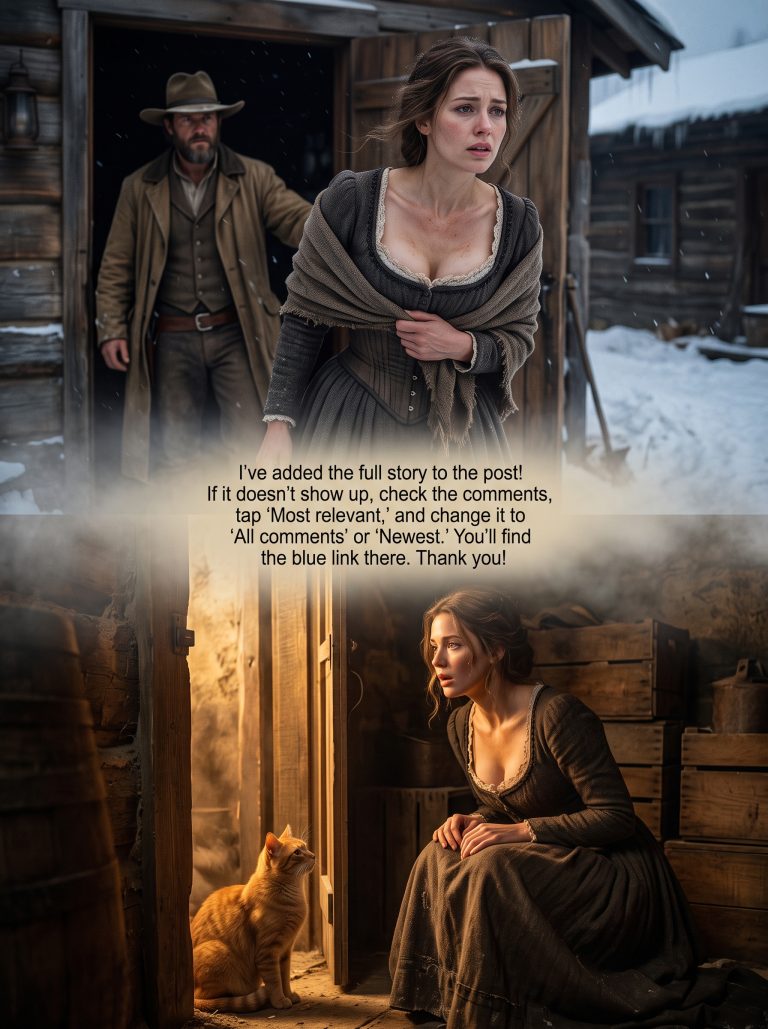
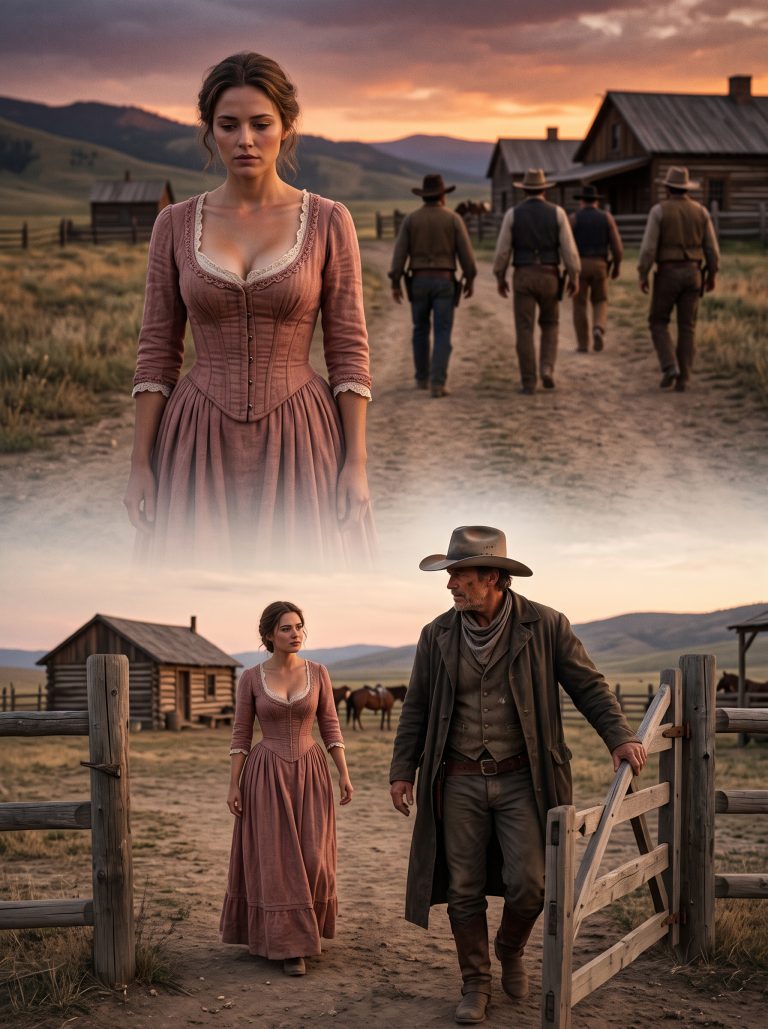
The bell of Pine Hollow Chapel had barely stopped ringing when Ethan Cole slipped through the side door, ducking his head beneath the low frame out of habit more than necessity. He was not a tall man, but he was built wide through the shoulders from ten years at the forge, and doorways built for thinner men had never quite fit him. Behind the livery he kept a small flock of ewes, the last remnant of the ranch he and Anna had once run together before he’d sold off the land and kept only the animals he couldn’t bear to part with.
He did not look at the pulpit. He did not look at the stained glass window the town had scraped together money for two winters ago. He walked, as he always walked, down the aisle to the third pew from the back, on the right side, nearest the wall.
It was always the third pew. Far enough forward that no one could accuse him of disrespect. Far enough back that he could be gone before the final hymn had finished echoing off the rafters.
He set his hat beside him and folded his hands.
Nearly two years now. Nearly two years of the same walk, the same pew, the same silence.
From the organ loft, tucked into the alcove where the morning light came through amber glass, Rose Whitfield watched him arrive, as she did every Sunday. She was not a woman given to sighing over men — she had buried that particular foolishness sometime around her twenty-third birthday — but she noticed things. It was a schoolteacher’s curse, noticing things. She noticed that Ethan Cole removed his hat before he’d taken three steps inside, when most men waited until they’d sat down. She noticed that during the hymns his mouth shaped the words but no sound came out, as though his voice belonged to someone he’d left behind. She noticed that when the collection plate passed him, he always added a penny to his nickel, quiet and unremarked, like a debt he was still paying.
She began the prelude. Her fingers found the keys without needing to look, and beneath the music, her attention stayed anchored, as it always did, to the still shape in the third pew.
Rose was twenty-seven, the town’s only schoolteacher and its only organist, a woman generally agreed to be sensible, capable, and — though no one said it unkindly — a little bit alone. She had made peace with that. Peace, she had found, was a thing you could build out of habit if you were patient enough with the materials.
It was the winter of 1884 that broke both their habits open.
Snow came down from the peaks in walls thick enough to swallow fence posts, and within two weeks the road to the outlying ranches was impassable for anyone without a death wish. Reverend Foster, a practical man who trusted God but distrusted frostbite, stood before his shrinking congregation one Sunday and made an announcement.
“Friends, until this weather breaks, no one is riding home and back again for evening service. We’ll share our morning meal here, together, and hold evening prayer before the light goes. Bring what you can spare, and the Lord will stretch it.”
For Rose, it was an inconvenience — a break in the quiet rhythm of her Sundays. For Ethan, it was a trap. His swift and silent exit, honed over nearly two years, was now blocked by a room full of long tables and expectant neighbors.
The following Sunday, the back of the chapel filled with the smell of roasted venison, fresh bread, and simmering beans. Benches scraped. Voices rose. Ethan stood at the edge of it all, plate in hand, weighing the shame of leaving against the discomfort of staying.
Reverend Foster found him before he could decide.
“Ethan. Sit. There’s room by Miss Whitfield.”
There was, in fact, exactly one open seat, and it was beside Rose and one of her students, a freckled girl named Lucy who looked at Ethan as though he were a creature out of a storybook.
“Mr. Cole,” Rose said. It was the first time in a year she had spoken to him directly.
“Miss Whitfield.” His voice came out rough, unused.
“Mr. Cole shoes the meanest horse in the county,” Lucy announced, as if imparting a secret. “My papa says nobody else will touch old Duchess but him.”
A small smile touched Rose’s mouth. “I’m sure that’s a fine talent to have.”
Then Rose asked, simply, “Is the work hard in this cold?”
Its plainness caught him off guard — no mention of his past, no careful skirting of old grief, just a question about the present — and Ethan found himself answering honestly, the words strange in his mouth after so much disuse. “Animals feel the cold same as people. Just need dry feet and a solid roof.”
“I imagine that’s true of most of us,” Rose said, and let the conversation move on to other things.
It was nothing. A single plank laid across a very old silence. But week after week, through that hard winter, Ethan found himself back on that bench, and the plank grew wider, until it began, without either of them quite noticing, to resemble a bridge.
Part 2
By March, the bridge had become something neither of them could pretend not to see.
Ethan learned that Rose had grown up on the flat eastern plains and still missed the wide-open sky some mornings, though she’d come to love the mountains fiercely. He learned she had a dry, unexpected wit — once, after a particularly long sermon on the patience of Job, she murmured, “I believe the Reverend was testing our patience today,” and Ethan had to hide his laugh behind his coffee cup.
He noticed the ink stain that never quite left her right index finger. He noticed she rarely spoke of herself unless asked directly, as though she kept her own history in a locked drawer.
What he did not know — what no one in Pine Hollow knew — was that Rose kept a small tin box beneath her bed, and in it were eleven letters, all addressed to her in a careful, looping hand that had stopped writing nearly two years ago.
They were from Anna Cole. Ethan’s late wife.
Rose had never told anyone they’d been friends before Anna’s fever took her — real friends, the kind who traded books and secrets in a town too small for either. And she had never told anyone about the last letter, written in a hand gone shaky with illness, which read, in part: If I don’t see spring, Rose, I want you to look in on Ethan. Not out of duty. Out of whatever it is you’re too stubborn to call by its real name.
Rose had folded that letter and put it away and told herself, for nearly two years, that watching him from the organ loft was simply what Anna had asked of her. A kindness. Nothing more.
Then Nathaniel Vance arrived.
He was a rancher from over the ridge, handsome in the easy, weather-untouched way of a man who’d never had to fix his own roof, and he began attending Sunday service with a regularity that had nothing to do with faith. He walked Rose home once. Then twice. The town approved of him instantly and loudly, the way small towns approve of anything that promises a wedding.
And Rose, if she was honest with herself, did not dismiss him. Nathaniel was steady where the town needed steadiness, open in a way Ethan had never learned to be, and he spoke to her plainly about wanting a wife who could run a household and a schoolroom both, should she accept him. He told her, one afternoon on her own porch, that he intended to call on her formally through the spring, with marriage in mind, and that he was a patient man but not an endlessly patient one. It was not unkind. It was, if anything, the plainest and most honest offer she had ever been given — and that was exactly what unsettled her, because it asked her to decide, and she still did not know what she was choosing between. Rose had promised him an answer before the spring planting was done, and by the following Sunday half the congregation had already begun speculating, in the pleased, half-whispered way of small towns, about when the proposal itself would come.
Ethan watched Nathaniel’s courtship happen from a distance, the collection plate forgotten in his hand, and felt something cold and unfamiliar tighten in his chest. He recognized it, eventually, as fear — not of Vance exactly, though the man’s confidence was hard to watch, but of discovering, too late, that the quiet thing between him and Rose had been real all along, and that his silence had finally cost him something he could not get back. Rose was not a woman who would wait forever on a man too afraid to speak. He understood that now, and understood he had perhaps a season left, no more, to prove it wasn’t fear that had the final word.
That night he opened the wooden chest at the foot of his bed for the first time in months. Anna’s things were still there — a lace collar, a pressed flower, a book of poems. He touched them gently, the grief still real, still his, but no longer the only thing left of him. For the first time, touching her keepsakes did not feel like asking permission to stop living.
He thought of Rose’s frayed coat cuff. He thought of her voice saying his name.
The next morning, he pulled down a bundle of wool he’d stored from his finest ewe’s last spring shearing and spent three evenings carding and spinning it into yarn the color of woodsmoke. He paid the widow Higgins to knit it into a pair of cuffs, and told her nothing of who they were for.
Then he waited for his chance to speak.
Part 3
The chance came after the next communal meal, when Vance was cornered by Reverend Foster over a donation for the new church bell and Rose was left alone at the long table, gathering plates.
“Miss Whitfield.” Ethan’s voice was low, steadier than he felt. “Could I have a word? Outside.”
She looked at him a long moment, then set down the plate in her hands. “Of course.”
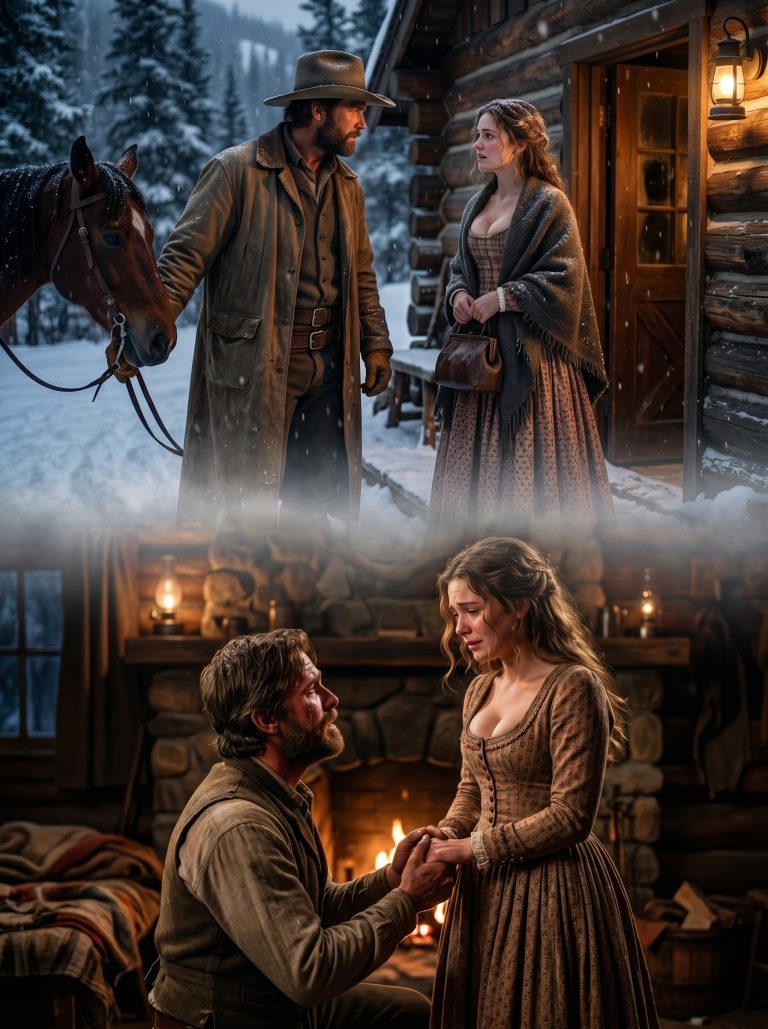
The afternoon was cold and pale gold, the sun weak above the peaks. He led her to the old oak beside the chapel, its branches bare against the sky, and there he stopped, turning his hat over and over in his hands, the words tangled somewhere behind his teeth.
“I’ve been slow,” he said finally. “I’m not a man who moves quick on matters of the heart. I saw Mr. Vance walking you home, and I realized — the thought of anyone else walking you home doesn’t sit right with me. Hasn’t sat right for a while now, if I’m honest, and I’ve been a coward about saying so.”
He held out the small parcel wrapped in brown paper. “I saw your coat cuffs were worn through. Made the yarn myself. Widow Higgins did the knitting.”
Rose took the parcel with hands that trembled slightly, and when she unwrapped it and saw the dark, soft gray of the cuffs, something in her face broke open — not sorrow, but a vulnerability she’d kept locked away as carefully as the tin box under her bed.
“Ethan,” she said, and stopped.
He kept going, because if he stopped now he might never start again. “I’ve been living half a life for nearly two years. Sunday was a duty — a way of honoring a memory. Then this winter I sat down at a table with you, and it stopped being duty. I’d like to ask permission to call on you properly. I’d like to build something forward, Rose. Not just keep honoring what’s behind me.”
He braced for her answer the way a man braces for weather.
But Rose was quiet for a different reason than he understood, and when she finally spoke, her voice was unsteady.
“There’s something you don’t know,” she said. “Something I should have told you a long time ago, and didn’t, because I was afraid of exactly what’s happening right now.”
He went still.
“Anna and I were friends,” Rose said. “Before you knew me. Before I was anyone in this town but the schoolteacher’s replacement fresh off the train. We traded books. We talked for hours after service, when you were still out working the ranch you had before the livery.” She swallowed. “She wrote to me. Near the end. She asked me to look in on you.”
Ethan’s face changed slowly, moving through confusion toward something harder to name.
“I told myself, for nearly two years,” Rose went on, “that watching you every Sunday was just — keeping a promise. Something I owed her. I never let myself wonder if it was more than that, because if it was more, I didn’t know how to trust it. I didn’t know if I was falling in love with you, Ethan Cole, or just doing what a dead friend asked of me. And I was too much of a coward to find out which, because either answer felt like it might hurt somebody.”
The wind moved through the bare branches above them. Ethan turned this over slowly, the way he turned over everything — carefully, without rushing.
“Anna asked you to look in on me,” he repeated.
“Yes.”
“And you’ve spent nearly two years afraid that’s all this was.”
Rose nodded, eyes bright and unwilling to spill over.
He was quiet a long moment, and when he spoke, his voice had none of the coldness she might have feared. “Rose. If Anna was the reason you first looked in on me, then maybe all she did was open a door neither of us was ready to walk through yet. What we’ve done with nearly two years of Sundays since — that’s ours. Nobody handed us that.”
“But how do I know,” Rose whispered, “that what I feel is mine, and not just — an old promise I kept until it grew roots?”
Ethan considered this the way he considered a stubborn lock, or a wheel that wouldn’t sit true. “I don’t reckon there’s a way to pull those two things apart and weigh them separate,” he said finally. “A promise can be the door somebody opens for you. Doesn’t mean what’s on the other side of it isn’t real. You didn’t have to keep coming back to that organ loft every week for nearly two years, Rose. Duty doesn’t explain that kind of patience. Only wanting to does.”
The tears she’d been holding finally slipped free, though her mouth was already curving upward. “That’s a very reasonable answer for a man who spun his own wool into courting yarn.”
“I told you. I’m slow. Not simple.”
She laughed — a real laugh, startled out of her — and it was that sound, more than anything he’d said, that undid the last of his fear. He closed the distance between them and took her hand, the knitted cuffs still clutched in her fingers between them.
“Anna asked something of you,” he said quietly, speaking her name gently, without the old weight of pain. “I’m asking something of my own now. Will you have me? Not as a promise kept for someone gone. As a choice you’re making, plain and clear, for yourself.”
Rose looked down at the cuffs, then up at him, and there was nothing uncertain left in her face. “Yes,” she said. “And Ethan — it was always my choice. I just needed to be brave enough to admit I’d already made it.”
The town watched their courtship unfold with the particular satisfaction small towns reserve for a romance they feel they’ve had a hand in. Nathaniel Vance, to his credit, took the outcome with grace, tipped his hat to Ethan one Sunday, and said, “You’re a fortunate man, Cole. Treat her well,” before quietly returning his attentions to a rancher’s daughter two valleys over.
Before the wedding, Rose finally showed Ethan the tin box, and together they read all eleven of Anna’s letters on the porch of his half-built house, out loud, taking turns, until the grief and the gladness became something they could hold at the same time without either one crowding out the other. It was, Ethan said afterward, the first time grief had ever felt like it was making room for something instead of only taking room away.
They married in the spring, in the same chapel where they had watched each other from opposite ends of the room for two long years. Rose did not play the organ that day; a younger student took her place at the keys, hands still clumsy on the hymns Rose had taught her. Rose stood instead at the front of the church in a dress the color of a summer sky, her hand in Ethan’s, and when he spoke his vows his voice was clear and did not stop at silence.
Five years on, Ethan Cole sat most evenings on the porch of the house he’d built beside the expanded livery, Rose beside him with two cups of coffee and roses climbing the fence she’d planted herself. Their son, Samuel, had his father’s patient hands. Their daughter, whom they had named Anna in honor of the friend whose letter had, in its own quiet way, brought them together, had Rose’s watchful eyes and her father’s habit of going quiet before she said something worth hearing.
“Sam tried to shoe the cat again today,” Rose said one evening, not quite hiding her smile.
“He’s persistent,” Ethan said.
“He gets it from his father. A man who sat in the same pew for nearly two years before he found the nerve to say a word to the organist.”
“I was being thorough.”
“You were being slow,” she said, and laced her fingers through his, the old ink stain long since faded from her hand, replaced now by the calluses of a gardener and a mother. It fit there all the same, as it always had.
They sat together as the sun dropped behind the ridge, painting the sky the deep orange of banked coals, and the silence between them was not the silence of two people keeping their distance. It was the silence of two people who no longer needed to fill every quiet moment with words, because the moment itself was already whole.
A quiet love rarely announces itself with thunder. It arrives the way the first snow does — one small, deliberate flake at a time, a promise opening a door here, a choice walked through there — until one evening you look up from your porch and find the whole landscape of your life has changed, built not from any single grand gesture but from the steady accumulation of small, true things.
— END —