She was shot while running away – The mountain man caught her… Then found the truth hidden under her coat

PART 1
Three riders broke through the tree line — heavy buffalo-hide dusters, weather-blackened. Bounty hunters. Men hired for work too ugly to carry out in daylight.
The lead rider raised a smoking Winchester. Cole recognized him too. Deke Sharp. A hulking brute who enjoyed pursuit more than pay.
The woman glanced back. Her boot caught a root. Sharp fired.
Cole saw the geometry unfold with horrible clarity — the rifle lifted, the round struck her high near the shoulder blade. Her knees buckled. Her head pitched toward the boulder.
Cole did not think. He launched down the embankment, crossed the creek, and reached her an instant before her skull struck stone, dragging them both behind the boulder as the next bullet struck granite where her head would have been.
She was terrifyingly light in his arms, eyes fluttering, blood spreading across emerald fabric.
“Hold on, girl,” Cole growled, voice rough from disuse.
Her gloved hand clutched a leather satchel. “The ledger,” she choked. “Don’t let Strand get—”
Her head lolled against his chest. She went limp.
Boots crunched in snow across the creek. “Spread out!” Sharp barked. “Find her and that bag.”
Cole had no time. He scooped her over his shoulder, blood seeping into the cold, and backed into the tracks of a passing elk herd, choosing the steepest incline toward Dead Man’s Drop. Sharp knew how to hunt men. Cole knew how to become the mountain.
For three brutal miles he climbed, lungs burning, wind clawing his face. The woman made almost no sound. That frightened him more than screaming would have.
Move. Move. Move.
This was no longer only a rescue. It was defiance — against the kind of badge men used as a knife. Whoever she was, she had crossed Marshal Eli Strand.
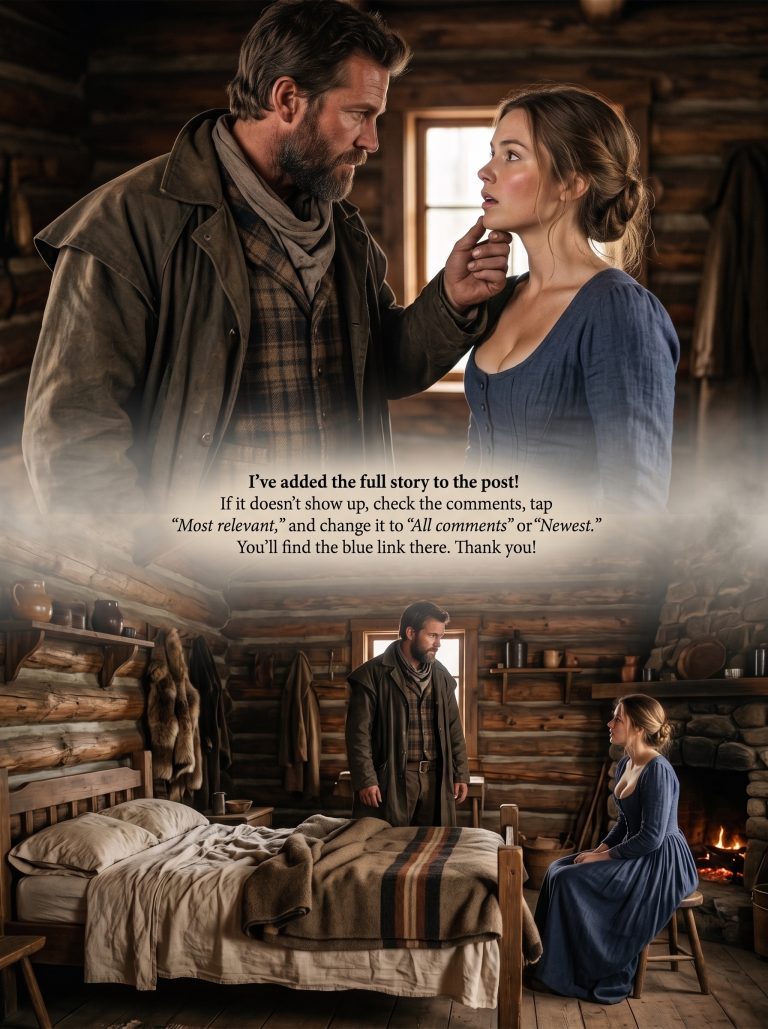
By the time the last light bled from the sky, he reached the hidden plateau where his cabin sat against sheer rock. He kicked the door open, laid her face down on the table, stoked the stove, lit three lanterns. He cut open the back of her dress. The entry wound was jagged and ugly. He found a hard lump near her collarbone — the bullet had passed through the scapula and lodged there, missing her lung. The first mercy.
“I’m sorry for this, miss,” he muttered, then poured rye whiskey directly into the wound.
She screamed, consciousness snapping back. Her spine arched off the table.
“Hold still,” Cole commanded. “I have to cut the lead out. If you move, the blade slips, and you bleed out before sunrise.”
Tears carved clean lines through soot on her face. She turned her head enough to see him — wild hair, thick beard, gray eyes cold as winter storms.
“Who?”
“My name is Cole. You’re in my home, and you’re currently dying. I need to cut above your collarbone and push the slug out.”
“Do it,” she whispered. “Just save the satchel.”
He heated the blade, handed her a strip of saddle leather. “Bite down hard.”
He made the incision. She shrieked into the leather. With iron forceps he clamped the lead and pulled it free with a wet slide. He packed both wounds with boiled cotton, bound her shoulder, and carried her to bed.
By then she was unconscious again, fever already rising beneath his palm.
Outside, the blizzard struck.
For two days, winter battered the cabin. The woman thrashed in fever, speaking in broken fragments.
“The deeds… Hargrove Ranch… they burned it… Strand signed them. False foreclosures… railroad money… blood money…”
Cole’s knife stopped. Eli Strand had always been a snake — a territorial marshal who made law serve money. But if her delirium was truth, Strand had moved beyond graft into a land grab, the Northern Pacific pushing west and a badge to make dead ranchers profitable.
On the second night, the fever broke. She blinked at the ceiling, the stove, the frost-laced window, and finally at the giant beside her.
“You’re alive,” Cole said.
She tried to sit up and gasped, falling back. “My satchel,” she demanded, weak but unmistakably a woman used to being obeyed.
Cole tossed the bag onto the bed.
“Thank you, mister. Cole, was it?”
“Cole Ashworth.”
Her eyes widened. “Ashworth. The Pinkerton who tracked the Reno gang through the Dakotas.”
“That man died a long time ago. Up here, I’m just a trapper.”
“I know who you are. My name is Nora Pierce. I was a clerk at the territorial bank in Helena.”
“A clerk doesn’t get hunted by three marshals.”
Memory returned in painful increments. “I wasn’t just a clerk. I handled vault transfers. Six months ago, Strand began depositing massive sums of gold that never appeared in the records. Land deeds passed through the bank — ranches owned by people I knew. All dead, supposedly in raids and accidents. Then their land was deeded to a holding company he controlled, sold to Northern Pacific interests.”
She withdrew a thick black ledger with trembling fingers.
“This is Strand’s shadow ledger. I stole it from his private safe. Every bribe, every forged signature, the names of the men he hired to murder those ranchers. The rope that will hang him.”
Cole stared at it. Not a book. A bomb.
“You should have taken this to a federal judge.”
“Strand owns the telegraph lines out of Helena. The moment he knew it was gone, he put a thousand-dollar bounty on my head, dead or alive.”
“You’d have died of exposure in three days, even without a bullet in your back.”
“It was the mountains or Strand’s firing squad. You saved me once, Cole Ashworth. But they won’t stop. Deke Sharp is a bloodhound.”
Cole scraped frost from the window. Moonlight spread across the valley.
“The snow covered my tracks. But Sharp’s a tracker.” He reached for the Winchester above the mantle. The lever racked with a harsh clack.
“Rest, Nora. The blizzard bought us time. But the wolves are already at the door.”
PART 2
For one week, Nora healed — not peacefully, not easily. Once she could stand, she insisted on moving through the cabin, learning the space as if motion alone could keep death from remembering her. She helped clean traps with one hand, stirred stew, read Shakespeare aloud in a voice rough but steady, sometimes pausing to look at Cole as if reconciling the man before her with the legend she’d heard in Helena.
They were opposites thrown together by violence. Nora belonged to ink and ledgers and the idea that truth could be preserved on paper. Cole belonged to cold iron and instinct, a solitary code that had survived after his faith in law had not.
Something began to gather between them. Not soft at first — the crackle before lightning.
One evening, Nora stirred stew while Cole oiled his revolver at the table.
“Why did you leave the Pinkertons?” she asked suddenly.
His hand stopped over the cylinder. “I caught a killer. Tracked him six months across the Badlands. The local judge was a friend of his father. They let him walk out the rear door of the courthouse the next morning.” His motions grew harsher on the gun. “True justice doesn’t wear a badge. It lives out here, where mountains don’t take bribes.”
Nora crossed to the table and set her good hand over his scarred knuckles. “Not all civilization is corrupt. There are people who need truth dragged into the light. That is why I stole the ledger.”
“You are a brave woman, Nora Pierce,” he murmured.
A sharp snap of frozen pine under deliberate boot-weight broke the peace.
Cole blew out the lantern. “Down,” he hissed.
At the tree line, a shadow detached itself — a man in winter furs, Sharps rifle in hand, scanning.
“A scout,” Cole whispered. “Sharp’s men.”
“Chimney smoke,” he said. “They spotted it from the valley.” If the scout returned, Strand would surround the cabin and burn them out.
Cole slid his loaded Colt across the floor to Nora. “Stay here. If anyone comes through that door and it isn’t me, empty the cylinder.” He took his Bowie knife instead of the rifle — no gunshot to carry down the mountain — and vanished into the trees.
The scout took exactly three steps after spotting the cabin before a hand the size of a dinner plate clamped over his mouth. Cole drove the blade upward between his ribs.
He searched the body and found a map — fresh, hand-drawn, showing the valley below Dead Man’s Drop. Not three riders. Fifteen men, marked at an encampment, waiting for the scout’s report.
PART 3
When he returned, Nora lowered the Colt only after he bolted the door. “Is it done?”
“He’s dead. But he wasn’t alone. Strand sent a war party. Fifteen men.”
“We can’t fight fifteen men.”
“No,” Cole said, pulling ammunition from beneath floorboards. “We don’t fight them here.” He loaded every weapon he owned. “There’s an old silver mine halfway up the peak. A labyrinth. I know it. They don’t. We leave them a trail right to the entrance. Then we bury Eli Strand’s army under the mountain.”
They abandoned the cabin an hour before dawn, leaving lanterns burning for illusion. Nora carried the ledger, the Colt, and the double-barreled shotgun slung where her injured shoulder allowed, leaning on a carved walking stick. Every step was agony, blood spotting her bandage again, but she bit her lip and refused to slow him.
They reached the mine as the horizon bled pale purple. THE WIDOWMAKER, CLAIMED 1872, read a crooked sign.
“They dug too deep, too fast,” Cole said, lighting a lantern. “Hit loose shale. Main shaft collapsed. Buried ten men. No one’s worked it since.”
He led her through the dark labyrinth to a massive junction where three tunnels converged.
“This is the choke point.” He dragged out a crate of old dynamite, sweat-stained, nitroglycerin weeping through waxy paper.
“Cole, that explosive is weeping.”
“I know. That’s exactly what I’m counting on.”
He wedged sticks into the load-bearing timbers and ran a fuse up to a high ledge, then helped Nora climb behind cover.
“You stay down,” he said, handing her the shotgun. “If anyone makes it past me, you don’t hesitate.”
“You could have run,” she said. “Left me in that cabin and disappeared over the Canadian border.”
“A man can run from his own conscience only so long. You brought the fight to my door. I intend to finish it.”
A rifle cracked far below. Cole extinguished the lantern. “They found the cabin. Empty. Sharp won’t take long to find our tracks.”
For an hour they waited in darkness. Then came boots on gravel and torchlight along the walls. Deke Sharp entered first, Walker Colt in one hand and torch in the other.
“Keep your eyes peeled. They’re in here. Spread out when we hit the junction.”
When the whole posse had funneled into the rigged cavern, Cole struck a match.
“Welcome to the Widowmaker, boys,” he whispered.
The fuse hissed alive. “Fuse! Look out!” The weeping dynamite detonated with a catastrophic roar. The ceiling groaned and thousands of tons of shale collapsed, crushing the rear half of the posse and sealing the exit.
“Move!” Sharp roared through the chaos.
Cole gave them no time to recover. He dropped from the ledge like a falling shadow and landed on a disoriented bounty hunter. The Bowie knife flashed in the dim light of a dropped torch. The man fell. Cole moved again, a ghost in the smoke, using darkness, boulders, and confusion to divide men who had believed numbers would save them.
The Winchester barked three times. Three rapid flashes split the dust. Three men hit the cavern floor.
“Fire! Shoot the bastard!” Sharp shouted.
The cavern erupted into chaos. Bullets whined off stone. Sparks jumped from rock walls. Smoke mixed with dust until every breath cut the throat. Nora stayed flat on the ledge, shotgun clutched in her good hand, heart hammering so hard she feared it would tear her stitches open.
Then she saw a man climbing toward her along the jagged incline below, knife clenched between his teeth, eyes fixed on her position.
Cole’s words returned. If anyone makes it past me, you don’t hesitate.
She braced the stock against her shoulder and pulled the trigger. Buckshot threw him backward off the rocks.
“Hold your fire,” a voice cut through the smoke.
Only Sharp and one other man remained standing. But it was the second man who made Cole freeze.
In the center of the cavern stood Marshal Eli Strand, impeccable in a tailored wool suit beneath a beaver-fur coat, grotesquely civilized amid the blood and smoke. In one hand, a silver-plated revolver pressed against the temple of a young local trapper.
“I have to admit, Ashworth,” Strand said, voice dripping venom, “when I realized it was the legendary Pinkerton who snatched my little clerk, I knew I couldn’t leave this to Sharp alone.”
Cole stepped from behind a boulder. “Walk away,” Strand said. “Leave the girl and the ledger.”
“You’re out of your jurisdiction, Marshal. And out of your mind if you think I’m walking away.”
“Tell him the truth, Strand,” Nora shouted from the ledge, shotgun still leveled. “Tell him about the gold. The ledger proves the murders — but it also contains the cipher for safety-deposit boxes in Denver. Half a million dollars in stolen railroad gold. That’s why you’re up here freezing your polished boots off.”
“Shut your mouth, you little thief!” Strand swung the revolver toward the ledge.
That was the distraction Cole needed. In a blinding draw he pulled his Colt. Sharp swung his Walker Colt toward Cole. Two shots rang out. Sharp’s bullet grazed Cole’s ribs, spinning him backward, but his own slug struck Sharp between the eyes.
Sharp collapsed, dead before he hit the ground.
Strand shoved his hostage aside and leveled his gun at Cole, struggling to his knees.
“No!” Nora screamed, and pulled the shotgun’s second trigger.
The blast tore into Strand’s shoulder and chest, shattering his collarbone. The revolver clattered to the rocks. He fell hard, gasping, staring up at the bleeding clerk on the ledge above him.
Silence followed.
Cole forced himself to stand, walked to where Strand lay, kicked the gun out of reach. “You should have stayed in Helena.”
Strand choked on blood. His empire of forged deeds and stolen gold crumbled in the dark, brought down by a brave clerk and a ghost he should never have disturbed.
“Come on down, Nora,” Cole said gently, reaching up. “It’s over.”
—
Getting out of the Widowmaker took longer than winning the battle inside it. The explosion had collapsed the main passage, but Cole knew the old ventilation routes. He bound his ribs while Nora checked the ledger with desperate care — dust-streaked but intact.
The young trapper, Eli Mercer, had been seized from a line cabin two days earlier and forced at gunpoint to guide Strand’s men toward Dead Man’s Drop. He walked behind Cole and Nora through the mine’s back passage with the stunned obedience of a man not yet convinced he had survived.
The route out was narrow, half flooded in places, and slick with mineral seep. Twice, Cole had to move rotted timbers with one shoulder while Nora held the lantern and gritted her teeth against the strain in her wound. Once, the earth shifted overhead, sending a shower of old dust down around them. Nora froze, eyes wide, ledger pinned beneath her good arm.
Cole turned back to her. “Breathe.”
“I am breathing.”
“No, you’re thinking. Breathe.”
She glared at him, then did as he said.
They emerged from the mountain on the far side of the ridge near midday, crawling through a narrow opening hidden beneath scrub pine and snow. The sky above was painfully bright. After the mine’s blackness, daylight felt almost violent.
Far below, smoke rose from the valley where Strand’s camp had been. Men not caught in the mine had scattered after hearing the blast and finding no marshal to lead them. A few would likely make for Helena. Others would vanish into mining camps, trading one name for another as men like that often did. But the ledger remained. The names were written. The cipher existed. Strand’s protection was gone.
That changed everything.
They returned to Cole’s cabin by a long, hidden route. It took half the day. Nora nearly collapsed twice but refused to be carried. Cole did not argue the second time. He simply walked close enough that if she fell, he would catch her.
By sunset, they reached the plateau. The cabin still stood. The stove had burned low. Snow had drifted against the door. Inside, everything looked both ordinary and impossible: the table where Cole had cut the bullet from Nora’s shoulder, the chair where he had listened through her fever, the bed where she had nearly died, the book of Shakespeare still lying open beside the lamp.
Nora stood in the doorway for a long moment.
“I thought I would never see this place again,” she said.
Cole stepped past her and set fresh wood in the stove. “I thought that about many places.”
She turned toward him. “And did you?”
“See them again?” He struck a match. “Some. Not the ones I wanted most.”
Nora did not ask what those were.
Not then.
They had survived too much for careless questions.
For three more days, they remained hidden on the plateau while Cole recovered enough to travel and Nora’s wound closed under clean dressings. Eli Mercer left on the second morning, carrying a letter Cole wrote to a federal contact in Missoula and another Nora wrote in a tight, precise hand to a judge in San Francisco whose name she had found months earlier in bank correspondence. Eli swore he would deliver them. Cole believed him, not because oaths meant much, but because the boy had looked at Strand dying in the mine and understood the difference between fear and loyalty.
On the fourth morning, Cole and Nora rode down from Dead Man’s Drop with the ledger wrapped in oilcloth and sealed inside a saddlebag.
They did not go to Helena.
Nora would not trust any office Strand had touched, and Cole agreed. They moved west by hidden routes first, then south, passing through settlements where Cole traded pelts for supplies and Nora kept her face hidden beneath a plain bonnet. The further they traveled, the more the mountains released them. Snow thinned. Pine gave way to open valleys. Rivers ran with the first force of spring melt.
The ledger reached a federal judge in San Francisco three weeks after Strand died.
What followed was slower than vengeance and less satisfying, but more enduring.
The investigation began quietly. Federal agents seized bank records in Helena. Telegraph operators were questioned. Northern Pacific representatives denied knowledge, then contradicted one another under oath. Safety-deposit boxes in Denver were opened using the cipher Nora had protected through blood, snow, and gunfire. Inside were gold bars, forged deeds, bribe ledgers, and letters written in hands belonging to men who had believed themselves untouchable.
Strand’s shadow company collapsed first.
Then the men who had signed its documents.
Then the politicians who had looked away.
Some fled. Some were caught. Some confessed when they realized the ledger named them more clearly than their allies could protect them. Stolen land was returned where surviving family could be found. In other cases, sale proceeds were placed into trust for widows and children who had been told their husbands and fathers died in accidents no one meant to investigate.
The story traveled across the territories in pieces.
A brave bank clerk.
A dead marshal.
A mountain gunfight.
A lost Pinkerton.
A ledger that undid an empire.
Cole Ashworth was asked twice to return to detective work. Once by a federal man in a black coat who spoke of duty. Once by an old Pinkerton acquaintance who spoke of reputation and money. Cole refused both.
He no longer believed justice was something a man chased across the country for wages.
Justice, when it came at all, had to be built closer than that.
Day by day.
Fence by fence.
Fire by fire.
With the people one chose to protect.
Spring came late to the Bitterroots. Snow retreated from the high ridges in stubborn patches. Meltwater ran down the gullies and filled the creeks until they sang under the thaw. Grass pushed through the old drifts around Cole’s cabin. The air softened, though the mountains still held winter in their upper teeth.
Nora stayed.
At first, she told herself it was because she could not yet travel. Her shoulder needed time. The wound was healing, but the bone beneath remained tender and strange. She had no desire to return to Helena, where every street would remind her of fear and ledgers and men who smiled while signing death warrants. San Francisco had offered safety, but safety in a city room felt airless after the cabin and the mountain.
So she stayed another week.
Then another.
By the time the valleys were green, the emerald riding dress was gone, cut into useful scraps and bandages long before. Nora wore denim and flannel now, her hair braided simply down her back, her injured arm regaining strength through daily work. She learned to set snares, mend tack, split kindling badly, then better. She argued with Cole about books, law, cooking, and whether a person could call dried beans supper three nights in a row without committing a crime against decency.
The cabin changed under her presence. Not much at first. A swept shelf. Herbs hung differently. The bed moved nearer the window because she said morning light should not be wasted. Shakespeare returned to the table instead of the shelf. Coffee was made stronger. A chipped blue cup became hers, though neither of them said so.
Cole changed more slowly. He still rose before dawn. He still checked the ridgeline by habit. He still carried a gun whenever he crossed the clearing. But the silence around him was no longer empty. It had room for another person now. He began speaking before necessity required it. He told Nora where the creek ran best in summer. He taught her which tracks belonged to fox and which to lynx. Once, while repairing a broken shutter, he found himself describing a childhood winter in Missouri, a memory he had not spoken aloud in twenty years.
Nora listened without interrupting. That was how she loved him first. Not with declaration. With attention.
Cole loved her in quieter ways: sharpening the small knife she used for kindling, setting coffee near her hand before she asked, moving heavy things before she pretended she could lift them herself, standing close on icy slopes but never touching unless needed. He never called it love. Not at first.
He had spent too many years believing any word that beautiful would turn to ash in his mouth.
One morning, Nora stood on the porch with coffee in sunlight that finally held warmth. Below, the valley spread green and silver. The route toward Dead Man’s Drop no longer seemed like a path into death. It seemed like the road by which everything had arrived.
Cole was chopping firewood near the shed. His broad shoulders moved with steady rhythm. The scars of their battle had healed across his ribs, leaving another pale mark among many. He paused, wiped sweat from his brow, and looked toward the cabin.
Their eyes met.
For a moment, the world held still in a way the mountains allowed only rarely.
Then Cole smiled.
A real smile.
Rare. Unpracticed. Almost boyish beneath the beard and weathered face.
She had been shot in the back while running, but she had not fallen. She had been caught before the earth could break her. In the arms of a man who thought he had buried his heart with his past, she had found not rescue alone, but home.
That evening, after supper, they sat outside while the last light faded behind the peaks.
Nora had the ledger’s copy in her lap, the one the federal judge had returned after the testimony was taken. The original would remain in evidence, locked in a courthouse vault. This copy bore the marks of travel and violence, but its pages were legible. Names. Numbers. Land parcels. Gold transfers. The architecture of greed written carefully by men who believed ink made sin respectable.
“You ever regret taking it?” Cole asked.
“Every hour between Helena and your cabin. Now I regret only that I did not take it sooner.”
“Do you ever regret catching me?” she asked.
“No.”
“You answered quickly.”
“Some truths don’t need inspection.”
“I was afraid when I first woke up here,” she said. “You looked like something out of a nightmare.”
“That was polite of you not to say at the time.”
“I had been shot. My manners were compromised.” She turned toward him. “But then you told me the truth. You said I was dying. You did not make it pretty.”
“The mountains don’t make much pretty.”
“No. But they make things clear.”
“What do you see clearly now?” he asked.
“That civilization is not saved by buildings or courts. It is saved by people who refuse to hand the world over to wolves.” Her gaze shifted to him. “And that wilderness does not always mean loneliness.”
Cole reached across the small distance and placed his hand over hers. Nora turned her hand beneath his and laced their fingers together. Nothing more was said because nothing more was required.
Years later, people told the story differently depending on who told it. Some made Cole larger than life, a ghost of the Bitterroots who could outdraw the devil himself. Some made Nora a saint of justice, a delicate clerk armed only with a ledger and a prayer. Others turned the Widowmaker fight into legend, adding gunmen and gold until the truth wore the costume of myth.
But the truth was simpler and harder. A woman saw corruption and refused to look away. A man who had given up on the law found something still worth defending. A ledger survived because a wounded woman would not release it. An empire fell because two people, half-dead and badly outnumbered, chose the ground on which they would make their stand.
They remained in the mountains. Not as fugitives. Not as ghosts. As builders.
They repaired the cabin. Expanded the porch. Cleared a garden from the rocky soil because Nora insisted that even a mountain deserved tomatoes if a person argued with it long enough. Cole built her a writing desk near the window, and she wrote letters there to judges, widows, ranchers, and sometimes to people who had never thanked her but deserved to know the truth.
He trapped less.
Farmed more.
He still kept his rifle clean and his Colt within reach, but his hands learned other work. Fence posts. Firewood. A cradle, eventually, though that came later and with such quiet wonder that Cole wept alone behind the barn when he finished sanding the rails.
Nora found that frontier life did not soften her.
It clarified her.
She still believed in ledgers, law, and civilization, but now she understood that paper required guardians. Truth could be written down, but someone had to be willing to bleed for it. Someone had to carry it through snow. Someone had to stand in the mouth of the mine and say no to the men who believed power made them permanent.
Cole found that solitude had been less a preference than a wound.
He still loved silence. He still walked alone at dawn. But now he returned to a cabin where coffee waited, where a woman’s voice might read Shakespeare badly on purpose to irritate him, where justice was no longer an abstract thing that failed in courthouses but a daily labor shared by two stubborn souls.
In winter, when snow buried the plateau and the wind screamed down from the Canadian border, Nora sometimes woke from dreams of running.
In the dreams, the shot always came.
Her body always pitched forward.
The ground always rose.
But before impact, arms caught her.
Always.
She would wake with her hand pressed to the scar near her shoulder, and Cole would already be awake beside her, because he knew the change in her breathing.
“You’re here,” he would say.
“I know,” she would answer.
That became their vow, though they never spoke it before any minister or witness.
You’re here.
I know.
It was enough.
The Bitterroots remembered them in their own way. The creek ran each spring. Snow returned each winter. The Widowmaker mine stayed sealed under collapsed stone, holding the bones of men who had followed greed into the dark. Dead Man’s Drop remained treacherous. The plateau remained hidden unless a person knew the path.
And on the porch of the small cabin overlooking that wild and ancient country, Nora Pierce Ashworth would stand in the morning sun with coffee warm in her hands, watching Cole split wood, mend harness, or look toward the ridge where they had once arrived half-dead and hunted.
He would glance up. She would smile. And every time, in that brief exchange, the whole story lived again — the gunshot swallowed by snow, the fall that never finished, the mountain man’s arms, the ledger, the wound, the mine, the justice dragged into light, and the home neither of them had expected to find beyond the reach of a corrupt world.
THE END