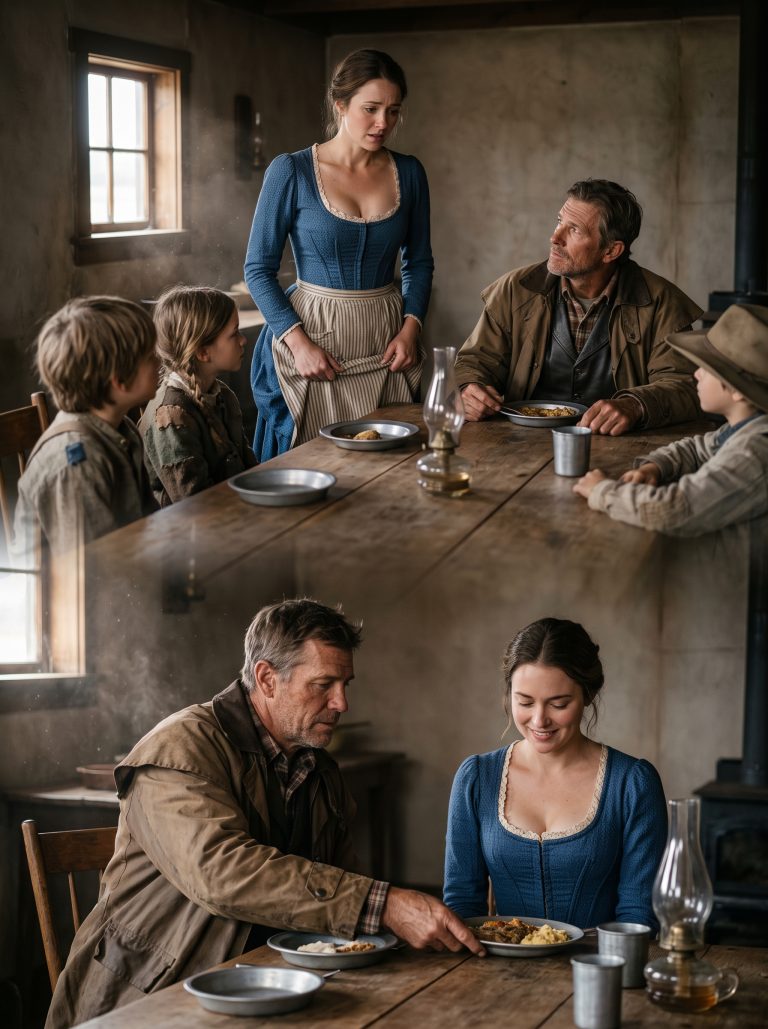
They Called Her the Monster Widow in the Cage—Until the Cowboy Paid a Fortune and Chose Her as His Bride

PART 1
Grace Larkspur had stopped counting the days by the third month.
She counted breaths instead. In through the nose, slow, so the men leaning against the bars wouldn’t see her shoulders shake. Out through the mouth, slower still, so nobody could claim the widow in the cage had finally cracked. That was the only victory left to her — refusing to give Cutter’s Bend the show it had paid for.
The sign above her had been repainted twice since spring. Same crooked letters. Same insult dressed up as commerce.
SEE THE WIDOW WHO KILLED THREE MEN — ONE DOLLAR
A second line, smaller, uglier, promised something worse to any man willing to pay ten.
The iron box sat dead center of Main Street, where a decent settlement might have put a well or a hitching post. Instead Cutter’s Bend had built a stage for cruelty and called it justice. Boys threw pebbles between the bars for sport. Grown men lingered until their wives dragged them home. Sheriff Silas Grady sat at his little table beside the cage door, sorting coins into towers with the satisfaction of a man who had found God in commerce.
Grace kept her eyes on the dirt.
She had learned, in eleven months of this, that dirt didn’t ask questions. Dirt didn’t smirk. Dirt didn’t pretend that watching a woman suffer was the same thing as caring what had happened to her.
A rock struck the bars an inch from her knee.
She didn’t flinch. Flinching fed them.
That was when the stranger rode in.
He came from the east road at an unhurried walk, trail dust thick on his coat, the kind of tired etched into a man’s face that came from more than one bad season. He wasn’t looking for trouble. Grace could tell that much — his eyes went to the mercantile sign first, the way any sensible traveler’s would, a man thinking of flour and coffee and a soft bed before dark.
Then his gaze snagged on the cage.
And stopped.
Grace had watched hundreds of strangers pass through that same moment of recognition — curiosity, then disgust or delight depending on the man. She braced for whichever this one would choose.
He didn’t choose either.
He swung down from his horse slow, like his knees ached with something heavier than saddle soreness, and walked straight up onto the platform without paying the sheriff a cent. Up close, Grace saw the hollow behind his eyes — not cruelty. Something closer to grief that had gone looking for a place to stand.
“How much to look?” he asked, though he was already looking.
Grady grinned, jowls swaying. “Dollar to look, ten to touch. Sign says plain enough.”
“That ain’t what I’m asking.” The stranger’s voice dropped low and even. “How much to buy her outright?”
The street went silent so fast Grace heard her own pulse.
Grady’s grin curdled. “She’s not livestock, mister. She’s serving out a sentence for murder.”
“Then sentence her somewhere that isn’t charging admission.” The stranger reached into his coat and produced a pouch heavy enough to make a sound like river stones when it hit the little table. He untied it with two fingers and let gold spill across the wood in front of the sheriff’s astonished face.
Someone in the crowd swore under their breath.
Grace’s heart had gone very still, the way it did before something worse always followed something almost-hopeful. She had learned that lesson from Thomas, from the alley behind the saloon, from every man since who had smiled at her like kindness and meant something else entirely.
“Five hundred,” Grady blurted, greed winning the argument with whatever conscience he still owned.
The number rippled through the onlookers like a struck bell.
The stranger didn’t blink. He counted the coins out one by one, unhurried, while the sheriff’s hands trembled around the growing pile.
When the last coin dropped, Grady snatched up his ring of keys as if the whole town might come to its senses and stop him. “She’s yours,” he said, and Grace hated the word so completely that for a moment she forgot to be afraid.
The lock groaned. The door swung wide.
Grace didn’t move.
A voice from the crowd — thick with soot and old fury — cut through the murmuring. Otis Kane, the blacksmith, shoved forward with both fists already curling. “You can’t just buy her like she’s a used plow! She killed my brother!”
Grace rose to her full height inside the open cage, and the crowd recoiled the way it always did once it remembered exactly how much space she took up.
“Your brother,” she said, voice rough from disuse but carrying clean across the square, “died in an alley because he and two others thought a widow with no kin left to protect her would be an easy thing to break. Ask the doctor what he found on my throat that night. Ask him whose blood was on my hands and whose wasn’t.”
Kane’s face went the color of a stoked forge.
The stranger turned from the blacksmith back to Grace, and something in his stillness told her he already believed every word.
He held out his open hand toward the cage door.
Grace stared at it the way she’d learned to stare at anything offered for free — waiting for the trap hidden underneath.
Then, from somewhere she couldn’t name, she reached out and let her fingers rest in his.
He helped her down into the dust of a street that had sold tickets to her suffering for the better part of a year, and the whole town watched in a silence thick enough to choke on.
The stranger didn’t let go of her hand.
Instead, with half of Cutter’s Bend still gawking, he lowered himself onto one knee in the dirt.
PART 2
A ring caught the afternoon light — plain gold, worn thin at the band, clearly older than the man holding it.
“My name is Caleb Hawthorne,” he said, loud enough for the whole square, quiet enough that it felt meant only for her. “I don’t believe any human being belongs behind bars for surviving. I buried a wife and a daughter two years back, and I’ve been running from silence ever since. I’m not asking because you need rescuing. I’m asking because I think two people carrying this much grief might do better carrying it side by side.”
He tilted his chin toward the cage. “Will you marry me, Grace Larkspur?”
The crowd erupted — gasps, a bark of nervous laughter, Grady backing away from his own gold as though decency might be catching.
Grace heard none of it.
She looked at the ring. At the empty cage behind her. At a stranger who had just handed a sheriff five hundred dollars and asked for nothing in return but her honesty.
“Yes,” she said, and the single word silenced the street faster than any gunshot could have.
They married that same evening in a whitewashed church two towns south, where nobody knew her as the giant widow, and the preacher’s wife asked no foolish questions about the torn hem of her dress. Caleb’s vow promised no man would cage her again while he still drew breath. Grace’s promised she would guard his back as fiercely as her own. When his mouth finally touched hers, it held nothing of the alley, nothing of grasping hands through iron bars — only a restraint so deliberate it made her chest ache.
Eleven days later they reached his ranch in the high Colorado basin, a sagging, silver-gray house that needed as much mending as both of them did. There were no bars there. No platform. No sheriff’s table. Only wind, grass, and work enough to keep old ghosts occupied.
For a season, it was almost peace.
Then, on a morning thick with the first frost of the year, a rider came up the long track at a dead run.
It was Dr. Abel Finch, one side of his face bruised violet, a leather packet clutched beneath his coat like something that might get him killed for carrying it. He swung down before his horse had fully stopped and looked at Grace with two years of buried shame finally breaking loose.
“Sheriff Grady’s coming for you,” he said, breathless. “Him and Otis Kane both. They’ve drawn up a false warrant — say Caleb bribed county property off a lawful sentence. Kane’s been stirring the whole county against you, and Grady’s desperate enough now to stop pretending it’s about the law.”
Grace’s blood went to ice.
“They know exactly where this ranch sits,” Finch said. “And they mean to come get you tonight.”
PART 3
Inside the kitchen, Finch laid his packet on the table like it might still burn him.
It held his own examination notes from the night Grace was dragged into Grady’s office eleven months ago — bruising at the throat, a torn bodice, blood beneath her nails that belonged to someone else entirely. Proof, written in his own frightened hand and buried ever since, that three men had cornered a grieving widow behind a saloon and paid for it with their lives when she refused to be broken.
“Why bring this now?” Grace asked, though she already suspected the answer.
“Kane came to my office two nights past,” Finch said. “Wanted me to sign a statement saying you threatened those men beforehand. When I wouldn’t, he struck me and told me if the law couldn’t drag you back, he and Grady would manage it after dark.” His hands shook around his hat brim. “I should have come forward the night it happened. I’m a coward for waiting this long. I won’t be one tonight.”
Caleb was already on his feet. “Nearest judge who won’t fold for a crooked sheriff?”
“Judge Harlan Reeve, in Stone Fork. A day and a half if the roads hold.”
“Then we ride at first light,” Caleb said. “We bring your notes, we bring the truth, and we get there before Grady can bury it under another lie.”
Grace shook her head. “It’s me they want. If I go to them first —”
“They’ll hang you where they should have begged forgiveness.” Caleb’s jaw was iron. “No.”
“They’ll burn this house to get to me.”
“Then let them try burning something that burns back.”
It should have frightened her, the flat certainty in his voice. Instead it lit something fierce and answering in her own chest, the first true anger she had let herself feel since the cage. They argued until the argument became agreement: not surrender, but strategy. Ride for Stone Fork. Bring proof before rumor could calcify into rope.
They never made it to dawn.
But first, there had been months worth remembering — the kind of ordinary days neither of them had believed they still deserved.
Grace had scrubbed the ranch house floor to floor that first autumn, beating two years of dust from curtains that probably should have simply been burned. Caleb rebuilt the sagging porch step and coaxed the stubborn pump handle back to life. She planted beans beneath the kitchen window because, in her words, no home worth keeping ignored food it could grow with its own hands. He never once complained about where she moved his tools, though he grumbled loudly enough each time he went looking for them in their new, sensible places.
They had ridden into the nearest town together only once that first month, for supplies, and Grace had felt the old familiar weight of strangers’ eyes settle on her the moment she stepped down from the wagon. Caleb had simply come around the horse and stood beside her before any man got brave enough to comment.
“My wife,” he’d told the shopkeeper, plain as weather, and the word had landed strange and warm in her chest — not widow, not giant, not murderer. Wife. When three young ranch hands drifted over from the livery afterward with smirks and careless words about a “giant bride,” Caleb had asked her, quietly, with one hand light around her wrist, whether she wanted to handle it herself or let him. She had chosen to let him, and watched with something close to wonder as he made the loudest of the three apologize to her face in front of his friends.
“No one’s ever done that,” she told him on the ride home.
“Best get used to disappointing old habits,” he’d said, and she had laughed for what felt like the first time in years.
Nights had been harder. Grace still woke some evenings certain she heard iron ringing somewhere close, certain hands were reaching through bars that no longer existed. Twice she woke gasping to find Caleb already half-risen beside her, one palm hovering at the small of her back, never touching until she gave the smallest nod that told him it was safe. In turn, she had learned to recognize the particular stillness that came over him whenever an unfamiliar rider appeared at dusk, and to simply put her hand in his until the stillness passed.
They buried nothing that autumn, but they gave the dead — his wife and daughter, her first husband — a shared place on the hill behind the house, and something about standing over those markers together, hand in hand, had mattered more than either of them expected. Grief, Grace had told him once in the dark, was a cruel houseguest. Never leaves, he’d answered. But perhaps, she’d said, it can be taught manners.
By the time frost came, the ranch no longer looked abandoned. It looked lived in. Chosen. Theirs.
It was that fragile, hard-won peace Grady and Kane rode out to destroy.
Midnight brought the first sound — a horse striking the corral rail hard enough that Caleb was out of bed before the second one landed. Snow hissed against the window glass. Voices murmured low beyond the barn, more than one, close enough that counting them mattered.
Caleb pressed the old shotgun into Grace’s hands. “Upstairs window. Don’t wait on my say-so.”
She didn’t argue. Six months of marriage had taught her that trust between them didn’t look like softness — it looked like exactly this, a weapon passed without hesitation and a door covered without being asked twice.
By the time fists struck the front door, Finch was crouched at the kitchen window with Caleb’s old rifle, and Grace was braced upstairs with her heart hammering hard enough to taste copper.
“Hawthorne!” Grady’s voice rolled out across the yard, thinned by cold and puffed up with borrowed authority. “Send the woman out and maybe your house stays standing!”
Through the slanting snow, Grace counted shapes — six men on foot, two horses held back near the fence line, a lantern swinging by the barn door. Grady stood nearest the porch steps with a rifle cradled like a man who had convinced himself this was still the law’s business. Otis Kane loomed a pace behind him, storm coat dusted white, hate carved plain across his face.
Caleb opened the door only wide enough to be heard, both pistols low and ready at his sides.
“Long way from Cutter’s Bend for a man with no real warrant,” he said.
“Warrant travels fine,” Grady called back.
“So does horse manure.”
Kane surged forward. “Send her out, Hawthorne!”
“No.”
One of the deputies lifted his lantern higher, hunting for movement behind the glass upstairs. Grace shifted out of the light and waited.
“You’re harboring a convicted murderer,” Grady shouted.
“You caged a grieving widow and charged admission,” Caleb answered. “Tell your boys to step off my property before my wife puts a hole through the next hand that reaches for my stock.”
Every head in the yard turned up toward the dark window.
A heartbeat too late.
Grace fired.
The blast tore the lantern clean from the nearest deputy’s grip; it burst apart in sparks and spilled oil, and the man went down screaming into two of his companions. The yard dissolved into chaos. Caleb fired once from the porch and dropped a man into the snow. Finch, steady despite his trembling hands, put a shot through the flank of a horse and sent it bolting riderless into the dark, scattering two more attackers with it.
Kane roared and charged the porch, a blacksmith’s knife catching lantern-light in his fist.
“Caleb!” Grace shouted.
He turned half a second too slow. Kane hit him full in the chest and drove them both off the steps into the snow, grappling, boots gouging deep furrows in the white. Grady, seeing his chance, raised his rifle toward the struggle on the porch.
Grace fired her second barrel.
The shot tore the rifle stock clean from the sheriff’s hands and spun him backward into a drift, cursing, one hand already blistering from the heat of the ruined barrel.
Below, Kane had gotten a thick hand around Caleb’s throat. “She should’ve hanged for what she did!” he snarled.
Grace was already moving. She dropped the empty shotgun, snatched the iron poker from beside the stove, and hit the yard at a dead run just as Caleb drove a knee into Kane’s gut and rolled them both through the churned snow.
Grady lunged for his fallen pistol.
Grace reached him first and swung the poker two-handed across his wrist. He howled and the gun spun away into the dark. When he looked up at her — really looked, no bars left between them — every ounce of his old contempt came flooding back, sharpened now by fear.
“You should have died in that cage,” he spat.
“And you should have learned what happens,” Grace said, “when people finally stop being afraid of men like you.”
She drove the poker into his ribs hard enough to fold him gasping into the drift.
Across the yard, Kane had wrestled Caleb half-pinned again, blood running from a cut above Caleb’s eye. He never heard Grace come up behind him. She caught a fistful of his coat and hauled with everything eleven months of forced labor and a lifetime of being underestimated had built into her shoulders.
The blacksmith went flying sideways into the porch post hard enough to make it shudder, the knife lost somewhere in the snow.
He stared up at her, stunned.
“You came to the wrong house,” Grace told him.
Kane lunged anyway, foolish with rage. Caleb, back on his feet, caught his jaw with a single brutal punch that put him down for good. The last deputy standing broke and ran for the tree line without looking back.
Snow kept falling over a yard gone suddenly, strangely silent.
Grady lay half-curled and groaning. Kane bled quietly into the white, breathing but still. Caleb bent double, dragging air into abused lungs, and Grace was at his side in three strides.
“Ribs,” he managed. “Maybe cracked. You?”
“Breathing,” she said, and then his arms were around her and hers around him, and for one long moment the whole ruined yard fell away.
Finch limped out with a lantern held high. “We should move before that deputy reaches town.”
Caleb straightened, jaw set again. “We don’t run. We finish it.”
By first light they had a wagon loaded — blankets, Finch’s precious notes, two groaning prisoners bound under a tarp, and Grace beside Caleb on the bench with the shotgun reloaded across her knees. He drove despite his ribs, refusing every offer to hand over the reins. The road to Stone Fork ran a day and a half through half-frozen mud, and by the time the courthouse cupola rose gold in the last of the sunset, none of them had slept.
Judge Harlan Reeve heard the matter that same night, not out of any particular nobility but because a bloodied rancher hauled a corrupt sheriff bodily into his chambers, a shaking doctor slapped two-year-old medical notes onto his desk, and a woman with old bruises still visible at her throat said, plainly, “If you wait until morning, another man will find a way to sell my pain again before sunrise.”
Statements were taken past midnight. Grady lied first, clumsily. Kane lied louder and worse. Then Finch spoke, and then Grace, and by the time Caleb finished, Judge Reeve was looking at the bound sheriff with the particular disgust of a man who had seen corruption too many times to be surprised by it, only exhausted by it.
“You built a cage,” the judge said quietly.
“Public protection,” Grady tried.
Reeve’s eyes moved to the faint scars still visible on Grace’s throat.
“Public appetite,” he corrected, and signed the arrest order himself.
The trial took place three weeks later, back in Cutter’s Bend, in the very square where the cage had once stood. Word had traveled ahead of them, and half the county turned out — some for justice, some for scandal, some simply because they had once paid a dollar and needed, quietly, to know what that made them.
The cage itself was gone. Judge Reeve had ordered it dismantled and the iron stacked as evidence in front of the courthouse, every bar lying useless in the dirt where the platform used to stand. Grace stared at the wreckage a long while before Caleb’s hand found the small of her back.
“You all right?” he asked.
“No,” she said honestly. “But I’m here.”
So were others. The preacher’s wife had traveled three days to swear that the widow who walked into her church that first night looked like a wounded woman, not a murderer proud of her work. Two ranch hands Caleb trusted rode over from Colorado because he’d refused to let Grace face her old town without people standing behind her. Even three women from Cutter’s Bend who had once brought their children to gawk at the cage now sat pale and silent in the gallery.
The truth, once it started, came out whole and ugly. Grady had stolen most of the town’s schoolhouse fund and split the profits with Kane, whose dead brother had been one of the three men who cornered Grace in that alley. Keeping her caged had been profitable. Keeping her guilty had been more profitable still. Finch’s notes proved self-defense beyond argument, and Grady’s own hidden ledger — pried up from beneath his office floorboards — listed daily cage receipts beside whiskey, bribes, and a line item that simply read widow exhibition, repeated across a dozen pages.
When Grace finally took the witness stand, the square went quiet in a way it never had before, not even under threat of a gun.
She wore a dark blue dress she had sewn with her own hands in Colorado. No rags. No bars. She stood tall enough that the witness rail looked built for someone half her size, and she looked out over the crowd that had once paid to stare at her.
“You called me a giant because it was easier than calling me wronged,” she said. “You called me a monster because admitting what your sons and your sheriff had done was harder than believing a lie. You left me in that cage because it let you perform fear instead of practicing justice. Then you sold me because keeping me had stopped being profitable.” Her gaze swept the gallery, steady and unflinching. “I don’t need your pity. I need every woman watching to understand that what happened to me was never the law. It was cowardice, wearing a badge.”
Nobody interrupted her. Nobody laughed. For the first time in almost a year, Cutter’s Bend gave Grace Larkspur something honest.
Grady was convicted of embezzlement, unlawful imprisonment, and obstruction of justice. Kane received five years for conspiracy and assault. The town council was ordered to repay the stolen schoolhouse funds from their own pockets, and Judge Reeve directed that the dismantled cage be sold for scrap, its proceeds funding a women’s shelter in Stone Fork — a decision he delivered with the closest thing to open fury anyone had ever heard from him.
Cutter’s Bend never quite recovered its old shape. Grace decided that was only fitting. Some towns earned the ghosts they were left with.
In the weeks after the trial, letters began arriving at the ranch — from women in three different counties who had read about the verdict in a circulated newspaper account, women who had never had the words for what had been done to them until they read Grace’s own testimony printed plain on newsprint. Grace answered every letter herself, in a careful, deliberate hand she had taught herself only that past winter, evenings by the fire while Caleb mended tack across the table from her. She kept no copies. She didn’t need to. Each answer was the same at its core: you survived it, and surviving was never the crime.
Doc Finch left Cutter’s Bend for good that spring and settled in Stone Fork, where Judge Reeve had quietly arranged for him a modest post examining prisoners and testifying honestly, for once, without a sheriff’s boot on his neck. He wrote to the ranch twice that year, both times ending his letters the same way: still ashamed of the silence, still trying to earn back the two years it cost.
Grace wrote back both times to tell him the debt was paid the night he rode out through the snow to warn them.
On the morning they finally rode out for home, she asked Caleb to stop the wagon in the empty square. She climbed down without help and walked to the bare patch of dirt where the platform once stood, the wind combing dust across old wheel ruts as though the ground itself were trying to forget.
She knelt, drove a small carved knife point-first into the earth, and rose again, brushing off her palms.
“What was that?” Caleb asked.
“A burial,” she said. “Long overdue.”
Spring had fully broken by the time the high basin opened up ahead of them again, grass running green along the creek, the old cottonwood behind the ranch house budding for the first time since Caleb’s first wife and daughter had been laid beneath it. The place looked less like somewhere a man hid from grief now, and more like somewhere two hard, healed people had chosen, deliberately, to stay.
Recovery wasn’t instant. Grace still woke some nights hearing iron ring in the wind. Caleb still went rigid at the sound of an unannounced rider at dusk. But the dark no longer felt bottomless the way it once had — it had edges now, and those edges were shaped, most nights, like the other person reaching back across the bed without being asked.
One evening in May they stood together on the hill behind the house, near the two weathered grave markers — Thomas Cross and Eleanor Hawthorne, a third small board beside them left blank for the daughter who never got a name. That week Grace had added a fourth marker, set slightly apart from the rest.
Caleb frowned at it. “What’s that one for?”
“For whoever we become after all this,” she said, watching cattle move slow and dark across the lower pasture in the last gold light. “Figured they deserved a place too.”
He studied the blank wood, then studied her. “You’ve been thinking again.”
“I do that.”
“Dangerous habit.”
She almost smiled. “I used to believe that cage was the truest thing that would ever happen to me,” she said. “That I’d spend the rest of my life being whatever Cutter’s Bend decided to call me.”
Caleb’s hand found the back of her neck, gentle, certain. “And now?”
“Now I think the truest thing that ever happened to me was a tired, stubborn rancher throwing his savings on a sheriff’s table because he refused to let strangers decide what I was worth.” She looked up at him. “And then staying, long after the gold ran out and the debt was only ever going to be paid in patience.”
“I had no plan that day,” he admitted. “Bought a wife, told her the truth, nearly got shot twice, and helped drag a whole town through its own sins. Busy year.”
“Poor man,” she said. “Shall I apologize?”
“No.” His eyes held hers, grave and steady in a way that always left her feeling both anchored and unraveled at once. “You can stay.”
The words landed harder than any vow spoken in a church, because they answered a fear she had never once said aloud — that some morning he would wake before dawn, feel the old pull of the open road, and decide grief traveled easier alone.
“I am staying,” she said. “For good.”
“Good.” He said it simply, the way a man might confirm the weather, and somehow that plainness meant more to her than any grander vow could have. There was no cage left to measure her against now, no crowd waiting to decide what her strength should cost her. Only this — a quiet hillside, a blank marker waiting for whoever they’d both eventually become, and a man who had never once flinched at the size of what she carried.
They walked back down toward the house together as the evening deepened and lamplight came warm and steady through the windows below — no cage waiting anywhere in that valley, no crowd, no price tag hung around either of their necks. Only open country, hard-earned peace, and the quiet, astonishing miracle of finally being seen correctly, after a world that had spent two years insisting on getting her wrong.
For the first time since Thomas died — maybe for the first time in all the years men had looked at her size and decided it meant danger instead of strength — Grace Larkspur felt entirely at home inside her own skin.
Beside her, Caleb turned his head, that same low, rough voice she’d trusted from the very first afternoon in the dust of Cutter’s Bend.
“You know the best part?” he asked.
“What’s that?”
He looked out over the land, then back at her, eyes warm in the fading light.
“They were wrong about both of us.”
Standing there with spring spread wide and gold before them, Grace knew, without any doubt left in her at all, that he was right.