The Arranged Bride Arrived at His Cabin—But the Mountain Man Waited for Her Heart

PART 1
Martha Reed was twenty years old when her father decided who she would marry, and he did it without asking her a single question.
She found out on a Tuesday. Supper was on the table. The light outside was going gold across the valley, the way it did in late August when the days still pretended summer wasn’t ending. Her father set down his fork, and something in the room changed before he even opened his mouth.
“Frank Ward has agreed to take you as his wife,” he said. “I’d like it settled before the first snow.”
Martha didn’t look up right away. She counted one breath. Then she set her own fork down, carefully, the way you set something down when you don’t trust your hands.
“You spoke to him before you spoke to me.”
“I did.”
The stove ticked in the silence that followed. It was the kind of quiet that has weight to it, the kind that presses on a person’s chest.
She knew the man he meant. Everyone in the settlement knew Frank Ward, in the way you know weather sitting on the horizon — present, watched, not yet understood. Capable, people called him. Quiet. No family that anyone had ever heard mentioned. He showed up in a place and made himself useful and never explained where he’d come from, and somehow that was enough for people out here. It had to be. There was no one to write letters to and check.
“He’s capable,” her father said. “He knows this country. He’ll keep you safe through whatever winter brings.”
Martha looked at him then, straight on. “You don’t know he’s a good man. You know he’s a useful one.”
He didn’t argue the point. That was the thing about her father — he wasn’t cruel, and he wasn’t a liar, and both of those facts made it so much harder to be angry at him. He looked at the table instead of at her.
“I’m getting older,” he said. “And this country does not wait for a man to admit it.”
She went to the river after supper because she needed somewhere to stand that wasn’t inside those four walls. She stood there until the cold came up off the water and the last light drained out of the mountains, turning them from gold to gray to nothing. There was no one out here to appeal to. No judge, no aunt, no letter she could send back east. Just a father who had staked his claim on a piece of land and a piece of her future in the same season, and a man she’d only ever watched from a distance across a communal fire.
She had three choices, and she turned each one over like a stone in her palm. She could refuse, and grow old at the edge of her father’s cabin, in the margins of somebody else’s life. She could leave — and out here, alone, with the pass closing in weeks, leaving meant walking into something with no name and no mercy. Or she could go. She could move into a stranger’s cabin, and she could keep her eyes open, and she could find out for herself exactly what kind of man he was, instead of trusting her father’s word or the settlement’s gossip.
She went back inside when she could no longer feel her hands. Her father had fallen asleep in his chair, and she stood over him for a long moment — the gray coming into his hair, the lines that hadn’t been there when her mother was alive, the particular exhaustion of a man who had lost more than he could afford to lose and was terrified of losing what remained.
She didn’t forgive him that night.
But she understood him. And out here, in this valley, with winter coming down off the mountains like a closing door, understanding was sometimes the only thing a person could afford.
In the morning, she told him she would go.
Not because she trusted Frank Ward.
Because she would rather walk into the unknown with her eyes open than be carried into it and told it was mercy.
There was no minister for a hundred miles and no church until the circuit rider came through in spring, so the arrangement, for now, was a promise and nothing more — her father’s word given to another man’s word, binding by custom, not yet by law. Whatever this became, it would not be a marriage until the pass opened again. It was, until then, simply a winter to get through, under one roof, with a stranger.
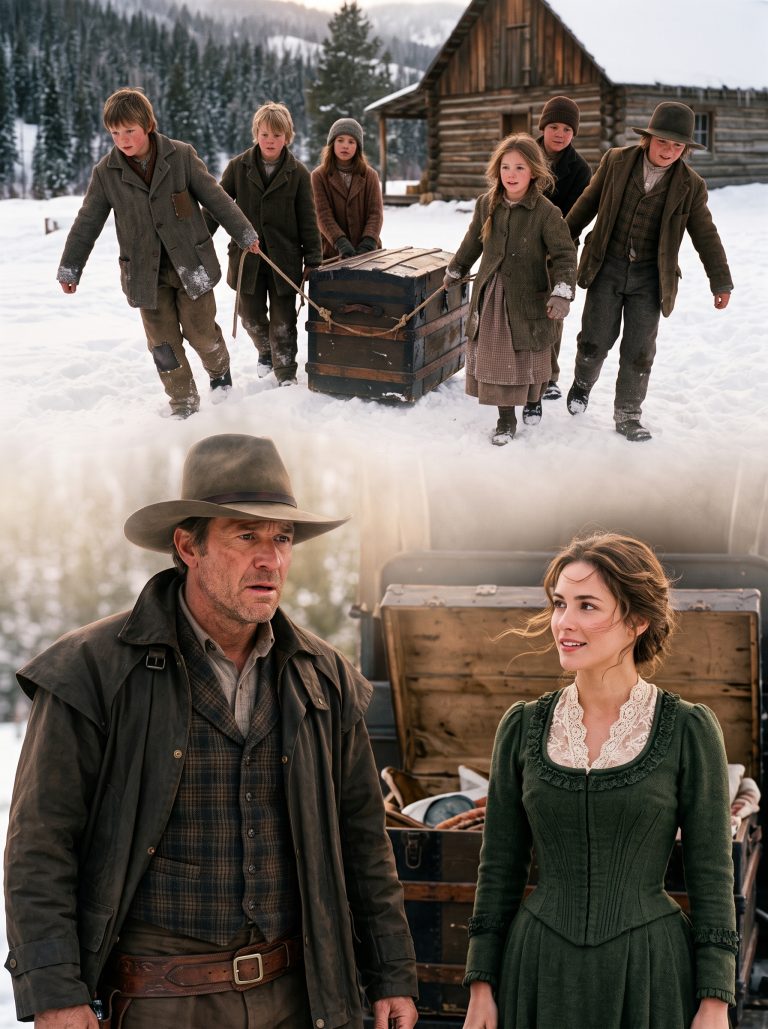
She moved her things on a Friday. One trunk. A wool blanket. A small tin box that had belonged to her mother, kept for no reason she could name except that it was the last thing that felt like hers. Her father carried the trunk across the clearing himself, set it inside the cabin door, and stood there with his hat in his hands, and then left without either of them finding the words for what needed saying.
The cabin was small and clean. A rifle hung on the wall. Traps by the door. One table. One chair. A plank partition separating a narrow sleeping room from the main space — the kind of order that belongs to a man who has only ever had to answer to himself, and has decided to do it well.
Frank Ward stood near the stove when she stepped inside.
“Room’s yours,” he said. “Door closes and stays closed.”
She looked at the room he meant — narrow bed, one window facing east — and then back at him, at the single chair in the whole cabin.
“Where do you sleep?”
He nodded toward the floor beside the stove. A bedroll was already laid out there, folded neat, tucked out of the way, taking up as little space as a man could manage to take.
She opened her mouth to say something — she still wasn’t sure, even afterward, exactly what — and he looked at her before she could get the words out. Direct. Unhurried.
“I know this wasn’t your choosing,” he said. “The room’s yours until that changes.”
He took his coat off the hook and went outside, and the door swung shut, and the cabin went quiet around her.
She sat down on the edge of the bed and looked at her own hands.
She had braced herself for a man who would be difficult in all the ordinary ways men were difficult. She had not braced herself for one who handed her the only bed in the house, took the floor beside a cold stove without a word of complaint, and made absolutely nothing of it.
It was, she thought, considerably harder to stay angry at a man like that.
She just wasn’t sure yet what that meant.