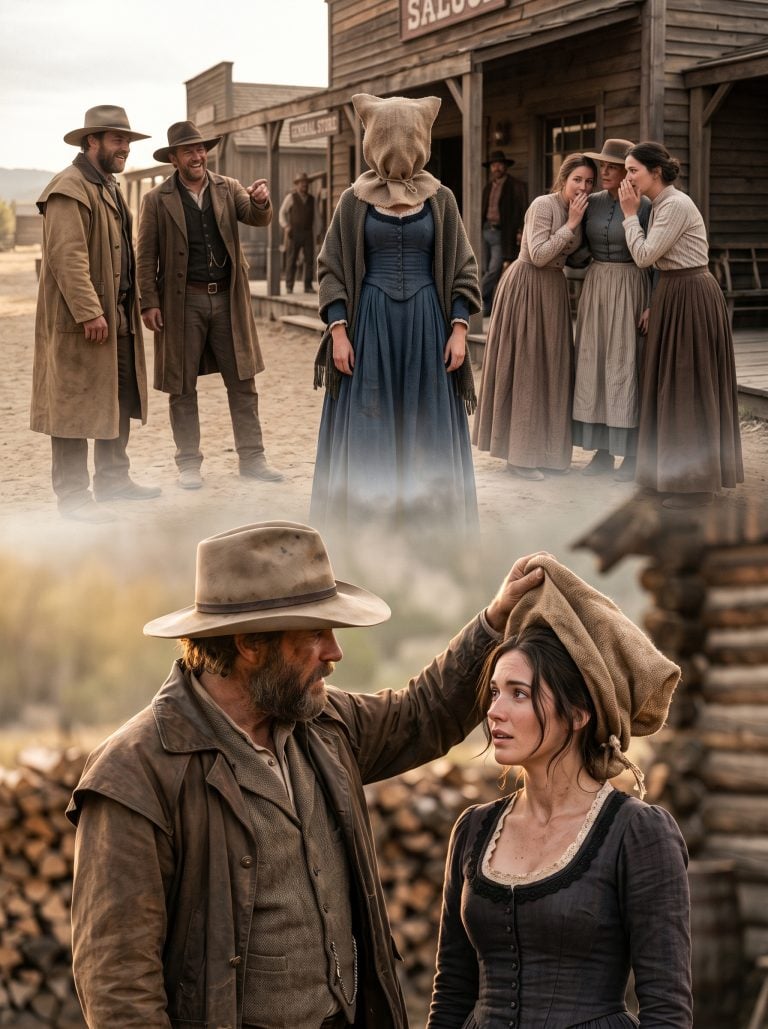
They Gave the Infertile Bride to a Cowboy as a Joke—She Came Home With His Child

Part 1
Three men had her cornered against the shelves before she even understood what was happening.
Lydia Hale felt the wood of the counter bite into her spine, felt the air go thin the way it does right before something terrible. She had come into town for flour. For salt. For the small, stupid necessities of a life she was barely holding together. Instead she got Colt Decker’s hand around her wrist and his breath, sour with tobacco, too close to her ear.
“Nobody spits in Mr. Stockton’s face,” he said.
Behind the counter, old Ezra Carter gripped the register like it was the only solid thing left in the world, and said nothing. That was the arrangement in Willowbend now. Silence in exchange for survival.
Lydia’s ranch — her father’s ranch, the only thing she had left of him — sat on land Baron Stockton wanted. He had wanted it politely at first. Then not so politely. Now three of his men had her wrist twisted hard enough to bruise, and the sheriff, everyone in town knew, would look the other way, because the sheriff worked for Stockton too.
“I’ll die first,” she told Decker, and meant it.
“That,” he said, smiling like it cost him nothing, “can be arranged.”
The bell over the door rang.
Nobody moved. Then a shape stepped out of the white glare of noon, and the sun seemed to walk in with him — dust on his coat, a gun tied low on his hip the way men wear a gun when they intend to use it, and eyes the gray of a storm that hasn’t decided yet whether to break.
He looked at the three men. He looked at her. His face didn’t change at all.
“Private conversation,” Decker said. “Store’s closed.”
“Sign outside says otherwise.”
“Lady’s not going anywhere.”
The stranger’s eyes moved to Lydia, and for one second something almost gentle passed through them.
“Ma’am. You want to leave?”
She nodded before she’d even decided to.
He turned back to Decker, and whatever softness had been there vanished, replaced with something flat and absolutely certain.
“She’s leaving with me.”
Decker went for his gun.
What happened next took less than two seconds, and Lydia would spend years trying to remember it clearly and never quite manage it. One moment Decker’s hand was closing around his pistol grip. The next, the stranger’s gun was already drawn, the barrel pressed dead center against Decker’s forehead, and the man hadn’t so much as changed his breathing to do it.
“Here’s how this works,” he said, quiet as a man giving directions to church. “You take your hands off those guns. You let the lady walk out. And you tell your boss whatever business he thinks he has with her — it’s finished.”
Nobody in that store believed, at first, that a stranger with dust on his boots had just interrupted Baron Stockton’s private war with four words and one drawn gun.
Lydia didn’t believe it either. Not until she was on her horse, riding hard out of town beside a man whose name she didn’t know, her wrist throbbing, her heart slamming against her ribs like it was trying to get out.
“Who are you?” she finally asked, once they’d slowed enough to breathe.
He was quiet a long moment.
“Name’s Caleb Rourke.”
“I’m Lydia Hale.”
“I know,” he said. “Those men in the store. They said your name.” A pause. “Said some other things, too.”
She told him about the ranch. About the year of threats, the year of watching her father’s life’s work rot because she couldn’t pay hands to save it, about Stockton wanting what wasn’t his to want.
She expected the stranger to wish her luck and ride on. Men who valued their own skin usually did, once they understood what they’d just made an enemy of.
Instead, Caleb Rourke looked out at the horizon where her ranch sat, half-dying under a merciless sun, and asked her a single question that she would replay for the rest of her life.
“Where’s your ranch?”
She didn’t know yet that the man riding beside her had spent five years hunting the very name that had just cornered her in a general store. She didn’t know that “she’s leaving with me” were the first words he’d said out loud to another human being in longer than he could remember that weren’t a threat or a lie.
All she knew was that for the first time in a year, she wasn’t standing alone.
She had no idea how much that single decision — to let a stranger follow her home — was about to cost them both.
Part 2
not gonna lie I clicked on this expecting a cute meet-cute story and did NOT expect a five-year revenge plot to be hiding underneath it
the thing that gets me is Caleb wasn’t just some drifter who happened to walk in at the right moment. He’d been looking for Stockton for five years by that point.
Different name back then, different ranch, but same man. Years earlier in Colorado he’d wanted the water rights under a family homestead and the family wouldn’t sell, so his men burned them out and called it a lantern accident. Caleb was eighteen and not even home that night — he’d stormed off after some fight with his dad that he couldn’t even remember the details of by the time he told Lydia about it. He came back to find his parents gone and his sister Elizabeth gone too. She’d almost made it clear of the fire. Almost.
He never really talked about what happened to her specifically. Just that she didn’t make it, and that it wasn’t quick, and that nobody involved was ever charged with anything.
So for five years he chased the men responsible across three territories. Some of it was tracking down leads that went nowhere. Some of it ended in gunfights he started on purpose. By the time he walked into that store in Willowbend, there was really only one name left on his list, and it belonged to the same man who was currently trying to burn a stranger off her land using the exact same playbook.
That’s the part that gets left out of the “handsome cowboy saves the day” version of this story. Caleb didn’t wander into Lydia’s life by accident. He was already at the end of something ugly, and helping her was the first time in five years he’d done anything that wasn’t about revenge.
Neither of them knew yet how bad it was about to get. Stockton doesn’t wait around when he’s embarrassed, and word was already moving that a nobody drifter had put a gun to Colt Decker’s head in front of witnesses. That’s not the kind of thing a man like Stockton lets stand for long.
Part 3
Willowbend, 1887. The kind of summer that drove men to drink before noon and made even the flies too tired to move.
Lydia Hale had buried her father eight months earlier, whispering a promise into his cold hand — don’t let them take it, Lyd, this land is home — and had spent every day since trying to keep it while the ranch bled out around her. Two hundred head of cattle down to thirty. A bunkhouse empty of every hand who’d once worked it, because she couldn’t pay them. Just her, and an old mare named Sadie, and a debt that grew heavier every week Baron Stockton’s men rode past her fence line, watching, waiting for her to break.
That morning she only wanted flour and salt. What she got, instead, was Colt Decker’s hand crushing her wrist in Ezra Carter’s store, and the particular, specific terror of understanding that no one — not Carter, not the town, not the sheriff paid to protect her — was going to help.
Then the bell rang, and a stranger stepped out of the sun.
Caleb Rourke didn’t look like salvation. He looked like a man who’d slept in his clothes for a week, which he had. He looked like trouble in the specific, quiet way that made the loud kind of trouble go still and reconsider. When Decker’s hand moved toward his gun, Caleb’s was already out, already pressed to the man’s forehead, and he hadn’t so much as raised his voice to do it.
“She’s leaving with me.”
Lydia rode out of town beside him with her heart still hammering, half-certain she’d traded one danger for another she simply hadn’t identified yet. But when they slowed the horses and he told her his name — quiet, almost reluctant, like giving it away cost him something — she found herself believing, against every instinct sharpened by a year of being cornered, that this one was different.
“Where’s your ranch?” he asked her, out of nowhere, once she’d told him what Stockton wanted and why she’d never give it to him.
“Why?”
“Because you need help.” He said it like the most obvious fact in the world. “Those men aren’t going to stop. And from what I can see, you’re out here alone, trying to hold together something that’s falling apart. Am I wrong?”
She wanted to argue. The words wouldn’t come, because they weren’t true, and they both knew it.
“I can’t pay you,” she said instead.
“Didn’t ask for pay.”
“Then why?”
He was quiet long enough that she thought he wouldn’t answer.
“Because someone should,” he finally said. “And because I was there.”
It wasn’t an answer. It was barely a fraction of one. But standing in that brutal heat with fear still thrumming in her blood and nowhere else to turn, Lydia found herself nodding anyway.
Five miles west. Follow the creek bed till you see the windmill.
By nightfall, a stranger with a battered hat and a gun tied low was sleeping in her bunkhouse, and for the first time in eight months, Lydia Hale did not feel entirely alone.
Caleb worked like a man running from something. That was Lydia’s first real observation of him — not his silence, not his scars, but the particular, driven way he threw himself at the barn roof that first afternoon, shirt off, hammer going long after the light should have stopped him.
By the end of the week the fences were mended, the windmill groaned back to life, and something had shifted between them that neither of them had a name for yet. They didn’t talk much. But on the third night she found him on the bunkhouse steps, cleaning a gun by lantern light with the practiced care of a man who trusted it more than most people.
“Where did you come from?” she asked. “Before Willowbend.”
His hands stilled on the cloth.
“I had a family once,” he said. “A long time ago. Parents, a sister, a ranch not so different from this one.” Two flat words. “They died. Fire in the night. My sister almost got clear of it. Almost.” His jaw worked. “I wasn’t there. I should have been there. But I wasn’t.”
“What was she like? Your sister.”
Something in his face shifted — not quite a smile, but close to the memory of one. “Elizabeth. She was sixteen. Wanted to be a schoolteacher. Used to practice her lessons on me whether I asked for them or not.” He looked away toward the horizon. “She was braver than I ever was. Never let fear stop her from doing what she thought was right.”
“I’m so sorry.”
He shook his head — not accepting the sympathy, not able to. “After that I drifted. Made enemies. Looked for the men who did it.” A pause that went on long enough to feel like its own kind of confession. “Been looking for five years.”
“Did you find him?”
Caleb’s gray eyes went cold as winter.
“His name is Baron Stockton.”
The silence that followed swallowed the whole yard. Stockton — the same Stockton circling her ranch like a wolf that had already decided how the night would end — had burned Caleb’s family off land they wouldn’t sell, the same way he now wanted Lydia’s. Changed his name. Changed territories. Never changed the pattern.
“That’s what he’s doing to you,” Caleb said. “He finds someone vulnerable. And when they won’t sell — he takes.”
“What are you going to do? Now that you’ve found him?”
“I don’t know,” he admitted, and for the first time she heard something raw underneath the granite. “I’ve spent five years planning what I’d do when I caught up to him. But he’s got an army. The law in his pocket. I’m one man. Even if I killed him, I’d never make it out — and nothing would change. His men take over. The next Stockton rises up.” His jaw tightened. “I don’t want to be like him. I’m tired of living in the dark. I want to sleep at night again.”
Lydia reached over and put her hand on his.
“Then we’ll find another way,” she said. “Together.”
He stared at her hand like he’d forgotten what kindness felt like. Then, slowly, his fingers turned beneath hers and laced through them.
“Together,” he agreed.
Neither of them could have known yet how soon that word would be tested.
Several weeks after Lydia walked out of Carter’s store — weeks in which the ranch had slowly, stubbornly begun to look like a ranch again — three riders appeared on the horizon at dusk. Decker again — this time with a message, and torches, and the particular arrogance of a man who believes he’s already won.
Forty-eight hours to sign over the deed. Or the lady burns.
Caleb told Decker to relay something back — that he knew who Stockton really was, what he’d done in Colorado, what he’d done to a girl named Elizabeth. He watched the name land on Decker’s face like a stone through glass: confusion first, then something closer to fear.
That night, Caleb didn’t sleep at all. Stockton wouldn’t wait forty-eight hours, he told her — that was theater, meant to look merciful. He’d hit them while their guard was still half-raised, because that was what he’d always done.
They needed the law. The real law, not the sheriff in Stockton’s pocket. Lydia rode into Willowbend and stood in a telegraph office, dictating a message to the federal marshal in Denver while a terrified clerk’s hand shook around his pencil, and Sheriff Pike blocked her path out the door with the oily menace of a man who’d never once had to answer for anything.
It was the town — Ezra Carter, the blacksmith Thomas Garrett, a handful of others who had watched silently for too long — who finally stepped between her and the sheriff and refused to move.
“Miss Hale is a member of this community,” Carter said. “That makes it our business.”
It was the first crack in a year of silence. It would not be the last.
Interlude: The Man Giving The Orders
Baron Stockton took the news in his study at Iron Ridge, standing at the window with a glass of brandy he hadn’t touched. Decker stood by the door, hat in hand, still smarting from having a gun pressed to his own forehead in front of half the town.
“Say the name again,” Stockton said, without turning around.
“Rourke. Caleb Rourke.”
Stockton was quiet for a long moment. Outside, the ranch he’d built on other men’s ashes stretched out toward the mountains, thousands of acres wide, and none of it had ever cost him a sleepless night. It cost him one now.
“There was a ranch in Colorado,” he said finally. “A long time ago. A boy who wasn’t home the night it burned.”
“You know him?”
“I know what he wants.” Stockton set the glass down, untouched, and turned around, and whatever had passed through his face a moment before was gone, replaced by the flat, practiced calm of a man who had buried problems before and intended to bury this one the same way. “Send for the Cortez brothers. Whatever they’re asking, pay it. I want this finished before that girl finds anyone in Denver willing to listen to her.”
He did not raise his voice. He never had to. That was, in its own way, the most frightening thing about him — and it was the last quiet moment he would have before the ground began, slowly, to shift beneath everything he’d built.
They arrived at midnight, under a sky heavy with a storm that had been building for days and finally chose that night to break. Eight men, torches lit, Decker at the center of them like a man who’d already decided how this story ended.
Walk away or burn.
Lydia stepped out onto the porch beside Caleb, rifle raised, and said the only thing she had left to say.
“This is my home. And I’m not giving it up.”
What followed was chaos — gunfire and thunder woven together, torches thrown, the barn catching in seconds, flame chewing through wood Caleb had spent a week repairing with his own hands. Lydia fired and watched a man fall for the first time in her life and felt nothing she recognized as triumph. Caleb went down with a bullet in his side, kept firing anyway, kept them both alive long enough for the sky to finally open and drown the fire before it reached the house.
By the time the surviving riders scattered into the storm, Caleb was unconscious in a pool of his own blood, and Lydia was holding onto him with both hands, refusing — flatly, furiously refusing — to let go of the only promise she had left.
Don’t you dare leave me now. You promised.
He lived. Barely, and only because Dr. Samuel Crane rode out through the last of the storm and worked through the night by lamplight while Lydia pressed her hands to a wound that wouldn’t stop bleeding and talked to a man who couldn’t hear her, telling him about her mother, her father, the first time she’d seen him standing in a doorway with the sun at his back.
What came next was the part of the story Lydia never expected. The town — the same town that had watched from a distance for a year while Stockton tightened his grip — showed up in her yard the following evening carrying lumber and flour and crates of chickens.
“We should have done something sooner,” Ezra Carter told her, twisting his hat in his hands. “Should have stood up years ago.”
They weren’t an army. They weren’t the cavalry. But they were a start, and a start was more than Lydia had had in a very long time.
Caleb’s fever broke just before midnight. When he opened his eyes and found her still beside him, the first thing he asked wasn’t about his wound. It was about the fire outside — whether it had taken everything.
“They came to help rebuild,” she told him, smiling for the first time in what felt like a year. “Can you believe it? After everything — they finally came.”
“People came,” he repeated slowly, like the words didn’t fit the world he’d been living in for five years. “They actually came.”
Word of the failed attack traveled fast, and it brought with it a stranger on a black horse — Hollister, a former Stockton man carrying a decade of guilt and a warning: twenty mercenaries, the Cortez brothers, hired at triple rate, riding in within a matter of weeks to finish what Decker’s men had failed to do.
Hollister also brought something else. He knew where Stockton kept the evidence of everything — every forged deed, every bribed official, every burned-out family in three territories, locked in a safe in his study.
“Get those documents to a federal marshal,” Hollister said, “and Stockton’s finished. Legally. Permanently.”
It meant breaking into the largest, most heavily guarded ranch in the territory. It meant Caleb, still healing from a bullet wound, picking locks in the dark while Lydia stood guard with a pistol and a heartbeat she was sure the whole house could hear.
They found the satchel. Deeds. Correspondence. A journal, in Stockton’s own hand, naming names and dates going back a decade.
“This is enough,” Caleb breathed. “This is more than enough.”
There wasn’t time to rest. Stockton would notice the documents missing, and when he did, he’d come looking. Someone had to carry the evidence to Denver before that happened — and Caleb, still bleeding through his bandages, was in no shape to make the ride.
“I’ll go,” Lydia said.
She rode three days through country that had turned against her — dodging Stockton’s riders in a rock-walled ravine, hiding while two men on her trail searched the very outcropping she was pressed flat against, holding her breath until they gave up and galloped on. She arrived in Denver after dark, dust-covered and running on nothing, and placed a decade of Baron Stockton’s crimes on a federal marshal’s desk.
“I’ve been trying to build a case against Stockton for three years,” Marshal Warren told her, turning the pages. “Every time I got close, witnesses disappeared. Evidence went missing.” He looked up. “This is different. This is his own handwriting. He can’t explain this away.”
She told him about the mercenaries. About the two days they might already be too late for.
“Then we don’t have time to waste,” Warren said, and called for his deputies to ride.
Back in Willowbend, Caleb spent his last days before the attack doing everything one man and a half-healed wound could manage — digging shallow trenches at the fence line, caching ammunition in three separate spots, stringing a tripwire of cans across the yard that wouldn’t stop a rider but might buy a few seconds’ warning. It wasn’t enough, and he knew it wasn’t enough. Thirty riders instead of the twenty they’d braced for — Stockton sparing no expense to finish what his men had failed to start — against one wounded man with a rifle and a plan built mostly out of desperation.
He held the first position behind the water trough for as long as it lasted, then fell back to the hay bales, then to the shattered doorway of the house itself, bleeding through his bandages, his ammunition running low enough that he’d started counting rounds instead of targets. It was never a fight he was winning. It was a fight he was trying to survive long enough for help to matter.
It came anyway.
Hoofbeats from the east. Federal badges catching moonlight. Marshal Warren’s column sweeping into the yard with rifles already raised, and beside him — impossibly, gloriously — Lydia, alive, home, in time.
Caleb slumped against the wall as the mercenaries threw down their weapons, the world going gray and distant, and the last thing he registered clearly was her voice, breaking.
“Caleb. Oh God. You made it.”
“I love you,” he told her, certain it might be the last thing he ever said. “Don’t you dare say goodbye to me,” she answered, furious with grief that hadn’t happened yet. “You hold on.”
He lived a second time. Three days unconscious, a fever that nearly took him anyway, and when he finally woke to sunlight and the weight of Lydia asleep against his shoulder, the first thing he learned was that Stockton had been arrested trying to flee his own ranch, and would stand trial for everything.
It should have felt like victory. Instead, weeks later, on a quiet porch in the deepening autumn, Caleb finally told Lydia the rest of what five years of hunting had cost him — the men he’d tracked down one by one, the confrontations he’d deliberately gone looking for, knowing full well how most of them would end. Not every one of them was fair. Not every one of them had to end the way it did.
“I’m not a good man, Lydia,” he said. “I told myself it was justice. Most of it was just anger with somewhere to point itself. And that doesn’t make me so different from the men I was chasing.”
She didn’t tell him it was fine. She didn’t pretend the blood on his hands would wash off.
“I’m not asking you to justify it,” she said. “I’m asking you to understand that I know who you are now — really know, all of it — and I’m still here. I’m still choosing you.”
“Why?”
“Because the man who did those things isn’t the man sitting in front of me. That man walked into a store and said, ‘She’s leaving with me,’ instead of walking away. Choose to be the man you want to be — not the man grief made you. And let me love you through the rest of it.”
Baron Stockton was convicted on every count a Denver jury could hand down — murder, arson, fraud, conspiracy — after five days of testimony that included Hollister’s devastating account and Caleb’s own, given from a witness stand on legs steadier than he had any right to expect. He was hanged the following February.
Caleb felt relief. He also felt, strangely, empty — the particular hollowness of a man who has spent five years building his life around a single act of vengeance, only to have it finally over and no longer know what shape he’s supposed to take.
“It’s like the war is over,” Lydia told him one evening, “but you haven’t learned how to stop fighting yet.”
“Then learn,” she said. “You’ve got peace now. Use it to figure out who you are when you’re not at war.”
He married her that November in the little church at the edge of Willowbend, in her mother’s altered wedding dress, in front of a town that had once been too afraid to help her and had spent every day since trying to make up for it.
Tommy was born the following autumn, three weeks early and in the middle of a cattle drive that nearly kept his father away — Caleb riding through the night to make it home in time to hold his son for the first time, and to finally, after five years of carrying grief like a stone in his chest, break down and weep with relief instead of loss.
Sarah followed two years later. The ranch — renamed the Hale-Rourke Estate — grew from thirty starving head of cattle into the largest, most respected operation in the territory, not through conquest, but through the same stubborn decency that had first put Caleb Rourke in a doorway between three armed men and a woman he’d never met.
Hollister stayed in the valley, tending a small farm at the edge of town, carrying his own guilt into a quieter kind of life until the end of his days. Before he died, he asked Caleb for something he knew he hadn’t earned.
“I forgive you,” Caleb told him. “Not because you deserve it. Because holding on to anger doesn’t bring anyone back. It just poisons the person holding it. I learned that the hard way.”
Forty years later, on the porch of the ranch they’d built from ash and stubbornness and one impossible act of courage in a general store, Caleb reached for Lydia’s hand the way he had every evening for four decades.
“Do you remember?” he asked. “The first thing I ever said to you?”
She smiled, the same smile that had once made a dying ranch feel survivable.
“She’s leaving with me.”
“Four words,” he said. “That’s all it took.”
Behind them, grandchildren laughed in a kitchen that had once been half-collapsed and hopeless. Beyond the fence, cattle grazed under a sky the same brutal, beautiful blue it had been the day a stranger walked out of the sun and refused to look away from a woman he’d never met.
Some stories don’t end. They just become part of something larger than the two people who lived them first.
THE END