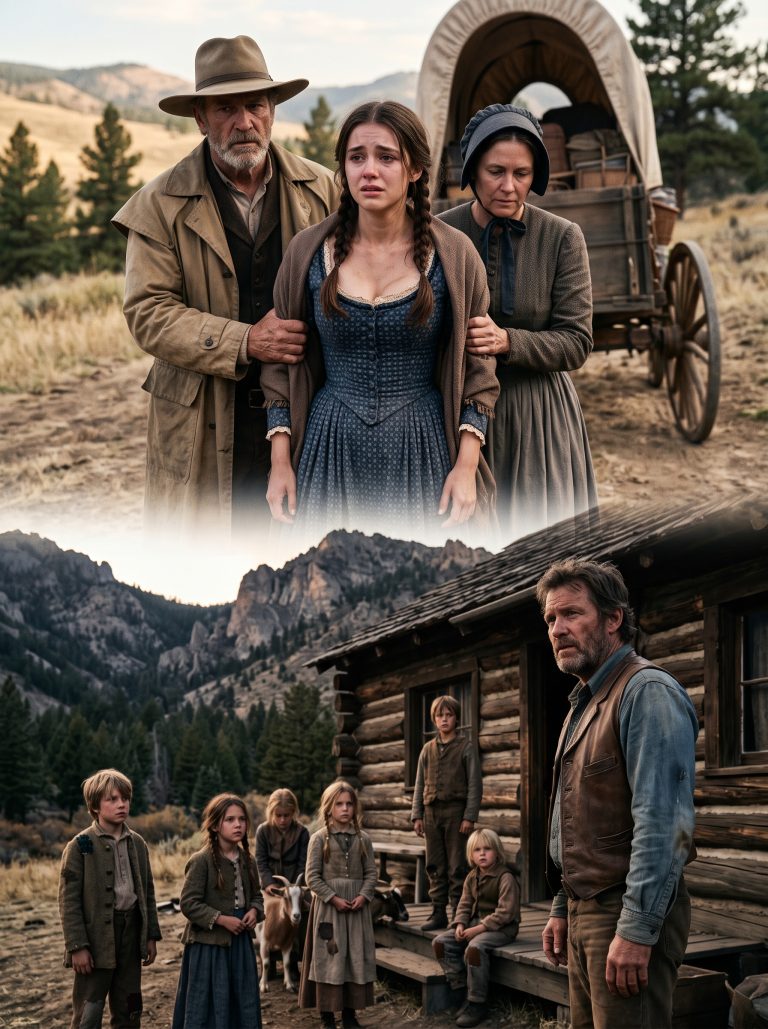
“Don’t Hire That Widow,” They Mocked—Until the Cowboy’s Starving Children Begged for Her Help and Called Her a Miracle.

Part 1
Grace Merrick carried the last of her flour in a cloth sack pressed to her ribs, and she walked like a woman who had learned that stopping was more dangerous than tired feet.
Wyoming Territory did not forgive weakness. The sun had been at her back since dawn, and the grass along the wagon road had gone the color of old rope. She had not eaten since the day before yesterday, when a farmer’s wife outside Larkspur had traded her a boiled egg for an hour of laundry.
Three months now since the bank in Cheyenne had nailed its notice to her cabin door. Three months since she’d buried her husband, Daniel, in frozen February ground and then watched the life they’d built together get itemized and sold to cover a debt she hadn’t known existed until the paper was in her hands.
She did not blame Daniel. She had decided that early, deliberately, the way a person decides which weight to set down and which to keep carrying. Grief was heavy enough without adding blame to it.
In the town of Larkspur she had overheard two ranch hands at the mercantile counter, not eavesdropping so much as simply existing where men forgot a woman could hear.
“Reed’s about done for,” one had said. “Wife passed in the spring. Man’s out there alone with four young ones and a ranch big enough to swallow him whole.”
“Won’t last the year,” the other agreed. “Not without help he can’t afford.”
Grace had set down the flour sack she was buying, picked up her basket, and asked directions.
She did not have a plan beyond that. She had a road and half a loaf of bread wrapped in cloth, and for three months that had been enough to keep her moving forward instead of sitting down in the dust and staying there.
The Reed ranch announced itself before she saw it — the smell of cattle and cut hay, of a place still being tended. A property that smelled like work was a property where somebody hadn’t yet stopped fighting.
Four children sat on the porch steps when she came through the gate.
The oldest was a girl, maybe thirteen, book open and unread across her knees, eyes fixed on some middle distance that had nothing to do with the yard in front of her. Beside her a younger girl braided grass stems with the restless focus of hands that needed a job. Two boys rounded out the group — one about seven, arms locked around his knees, and the smallest, no more than four, lying flat on the boards with his cheek against the wood.
The oldest was on her feet before Grace had crossed half the yard.
“This is private property.”
“I know it,” Grace said, stopping well short of the porch. “My name’s Grace Merrick. I’m not looking for trouble. I wondered if your family might take some bread off my hands.”
“We don’t take charity.” The girl’s chin trembled even as her voice held firm.
“It isn’t charity if I ask something back. A cup of water’s all. I’ve walked a long way today.”
The younger girl tugged her sister’s sleeve. “Abigail. She’s got bread.”
Abigail’s eyes dropped to the basket, then rose again, softer than before. “You can leave it at the fence.”
“I could,” Grace agreed. “Or I could sit on your step five minutes and drink that water, and then be on my way. I won’t come past the porch.”
It was the smallest boy who decided it. He hadn’t moved from the boards, but his eyes, dark and far too watchful for four years old, stayed fixed on the basket.
“Eli hasn’t eaten since yesterday,” the younger girl said quietly. “He just lays down like that.”
Grace knelt, ignoring the ache in her knees, and unwrapped the bread. She broke off a piece and held it toward the porch, offering nothing else, asking nothing else.
“For him,” she said. “No conditions.”
Something shifted behind Abigail’s guarded eyes — the particular give of a person who has stood watch so long that even a small offer of help nearly buckles the legs.
“Come sit,” Abigail said. “I’ll get water.”
By the time the sun leaned west, Grace had learned their names — Abigail, thirteen and holding the household together with sheer will; Nora, ten, curious and watchful; Micah, seven, careful and quiet; Eli, four, who ate his bread in small serious bites and never once looked away from her face. She learned their mother had died in the spring fever, that their father worked from dark to dark, that somebody — clearly Abigail — had been keeping four children fed, washed, and dressed since April on nothing but stubbornness.
“You’re doing a fine job,” Grace told her.
Abigail said nothing, but her shoulders dropped half an inch, the way a person’s do when a weight is, if only for a moment, shared.
When Nathaniel Reed rode in at dusk, dust-covered and hollow-eyed, he found a stranger’s supper cooking on his stove and did not know whether to be angry or grateful. He settled, in the end, on neither — only tired, and willing, for one night, to let a stranger finish what she’d started.
“Barn’s out back,” he said when the meal was done. “Cot in the tack room. We’ll talk in the morning about what you’re owed.”
Grace understood that for what it was: not a welcome, but a door left unlatched.
It would have to do.
Part 2
Grace woke before the household stirred, as she had every morning of her married life. By the time Abigail came downstairs, biscuits were browning and coffee sat warm on the stove.
Abigail stopped in the doorway. For one unguarded second, something crossed her face — the shock of being cared for by someone else’s hands.
“You didn’t have to,” she said.
“I wanted to.”
Over breakfast, Nathaniel said little, but he ate two full plates, and Grace noted it the way she noted weather — quietly, and with purpose.
It was Micah who told her about the trouble, out at the well at midday, handing her a bucket without being asked.
“I heard Papa talking to a man in town,” he said. “Something about a lien. I don’t know what that means.”
“It’s a claim against the property,” Grace said. “Someone saying money’s owed, so they hold the land until it’s paid.”
“Can they take the ranch?”
“Sometimes. If the claim’s true.”
“What if it isn’t?”
“Then it can be fought.”
He turned that over like a stone in his palm, then went quiet again, watching the fence line where his father worked.
That evening, going through the household ledger with Nathaniel’s reluctant permission, Grace found the name written at the top of a legal notice tucked between receipts.
Silas Croft.
Her hands went still on the page.
She had heard that name before — in a Cheyenne bank office, across a desk, the day the notice went up on her own cabin door. Silas Croft had held the note on Daniel’s equipment loan. Silas Croft had called it unfortunate business while he signed away everything she owned.
“You know him,” Nathaniel said, watching her face.
“I know him,” Grace said. “Better than you’d think.”
Part 3
She told Nathaniel that night, plainly, without softening it. How Silas Croft had foreclosed on her farm within a month of Daniel’s death, moving faster than grief could keep pace with. How he’d smiled the whole time he did it.
“He does this,” she said. “Finds a man who’s grieving, or alone, or too tired to check his own paperwork, and moves while the ground’s still soft.”
Nathaniel’s jaw tightened. “He’s claiming I’m three payments behind on equipment I bought four years back. I have receipts. He says they’re worthless because the bank they were drawn on closed last year.”
“Who witnessed the payments?”
“Harlan Moore. The land agent. He passed in June.”
“Two weeks before or after Croft filed?”
Nathaniel went still. “Two weeks after.”
“That’s not a coincidence,” Grace said. “That’s a pattern. He waits for the witness to die, then claims the paper trail’s broken. He did the same to me — except my land agent had already moved to Oregon, so there was no one left in the territory to contradict him.”
“Then how do we beat him?”
“County records,” Grace said. “A land agent’s files don’t vanish when he dies. They go to the courthouse, or a successor, or a bank. Somewhere there’s an independent copy of what you paid, with a county stamp, that doesn’t depend on Harlan Moore being alive to vouch for it.”
Nathaniel studied her for a long moment — not doubt now, but something closer to reckoning. “You never got yours back. Your farm.”
“No,” Grace said. “I didn’t know what to look for then. I know now.”
He wrote her a letter of authorization that night, hands steadier than his voice.
She rode into Larkspur before first light.
The courthouse clerk, a patient man named Dunmore, disappeared into the records room with her request and came back twenty minutes later with a ledger the size of a church Bible. Grace gave him the dates from memory — March, July, September — and watched his finger travel down each column.
“All three,” he said finally. “County stamped, filed independent of Moore’s private books.”
Grace’s knees went weak with a relief she hadn’t let herself expect. She paid for certified copies with the last of the coins sewn into her hem — money she’d been saving against an emergency she hadn’t been able to name until now.
She was halfway back to the ranch when she passed the turnoff to Cheyenne and understood, with sudden clarity, why she had recognized Croft’s methods so quickly. He had not simply been lucky with her. He had been practiced. A man who preyed on new widows and new orphans wasn’t unlucky in his timing — he was watching for it.
That thought rode home with her, cold and useful.
Silas Croft arrived at the ranch himself two days later, once word reached him that certified county copies existed. He climbed down from his buggy with the easy confidence of a man who had never once had to answer for himself.
“Nathaniel,” he said warmly. “No need for this to get unpleasant. We can call it a clerical misunderstanding.”
“You waited for Harlan Moore to die,” Nathaniel said. “Same as you waited for my neighbor’s husband to die before you took her farm out from under her.”
Croft’s smile did not move, but his eyes did — sliding to Grace, standing at Nathaniel’s side.
“Mrs. Merrick,” he said slowly, recognition arriving like a dropped stone. “I didn’t expect to see you again.”
“I imagine not,” Grace said. “You count on women like me disappearing quietly. It’s bad for business when one turns up on someone else’s porch with a county clerk’s stamp in her pocket.”
“This is a private matter between Mr. Reed and myself.”
“It stopped being private the moment I recognized your name in his ledger,” Grace said. “I have three certified payments here that prove your lien is false. And I have a memory of exactly how you handled my own foreclosure — quietly, quickly, before anyone thought to check your timing against a dead man’s funeral date.”
Croft’s composure thinned, just slightly, at the edges.
“You’ll withdraw the lien,” Grace continued. “In writing, with a stated cause — not a clerical error, an acknowledgment that the payments were made in full and on time. And you’ll do it by Friday. Because if you don’t, I intend to ride to every bank office and county courthouse between here and Cheyenne and lay out, in plain terms, exactly how you’ve been making a living off the recently bereaved.”
The yard had gone very quiet. Abigail stood at the porch rail, Nora frozen beside her, Micah’s arms crossed in fierce imitation of a man twice his age.
“You can’t prove a pattern,” Croft said, but the warmth had gone out of his voice.
“I can prove two cases myself,” Grace said. “And I suspect I’m not the only widow you’ve called on. Once word starts moving through this county, others may find their memory sharpens considerably.”
Croft looked at Nathaniel, then back at Grace, and did the arithmetic men like him always did in the end — weighing what a fight would cost against what quietly folding would save.
“Friday,” he said, and climbed back into his buggy.
He did not look back.
The weeks that followed reshaped the house the way water reshapes a riverbed — slowly, and then all at once you notice the banks have moved. Grace’s presence settled into the kitchen, the garden, the mending basket, until the ranch simply assumed the new shape of itself around her. Abigail relearned what it was to be thirteen instead of the only adult in a house of children. Micah asked questions instead of carrying them alone. Nora braided her nervous energy into rope and ribbon and, increasingly, into laughter. Eli stopped lying flat on the porch boards and started climbing into Grace’s lap at every opportunity, offering her, one afternoon, his favorite button as though it were a deed to something.
It was a letter from Grace’s brother-in-law in Laramie, weeks later, that turned the story once more. Daniel, it turned out, had carried a small fraternal insurance policy he’d never thought worth mentioning. The payout was modest but real — enough, for the first time in a year, to make Grace’s presence at the Reed ranch a choice rather than a necessity.
She sat with Nathaniel on the porch the evening the money arrived and told him so, plainly.
“I need to know I’m staying because I want to,” she said, “not because I have nowhere else to go.”
“I can’t answer that for you,” Nathaniel said. “But I can tell you this house would be smaller without you in it. So would I.”
It was not a grand declaration. It was better than one — it was honest.
She used part of the insurance money to pay back the widow in Larkspur who’d fed her on the road, and part of it to send an anonymous notice to the territorial land office, laying out, in careful and unembellished language, the pattern of Silas Croft’s dealings with recently widowed landowners. She did not know, and would never know for certain, whether it was her letter alone that led to the inquiry that followed. She only knew that six months later, Croft’s name stopped appearing on new filings in that county, and she let that be enough.
On a cool evening in October, with a pie cooling on the table and Micah arguing with Abigail over a column of figures that stubbornly refused to add up right, Nathaniel came in from the fields, stood in the doorway a moment taking in the whole warm, noisy shape of his kitchen, and crossed to where Grace stood at the stove.
“I’d like to court you properly,” he said, plain as he said everything. “Not because you saved this ranch. Because I don’t want a single day to pass where you’re unsure how I feel about you being here.”
“If you’ll have me,” Grace said.
Eli, understanding none of it and delighted by all of it, laughed simply because everyone else did, and the kitchen filled with the particular noise of a family that had, against long odds, put itself back together.
Grace Merrick had walked a hundred miles with half a loaf of bread and nowhere left to go, certain that the worst thing that had happened to her — Croft’s cold efficiency at her own kitchen table — would only ever be a wound. Instead it had become, unexpectedly, a kind of map: the very knowledge that had cost her everything was the knowledge that let her save someone else’s home, and in saving it, find her own.
That, she thought, standing in a kitchen that smelled of apples and woodsmoke, was the whole of what surviving was for — not simply to endure what took something from you, but to carry what you learned from it forward, until it became useful to somebody else.
She was staying. Not because the road had run out.
Because, at last, she had somewhere to stop.
The End