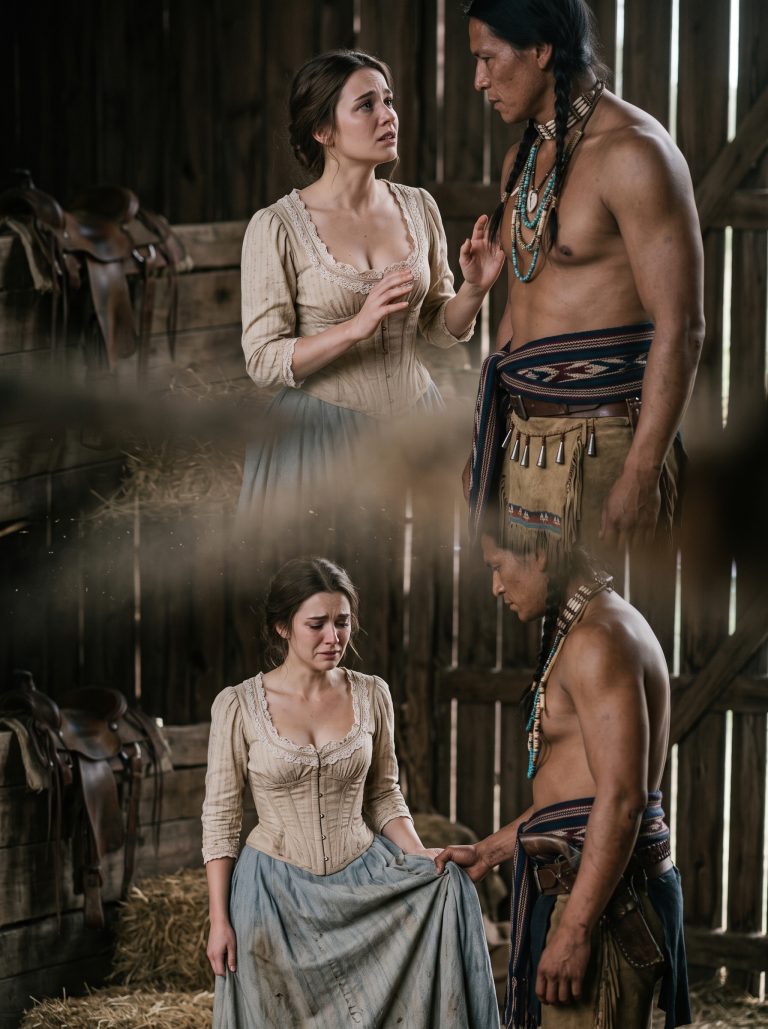
The Rich Cowboy Chose the Outcast Sister—And Shocked the Entire Town

Part 1
The Hart ranch had been dying since before Elena could remember — not the fast death of fire, but the slow, humiliating kind. Paint curling off the porch boards. Fences leaning like tired old men. Cattle sold off, one bad season at a time.
Elena had learned early that love in this house was a wage, paid out only for usefulness. So she made herself useful. She mended fences before anyone asked. She swallowed her own hunger to make sure Rosalind’s plate was full. She had never once, in twenty-one years, asked anyone for help — not because she didn’t need it, but because asking felt like admitting she wasn’t worth keeping without it.
“Stand still,” her stepmother Louisa hissed, dragging a brush through Elena’s hair. Louisa was a strange, watchful woman — arrived from somewhere east eight years ago, married Franklin Hart within a season, and never once spoke of the family she’d come from. She wore a small tarnished ring, a chipped letter B worked into the band, and she never took it off. Once, packing linens as a girl, Elena had found a yellowed letter tucked in Louisa’s trunk, addressed to a Miss L. Brennan — and been swatted so hard for prying that she never looked again.
“The Calloway boy will be here within the hour,” Louisa said now, voice tight in a way that had nothing to do with Rosalind. “You will not embarrass this family.”
It was odd, Elena thought distantly, how pale her stepmother went at the name Calloway — paler than the occasion warranted.
Nathaniel Calloway arrived at exactly three o’clock, sun-browned and lean, a thin scar tracing his jaw. Not the soft dandy Rosalind had been dreaming of. In the parlor, while Franklin performed his booming welcome and Rosalind performed her practiced smile, Nathaniel simply looked at Elena — a real, searching look, like he was reading a brand on a strange animal.
“I’d like to see your stables,” he said, cutting through Franklin’s talk of gardens.
In the barn, he didn’t ask about horses at all.
“How old are you? Why aren’t you married?”
“Because I’m not the daughter anyone wants,” Elena said. “Look at my sister. Delicate. Decorative.”
“Delicate breaks the first time life hits hard.” His eyes were steady, but there was nothing warm in them yet — just calculation, the same calculation she’d grown up watching men use on cattle and land. “My family’s fighting a range war with the Doyle outfit — poisoned cattle, burned barns, a bullet meant for our foreman last month. Whoever marries me stands in that fire beside me. I’ve got two horses saddled. Ten minutes, I ride for the Calloway ranch. If you’re on the second horse, we marry within the week.”
“You’re asking me to choose.”
“I’m asking you to save yourself. Nobody else is going to do it for you.”
She didn’t trust him — not yet, and not for a long while after. But she trusted her own life at the Hart ranch even less, and that was reason enough.
She didn’t remember walking back to the house. She remembered her father’s voice shaking as he called her worthless in front of a stranger, and Louisa standing rigid by the window, her ringed hand pressed flat over her mouth, staring at Nathaniel Calloway like he was a ghost.
“With respect, Mr. Hart,” Nathaniel said, “you’re a fool. You’re trying to sell me the showhorse while the workhorse is the only thing keeping this place alive. It’s her choice. Not yours.”
“If you ride away with him, you are no longer my daughter,” Franklin said. “You’ll have nothing. Be nothing.”
Elena looked at the man who had spent twenty-one years telling her exactly that.
“Then I’ll finally have something in common with the Hart name,” she said, and took Nathaniel’s hand — not as a woman falling in love, but as a woman jumping from a burning roof onto whatever ledge was nearest.
As she swung onto the second horse, she caught one last glimpse of Louisa on the porch — not angry, not grieving. Watching the road toward Calloway land like she’d been waiting eight years for someone to ride down it.
Part 2
They rode two days through open country, mostly in silence. This was a bargain, not a courtship, and both of them seemed careful not to mistake it for anything softer.
Around the second night’s fire, Nathaniel’s careful politeness cracked, just once. “My father’s dying. Cancer. He wants me married to Judge Whitmore’s niece before he goes — connections, protection. I told myself I was rebelling against him by choosing you. That’s not the whole truth, though. When I was nineteen, my father sent me to serve foreclosure papers on a widow — told me it was routine. I didn’t ask questions. I found out later the papers were forged, and the family never recovered. I’ve never told anyone that.”
“Why tell me?”
“Because you’re about to marry into what that made us. You should know exactly what you’re standing beside.”
Elena said nothing for a long moment. “I don’t forgive people quickly,” she said finally. “But I’d rather know a man’s worst mistake now than his best speech later.”
It wasn’t warmth, exactly. It was the beginning of something more useful than warmth: a wary kind of respect.
The Calloway ranch appeared on the horizon like a kingdom carved from stone — three-story house, barns bigger than the whole Hart estate. Silas Calloway met them on the porch, iron-eyed and merciless.
“Some ranch girl in a secondhand dress. No.”
“This is Elena Hart. My fiancée. That’s not a request, Father. It’s a fact.”
“Then let her prove it,” Silas said. “Dinner is at seven. We’ll see how long the workhorse survives among wolves.”
Elena climbed the steps into the lion’s den, and did not let herself shake until the door closed behind her.
Part 3
Dinner was a battlefield disguised as manners. By dessert, Silas Calloway was watching Elena with something that might have been respect. At dawn he tested her on the worst twelve miles of the ranch, and she kept up, earning a grudging nod that felt, absurdly, like the first unconditional praise of her life.
It should have satisfied the old hunger in her. It didn’t. If anything, it fed it — she began working herself past exhaustion, taking on tasks no one asked her to take, terrified that the moment she stopped proving her worth, someone would remember she hadn’t been born to any of this.
Nathaniel noticed, in the slow way people notice things about someone they’re only beginning to actually see. He didn’t press her on it. Months passed in ordinary, unglamorous partnership — long rides, longer arguments over ledgers, the occasional evening on the porch that stretched a little past necessity. If anything grew between them, it grew the way good pasture does: not overnight, and not without weather.
The fire came on a windy Tuesday — the north timber stand, driving hard toward the rival Doyle ranch. Every hand rode out; Elena fought smoke and flame until the blaze died at the break they’d cut, only for Thomas Doyle to arrive with twelve armed men, certain the Calloways had burned him out on purpose. Guns rose on both sides.
Elena stepped into the gap before anyone could stop her — an old reflex, the same one that had once made her fix fences no one asked her to fix. “If the Calloways wanted you gone, burning their own timber is a strange way to do it,” she said. “Someone wants you two killing each other. Ask who benefits while you’re both busy bleeding.”
Doyle lowered his gun, suspicion redirected toward the Ironwood Mining Consortium, which had been circling both properties for months.
That instinct to act first and explain later ran deeper in Nathaniel than he liked to admit. Three nights after the fire, without a word to Elena, he rode out alone to the northern boundary where Ironwood surveyors had pitched camp, meaning to run them off before anyone else got hurt. He came home past midnight with a split lip and a story he trimmed shorter with every telling. It was Elena who found his tally the next morning — men, guns, dates — a plan made and carried out without her name anywhere on it, though her name was on the deed same as his.
“You didn’t think to tell me.”
“I didn’t want you anywhere near it.”
“That’s not protecting me, Nathaniel. That’s exactly what your father does. He decides, and everyone else finds out after — usually from a ledger, or a fire.” She set the paper down between them. “I didn’t leave one house run by a man who wouldn’t say things out loud to walk straight into another.”
He didn’t have a quick answer for that, and to his credit, he didn’t reach for one. It sat between them for days — an old habit, inherited rather than chosen, that he’d never had real cause to name until she named it for him.
Two nights later, Silas’s study was ransacked — his private letters stolen. Cornered, dying, he finally confessed the truth to Elena and Nathaniel: thirty years back, he had forged a will that stripped a rancher named Samuel Brennan of everything he owned — land, water rights, standing in the valley. Samuel Brennan had two children: a son, who inherited nothing and eventually lost his own household to a foreclosure years later, and a daughter, still a girl at the time, who watched the family scatter and never forgot a single name involved.
“The widow I foreclosed on when I was nineteen,” Nathaniel said slowly. “You said her husband’s family had lost everything once already. That was Samuel Brennan’s son. His wife.”
“His daughter-in-law,” Silas confirmed. “You didn’t forge the will, boy. I did, before you were born. But you finished a piece of what I started, whether you knew it or not.”
The room went quiet. Nathaniel didn’t excuse himself, didn’t reach for anger at his father to soften his own part in it. He just sat with it, and Elena understood, watching him, that his rebellion against Silas hadn’t started with her. It had started the day he learned what his obedience had cost, and he simply hadn’t known where to put that weight until now.
It was Elena who placed the last piece. The tarnished ring. The letter to Miss L. Brennan. The way Louisa had gone pale at the name Calloway.
“Louisa,” she said. “My stepmother. She’s Samuel Brennan’s daughter.”
The lawyer confirmed it within a day: Louisa Hart, born Louisa Brennan, was the silent majority owner behind the Ironwood Consortium — the same daughter who’d watched her family lose everything as a girl, and later watched her own brother’s wife lose the little that remained to a nineteen-year-old Calloway boy following orders. She hadn’t married Franklin Hart for love or money. She’d married near the Calloways and waited eight patient years for a way inside — and when Elena rode off with Nathaniel, she’d found her opening: a foothold in the enemy’s house, a range war to cover a slower reckoning.
Elena rode to the Hart ranch alone to confront her — the old habit again, the belief that a debt this personal was hers to settle without help. She found Louisa in the parlor where she’d once brushed Elena’s hair too hard, a ledger of Brennan land claims open on the table between them like a hand of cards already played.
“You could have told me,” Elena said. “Any of the eight years I lived under your roof.”
“Told you what? That the man courting your sister’s roof over her head was built on my father’s grave?” Louisa didn’t raise her voice. She didn’t need to. “I raised you both in the wreckage of what the Calloways left my family, Elena. You think I owed you the truth before I’d finished deciding what to do with it?”
“You used me to get inside.”
“I used the door you opened when you left. That’s not the same thing as using you.” For the first time, something in Louisa’s face cracked — not toward apology, but toward something closer to grief. “I watched my father die believing his own children would inherit nothing but his shame. I have spent thirty years making sure the Calloways would answer for that one way or another. You simply happened to marry into the answer.”
Nathaniel arrived partway through — not because he’d decided alone that she needed him, but because she’d sent word ahead this time, and for once he’d waited for it instead of riding out on his own judgment. He came to stand beside her, not to rescue her, and Elena found she didn’t need rescuing — only a witness. “There’s another way to answer for it,” he said. “Not secrecy. Not a slow ruin dressed up as coincidence. My father’s dying, and he’s finally willing to say what he did, in the open, and make it right. I’ll do the same for what I did, knowingly or not. That’s worth more to the Brennan name than watching two more ranches burn.”
Louisa studied them both for a long moment, weighing thirty years of careful patience against an offer she hadn’t planned for. “Prove it,” she said finally. “Publicly. Not in a private letter I can be made to forget.”
It wasn’t peace. It was a start, which was more than any of them had truly expected walking in.
Instead of war, they chose the harder, slower path. Too weak by then to sit a horse, Silas asked to be driven in a wagon out to what remained of the old Brennan homestead — a collapsed chimney and a fence line gone to weed, the first land he’d ever stolen. Neighbors from both sides of thirty years of grudges gathered at his asking, Louisa among them, arms crossed, unwilling to soften her face for him. In front of all of them, Silas took the original forged will — the real one, not a copy, kept for three decades as proof of what he was capable of — and fed it into a fire built on the very ground it had stolen. He said no fine speech over it. He only watched it burn down to nothing, the way the timber stand had, the way most of his life’s work would have to, before anything honest could grow back in its place.
It didn’t undo thirty years. Nobody there mistook it for that. But it was the first time in Elena’s short acquaintance with him that Silas Calloway had destroyed something on purpose instead of taking it.
Land and money followed within the month — full restitution to the Brennan family, documented and witnessed. Nathaniel made his own separate amends to the widow he’d once, unknowingly, helped ruin, a debt his father’s confession couldn’t pay for him. Louisa, offered honest reckoning instead of a private grievance she alone had to carry, finally set the Ironwood scheme down. Not forgiveness — that would take longer than anyone at that table had left to give — but an end to the slow bleeding.
Rosalind, married off in Elena’s absence to a wealthy, violent man, was bought free with Calloway land and money. She left for Helena to teach, choosing, for the first time, a future nobody had built for her.
Silas died that winter. Elena and Nathaniel married quietly under a stand of blazing aspens — not the swept-up romance of a courtship, but two people who had spent a hard year learning to trust each other’s word, which, in that country, counted for more. They rebuilt the ranch as something closer to a cooperative — land and profit shared among the families the old empire had crushed, including, eventually, an uneasy but honest peace with Louisa herself.
Years later, at the same hour of the same kind of gold October evening, Elena stood on that porch with her own daughter asleep against her shoulder.
“Do you still feel like you have to earn all this?” Nathaniel asked.
“Some days,” she admitted. “Less than I used to.”
Below them, a lone rider crossed the valley floor — one of the hands heading in for supper, small as a stitch against all that open ground, dust rising gold and slow behind his horse in the last of the light. It was the same trail, Elena realized, that she’d ridden down as a stranger with nothing but a bundle of mended dresses and a stranger’s promise. Tonight it just looked like a road home.
She didn’t say anything grand. She didn’t have to. Nathaniel’s hand found hers on the porch rail, and together they watched the valley go the color of a struck match and then, slowly, to ash-blue dusk — the fires banked low in the ranch houses scattered across land that no longer belonged to one man’s ledger, but to all the names finally written honestly into it.
“I spent twenty-one years believing I was the wrong daughter,” Elena said at last, quiet enough that it was almost just for herself. “Turns out I was standing in the wrong house, being measured by people who’d already decided what I was worth before I opened my mouth.”
The last light dropped behind the ridge. Somewhere below, a screen door banged, a dog barked once, and the valley settled into dark — ordinary, unremarkable, entirely hers.
The End.
Message: Old debts don’t vanish when they’re buried — they’re only inherited by the next generation, until someone finally names them out loud. And a person’s worth was never anyone else’s to weigh in the first place.