The Wyoming Widower Paid Her Six Dollars a Month to Care for His Sons — Then She Set a Fourth Place at the Table and Changed Their Lives Forever

Part 1
When Eleanor “Nora” Hayes climbed down from the stagecoach in Cedar Hollow, Montana Territory, in April of 1887, she carried her whole life in one trunk and tried hard not to let her face show how tired, and how frightened, she truly was.
The wind came sharp off the foothills, tugging at her bonnet and scattering dust along the plank walk. Cedar Hollow was smaller than she had pictured from the agency’s letter — a scatter of clapboard storefronts, a livery, a church steeple leaning slightly against the sky. Beyond the last building, the land opened into pale grass and distant blue mountains, and Nora understood, with a quiet drop in her stomach, that she had traveled a very long way from Ohio to a place where nobody knew her name.
She was twenty-eight. She had spent the last six years nursing her father through a slow illness, and when he died the previous winter, he left her a small debt-ridden house and almost no choices that did not require swallowing her pride. So when the agency wrote of a widowed rancher in Montana Territory needing a housekeeper for himself and his two sons, Nora had read the letter three times by lamplight. It was not a romance. It was employment — eight dollars a month, room and board, a two-month trial.
She accepted because survival sometimes came with plain terms and no softness at all.
Nathaniel Calloway was waiting near the livery, a tall man with weather-carved shoulders and a hat brim that shadowed a face built for hard decisions. He was thirty-nine, broad-shouldered, and spare with words.
“Miss Hayes.”
“Mr. Calloway.”
His eyes moved once to her trunk, measuring what needed carrying, not her. “Road tire you out?”
“Some.”
He nodded, hefted the trunk without asking, and said, “Ranch is five miles.”
That was nearly the whole conversation on the drive.
The Calloway place sat against open country — a low house, a barn, corrals gone gray with weather, a line of cottonwoods along a creek. Nothing neglected, exactly. Only the look of a place kept alive by a man too tired to make it gentle.
Inside, Nathaniel set her trunk by the kitchen door and spoke like a man closing a business deal at a counter. “Terms are plain. You’ll cook, keep house, see to the boys’ clothes and schooling. Trial’s two months, for both our sakes. Any questions?”
Nora looked at the cold stove, the stacked dishes, the three chairs at the table.
“No questions, Mr. Calloway.”
He called the boys. Thomas came first, eleven, narrow-faced and wary, his father’s guarded eyes set into a boy’s face. Samuel followed, seven, half-hidden behind his brother’s shoulder.
“This is Miss Hayes,” Nathaniel said. “She’ll keep house.”
Thomas gave a stiff nod. Samuel whispered, “Ma’am,” and neither boy smiled.
“I’ll be outside,” Nathaniel said, and was gone before Nora could answer. A ranch did not pause for a stranger’s arrival.
That evening she made the first proper supper that kitchen had seen in longer than she wanted to guess — beans, biscuits, coffee strong enough to stand a spoon in. Samuel broke his biscuit in half and looked startled to find it soft. Thomas ate carefully, trying not to seem hungry, and failing.
Nathaniel thanked her once, plainly, and went back to the barn, because animals did not care whether a man was grieving.
Later, after the boys were asleep and the dishes were washed, the door opened and Nathaniel came in for water. He stopped, seeing her still at the table.
“Didn’t mean to disturb you.”
“You’re not.”
He drank, and left again.
It was nothing. Only a widower and his hired housekeeper learning the same roof. Nora thought no more of it that night.
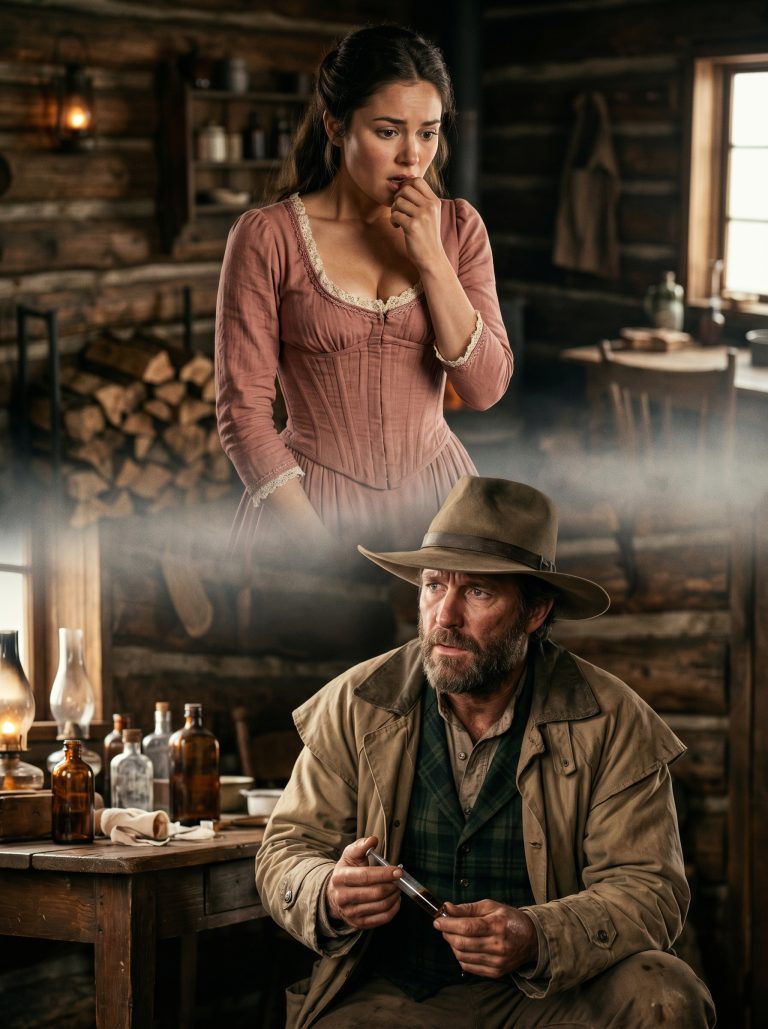
She did not yet know that Nathaniel had buried more than a wife. Three years before, Rebecca Calloway had died giving birth to their third child, and the baby had died with her, and Nathaniel had grieved the only way he trusted — by working until exhaustion left no room for feeling. He had hired three housekeepers before Nora. One had married and left. One had lasted only three weeks before the isolation drove her away. The third had stayed nearly a year, long enough for the boys to lean on her, before Nathaniel dismissed her over a disagreement about how Thomas ought to be punished — and Thomas, who had already lost his mother, learned the bitter arithmetic of a child: people who arrive can also leave, and hoping only makes the leaving worse.
Nora knew none of that yet. She only knew she’d been hired to cook and clean and mend. But in a house with children, the written terms were never the whole of the truth — and within two weeks she had learned that Samuel liked the heel of the bread, that Thomas pretended not to care who got the last spoonful of preserves, and that both boys went still whenever a woman’s voice rose too fast.
Then Thomas came home from school with a split lip, daring her to scold him — and instead, she sat with his torn shirt in her lap that night, and asked him gently what had happened, and learned, stitch by stitch, that a boy had mocked his dead mother, and that nobody had asked Thomas about her in three years.
“She sang when she made biscuits,” he admitted, so quietly Nora had to lean in to hear it.
She bent over the mending so he wouldn’t see what that did to her face. “What did she sing?”
He didn’t remember all of it. But he hummed a few notes, embarrassed, and Nora listened as though it were the most important sound in the territory.
Part 2
By the sixth week, the ranch had begun pulling at Nora before she could stop it — the sound of Nathaniel’s boots on the step, Thomas’s restlessness when the weather turned, the shy pride in Samuel’s face when she remembered to ask about his drawings.
Then Nathaniel wrenched his back hauling fence posts. Nora found him bent double against a rail, pale under sun-browned skin, waving her off.
“You’re bent like a broken hinge,” she said. “Inside.”
He went. For three days she took on what outdoor work she could — feeding stock, mending the sagging chicken coop herself, board by board. When Nathaniel came out on the third day and found it fixed square and tight, he only asked, “Where’d you learn that?”
“My father raised me without sons.”
Something in his gaze held a moment too long. “Thank you,” he said, low, and something between them had quietly shifted.
A few weeks later, the two-month trial quietly ended. Neither of them spoke of it. Nathaniel simply paid her wages on the first of the month as always, and Nora simply stayed, and the matter settled itself without either of them having to find the words for it.
Not long after, Samuel brought her a drawing of a horse, his whole face braced for disappointment. “It’s a very fine horse,” Nora told him, and meant it, and pinned it to the wall by the stove. A few days later, Nathaniel noticed it — and noticed, too, that his younger son had shown it to Nora before showing him.
That same month Nathaniel came home from town with flour, nails — and a fourth wooden chair, which he set at the table without a word of explanation. Until then there had been three: one for him, one for each boy. Nora had always eaten standing by the stove, as hired women did.
At supper the new chair sat exactly where she always stood.
Nobody spoke of it. Nora sat down. Thomas looked from his father to her, and for the first time since her arrival, the guarded boy’s face eased into something dangerously close to hope.
Autumn came on. One evening Nathaniel lingered late at the water trough, and came in expecting a dark kitchen — and instead found Nora at the table with tea, lamplight on her cheek, not working, simply resting in the quiet the house no longer forced him to dread.
“I wasn’t waiting up,” she said. “I just hadn’t gone to bed.”
But she stayed sitting across from him while he ate, and something in Nathaniel — some old, careful door — creaked open half an inch.
It was, he realized with something like alarm, pleasant.
He didn’t say so. By then, autumn had settled fully over Cedar Hollow, and Nora had been at the ranch nearly eight months. Two days after that quiet evening, a letter came for her from an Ohio lawyer’s office, and she read it twice at the kitchen table with a stillness that made Thomas, passing through, stop and stare at her before slipping quietly away to find his father.
Part 3
Nora did not mention the letter at supper. She folded it into her apron pocket and served beans as though her hands weren’t unsteady, and it was two days before she found the nerve to speak of it, and only then because Nathaniel asked her directly, in the wash yard, whether something was troubling her.
“My uncle died,” she said. “My father’s brother. I hadn’t seen him since I was a girl — there was some falling-out I never understood. He left me his share in a boardinghouse in Cheyenne. The lawyer says it’s worth near six hundred dollars, clear.”
Nathaniel went very still. Six hundred dollars was not a fortune, but it was enough — enough for a woman to stop being hired help and start being her own proprietor. Enough to never again need to stand at a stove eating another family’s bread out of gratitude.
“That’s good news,” he said, careful, and Nora heard the carefulness in it, the same way she’d learned to hear weather changing before it arrived.
“It is,” she agreed, and said nothing more, because she did not yet know what it meant to her, only that for the first time since her father died, she had a door that did not require anyone’s permission to walk through.
She told herself she needed time to think. What she did not tell Nathaniel — what she barely admitted to herself — was that she had spent her whole life being useful, first to her father, then to this house, and the letter offered her something she had never once been offered: a choice that didn’t hinge on anyone needing her.
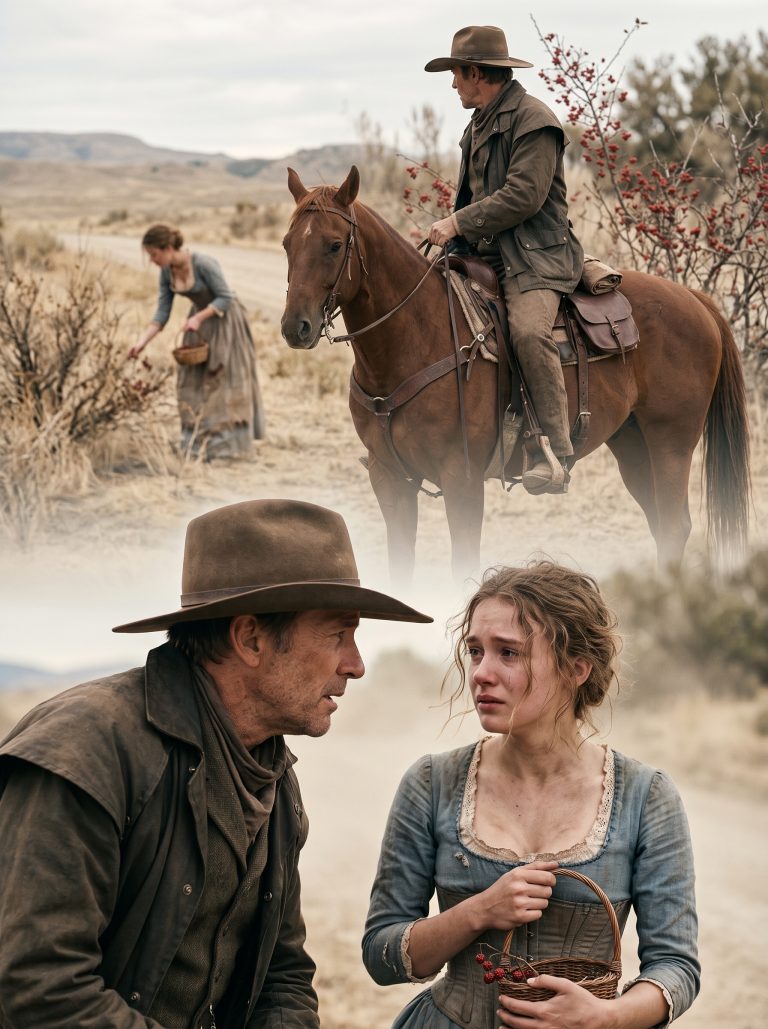
It was into this uncertain week that Everett Whitfield rode out from town.
Whitfield owned the largest spread this side of the river and had buried a wife of his own two winters back. He was courteous, well-spoken, and direct in the manner of a man used to getting what he asked for. He had noticed Nora at church. He had heard, as everyone in Cedar Hollow eventually heard everything, about the boardinghouse in Cheyenne.
“A woman with means and sense enough to run a business,” he told her plainly, standing at the fence rail while Nathaniel was away at the stockyard, “oughtn’t spend her days keeping another man’s house for wages. I’d be glad to make you an offer with rather better terms than Calloway’s, Miss Hayes. Marriage. A house of your own to manage. A husband who would never expect you to eat standing beside the stove.”
Nora looked at him for a long moment — at his clean collar, his reasonable, unhurried courtesy — and felt something twist strangely in her chest, because he was not wrong about anything he said, and yet every word of it landed like a stone dropped into still water.
“I’ll think on it, Mr. Whitfield,” she said, because it seemed the only honest answer she had.
She did not tell Nathaniel about the visit. She told herself it wasn’t his business to know. But Thomas, sharp-eyed as ever, had seen Whitfield’s horse from the hayloft, and said nothing to his father either — not out of secrecy, but out of a boy’s old, private terror that naming a danger might make it real.
For a week, Nora moved through her days with a knot in her chest that no amount of work would loosen. She had an inheritance now. She had an offer of marriage from a man who could give her comfort without asking her to earn it first. And she had this — this ranch, these boys, this quiet man who brought her water and left her chairs and had never once, in eight months, asked her for anything he thought he had a right to.
That was the trouble. Nathaniel Calloway had never once acted like a man who believed he had a right to her staying. He had only ever made room, and waited, and hoped in the silent, stubborn way of a man who did not trust his own hoping.
It was Thomas, in the end, who broke it open.
He came to her one evening with the drawing of the horse in his hands — Samuel’s old drawing, the one still pinned by the stove, its edges gone brown with heat and time.
“Are you leaving?” he asked, without preamble, in the flat voice of a boy who had rehearsed sounding unafraid.
Nora set down her mending. “Why would you ask that?”
“Sam saw the lawyer’s letter on the table. And I saw Mr. Whitfield’s horse.” Thomas’s jaw was tight, but his eyes were too bright. “Everybody leaves eventually. The last one did. You don’t have to pretend.”
Nora’s throat closed. She reached for his hand, and this time he let her take it.
“I haven’t decided anything,” she said, which was true, and which felt, saying it aloud, like only half the truth — because somewhere beneath all her uncertainty, she already knew which life she feared losing. “But I want you to hear this, Thomas, whatever I decide: it was never going to be decided because of money, or because some other man offered me an easier life. If I go, it won’t be because you and Samuel weren’t worth staying for. And if I stay, it won’t be because I had nowhere better to go.”
Thomas studied her with his father’s exact, measuring eyes. “Then why would you stay?”
It was the plainest question anyone had asked her in eight months, and it undid something in her.
That night, after the boys were long asleep, Nora found Nathaniel in the barn, checking a lantern that did not need checking. She told him everything — the inheritance, Whitfield’s offer, the week of silence she’d kept out of her own confusion rather than any wish to deceive him.
Nathaniel set down the lantern very carefully, as a man sets down something he is afraid of breaking by holding it wrong.
“You have every right to take either,” he said, and his voice was rough. “The boardinghouse. Whitfield’s offer. Any of it. I’ve no claim on you beyond wages, and I told you that plain the first day, and I meant it.”
“I know what you told me the first day.”
“I’m not telling you that now.” He looked at her, and for once did not look away first. “I’m telling you I don’t want you to go. Not because the house needs running — Whitfield’s right, you could hire that done. Not because the boys need a mother, though God knows they do, and it’s you they’ve chosen, not me choosing for them. I want you to stay because somewhere in these eight months I stopped being able to picture the evenings without you in them, and I was too slow and too proud to say it before another man rode out here and said it faster.”
Nora felt her eyes fill. “That might be the longest speech I’ve heard from you yet, Nathaniel.”
“I know it’s plain.”
“It’s exactly right.”
“Then tell me plain back,” he said. “Whitfield offered you comfort. What would you be staying for?”
And here was the thing Nora had not let herself say, even to herself, until the words were already leaving her: “Not comfort. Not because I’ve nowhere else. I have somewhere else now — that’s the difference this time, Nathaniel. I could go. I’m choosing not to. I want this. I want you, and this kitchen, and those boys, and I want it because I want it, not because I’ve run out of other doors.”
Something in Nathaniel’s face broke open, quiet and complete.
“Marry me,” he said. “Properly. Not because the trial period ended a long time ago, though it did. Because I love you, and I’d rather ask a woman who has a choice and still chooses me than one who never had anywhere else to go.”
“Yes,” Nora said, and then, because he deserved more than a whisper, “Yes, Nathaniel. I will.”
She did not sell the inheritance away, and Nathaniel did not ask her to. She kept the deed to her share of the boardinghouse in her own name, drawing a modest income from it. The rest she invested in new stock and a proper roof for the barn, not because anyone expected her to, but because she wanted to build the future she had chosen. She told Whitfield plainly that she’d made her choice. For the briefest moment, regret crossed his face. Then he accepted her answer, as a reasonable man would, with only a tip of his hat and no bitterness.
They were married the following month in the small whitewashed church in Cedar Hollow. Thomas stood by his brother with his hair combed fiercely flat. Samuel clapped before anyone else did. Nathaniel’s voice was steady through the vows; Nora’s caught only once.
Afterward, at the church door, Thomas found her in a quiet moment and said, without any of his old guardedness, “I knew before you did.”
“Did you?”
“You could’ve left. You didn’t.” He shrugged, eleven years old and entirely satisfied with himself. “That’s different from the others. The others left when another door opened. You had another door too, and you chose to close it. That’s the part that counts.”
Nora looked across the churchyard at Nathaniel, who was enduring congratulations from men more comfortable discussing cattle than marriage, and found that her son — for that was what Thomas was to her now, in every way that mattered — had understood the whole of it better than she had, for a while, understood it herself.
Years went by, as years do on a ranch. Storms tore at the barn roof and were mended. Boots wore through and were replaced. Two more chairs joined the table as the family grew, and the kitchen grew louder with them — more boots by the door, more mending, more birthdays.
But the fourth chair stayed exactly where it had always been.
Late one autumn evening, long after the boys were grown, Nora sat with her tea and ran her hand along its worn back.
“Thinking of replacing it?” Nathaniel asked, sitting across from her the way he had every evening for thirty years.
“Never.”
“It’s worn through.”
“So are we,” she said, and he laughed, low and real.
“I used to think,” Nathaniel said, turning his cup slowly, “that love meant keeping someone from leaving. Locking every door but one. Took me half our marriage to understand it the other way around.”
Nora reached across the table, and he took her hand the way he always did — carefully, as though it were still a gift he hadn’t quite gotten used to being given.
“And what took you so long to learn it?” she asked.
“Watching you not need to stay,” he said, “and choosing to anyway.”
Outside, the wind moved over the wide dark land, past the barn and the corrals and the cottonwoods along the creek. Inside, the lamp burned steady over a table that had held thirty years of suppers, and the fourth chair — bought once by a careful man who hadn’t yet found the words for what he meant by it — held its place at the table for the rest of their lives, worn smooth by a choice that had been made once, and honored every quiet evening afterward.
The End