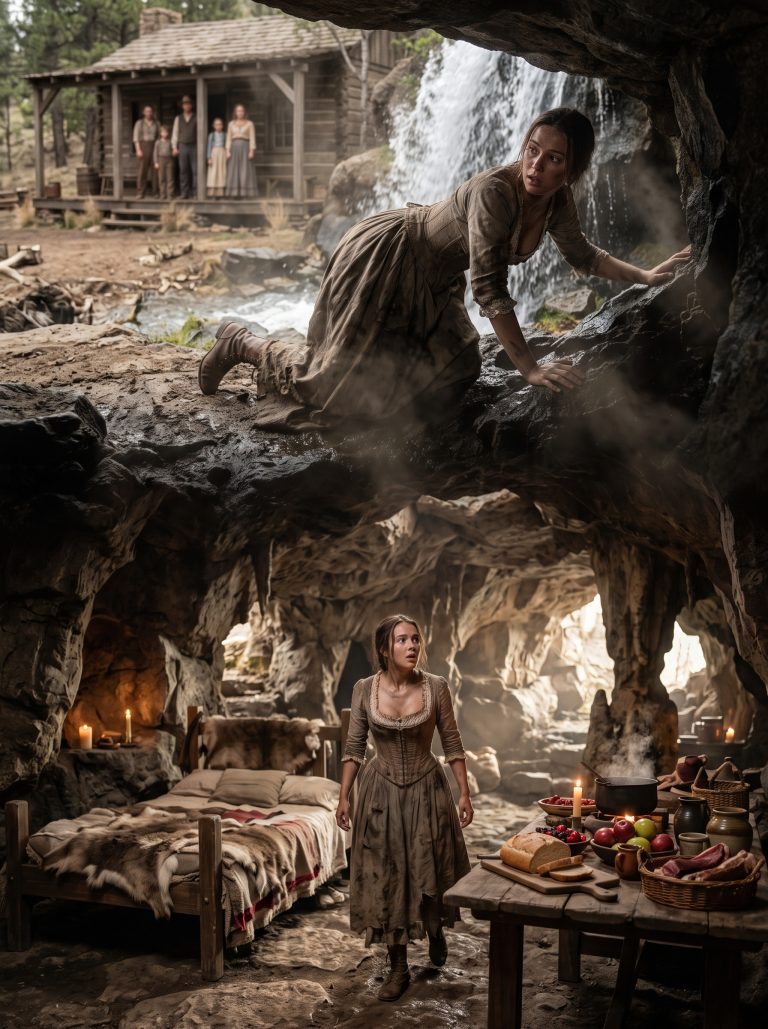
“Wait… You’re Putting THAT Inside Me?” The Giant Mail-Order Bride Froze in Shock—But the Mountain Man Needed Her to Survive the Night

PART 1
“Wait,” Nora Bell choked, her back pressed against the raw log wall. “You’re going to put that inside me?”
The black strip of linen steamed in Jed Crane’s hand.
It smelled like burned pine, animal fat, whiskey, and something bitter enough to make her eyes water. In his other hand: a bone-handled knife, still stained near the hilt. His knuckles were dark with mud and Nora’s blood. The stove roared behind him, turning the cabin orange and monstrous.
Jed did not blink. “It goes in,” he said.
Nora was twenty-five, five feet eleven in her stocking feet, built with wide hips and shoulders that dressmakers in Boston had treated like a personal insult. Men had laughed at her size for years. She had learned to stand straight anyway.
But now she was shaking so hard the straw mattress rustled under her.
“That is tar,” she whispered.
“Pine pitch. Rendered fat. Yarrow. Charcoal. Hot enough to burn the rot out.”
“You are not a doctor.”
“No.”
“You are not even kind.”
“No.”
“Then why should I let you do this?”
Jed’s pale gray eyes lifted from the wound to her face. Broad, battered, wrapped in old flannel and suspenders, with a black beard threaded silver.
“Because if I don’t,” he said, “you’ll be dead before your wedding dress dries.”
Not a wedding night. A warning.
Six hours earlier, Nora had thought the worst thing about becoming a mail-order bride was that her husband might be disappointed by the size of her waist.
The stagecoach had left her in the mud outside Leadville, Colorado. The driver, Harlan Goss, dropped her trunk hard enough to splash her hem, then looked her over — the heavy coat straining at her hips, the men’s boots she wore because women’s boots pinched her feet.
“Crane asked for strong,” he said, smiling without warmth.
“Then perhaps one of us will not be disappointed,” Nora replied.
She had spent her last money on this ticket, purchased with the kind of courage indistinguishable from desperation. Boston had closed around her like a fist after her father died. Her stepfather had made it clear that Nora’s size, her presence at the breakfast table, had become an expense no man should bear.
The advertisement appeared in a matrimonial paper passed among boardinghouse women: Colorado mountain man seeks wife. Beauty not required. Lies not tolerated. She had read that last line twenty times. It sounded like mercy, which should have made her suspicious. She wrote back plainly: I am large. I do not faint when insulted. I will not pretend to be delicate.
Three weeks later: money for a ticket west. One-way.
Jed appeared twenty minutes later on a mule. Six foot two, thick through the chest. He looked at her boots first, then her hands, then her face.
“You Nora Bell?”
“I was when I left Boston.”
“You’re bigger than the picture.”
She had expected it. Prepared for it. “And you’re dirtier than the letter.”
He looked at his mud-caked trousers and nodded. “Fair.”
He grabbed her trunk and lifted it as if it had mildly offended him.
Two hours into the climb, the trail vanished under storm debris. A lodgepole pine had come down across the pass, wedged between rock and a fog-filled ravine. They could not go around. They could not turn back on the narrow trail.
“We move it,” Jed said.
Nora planted her boots in mud, gripped a dead limb, and leaned until her shoulders screamed. Jed shoved his shoulder under the trunk. She pulled harder — not with grace, but with fury at Boston, at her stepfather, at every dressmaker who had sighed before measuring her.
The tree moved. Only a foot.
Then the limb snapped.
Nora fell backward. Something struck her thigh with brutal force — not a blow. A tearing. A deep, wrong entry. She landed on stone.
For one stunned second, she felt no pain.
Then she looked down.
A jagged branch protruded from the outer meat of her right thigh, driven through wool, petticoat, and flesh. It looked impossible. Insulting.
Jed drew his knife, cut her skirt without ceremony, then gripped the branch. “I have to pull it now. If I leave it, you can’t ride. If you can’t ride, you freeze.”
He yanked.
Pain exploded white behind her eyes. Blood surged from the puncture, hot and dark.
“Breathe,” Jed said, pressing his hand against the wound.
“I hate you.”
“Good. Hate keeps folks awake.”
He ripped her petticoat, packed the wound, tied rope tight around her thigh. Then he lifted her — no ceremony, no hesitation, just his hands finding her waist and setting her on the mule.
By the time they reached the cabin, Nora’s world had narrowed to the throbbing wound and the stubborn shape of Jed Crane moving through snow.
Inside, he boiled water, lit the stove, poured whiskey into the wound — Nora arched off the bed, choking on a scream — then used the knife to dig out splinters. He did not apologize.
When the last splinter came free, he turned to the stove.
Then came the steaming black strip.
“Why would anyone do such a thing?” Nora whispered.
“Because pretty medicine don’t always keep people alive. Close it, and dirt seals inside. Fever comes. Leg turns black. You die cursing me.”
A laugh tried to escape her and became a sob.
Jed waited. He did not plead. He did not bully. He simply stood with the horrible remedy in his hand and allowed her the dignity of choosing agony over death.
She had not crossed half the country to die before proving them wrong.
“Do it,” she said.
The tarred linen entered the wound like a brand from hell. She thrashed. Jed’s forearm came down across her chest, holding her.
“Breathe, Nora.”
The first breath was a broken gasp. The second dragged smoke and whiskey and pain. The third belonged to a woman who had survived the first two.
PART 2
The fever came on the second night. She dreamed Boston — narrow hallways, narrow women, a seamstress sighing at her waist.
“Too much girl.”
“I can pull the tree,” Nora mumbled.
A hand lifted her head. “Drink.”
Jed wrung a rag and wiped her face. Thoroughly. “Do you say that to all your brides?” “None.” His jaw tightened. “Had a brother.” Unfinished. “What happened?” “Mountain.” That was all.
For three days he forced broth between her teeth, held her when chills shook her, changed the bandage without lingering or leering. He did not call her too much. He simply kept her alive.
When the fever broke, he was sharpening a hatchet.
“Fever broke.” “Means I have to feed you something besides broth.” “Tragic.”
She ate. Then: “Missed the wedding.”
“Bible,” he said. “Nearest preacher is three days down.”
She was alive because of his hands. But alive was not the same as willing. “Did you buy a wife or hire a mule with a petticoat?”
“I sent for a partner.” He turned. “You think I dragged you here to cheat you?” “I do not know you.” “No,” he said. “You don’t.”
The weeks that followed were school without softness. Nora learned to skin a marten, split kindling, bank a stove. Her body fit strangely well into labor. One afternoon Jed placed his hand over hers to adjust her knife angle — warm, matter-of-fact — and her breath caught. He removed his hand. “You have it.” She did. That was the problem.
The wedding happened during the blizzard that sealed the cabin for three days. They stood opposite each other, two survivors negotiating with God.
“I, Jed Crane, take you, Nora Bell, to be my wife. I will keep the fire, share the work, tell the truth when it costs me, and stand between you and the cold until the ground takes one of us.”
“I, Nora Bell, take you, Jed Crane, to be my husband. I will lean when I must, work beside you, curse you honestly, and stand my ground until the mountain takes us.”
Jed’s eyes changed at curse you honestly. She placed her hand in his. “Done.” He went back to filing a trap spring.
It was the first promise anyone had made to her that sounded built to survive bad weather.
Spring came. Jed returned from town with a bundle in brown paper.
Inside: a dark green canvas duster, sheepskin-lined. Shoulders broad enough. Sleeves long enough. Waist unpinching. It fit over her hips without apology.
“Measured you against the door while you were fevered. Denver tailor. Told him: tall woman, swings an ax.”
He had not bought her a dress to make her smaller. He had bought her armor.
“Well?” he asked.
Nora swallowed. “It’ll do.” The words cracked.
Jed took the lapel and pressed his forehead to hers.
For one quiet moment, Nora believed the transaction had become something else.
Then Harlan Goss rode up the trail with two armed men behind him.
PART 3
Jed saw them first.
His hand dropped from Nora’s coat. His face closed, hard and immediate.
“Inside,” he said.
Goss sat a chestnut horse at the edge of the clearing, wearing a town coat too fine for mud. Behind him were two men in black dusters. One had a deputy’s badge pinned crookedly to his chest. The other held a rolled paper tube like a weapon.
Goss smiled when he saw Nora.
“Well, Mrs. Crane. Look at you. Mountain didn’t eat you after all.”
Jed stepped off the porch. “What do you want?”
“Business.”
“Speak it from there.”
Goss dismounted anyway. His eyes moved over the cabin, the mule shed, the stacked wood, the trap boards. A man counting what did not belong to him.
“This here is Deputy Malloy,” he said, gesturing to the badged man. “And Mr. Silas Prewitt from the Rockwood Mining Company.”
Jed went still.
Mining company.
Prewitt unrolled the paper and cleared his throat. “Jed Crane, this property and the upper creek access remain under dispute due to lack of proper patent filing and noncompliance with household residency requirements.”
Jed’s voice was quiet. “Patent’s filed.”
“Filed incorrectly. As a single man.”
“I amended.”
“No record in Denver.”
“I sent the papers.”
“With me,” Goss said pleasantly.
Goss had stolen the filing.
Prewitt continued. “Additionally, questions have arisen regarding the validity of your alleged marriage. No minister. No witness. No license recorded. As far as county law’s concerned, she ain’t your wife.”
Nora’s stomach tightened.
Goss withdrew another paper.
“The lady here was transported under matrimonial contract. But if marriage fails or is not completed, placement authority reverts to the bureau’s agent.”
“Placement authority,” Nora repeated.
Goss looked at her the way he had at the station, measuring where profit might be extracted.
“You didn’t think that ticket was charity, did you?”
Her ears rang. The coat on her shoulders suddenly felt heavy.
Jed stepped forward. “She is not property.”
“No,” Prewitt said smoothly. “But debts are. Transport fees. Bureau fees. Handling fees. Someone must pay them.”
“Send the bill.”
Goss laughed. “You already owe more than this cabin’s worth, Crane. Unless you sign over the creek claim.”
There it was. Not Nora. Not marriage. Land. The creek, swollen with spring melt, ran through the back edge of Jed’s claim. Nora had heard him mention the old silver traces upstream, the way mining men had been sniffing around for years.
Jed’s hand curled.
Something sharp and clean cut through Nora’s shock. Her humiliation had no room to stand because anger had shouldered past it.
“You arranged this,” she said to Goss.
He looked delighted she had caught up. “I arranged opportunity. You should thank me. Most women of your proportions don’t get husbands in any state.”
Jed moved so fast Nora barely saw it. He had Goss by the coat front and slammed him against the mule shed.
Deputy Malloy drew his revolver. “Back off, Crane!”
Prewitt smiled as if violence was exactly what he wanted.
Jed released Goss slowly. Goss coughed, then straightened his collar.
“Your brother wasn’t much smarter than you,” he said. “What was his name? Eli? Shame about that thaw. Folks say if you’d cut faster, he might have lived.”
The clearing went silent.
Jed’s face changed. Not anger. Something worse. A hollowing.
Goss saw it and pressed.
Nora stepped forward before Jed could.
Her limp dragged. She did not stop.
“You will not speak his name,” she said.
Goss laughed. “And what will you do, big girl? Sit on me?”
Every old insult in Nora’s life gathered in that moment, expecting to hurt her.
Instead, it fed her.
She walked down the steps, the green coat swinging around her legs.
“No,” she said. “I will read.”
Prewitt frowned. “Read what?”
Nora turned to Jed. “The trunk.”
Jed’s eyes flickered.
She had found it during his trip to town. Not opened it — just found it while sweeping, when the floorboard near the bed shifted under her broom. A small iron-bound box lay below, wrapped in oilcloth. She had decided privacy was a form of trust and left it untouched.
Now Jed looked at her, and she understood that whatever lay in that box mattered more than pride.
“Go,” he said.
Nora went inside.
Her hands shook as she pried up the loose board. The box was heavier than it looked. Jed took a key from a string around his neck and unlocked it.
Inside were letters. Dozens of them. Not love letters — complaints, receipts, copies of filings, names of women transported west through the same bureau. Notes in a careful hand. Goss’s signature appeared again and again on delivery forms, witness statements, fee claims.
Jed lifted a packet tied with faded blue thread.
“My brother kept records,” he said, his voice controlled and terrible. “Goss and the bureau were selling women twice. Sending them west as wives, then claiming failed contracts and placing them with mining camps, ranches — anywhere men paid. Eli found out. He was taking statements.”
Goss’s face drained of color.
“Eli died after meeting you at the creek,” Jed said.
Prewitt’s expression hardened. “Old papers prove nothing.”
“No,” Nora said, pulling the top page from the packet.
Her name was written there.
Nora Mae Bell. Fee paid by Jed Crane. Secondary placement noted: Prewitt Company boarding camp if union fails within thirty days.
She read it again.
Secondary placement.
She had not escaped being sold. She had merely been shipped farther.
Her fingers went numb around the paper.
“I found that note the morning I came for you,” Jed said quietly.
She turned to him.
“You knew?”
“I knew Goss had marked you. I didn’t know how deep the company was in it until I saw Prewitt today.”
“You knew I had been sent into a trap. And you did not tell me.”
“I thought if I told you on the trail, you’d run.”
“Run where?”
“I know.”
Anger rose so hot in Nora that for a second she forgot the men in the clearing.
“You let me believe you chose me from my letter.”
“I did.”
“No. You pitied me.”
His head snapped back as if she had struck him. “I did not.”
“You saw a woman too large for Boston and too useful to waste.”
“I saw a woman standing in mud with one trunk, no money, and no idea three men had already put prices on her future.”
“That is pity.”
“That is rage.”
The word silenced her.
Jed stepped closer, his voice still low but shaking now with the force of what he had held back. “I was angry before I saw your face. Angry enough to kill Goss in the road if that would have saved anyone. Then you insulted my smell, mounted a mule in freezing rain, and pulled deadfall beside me like you had something to prove to the whole cursed mountain. I did not pity you, Nora. I recognized you.”
She could not answer.
Goss moved.
He lunged for the papers.
Jed shoved Nora behind him, but the bad leg slowed her step. Malloy shouted. Prewitt drew his revolver.
The shot cracked across the thawing mountain.
Jed staggered.
For one second, Nora thought the sound had missed everyone. Then she saw the dark bloom spread across Jed’s left side.
He dropped to one knee.
The world went very clear.
Not quiet. Clear.
Goss held the pistol, smoke curling from the barrel. His eyes were wide, surprised by his own action. Prewitt cursed him. Malloy shouted, unsure whether to arrest the shooter or obey the company man paying his debts.
Nora did not think.
She grabbed the splitting maul leaning against the porch rail.
Goss turned the pistol toward her.
“You stay back.”
Nora walked forward.
The green coat swung around her. Her scar pulled. Her heart hammered with something older than fear.
“I have been told to stay back,” she said, “by smaller men than you.”
He fired.
The bullet tore through the wide canvas skirt of her coat and struck the porch post behind her.
Nora reached Goss before he could cock the pistol again.
She swung the maul handle — not the blade, because she did not want him dead yet. The hickory shaft cracked across his wrist. The pistol flew. Goss screamed and folded.
Prewitt raised his gun.
A rifle cocked from the porch.
Jed, pale and bleeding, had dragged himself up with one hand braced against the steps. The rifle shook. His aim did not.
“Drop it,” he said.
Prewitt looked at Nora, at Goss on the ground, at Jed’s rifle, at Malloy’s horrified face.
Nora spoke to Malloy.
“You heard him admit the filing was stolen. You saw Goss shoot an unarmed man. You saw the contracts.”
Malloy swallowed.
Prewitt snapped, “Deputy, do your job.”
For a moment, cowardice and duty fought in the man’s face.
Then Malloy lowered his revolver away from Jed and aimed it at Prewitt.
“I think I just did.”
Malloy tied Goss and Prewitt to the porch posts while Nora and Jed worked on Jed’s wound inside. The bullet had cut along his ribs and lodged shallow near the back. Nora’s hands trembled when she poured whiskey over the wound.
Jed looked up at her from the bed.
“You going to put that inside me?” he asked weakly.
She stared at him.
Then she laughed — a cracked sound born half from terror, half from revenge.
“If necessary.”
“Fair.”
She cleaned it the way he had taught her. Dug out cloth fibers. Packed it. Bandaged it tight. When he groaned, she leaned close.
“Breathe, Jed.”
His eyes found hers. “You remembered.”
“I am inconvenient that way.”
By nightfall, Malloy rode down with Goss, Prewitt, and enough documents to ruin at least three respectable men in Denver. Nora sat beside Jed on the stool where he had sat beside her. She wiped his face with cold water, fed him broth, changed the bandage when it soaked through.
At dawn, he woke.
“Papers safe?”
“Safe. Goss and Prewitt are gone.”
“Good.”
He tried to shift and hissed.
“Lie still,” she said.
“You sound like me.”
“A terrible fate.”
His mouth twitched. Then the humor faded.
“I should’ve told you.”
“Yes.”
“I was afraid.”
“You? Afraid?”
His eyes stayed on hers. “That you’d look at me like I was another man deciding your life.”
She had no quick answer for that. Because he had been. Not cruelly. Not greedily. But silence, even born from protection, could still become a cage if it removed a woman’s choice.
Nora looked at the new coat hanging by the stove, bullet hole torn through one side. Armor, damaged on its first day of war.
“My whole life,” she said slowly, “people made decisions about what should be done with me. Fed less. Hidden more. Married off. Shipped west. Placed elsewhere if inconvenient.”
Jed closed his eyes. “I know.”
“No. You knew facts. That is not the same as knowing the weight.”
He opened them again. Then he reached weakly toward the trunk near the bed.
“Top drawer.”
Inside the drawer lay an envelope, sealed but unmarked. Nora brought it to him.
“Open it,” he said.
Inside was a deed.
Her name was on it.
Nora Mae Bell Crane.
Half interest in the cabin claim, creek access, timber rights, trap earnings, livestock, tools, and dwelling.
Signed before his trip to town.
Witnessed by the Denver tailor and Harlan Goss — Goss not knowing what he had witnessed.
Nora stared at the date.
“You did this before they came.”
“Before I gave you the coat.”
“Why?”
Jed’s voice was rough with pain and something more difficult than pain. “Because a bought wife ain’t a wife. Because if you wanted to leave when the stage came, you needed something besides gratitude in your pocket. Because partnership written only in a man’s mouth can change when he gets selfish.”
Nora read the deed again.
Half.
Not charity. Not protection. Not placement.
Ownership. Choice. Weight equal on the ropes.
Her eyes burned.
“You insufferable man,” she whispered.
“I know.”
“You should have given this to me before the coat.”
“Coat seemed easier.”
She laughed, and this time the tears came with it. Not delicate tears. Angry, relieved, exhausted tears that slipped down her cheeks while she stood in a rough cabin in the Colorado mountains holding a deed with her name on it.
Jed watched her as if every tear hurt worse than the bullet.
“Nora,” he said, “if you want to go east, I’ll take you down when I can ride.”
She wiped her face with the heel of her hand.
“And if I stay?”
His throat moved. “Then you stay because you decide to.”
Outside, the creek roared with snowmelt. Inside, the stove ticked. Jed bled through linen. And Nora held her future in both hands.
She thought of Boston. Of narrow doors. Of careful hunger. Of her mother’s silence. Of Goss’s smirk. Of a branch through her thigh and black pitch burning like hell. Of Jed placing a chamber pot beside the bed and walking out so she could keep her dignity. Of a bed too small for two large bodies and still somehow big enough for warmth. Of a coat made not to disguise her shape but to give it room to work.
She folded the deed carefully and placed it on the table.
Then she sat beside Jed and wrung out the rag in cold water.
“You are not well enough to travel,” she said.
“No.”
“And the south wall needs rechinking before next winter.”
“Does.”
“And if the creek is worth what Prewitt thinks, men worse than him may come.”
“Likely.”
“And you favor your left when you lie.”
His eyes softened. “Had a bullet inside the right.”
“Fair.” She pressed the cold rag to his forehead. “I will stay through summer. Then I will decide again.”
Jed closed his eyes, but not before she saw the relief move through him, quiet and devastating.
“Fair,” he whispered.
Summer came green and fierce.
Deputy Malloy returned twice — first with questions, then with news. Goss had tried to trade names for mercy and given up more than he intended. The bureau in Boston collapsed under investigation. Three women were found at a mining camp near Buena Vista and brought to town. Two went east. One took a job at a hotel and sent Nora a letter written in a careful hand.
You do not know me, but I was told your papers helped make me free. I hope you have a roof that does not leak and food enough to eat.
Nora read the letter three times. Then she folded it carefully into the Bible alongside Eli Crane’s records.
When Jed found her holding that collection one evening, he did not say much. He rarely did.
“Eli would’ve liked you,” he said finally, his voice careful.
“Why?”
“You argue well and you don’t flinch at the pitch.”
Nora smiled. “High praise from mountain men,” she said.
“Highest I’ve got,” he said simply.
She kept that letter in the Bible for the rest of her life.
Jed healed slowly and complained with less dignity than Nora had, which she enjoyed more than was kind. They fought often — about salt, about trap placement, about whether coffee should be boiled until it could remove paint, about Jed’s habit of answering complicated questions with three words, about Nora’s habit of rearranging every shelf because “a cabin is not improved by hiding nails behind dried intestines.”
They also laughed, though quietly at first, as if laughter were a wild animal that might spook.
In September, Jed rode down to town and returned with another brown-paper bundle.
Nora eyed it from the chopping block.
“If you bought me a second coat, I will worry you have mistaken marriage for outfitting a regiment.”
“Not a coat.”
Inside was cloth. Deep blue wool, sturdy but softer than canvas, enough for a dress. Not fashionable. A dress that could survive kneeling in a garden and sitting on a wagon bench. With it lay brass buttons and a note from the Denver tailor.
Mrs. Crane, your husband claims you require beauty that works. I hope this will do.
Nora looked at Jed.
He stood with his arms crossed, trying to appear indifferent and failing.
“I did not ask you for a dress,” she said.
“No.”
“Then what is this?”
He looked at the cloth, then at her. “Room,” he said.
It was not a poetic answer.
It was the right one.
Nora stepped toward him, limp and all. She took his beard in both hands, pulled his face down, and kissed him.
Jed went completely still.
Then, very carefully, as if she were a loaded rifle or a wounded bird or a miracle that might punish rough handling, he kissed her back.
It was not the beginning of love. That had begun somewhere messier — in blood, in pitch, in snow, in a chamber pot set down without mockery, in a coat made broad enough, in papers signed before desire could claim credit for justice.
But it was the first time they allowed love to have a recognizable shape.
By the next spring, Nora Crane’s name was known in Leadville for three things.
First, she could split oak cleaner than most men in town.
Second, she had helped expose a trafficking scheme disguised as respectable matchmaking, which made certain businessmen cross the street when they saw her.
Third, she wore a green canvas coat with a bullet hole patched in blue wool over the left side, and when asked why she did not mend it properly, she said, “That is mended properly. It remembers.”
Jed built a second room onto the cabin before next winter — not because propriety had resurrected itself, but because Nora wanted shelves and a desk. On that desk, she wrote letters for women who could not safely write their own. Some wanted husbands. Some wanted work. Some wanted to disappear.
Nora answered each plainly, from experience she had purchased with a branch through her thigh and black pitch in a tin cup:
Do not trust an agent who refuses names. Keep your ticket in your own pocket. Ask who holds the deed. A mountain will take everything you have and return it to you changed. That is not the worst bargain in the world.
Beauty is not required. Lies are not tolerated.
One evening, as the first snow of the season began to silver the pines, Nora stood on the porch in her green coat, one hand resting on the rail Jed had built at exactly the right height for her.
Jed came up beside her, shoulder to shoulder. They were both too large for the narrow porch, so their arms pressed together. Neither moved away.
Down below, the creek ran dark through the ravine. Above, the mountain rose brutal, greedy, honest.
“You know,” Nora said, “when I saw that pitch in your hand, I thought you were the worst thing that had ever happened to me.”
Jed’s mouth twitched. “Wasn’t?”
She considered the scar in her thigh, the deed in her desk, the letters in the Bible, the women now free because the wrong bride had reached the right mountain.
“No,” she said. “You were merely the rudest.”
His laugh came low and surprised, rolling out into the cold.
Nora leaned her head against his shoulder.
The mountain did not become gentle. Winter would still try the roof. Wolves would still take what wandered. Men would still lie where profit waited. Nora knew better now than to mistake hardship for romance.
But she had built a life here, a real one — not around a man, but alongside him. Her name was on the deed. Her hands knew the work. The coat on her shoulders had been built broad enough to act in, not narrow enough to disappear in. The women who wrote to her were learning the same: that a woman’s size was not the measure of her right to take up space. That beauty not required could be a promise rather than an insult. That a marriage worth keeping was one where both parties held something real.
She pressed the cold rag to his forehead.
“I will stay through summer,” she had said that winter. “Then I will decide again.”
She kept deciding. Every season. In favor.
The mountain did not call it love. The mountain did not call anything anything.
But it held them both, and the stove burned warm, and the deed sat in her desk with her name on it, and that was honest — and that, Nora had learned, was more than enough.
The End