They Said No Woman Would Wed the Scarred Blacksmith — Then His Mail-Order Bride Arrived

Part 1
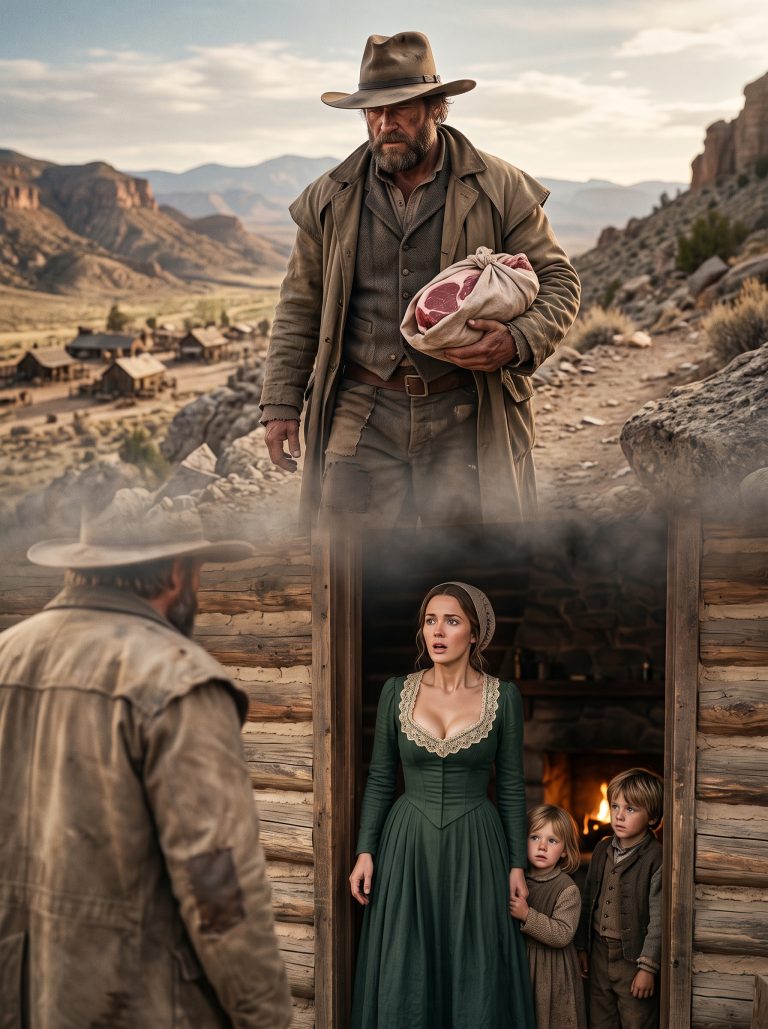
They said the fire had taken more than Caleb Whitfield’s face — it had taken his right to ever be looked at without flinching. For nine years the town of Miller’s Creek, Montana, had believed this so thoroughly that it had stopped being a rumor and become simple fact, the way the mountains were fact, or the long winters.
Caleb was thirty-six. The left side of his face still remembered what he’d looked like before — square-jawed, dark-browed, the kind of face that had once turned heads at barn dances. The right side told a different story: a ridge of scar tissue climbing from his collarbone to his temple, pulling the corner of his mouth into a permanent, unwilling frown. He had been twenty-seven when the Whitfield barn caught fire on a July night in 1880, with no lightning and no lantern left burning by any hand of his own — twenty-seven when he’d gone back inside for his father, who never came out at all.
His elder brother, Thomas, had taken his young wife east within the month, unable to stay on land that still smelled of smoke whenever the wind turned. They wrote at Christmas and little else. Caleb had stayed. He rebuilt what was left of the family forge with his own scarred hands and let the work speak where his face no longer could. There was hardly a wagon axle, a branding iron, or a stove door in the valley that had not passed through Caleb’s hands at some point. People needed him. They simply conducted their business quickly, eyes fixed on the tools, and left.
What none of them knew, on the September morning the matter began, was that a letter addressed in a careful, unfamiliar hand was already three days out from Chicago, riding east to west in the mail pouch of the Overland stage.
Eleanor Hayes was twenty-nine years old, and she had spent the last four of those years being useful to other people’s families without belonging to one of her own. Her mother had died when Eleanor was nineteen; her father, a printer, had followed two years later, leaving debts instead of an inheritance. Since then she had kept house for her uncle’s family in Chicago, minded her cousins, and watched, with a patience that had begun to feel less like virtue and more like erosion, as her own life was quietly spent on other people’s behalf — useful in that house, but never quite needed.
It was her cousin Ruth who found the notice, tucked between advertisements for patent medicine and a lost dog. Blacksmith, Miller’s Creek, Montana Territory. Thirty-six years of age. Own forge, own land, sound in every way but one — I was burned in a fire some years past and the marks of it are plain and permanent upon my face. I will not deceive a woman about this nor ask her to pretend otherwise. I want a wife, not a nurse and not a martyr — someone who can build an honest life beside a man this town has already decided not to see. If that sounds like more trouble than comfort, I understand, and I wish you well. If it does not, write to me.
Eleanor read it twice. Most of the matrimonial notices she’d seen wanted a cook, a broodmare, or a saint. This one wanted, apparently, nothing but honesty — and offered the same in return, including the parts most men would have hidden until the wedding night made hiding impossible. She wrote back before she could talk herself out of it.
They exchanged eleven letters over three months — his short and plainly spelled, hers growing longer each time as she found, to her own surprise, that she wanted to tell him things: about her father’s failed print shop, about the particular loneliness of being useful in a household that was never truly hers. In his sixth letter he wrote: I don’t have much to offer a clever woman except quiet and iron and a face that will take some getting used to. But what I offer, I mean. By the ninth, they had agreed between them — carefully, in the plain language both had used from the start — that if neither found reason to withdraw once they’d met face to face, they would marry within the week rather than draw out what a longer courtship, at that distance, could do little to improve. Eleanor packed her trunk the same week his final letter arrived.
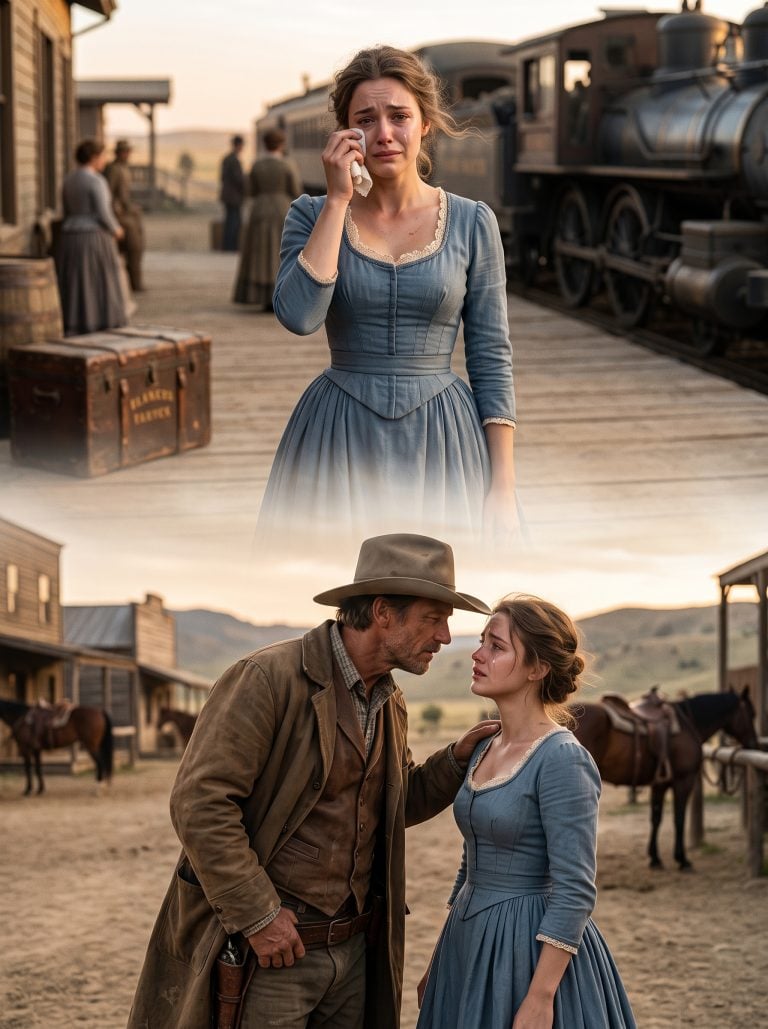
The stage rolled into Miller’s Creek on a bright, cold Thursday, and by the time Eleanor stepped down onto the boardwalk, half the town had found a reason to be standing near the depot. She understood the particular quality of that silence immediately; she had grown up poor enough to recognize an audience gathered for a spectacle.
Caleb stood at the edge of the crowd in his forge apron, hat in both hands, having clearly come straight from the fire without stopping to think better of it. He held himself the way a man holds himself when he has already decided how the next five minutes will go and is only waiting for it to be over.
Eleanor crossed the boardwalk, looked directly at the scarred side of his face without the practiced flinch-and-recover she’d have offered a stranger’s deformity, and put out her hand.
“Mr. Whitfield. I’m Eleanor. You wrote an honest letter, and I’ve come a long way trusting it was the truth.”
It took him a moment to find his voice. “Ma’am. There’s — I’ve got a wagon for your trunk.”
“Then let’s go home,” she said, “and you can tell me what a blacksmith eats for supper, because I intend to cook it better.”
Somewhere behind them, the crowd that had gathered for a humiliation began, disappointed, to drift apart. Neither Eleanor nor Caleb noticed. They were already walking, and neither of them yet understood that the hardest part of what lay ahead had nothing to do with the town at all.
Part 2
The house was small, swept clean, and entirely without the bachelor’s neglect Eleanor had braced for. A jar of late asters sat on the table — cut, she realized, by a man who owned no vase and had not known what else to do with flowers. Caleb had given up the bedroom and intended to sleep in the lean-to by the forge “until you say otherwise, ma’am,” a sentence that undid something in her chest the long journey hadn’t touched.
They married that Sunday in the white church at the end of the street, with two witnesses and no celebration, exactly as they’d promised each other on paper. His voice shook on the vows. Eleanor took his hand and held it steady until the end.
The marriage was not, in its first weeks, as tidy as either of them had hoped a promise could make it. One night Eleanor woke in the dark, forgetting for a moment where she was, and startled at the shape of the scarred side of Caleb’s face before her mind caught up with her eyes. It was a small thing — gone in a breath — but he had felt her flinch, and he said nothing about it, and slept in the lean-to three nights running before she coaxed him back with an apology that cost her more than the offense had cost him. “I wasn’t afraid of you,” she told him. “I was afraid of my own bad manners.” He came back to the house, but it was Eleanor, after that, who understood something she hadn’t fully believed before: that loving a man well was not the same as never failing him, and that what mattered was what she did in the next moment, not the flinch itself.
Then came Nell.
Nell Carrow was seven, the daughter of the widow who ran the boarding house, and she had decided, against her mother’s warnings and the other children’s ghost stories, that the blacksmith’s forge was the finest place in Miller’s Creek. Caleb had caught her watching from the fence weeks before Eleanor’s arrival and had bent her a small iron horse out of scrap rather than send her off. She’d been coming back ever since, entirely unafraid of the face the whole town found unbearable to look at.
Eleanor found them there one gold afternoon — Caleb crouched at a child’s height, showing Nell how the bellows breathed, the little girl gazing at his ruined cheek with nothing in her face but delight. She’s not scared of me, he told Eleanor that night, still faintly astonished by it. Children see what’s actually there, Eleanor said. It’s the rest of us who have to be taught it back.
Part 3
Winter brought its own test. Silas Cobb, who owned the largest spread in the valley and had never once paid a bill on time, came to collect a set of wagon repairs and did not like Caleb’s price. When Caleb wouldn’t bend, Cobb reached for the only weapon such a man carries.
“Should’ve known better than dealing square with a devil’s own brand,” he said, loud enough for the men outside the mercantile. He looked at Eleanor. “Chicago must be hard up, sending its women out to wed a thing like that. What’d he pay you?”
The street went quiet. Eleanor crossed it and stood square in front of Silas Cobb, and she did not need to raise her voice.
“My husband ran back into a burning barn for his own father, Mr. Cobb, while better-looking men stood clear. That’s how he came by his face. He wears the proof of his courage where the rest of us get to hide ours.” She let her eyes move once, deliberately, over the men listening by the mercantile. “A scar only tells you where the pain stopped, Mr. Cobb. It tells you nothing at all about the man who survived it. Now — he’s done your wagon honest. Pay him honest, or find another forge in the next forty miles. I’ll wait.”
Cobb paid. He drove out of town with his ears burning redder than any fire, and somewhere by the mercantile a man laughed — but it was a different kind of laugh this time, and it wasn’t aimed at Caleb.
That night Caleb couldn’t meet her eyes. “You didn’t have to do that. I’m used to worse.”
“That’s exactly why I had to,” Eleanor said. “Because you’re used to it, and you shouldn’t have to be.”
Spring came the way it always does — slowly, then all at once. By the spring of 1890, Montana had been a state for some months, and Miller’s Creek had begun, in its small way, to change along with it: a second street of storefronts going up, a schoolhouse promised for the fall. The women who had watched Eleanor’s arrival like a public humiliation now left cuttings for her garden on the porch rail. Men who had laughed outside the saloon began, one by one, to call Caleb by his name instead of around it.
It was in the middle of that thaw that a stranger arrived on the Tuesday stage, asking after the Whitfield place by its old name rather than its new one.
His name was Harlan Voss. He told the mercantile owner he was a cattle buyer up from Helena, though he asked more questions about a fire nine years past than about cattle, and Nell — who noticed everything a seven-year-old notices and repeated everything a seven-year-old shouldn’t — mentioned that the strange man had stood a long while outside the forge that morning, just watching, before Caleb ever looked up.
Eleanor told Caleb that evening, expecting him to shrug it off. Instead his hands went still over his supper plate.
“Voss,” he said slowly. “There was a Voss boy who courted my brother’s wife, Rachel, before she and Thomas ever married. Left the territory that same summer the barn burned, and never came back for any of it — not the land, not an apology, nothing.”
“You think he had something to do with the fire.”
“I think the sheriff called it an accident because nobody wanted the alternative. Lantern oil doesn’t spill itself in a locked barn on a dry night with no storm for fifty miles.” He looked at his own scarred hands. “I’ve spent nine years telling myself it doesn’t matter who lit it. My father’s just as dead either way.”
“It matters,” Eleanor said quietly, “because you’ve spent nine years wearing another man’s guilt on your face, and letting this whole town treat it like a verdict on your character instead of a wound somebody else gave you.”
Harlan Voss came to the forge himself two mornings later, without the cattle-buyer’s pretense and without the nerve to look Caleb full in the face while he talked. He had, he admitted, seen Caleb’s matrimonial notice reprinted months earlier in a Helena newspaper, the way such notices sometimes traveled from paper to paper for want of other copy — a plain, unflinching description of a man’s burned face that had followed Voss from town to town until the silence he’d kept for nine years became harder to carry than whatever punishment might follow it.
Eleanor had been in the yard hanging wash and came in at the sound of a stranger’s voice gone low and strange. She did not send Nell home, though she thought about it; the girl had trailed in behind her carrying a bucket of scrap for the forge, and by the time anyone thought to send her out again, she had already set the bucket down by the door and gone still and quiet the way children do when they sense, before they understand, that something important is happening.
The truth came out slowly, in pieces Voss seemed to have rehearsed a hundred times on the ride over and still couldn’t say cleanly. He had come back that July night in 1880 to see Rachel one last time before he left the territory for good, and had found Thomas Whitfield waiting for him instead — Thomas, who’d heard rumors of the visit and come to the barn to settle it man to man. The argument had turned to shoving, the shoving had knocked a lantern from its hook, and old dry hay had done the rest before either of them thought to stamp it out. Caleb’s father, asleep in the loft where he sometimes bedded down near a sick mare, had been trapped by the time the two younger men got the barn doors open enough to see the flames climbing. Thomas had gone in after him and been driven back by the smoke before he could reach either his father or his brother — Caleb had never known that; in the chaos and the dark he’d assumed himself alone in the barn until this moment, nine years later, standing at his own workbench. Voss had not gone in at all. He had run, and kept running, all the way to a stage bound east, and left Thomas to tell whatever story would hold — an accident, a spilled lantern, nothing anyone need answer for.
Caleb didn’t move while Voss talked. His hands had found the edge of the workbench somewhere in the middle of it, and by the end his knuckles had gone white beneath years of soot, the tendons standing up along the backs of his scarred forearms like something about to give way. For one terrible heartbeat, Eleanor thought he might come across the forge and put Voss through the wall of it, and she found she would not have blamed him if he had. She did not move to stop him. She only watched, and waited, the way she had learned to wait on the boardwalk a year before, to see what he would do with the next moment.
“You knew,” Caleb said at last, and his voice was very quiet, which was worse than shouting would have been. “You knew for nine years what my face cost, and you let this whole valley believe it was an accident. You let me believe it.”
“I did.” Voss did not try to soften it. “There’s no version of this where I come out anything but a coward, Mr. Whitfield, and I’ve had nine years to try and find one.”
“I’m not asking forgiveness,” he added, turning his hat the way Caleb once had. “I know I’ve no right to ask for any. I came to say it plain, since nobody else ever will, and to put it to the sheriff myself, whatever that’s worth nine years late.”
Caleb was quiet a long moment — long enough that Eleanor, watching from the doorway, found she was holding her breath for him. It was Nell who moved first. She crossed the floor without being asked and took hold of Caleb’s hand, the one still gripping the workbench, and simply held it, the way she might have held a horse’s lead to keep it from bolting. Caleb looked down at her, and something in his shoulders came unlocked.
“It’s worth something,” he said finally. “Not because it undoes anything. Because I’ve spent nine years wondering if the fire meant something about me — if I was marked because I deserved marking. Turns out the fire was never a judgment on me at all. I was simply the one left carrying the cost of it.” He looked at his own hands, iron-dark and steady again now, Nell’s small fingers still wrapped around two of them. “Go to the sheriff. Say it plain, like you said it here. That’s the making-right I’ll take.”
The sheriff reopened the old file before sundown. Voss was taken into custody that same evening while statements were gathered from what few witnesses the years had left, and a letter went east to Thomas that night, in Caleb’s own hand, the first he’d written his brother since the Christmas after the fire. It would be weeks before any answer came back about what, if anything, a jury so long after the fact might do with a case that old. For the first time in nine years, though, the official record no longer called the fire an accident, and that alone — Caleb found, somewhat to his own surprise — was worth more to him than he’d expected. Not vindication, exactly. Just the plain truth, finally written down where the town could read it.
Thomas returned before the first snow, stepping down off the same stage line that had once carried Eleanor west, alone — Rachel, he explained, had made her peace with the past long ago and forgiven him for his part in it, but the valley itself was another matter; she could not make herself ride back into the town where it had happened. Caleb did not ask more than that. The brothers stood awkwardly outside the forge for nearly a minute before either of them spoke, two grown men who had last stood this close to each other in the light of a burning barn.
“You could’ve written sooner than nine years,” Caleb said finally, which was not what he’d meant to say and was, in its way, exactly what he’d meant to say.
“I could’ve,” Thomas agreed. “I told myself I was giving you time. Mostly I was giving myself time, and telling it a prettier name.” He looked at his brother’s face fully then, for the first time since he’d stepped off the stage, the way most of the valley still had to work up the nerve to do. “I should’ve found a way back to you both. I’ve thought that every day for nine years.”
“You did go in,” Caleb said. “Voss told me. I didn’t know it until he said it.” He held out his hand, scarred palm up, the way he might have offered it to a nervous horse. “We were both of us in that fire alone, thinking the other one wasn’t. Seems a waste to spend the next nine years the same way.”
They never discussed the fire again after that, not in any detail. They didn’t need to. Thomas stayed through the winter, then bought the old Hargrove place two miles up the valley, close enough that Eleanor set an extra plate most Sundays without being asked.
Miller’s Creek, which loved little more than it loved a story, had within a week an entirely new one to tell about its blacksmith — not a man marked by the devil’s own brand, as Cobb had once sneered, but a man who’d run into a fire for his father while two other men, in their own ways, had run from what they’d started. The distinction mattered to the town more than it should have; it mattered to Caleb, Eleanor noticed, less than she’d expected. He had already decided, letter by careful letter, what his own worth was, long before Harlan Voss ever stepped off a stage to confirm it.
That May, with the lilacs heavy on the evening air, Caleb found Eleanor in the garden and stood before her without turning the scarred side of his face away, which by then had become such a habit between them that she almost didn’t notice he’d done it on purpose.
“I have to tell you something,” he said, “and I’ve made a poor job of it all week.” He set his hat down, as if he no longer needed something to hold onto. “When I wrote that notice, I expected nobody’d answer, and I’d made my peace with that. A man learns to want less so the wanting doesn’t kill him. Then you got down off that stage and put out your hand like it cost you nothing, and I’ve spent near a year now waiting for the day you’d come to your senses and wish you’d stayed in Chicago.”
Eleanor crossed to him and laid her palm flat against the scarred side of his face — the side no one touched, the side he’d spent nine years angling away from mirrors and strangers alike — and held it there until she felt him let out a breath he seemed to have been holding for the better part of a decade.
“Caleb Whitfield,” she said, “I have never once wished I’d stayed in Chicago. Not on the worst day, and there’ve been a few, some of them my own fault. They told me a story about you before I ever set foot here — the same one they told themselves for nine years, that no woman would have you, that the marks on your face were the truest thing about you. Every word of it was wrong. The only thing that was ever wrong with you is that for a long while, you believed them too.”
“I’m working on not,” he said, and something in his ruined face, when he almost smiled, looked entirely whole.
Years later, when people in Miller’s Creek told the story of the blacksmith and his Chicago bride — and they told it often, the way small towns tell the stories that let them feel better about themselves than they’d actually been — they mostly left out the part where they’d gathered at the depot hoping to watch a woman flinch. Eleanor let them leave it out. She had learned that grace was mostly the art of letting people become kinder than they’d been without making them apologize for the difference.
Nell Carrow grew up, married a rancher’s son, and wore pinned beneath her wedding collar, where no one else could see it, the very first iron horse the scarred blacksmith had ever bent for a frightened, fearless child at his fence. She named her own son after him, and never had to explain why.
That son, small and solemn and not yet five, took to trailing after his namesake at the forge much the way his mother once had, and one summer evening he climbed up onto the old man’s knee on the porch, reached up without any of the ceremony grown people brought to it, and laid two fingers flat against the ruined side of Caleb’s face.
“Does it still hurt?” he asked, the way children ask the only question that has ever mattered.
Caleb considered it honestly, the way he considered most things.
“Not anymore,” he said.
And on long summer evenings, for as long as anyone in the valley could remember, you could find Caleb Whitfield and his wife on the porch of the house up the rise — his great scarred hand wrapped around her smaller one, watching the light go gold and slow across the mountains, in a town that had once believed his scars told the whole truth about him, and had eventually learned, in the plainest way a town ever learns anything, how little it had understood him at all.
The End