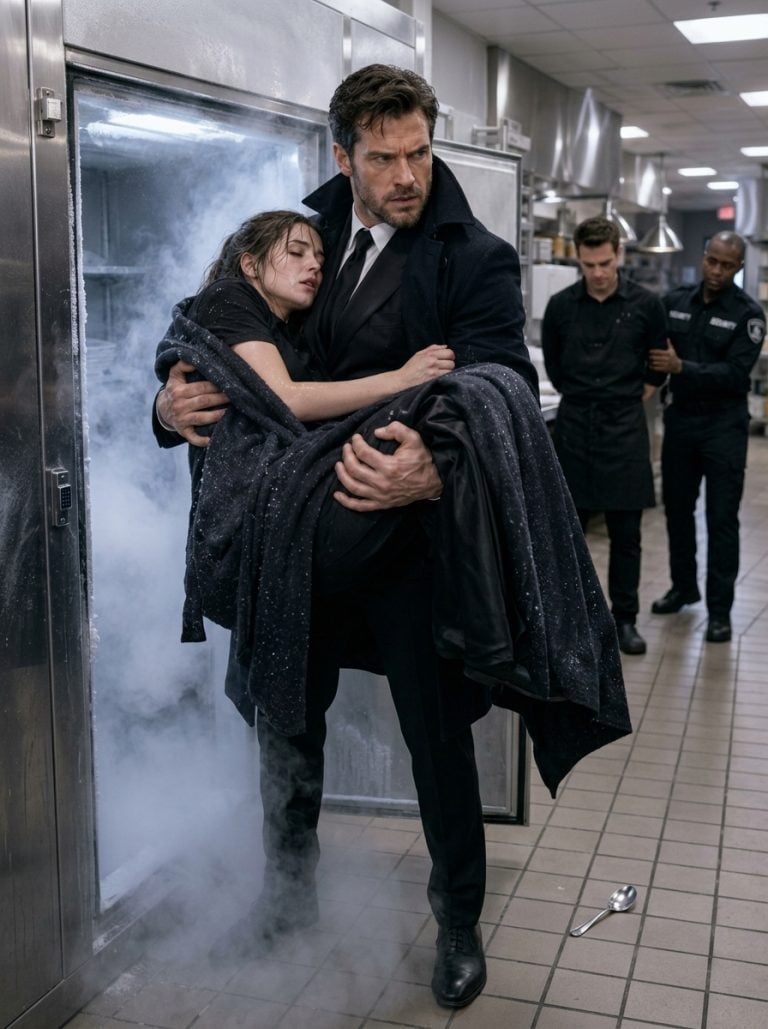
He Thought No One Saw Him Smash His Pregnant Wife’s Phone—Until the Mafia Boss Looked Up from Aisle Three

PART 1
The man in aisle three had been watching Sophia Winters for twenty minutes.
She was seven months pregnant, working the register at Crown Convenience on Boston’s north side, and somehow still afraid of trusting her own fear.
He wore a dark coat and expensive shoes. He moved like someone trained to see everything.
When Derek crashed through the front door with the smell of whiskey and rage, the man set down his unopened coffee.
“Elena!” Derek grabbed her wrist. “Where’s your phone?”
“Working. Derek, not here—”
He twisted.
The pain was immediate. White-hot. Familiar.
Behind him, the man in the dark coat moved. One step. That was all.
Derek turned, sneering. “This is between me and my wife.”
The man’s voice was quiet.
“No,” he said. “You decided it was everyone’s business when you put your hands on her.”
Derek’s face changed. Recognition, then panic, then a desperate attempt to reassemble confidence.
“I don’t want trouble.”
“You created it the moment you walked through that door.”
Two men in dark suits entered without announcement. One locked the door and flipped the sign to CLOSED. The other picked up the store phone.
“Ma’am,” he said to Sophia, his voice careful, “police or medical?”
The question was so simple it almost broke her.
“I don’t know,” she whispered.
The man in the dark coat looked at her face—really looked at it—for the first time.
“Are you hurt?”
Derek moved to answer for her.
The man’s head turned toward him slightly.
That was all.
Derek froze.
“My wrist,” Sophia said.
“Anything else?”
“He scared me.”
The man nodded once.
Then he turned to Derek with an expression that made every atom in the room go still.
“You broke her phone. You put your hands on a pregnant woman. You tried to trap her with information a man like you had no business having.”
Derek’s face went gray.
“I know your father warned you about me,” the man continued. “I know you heard the stories. And I know you thought those were just stories.”
Derek’s mouth opened.
“Let me be clear,” the man said. “They were not stories.”
Outside, through the glass, Sophia watched them speak under the flickering streetlamp. She saw Derek’s shoulders fold. His frantic nodding.
Then Derek was pointed toward his truck.
He drove away.
The man reentered.
He did not approach too closely.
That distance mattered.
“Your name?” he asked.
“Sophia Winters.”
“Sophia. I’m Nicholas.”
The young customer behind the counter whispered, “That’s Nicholas Kane.”
Everyone’s face went pale.
Nicholas Kane was a name that made doors open in ways they should not. That made certain people lower their voices. That meant consequences arrived quietly.
He placed a white card on the counter.
No logo. No title. Just a phone number embossed in black.
“You call this,” he said, “and someone answers. Any hour.”
Sophia looked at the card in her shaking hands.
“Why are you helping me?”
Nicholas was already walking toward the door.
“Because no one helped my mother,” he said.
Then he was gone.
Sophia stood behind the counter with a bruised wrist, a racing heartbeat, and a white card that felt heavier than any weapon.
PART 2
For three days, Derek did not come home.
That silence was worse than his presence.
Silence meant he was planning something.
On the third morning, Sophia called the clinic and lied about her bruised wrist.
The nurse, a woman with tired eyes and a voice like warm water, did not believe her.
“Do you feel safe at home?”
Sophia’s lips parted. The old answer rose automatically.
Then the baby kicked.
“No,” she whispered.
By the time she left, she had resources, a lawyer’s name, and a document titled “Medical Evidence of Domestic Violence” that made everything more real and more terrifying.
That evening, she returned to Crown Convenience because rent did not care about trauma.
Mr. Patterson, the owner, looked ashamed.
“I should have done something sooner,” he said.
He slid a prepaid phone across the counter.
“I put some numbers in there. The shelter. My wife’s cell. Mine.”
Sophia felt tears come.
At the apartment in Oak Park, she lay awake cataloging every sound.
Also: a black car parked across the street. Always the same car. Nicholas Kane, protecting her like he had promised.
Across the city, Derek discovered what happened when you caught the attention of people who actually had power.
His boss fired him.
Not for missing work, but because the owner looked genuinely afraid.
His bank account froze.
The men he owed money to stopped answering.
By midnight, Derek was sober enough to understand he was in danger.
By morning, he was furious enough to make another mistake.
He went to the apartment.
Sophia was not there.
Her clothes were gone. The folder of shelter information was missing. The sonogram photo was gone.
On the kitchen table: I am safe. Do not contact me.
Derek screamed.
Then his phone rang.
Nicholas Kane’s voice came through calm and measured.
“You were warned,” it said.
The line went dead.
Sophia delivered Grace Rose at 3:18 a.m. during a thunderstorm.
Not pretty. Not gentle. Pure survival.
When they placed the baby on her chest, Sophia sobbed in a way that cracked her open completely.
The same body Derek had bruised had created something perfect.
She named her Grace because there had been no grace in Derek. Because she wanted to name something after what she had found instead.
Derek found out through his mother. He was out on bond by then, rage disguised as fatherly concern.
He arrived at the hospital carrying a teddy bear from the gift shop.
Sophia was alone.
“Ellie.”
“Get out.”
“I came to see my daughter.”
“You’re under a protective order.”
He closed the door behind him and slapped the call button from her hand.
Grace Rose slept in the bassinet.
Sophia sat up slowly, pain tearing through her.
“Do not wake my daughter,” she said.
Derek laughed. “You’re crazy.”
“No,” Sophia said, her voice steady. “I’m done.”
He grabbed her arm.
The door opened.
Nicholas Kane stood in the doorway.
Sophia raised her hand.
“Wait,” she said.
She picked up the hospital phone.
Her fingers shook, but her voice was clear.
“This is Sophia Winters in maternity. I have a protective order. Derek Hayes is in my room, and he has put his hands on me. I need security and police now.”
Derek’s face drained.
Sophia held the phone steady.
“I’m done letting you destroy me,” she said.
PART 3
Three months later, Sophia stood in front of a yellow building on a quiet street in Boston, watching autumn light move across the windows.
The sign above the door read: The Sophia House.
A transitional home for women and children leaving domestic violence.
It existed because Sophia had decided her story would not end with Derek Hayes in an ankle monitor, waiting to be tried.
It existed because Grace Bell, a lawyer with silver hair and no patience for weakness, had helped her build something that would shelter other women before they understood the difference between love and entrapment.
It existed because Mr. Patterson had donated shelves. Because Rosa Delgado, the nurse from the clinic, had organized volunteers. Because Nicholas Kane had written a very large check and pretended it was simply “making a call.”
The legal battle took eighteen months.
Sophia had to testify about the bruises, the threats, the nights she slept with her purse under her pillow.
Grace presented the evidence methodically. Security footage. Medical reports. Text messages. Voice messages left at three in the morning.
Derek’s lawyer tried everything.
He argued that Sophia was vindictive. That Derek’s love for his daughter should count for something. That she had provoked him by leaving.
The judge listened.
Then she looked at the evidence.
“Mr. Hayes,” the judge said, “this court finds that you have demonstrated a clear and convincing pattern of intimate partner violence. The protective order is granted for five years. Supervised visitation may be considered only after completed counseling and two years of sustained behavioral change.”
Derek left the courtroom handcuffed.
Sophia sat in the front row with her daughter asleep on her chest and understood, finally, that institutions could sometimes protect people. That the law was not always just, but it could be a tool.
The house opened nine months later.
The first resident was Christina with a broken arm and a black eye. Her seven-year-old son, David, refused to speak for the first two weeks.
Sophia sat with them in the kitchen.
“He says it’s his fault,” Christina said, her voice hollow. “That he made his dad angry.”
Sophia took her hand.
“You tell him the truth,” she said. “That his father is an adult. That adults are responsible for their own choices. That love should not hurt. And then you show him that you meant it by protecting yourself.”
Within six weeks, David started drawing again.
Within two months, Christina had enrolled in community college.
The second resident was Jasmine with scars on her shoulders and a two-year-old daughter. She had tried to leave seven times. Seven times she had believed that love might eventually look different.
“Why did you come this time?” Sophia asked her.
“Because of you,” Jasmine said. “Because I read your story. About the phone. About the man in the store. About how you decided you were worth more than the fear.”
Sophia felt tears come.
“You’re worth more,” she told Jasmine. “I promise you.”
Jasmine moved to Portland six months later. She sent a Christmas card every year.
Rosa became a trained victim advocate and worked with the shelter, transforming from helpless into useful.
Margaret Patterson became the board secretary, dedicating every hour to the idea that her own mother’s silence did not have to be the final word.
Grace Bell won the Pro Bono Lawyer of the Year award and donated it all to The Sophia House.
Derek served his sentence, completed anger management with visible resentment, and was released with probation, a tracking device, and a permanent restraining order. He left Boston for Florida and remarried within eighteen months.
Nicholas Kane continued to appear in the backyard occasionally, at dusk, always wearing his expensive coat and his quiet authority. He checked on the trees he had planted, asked Sophia if the house needed anything, and left before anyone could thank him.
On the third anniversary of the opening, Sophia asked him to stay for dinner.
He almost declined.
Then he saw Grace Rose, now three years old, running through the hallway with her arms out, pretending to be a bird.
He stayed.
The little girl sat on his lap while he ate, completely unselfconscious, tugging on his tie like she owned him.
“She has no idea who you are,” Sophia said.
“No,” Nicholas agreed. “And she never needs to.”
“Why did you really help me?” Sophia asked, the question she had carried for years.
Nicholas watched Grace Rose color on a napkin with a borrowed marker.
“My mother tried to leave twenty-three times,” he said. “She saved money under the floorboards. She called shelters that had no room. She left letters that my father found and destroyed. She planned escape routes that fell apart when she ran out of gas.”
He paused.
“Nobody witnessed her. Nobody helped. She is buried in a cemetery on the west side of Boston under a headstone with my father’s name on it too, like they were partners in something.”
Sophia reached for his hand.
“Lucia,” she whispered.
“Lucia,” he confirmed.
By the time The Sophia House celebrated its third anniversary, it had sheltered forty-three women and fifty-one children.
Christina earned her GED and became a peer counselor. She started a support group for young mothers in dangerous relationships and began publishing articles about teaching children that violence is not love.
Jasmine sent videos of Maya playing violin in her Portland elementary school talent show, surrounded by people who would never hurt her.
Margaret Patterson donated her mother’s journals to the University of Boston, creating an archive of one woman’s attempt to document her own abuse.
Rosa worked with the hospital to implement new domestic violence screening protocols.
Grace Bell took on three new clients from the house pro bono and won custody battles for all of them.
On Grace Rose’s third birthday, Nicholas appeared with a music box that played a lullaby.
“For her,” he said.
“What song is it?” Sophia asked.
“My mother used to sing it. I was maybe three years old. I haven’t heard it in forty years. I thought—”
He stopped.
Grace Rose wound the music box and danced, completely unaware that she was listening to the last song her mother ever heard.
“She would have liked her,” Sophia said.
Nicholas nodded.
He could not speak.
In the kitchen that evening, Sophia found him standing alone, watching the darkness out the window.
“You changed the world,” he said.
Sophia shook her head. “I just kept living. You changed the world by deciding to witness.”
Nicholas turned to look at her.
“That’s the difference between us,” he said. “You believe you changed the world because you survived. I believe you changed it because you built something that saved other people from my mother’s fate.”
Sophia felt the weight of that responsibility and also the liberation in it.
She was not responsible for fixing Derek Hayes.
She was responsible for making sure that the next woman who walked through Crown Convenience wearing bruises and fear had someone to step in.
That was enough.
That was everything.
Five years after the house opened, The Sophia House had sheltered one hundred and twelve women and one hundred and eighty-two children.
The waiting list was six months long.
Funding had expanded. Corporate sponsors stepped in. Local politicians who had once ignored domestic violence suddenly discovered its urgency. A hospital system donated a part-time counselor. The university sent graduate students in social work.
Sophia trained other survivors to become peer counselors.
Christina, now with her GED and working on a bachelor’s degree, took on a leadership role. She told new residents her story and watched understanding flicker across their faces.
“You didn’t deserve it,” she would say. “You did nothing to provoke him. And the fact that you survived means you are stronger than you know.”
Margaret Patterson served as board chair and used her position to push for systemic change. She spoke at city council meetings about funding gaps. She testified before the state legislature about laws that were not strong enough. She became the kind of woman her own mother had needed.
Rosa expanded her training protocols across three hospitals.
Grace Bell took on pro bono cases involving women from the house and built a track record of impressive court victories. She became known in legal circles for being merciless in defending women against men like Derek Hayes.
Sophia never saw Derek again.
She heard, through various channels, that he had settled in Tampa. That he had remarried. That his new wife did not know about the man from Boston who had apparently issued very specific warnings about what would happen if Derek ever committed another act of violence.
She heard that the tracking device had come off.
That Derek had found work again.
That life, in whatever limited form, had continued for him.
But she also heard that he had completed his anger management counseling and that therapist had documented significant resistance throughout. That he had completed a domestic violence intervention program and had challenged everything taught.
That he had been required to take a parenting class and had argued that fathers should have more authority over their children’s lives.
All of this Sophia learned through the legal system’s slow machinery. All of it confirmed what she already knew.
Derek had not changed.
He had simply learned to be more careful.
On Grace Rose’s fifth birthday, Nicholas came to the party at the house.
Twenty-three residents and their children were there. There was cake from the bakery upstairs. There were colored streamers and balloons. There was laughter that sometimes broke when women remembered what laughter had sounded like before they lived in fear.
Grace Rose, blonde and wild and completely fearless in the way of children who had only ever been loved, climbed onto Nicholas’s lap without hesitation.
“Will you dance with me?” she asked.
He stood, and they danced to music playing on someone’s phone, his expensive suit and her pink birthday dress moving through the kitchen while everyone watched.
Sophia saw something in his face then—something that looked like redemption, or at least the possibility of it.
When the party ended and residents had gone to their rooms, Sophia and Nicholas stood on the back porch together.
The two trees he had planted had grown. One was strong and healthy. One had struggled but survived. They bore marks of hard years, but they bore them proudly.
“My mother would have liked this,” he said, standing near Lucia’s tree.
“Yes,” Sophia agreed. “She would have.”
They stood in silence for a while, watching the city lights bleed across the Boston sky.
Sophia never called the white card again after that first night at the convenience store.
But she kept it.
And sometimes, when new residents arrived at the house with fear written across their faces, she showed them the card.
Not to tell them that a powerful man would save them.
But to tell them that witnesses exist.
That someone is always watching to see if decency still matters.
That standing in aisle three of a convenience store and choosing to step forward can change the trajectory of a woman’s entire life.
And that sometimes, all it takes is one person to refuse to look away.
THE END