No One Stopped Laughing at the Sack-Headed Woman… Until the Strongest Man in the Valley Pulled It Off and Shocked Them All

PART 1
Ashwood Flats, Wyoming Territory, April 1887.
Nobody in town could say exactly when they’d decided Cassandra Doyle was a monster. They only remembered Bartholomew Reeve announcing it three years back — that the fire which gutted the orphanage had left her face too horrible for decent folk to look upon, and that letting her live, hooded and silent, working off what she’d supposedly destroyed, counted, in his telling, as plain charity. Swallowing his story cost the town nothing.
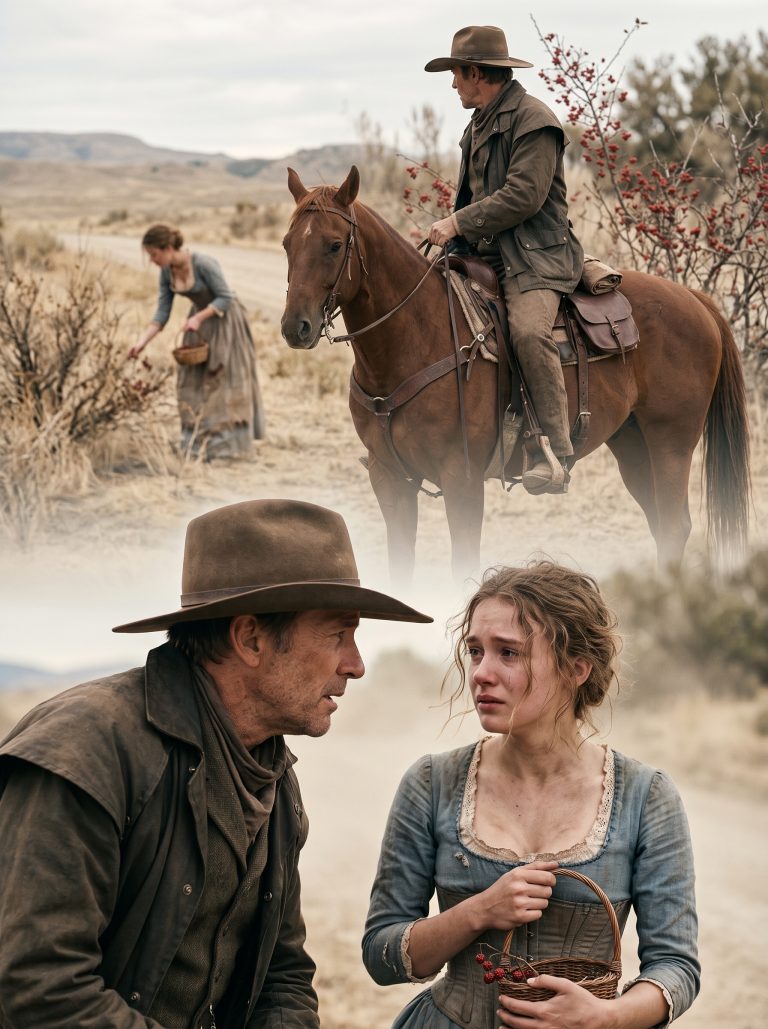
She scrubbed from sunup until her knuckles split. Coarse burlap sagged over her skull, stitched with two crooked eye-holes and a narrow mouth-slit, the fabric gone stiff with years of old sweat. A cord bit into her throat where the skin had long since stopped trying to mend.
Emmett Slade’s boot found her bucket that morning, tipping filthy water across boards she’d spent an hour scrubbing clean. “Faster, Sackface,” he called from the porch rail, and the loafers around him chuckled the tired way men chuckle at a joke they’ve already worn smooth.
She said nothing. Silence was the only weapon left her.
She hauled fresh water, knelt again, and bit down a cry when a spur raked her calf. Somewhere above her, Emmett muttered a word meant for witches. The laughing swelled —
Then it stopped cold.
A horse came down off the north trail, taller than anything this stretch of Wyoming had seen since the last cattle drive, its hide black as river stone. The man in the saddle wore his hat low and a rifle slung across a shoulder gone silver with dust. Folks spoke his name the way they spoke of weather they respected: Nathaniel Colter, who kept to the high timber above Coldwater Ridge, traded furs twice yearly, and otherwise wanted nothing from Ashwood Flats. Rumor claimed he’d wrestled a lion off a dying trapper. Nobody argued with the rumors to his face.
Colter did not dismount. His gaze landed on her and stayed.
“On your feet.”
Emmett squared his shoulders. “She’s town property, stranger. Doing her duty.”
“Didn’t ask you.”
Something in Emmett’s jaw shut like a drawer.
Colter swung down easy for a big man and tossed a coin that struck the dirt an inch from her knee. “Fetch water for my horse.”
Otis Grumman leaned out the saloon door, drying his hands on his apron. “She don’t lay hands on decent animals. She’s cursed, mister.”
“Woman scrubs your saloon floor every morning,” Colter said. “A horse ought to be easier.”
Cassandra closed her fingers around the coin like it might dissolve, then walked the animal toward the trough, braced for it to shy from whatever horror the town insisted lived under her hood.
It only bent low to drink, unbothered, calm as a Sunday afternoon.
Something clenched tight for three years eased loose in her ribs.
Across the road, behind the bank’s polished window, Bartholomew Reeve watched with his cane propped against his knee, disliking — as he always did — a scene he hadn’t authored himself.
By dark the saloon reeked of tallow smoke and forced laughter. Cassandra carried coal in from the shed with her chin tucked, until Otis shoved her hard enough that the scuttle upended and soot scattered like black snow across the floor.
“Get it up,” he barked, hand already rising —
Colter’s hand clamped down on the saloonkeeper’s arm a heartbeat before the strike could fall.
Every voice in the room died.
“Leave her be.”
Reeve emerged from a shadowed corner near the bar, unhurried, buttoned tight into his good coat. “There’s no need for theatrics, Mr. Colter. Miss Doyle carries an honest debt.”
“Owed for what.”
“Five thousand dollars. Burned property. Her care these three years.”
Colter’s eyes moved over the bruising climbing her wrists, the raw groove the cord had worn into her neck, and something in his face turned very still and very cold.
He drew a leather pouch from his coat, loosened the tie, and let its contents cascade across the tabletop — dust and rough nuggets catching the lamplight.
“Call it seven thousand,” he said. “Weigh it yourself.”
Reeve’s smoothness slipped a fraction. “This is highly irregular—”
“I’m not purchasing the woman,” Colter said. “I’m purchasing whatever ledger you’re using to keep her scrubbing floors. Once it’s settled, nobody owns her but herself.”
“She’s a danger to this town.”
“Then you should sleep easier once she’s gone.”
Otis sputtered something about ownership. Colter turned his head a fraction, and the saloonkeeper found somewhere else to look.
Cassandra stood frozen as Colter crossed to her and lowered himself — not the way a man kneels before a servant, but the way a man drops his own height so fear doesn’t have to crane upward to meet him.
“I won’t lay a finger on that hood,” he said, low enough for only her ears. “And I won’t drag you one step you haven’t chosen. But if there’s a life for you outside Ashwood Flats, tell me now.”
Three years of silence buckled under one sentence.
“There is. Take me.”
He rose. “She rides north with me at sunrise,” he told the room, and nobody argued.
Reeve only smiled, thin as a blade. “You’ll live to regret tangling in matters past your understanding.”
“I generally regret the opposite more.”
Dawn found half the town gathered along the street, pretending they hadn’t come to watch. Colter set her onto the saddle, then paused, one boot still on the ground.
“Permission?”
The small courtesy of the question did something to her chest three years of cruelty had never managed.
They rode out without a goodbye.
Behind them, in his darkened office, Bartholomew Reeve set his cane against the desk and spoke without turning to the man waiting near the window.
“Give them the ridge road first. Let her believe it’s finished.”
Judson Cray said nothing. He simply began feeding cartridges into his rifle, one by one.
PART 2
Three days of hard climbing carried them up into timber country, the air sharpening with every mile until it tasted like frost and resin. Cassandra never loosened the hood once, not even at the streams, where she’d wait until Colter found something urgent to study in the opposite direction before she lifted the cloth to drink.
Somewhere around the second campfire, curiosity got the better of her caution. “What made a stranger hand over that much gold for me?”
Colter turned a stick slowly in the flames. “Already told you. I’ve got no patience for a trap dressed up as charity.”
“There’s more to it than that.”
“Maybe. It’s still all you’re getting.”
She watched the light move across his jaw. “You don’t think I burned that orphanage.”
“Not for a second.”
“Why.”
“Because every time it comes up, you flinch like you can still hear it happening.”
That undid something in her chest, and by the time the fire burned low she’d told him all of it — the smoke, running barefoot toward the gate, Reeve’s voice ordering her back, the cracked glass he’d shoved in front of her the next morning as proof of a ruin she’d never actually seen. Colter only stared into the dark timber and said, almost to himself, that a man frightened of a woman’s face rarely bothers keeping it hidden from her too.
His cabin waited on the ridge above, chimney smoke-stained stone, a porch deep enough to sit out a storm, the whole valley falling away beneath it in blue distance. She stood breathing air that held nothing but pine and cold rock, and realized, with something close to disbelief, that nobody nearby was laughing.
Four days folded into each other quietly. The little side room became hers, the hearth stayed his, and he pointed out where she’d find the flour and coffee, warned her off the far ridge until she knew its moods — not as a command, he said, just plain caution against weather that killed without caring who it took. She cooked because it settled her hands. He mended fences and split cordwood. Neither one spoke about the hood.
That silence was exactly what loosened it.
On the fourth evening, firelight thick across the room, her fingers found the knot beneath her chin almost without permission.
“Shed it whenever you’re ready,” he told her, eyes still on the blade he was sharpening. “Nobody here’s going to flinch.”
“You don’t know that.”
“I’ve watched decent men do worse than anything hiding under that sack.”
The first loop of twine came loose in her hand —
The door caved off its hinges.
A rifle cracked. Colter spun as the shot punched through his shoulder, and three armed shapes crowded in through the snow behind it. Cassandra’s cry cut off hard when a fist sent her sprawling across the floorboards.
Judson Cray stood over him grinning around a still-smoking barrel. “Mr. Reeve wants his property returned.”
Lamp oil hit the boards in a wide arc. Fire caught the wall by the hearth and climbed it greedily.
They pulled her out into the drifts by both wrists.
Behind them, the cabin already roaring, Nathaniel Colter lay unmoving, dark blood pooling beneath his ruined shoulder.
Then, against all reasonable odds, his eyes opened.
PART 3
A mountain cabin doesn’t burn slow. Colter’s had stood through eight winters of hard weather, but nothing in its timbers had been built to argue with lamp oil.
He surfaced from the smoke already rolling, hauled himself past a toppled chair, and spilled out into snow that felt almost kind against his skin. One breath of cold to clear his head. Then he spotted the tracks — a dragging, uneven line bracketed by three heavier sets of boots, all pointed downhill toward the timber.
He crammed handfuls of snow against the wound, tore a strip of shirt loose with his teeth to bind the shoulder, and forced his legs to hold him upright.
The cabin was ash behind him now. The tracks were still fresh.
Cray’s men had chosen the southern grade, the descent only a frightened man risks in a storm like this one, and Colter tracked them by feel once his eyesight began to swim with fever. Deep into that first night he caught Cray’s voice on the wind, mocking the hooded shape tied across a saddle.
“Your mountain man’s ash by now, girl. All that trouble spent on something wrapped in burlap.”
There were no tears left in her to spend on him. But four days inside that cabin had shifted something loose in her chest — a man who asked before he reached for anything, who set wildflowers on a table without ever mentioning them, who insisted plainly that cruelty lived in what people chose to do, never in what a face happened to look like. Reeve’s men could haul her body back down that mountain all they liked. They couldn’t undo what those four quiet days had already rebuilt in her.
Ashwood Flats came apart with noise the moment the riders reached its edge. Voices climbed over each other — she’s caught, mountain man’s finished, dead is what I heard — and Cassandra was dragged off the pack mule and pushed toward the square on legs that barely answered her.
Bartholomew Reeve stood waiting by the old holding cage, its door already hanging open like a mouth expecting supper.
“You’ve come home,” he said.
“You murdered him.”
“I fixed an error, nothing more.”
They shoved her inside and turned the lock. A crowd gathered in layers — children first, unashamed in their cruelty, then men drifting over from the saloon, then women who understood exactly what they were watching and stayed to watch it anyway. Somebody’s rotten apple burst against the bars.
“Come tomorrow,” Reeve announced over the noise, “this town will hold a proper hearing on Miss Doyle’s future arrangements.” Arrangements, from that mouth, meant a locked room in some distant asylum. Or ground quiet enough that nobody would ever come looking.
He came back alone once night settled, moonlight pooling flat across the empty square.
“Tell me why,” she said through the bars. “Why any of it.”
“Because your mother’s holdings became my entire fortune.” He said it the way a man recites a ledger, bored by his own honesty. “Every acre between the ridge and the creek belonged to her, then sat in trust once she died, mine to manage until you reached twenty-one. This bank was built on her water rights. The moment you reached your majority, every bit of it should have reverted to you.”
“That’s a lie.”
“It’s precisely true, and some part of you already senses it. A woman blamed for a fire that killed children can hardly march into a courthouse demanding land back. A girl too ruined and unstable to show her own face can be managed indefinitely, and quietly.”
Her hands tightened on the iron. “My face. Was there ever anything wrong with it at all?”
“Would the truth change what three years already cost you? You believed it. This whole town believed it. Belief has always served me better than any fact could.”
Three years collapsed into a single instant — the stink, the heat, the bowed head, the certainty that a cracked pane of glass had shown her something real. Thirty-six months spent terrified of a lie made from soot and warped glass.
“Come morning you’ll be ruled unfit to manage your own affairs,” Reeve said, tapping the bars once with his cane. “A physician’s already riding down from the capital, and his signature goes wherever I point it.” He turned and walked off across the frozen dirt without once glancing up at the roofline above the bank, where a shape had gone still in the dark.
Colter reached town somewhere past midnight, the buildings swimming at their edges through fever, a revolver lifted off a drunk asleep behind the livery, its rounds counted purely by feel — five rounds, nowhere near enough for a real fight, plenty enough to light one.
He found the cage. He found her folded small inside it. And tucked behind the general store, watched over by nothing but routine, he found kerosene barrels stacked and forgotten.
He needed every eye in that town pointed somewhere other than at her.
So he handed them a fire of their own.
By the time Sunday’s light climbed over the rooftops, smoke already sat thick over the street below. The general store went up the moment the first thrown lantern shattered against its wall, and Colter moved through the back alleys like something stitched together out of fever and ash while the whole town herded itself into the square around a platform somebody had rushed to build overnight.
Reeve stood atop it with a Bible in hand, and something about that struck Colter as far more offensive than any deputy’s holstered pistol. “Citizens of Ashwood Flats,” he called, arms spread wide, “we stand here to shield this community from a menace we’ve tolerated for far too long.”
Two deputies hauled Cassandra out of confinement. She swayed on her first step, then found her footing.
“Strip the covering off her,” Reeve ordered.
The street tore itself open.
Glass exploded outward from the burning store. Horses screamed against their tethers. A gunshot ripped through the noise, and Judson Cray leapt clear as a bullet chewed the boards by his boot.
Colter stood in the drifting smoke, revolver raised, one hem of his coat scorched black, his left arm strapped tight across his ribs, his face the color of ash but his hand rock steady.
“Kincaid.” Cray said the old trapper name like it left a bad taste.
“You left the job half-finished.”
The sheriff went for his own weapon. Colter’s bullet snapped the sheriff’s hat straight off his skull. “Next one won’t miss so kindly,” he said, and the pistol dropped into the dirt.
Cray reached for his sidearm anyway. Two shots answered, spinning him screaming onto the platform boards, his own gun clicking empty on the following pull. Colter tossed the spent revolver aside, drew his blade, and climbed the platform one measured step at a time while nobody in that crowd found the nerve to stop him.
“You were supposed to have died,” Reeve said, retreating toward the rail.
“People keep telling me that.”
Colter turned to her, and everything in his voice went gentle at once. “Do you trust me right now?”
“Only if you don’t force it.”
“I won’t force anything.” He held one palm open, the knife loose in his other hand. “I think Reeve’s been lying to you your whole life. Maybe some part of you already knows it. But this decision belongs to you and nobody else — take the hood off, or leave it be, and I’ll stand in this square until every last man here grows tired of watching.”
She closed her eyes. Saw smoke pouring through the orphanage gate. Saw a cracked mirror held up like a sentence. Saw wildflowers left on a table with nothing said about them. Saw a black horse dip its head calmly into her open palm.
“Take it off me.”
The twine gave way. The entire square seemed to hold its breath together.
No scream came. No sharp intake of breath. No child shrieking about monsters.
Colter produced a small mirror from inside his coat and steadied it before her eyes.
A stranger’s face looked back — pale skin, blue eyes, a mouth caught somewhere between disbelief and relief, no scarring anywhere, no ruin at all, only the same face she’d carried at twenty-one — aged some by sorrow, but complete, every last feature intact.
“There’s no ruin in me,” she managed, barely louder than a whisper.
“No,” he told her. “You were never ruined, not once.”
Something broke open across that whole crowded square. Women pressed hands over their mouths. Grown men couldn’t meet her eyes. A town that had spent three years mocking a hooded shape now had to reckon, all at once, with what it had actually done to a living person.
Colter turned on the crowd entirely. “Look at her. Every stone somebody threw. Every insult somebody shouted. All of it because one man in a fine coat gave you leave to do it.”
Reeve edged backward toward the platform’s rail.
Cassandra faced him instead. “You lit that fire yourself.”
“You’re overwrought.”
“You told the world my face was ruined. You took my mother’s land right out from under me. You kept me buried alive in burlap for three years.”
“None of that can be proven.”
“The proof’s sitting in whatever books you’ve kept,” Colter said. “Your kind never stops keeping books. Ink has always earned more of your trust than any living soul ever did.”
A low murmur rolled through the crowd. The sheriff, hatless now and pale with something close to shame, looked between the banker and the woman he’d locked away. “Mr. Reeve,” he said, slow and heavy, “seems to me we’d best have a look at those books ourselves.”
Reeve broke and ran. Colter caught his collar one-handed and slammed him back against the rail. “Go on,” he said, low and even. “See how far that gets you.”
Reeve stopped struggling. Then Colter’s legs simply gave out beneath him, all the fever and blood loss arriving together at last, and Cassandra caught him before his shoulder could strike the boards.
“I have you,” she said. “I have you now.”
His gaze settled on hers. “Convinced now? Not once were you any kind of monster in this whole story.”
Four fever-soaked days followed in a rented room over the livery stable, and she never once left his side through it. The town doctor cut away the dead flesh, packed the wound in carbolic, and wore the particular grim look doctors wear when they’ll take credit if the patient lives and none of the blame if he doesn’t. Colter’s mind wandered loose between waking and delirium — once calling out for a brother she’d never heard him speak of, cursing at a storm that existed only in his fever, groping blindly for a blade that wasn’t there. She stayed through every one of those spells until they passed.
Baskets began piling up outside the door — bread, coffee, jars of preserves, apology notes penned in careful, guilt-ridden script. She left every one of them unread. Three years under that hood had taught her that other people’s shame, arriving this late, owed her patience rather than the reverse.
By the fifth morning, his eyes finally opened clear.
“You stayed,” he rasped.
“Where would I have gone.”
“Word’s already out you own half this valley.”
“Haven’t settled on burning it down or keeping it yet.”
Something like a smile pulled at his mouth. “Coffee comes before either decision.”
She laughed before she meant to, and the sound caught them both off guard.
Attorneys arrived from the capital inside the week. Reeve’s bank got pried open under the sheriff’s watch, and whatever sat locked in those drawers turned out worse than any rumor the town had ever traded — deeds, trust filings, forged doctor’s statements, payments logged under Judson Cray’s name, false debt records, and a receipt for lamp oil dated the same week fire reduced the orphanage to nothing.
The truth, once it surfaced fully, made every rumor look gentle by comparison. Cassandra’s mother had owned that whole valley outright — every acre, every drop of water — and Reeve had spent a decade managing the inheritance in trust, then torched an orphanage and invented a monster rather than surrender any of it once it came due.
Not a single scar had ever touched her face. The mirror he’d held up three years back had been nothing but warped glass fogged with soot.
Reeve was charged with fraud, with arson, with conspiracy, and with murder besides. Cray, wounded and out of nerve entirely, gave a full confession before the trial even opened. Otis Grumman rediscovered what basic decency looked like almost overnight. Emmett Slade cleared out of town before anyone thought to ask what he’d traded for Reeve’s protection over the years.
From then on, Cassandra walked the streets with nothing covering her face. On that first day, every passing glance felt like fingers pressed flat to her skin. Ten days later, a small girl standing near the church told her she looked pretty, then broke down crying, because somewhere along the way her mother had already taught her that shame shows up whether or not it’s deserved.
Cassandra crouched down to her level. “I get angry too, sometimes,” she said softly. “Nobody’s just a single thing.”
The girl gave a solemn nod, as though she’d been handed a piece of scripture.
The lawyers brought choices with them — the bank, the rented houses, the water rights, and the charred lot where the burned orphanage still stood, part memory and part ash.
“You may well rank as the wealthiest woman anywhere in this territory now,” the attorney admitted, not quite hiding his own surprise.
She looked through the bank’s clean glass at the boardwalk where she’d once knelt scrubbing with a hood laced tight over her face. “No,” she said. “I’m the woman this whole town watched kneel and did nothing to stop.”
First on her list came the orphanage itself, rebuilt entirely out of brick, complete with a real schoolroom, a garden out back, and a matron chosen for warmth rather than mere respectability. Her second order was selling off the saloon outright. Her third was returning every rented house to the families already living inside them, sold at a fair price, spread across years, without a dime of interest tacked on.
“That’s a considerable loss to the estate,” the lawyer warned her carefully.
“So was losing three years of my own life.”
Nobody argued with her twice.
Colter healed slower than his patience wanted and quicker than her private fear preferred — the fear that once fully mended, he’d simply saddle up and disappear back into the high country alone. Neither one of them had said the word staying out loud yet. Then one evening she walked into his rented room over the livery and caught him one-handed, cramming gear into a saddlebag.
The moment struck her harder than she expected.
“You’re going.”
“My business here’s done.”
“Your shoulder isn’t.”
“Close enough to done.”
She pulled the door shut behind her. “It isn’t close to anything.”
He kept his eyes on the bag. “You’ve got your whole life handed back to you.”
“And you? What do you have?”
“Belong in those mountains. Always did.”
“That’s a place, Nathaniel. It isn’t an answer.”
He turned at last, pain still drawn tight across his face, beard rough, exhaustion sitting deep behind his eyes. “Ashwood Flats owes you more than it could ever repay in full. You could shape it into something worth its name.”
“I’m already rebuilding the orphanage myself. I’m settling every acre of that land myself. I’m putting real law in place so nothing like Reeve grows back too easily.” She closed the distance between them. “But I refuse to live inside some apology from people who needed to see my bare face before admitting I was ever a person at all.”
His jaw went tight.
“I have no use for the bank,” she told him. “I have no use for lace at my collar, or a town calling me Miss Doyle politely each morning after three years of calling me a monster instead. I want to breathe air that isn’t still thick with every whisper they ever threw at me.”
“Mountains don’t forgive many mistakes,” he said, though the warning had gone hollow.
“Neither did that cage.”
“Winters up there will test anyone.”
“So did this whole town.”
“There’s no real comfort in that kind of life.”
She stepped close enough to touch him. “Burlap never once gave me comfort either, Nathaniel. Don’t try scaring me off with honest hardship, not after what polite, civilized cruelty already put me through for three straight years.”
His hand stilled against the saddlebag strap.
“You’d grow tired of it eventually,” he tried, though even his own voice didn’t believe that anymore. “The isolation. The cold. The relentless chores.”
“You once left wildflowers sitting on my table.”
He went still.
“You assumed I hadn’t caught it, since you never mentioned it aloud. But I noticed the coffee cup set exactly where the hood still let me see it. I noticed you never crossed behind me without some small sound first, so I’d always know where you were. I noticed you told an entire room of armed strangers, out loud, that settling my debt wasn’t the same thing as owning me.”
His throat worked before he managed to swallow.
“I want to live somewhere someone actually sees me,” Cassandra said. “Not as a curse. Not as a fortune. Just as myself, whole.”
He crossed what remained of the room slowly. “If you ride with me, it has to be your choice alone. Not gratitude. Not owed to me for hauling you off that mountain once, or for the blood it cost getting you back.”
“I understand that.”
“And if you ever change your mind, I’ll bring you straight back myself, or carry you off to wherever else you’d rather be.”
“I understand that too.”
He looked at her like a man still not quite convinced he was permitted to look at her freely, in daylight, without consequence.
“I love you” — the confession finally broke loose, rough and unpolished. “I meant to get clear of this room before caring for you turned me into a selfish man.”
Her eyes filled without asking permission first. “You’re a little late on that count.”
It was the first laugh she’d ever heard out of him, low and unguarded and — low, unguarded, real.
They married two weeks on, not inside any church at all, but out among the framework of the half-built orphanage, its brick walls barely three courses off the ground, children scattering wildflowers along the wet mortar lines. Cassandra wore no veil of any kind. Colter kept his arm bound in its sling through the whole brief ceremony, and when he finally kissed her, the entire town that had once laughed at her stood in complete, unbroken quiet.
They rode out before the sun had cleared the ridgeline. She left behind a stack of signed papers on the hotel room’s writing desk — the full orphanage trust, every land transfer, wages set aside for the builders, seed money for the coming planting season, and one final instruction: that the rusted holding cage standing in town square be pulled apart completely, its bars recast as hinges for the orphanage’s new front doors.
Bartholomew Reeve was convicted before that season’s first real snowfall, and died years afterward behind prison walls, entirely forgotten by the very town he’d once believed answered to him alone.
Ashwood Flats changed in the years that followed, though never completely — no town manages that. The orphanage stood finished by summer’s end. Children learned their letters under a roof that never once leaked. Widows who’d rented for years finally held deeds of their own. The old saloon turned into a feed store, trading the reek of whiskey for the dry smell of grain. And the bank, against all its own history, finally kept books an honest man could read straight through without flinching.
High above the valley on Coldwater Ridge, a new cabin rose out of the old one’s ashes — larger this time, its windows angled to catch the sunrise every morning without fail, because Cassandra had asked for exactly that. She fought the thin mountain soil for a vegetable patch and planted stubborn flowers along the porch rail regardless of the odds stacked against them. Colter trapped, hunted, mended what needed mending, and discovered that a house holding a second voice inside it wasn’t quieter peace lost — it was the same peace, doubled.
Travelers found their way up that ridge from time to time. Lost riders. Grown orphans, curious about the woman who’d rebuilt their childhood home out of brick and sheer stubbornness. Widows wanting plain advice on some deed nobody else would explain honestly. They always found steady smoke over the roofline, a black horse dozing beneath the lean-to’s roof, and a woman waiting at the threshold, hair loose, her whole face open and unashamed.
She kept that old hood only long enough to watch the blacksmith feed it into his forge, right alongside the melted bars from the cage that had once held her.
On the stillest nights of winter, once the trail lay buried under snow and firelight turned the whole cabin the color of honey, Colter would sometimes rest two fingers over the old scar in his shoulder, thinking back on the platform, the small mirror, and the way a whole town had gone utterly quiet around the pair of them.
Cassandra would simply reach across and fold her hand into his.
“I remember too,” she’d tell him. Because certain things between two people never need explaining twice.
Outside, the wind drifted over pine and rock, carrying no judgment in it at all. Inside, bread rose slow near the stove, dried wildflowers hung from the rafter beams, and a man and woman who’d each survived their own private loneliness now sat near enough that their shoulders met without either flinching from it.
The town had once called her a monster. Reeve had once called her his property. A dirty, warped piece of glass had branded them both liars long before anyone else caught on.
But Nathaniel Colter — a mountain man in every sense the territory still used that word — had, in the end, managed something bolder than facing down flame or armed strangers. He’d handed Cassandra Doyle back her own right to be seen exactly as she was, nothing added and nothing hidden.
And high in that clean, cold country, where nobody laughed anymore unless real joy asked them to first, she stood, in full view of everyone, at last, precisely what she’d always been under that burlap all along.
Whole.