He Only Came to Bring Meat to a Lonely Woman’s Cabin Was Routine… But Two Words From Her Changed Everything He Believed

Part 1
Silas Cade had not planned on stopping.
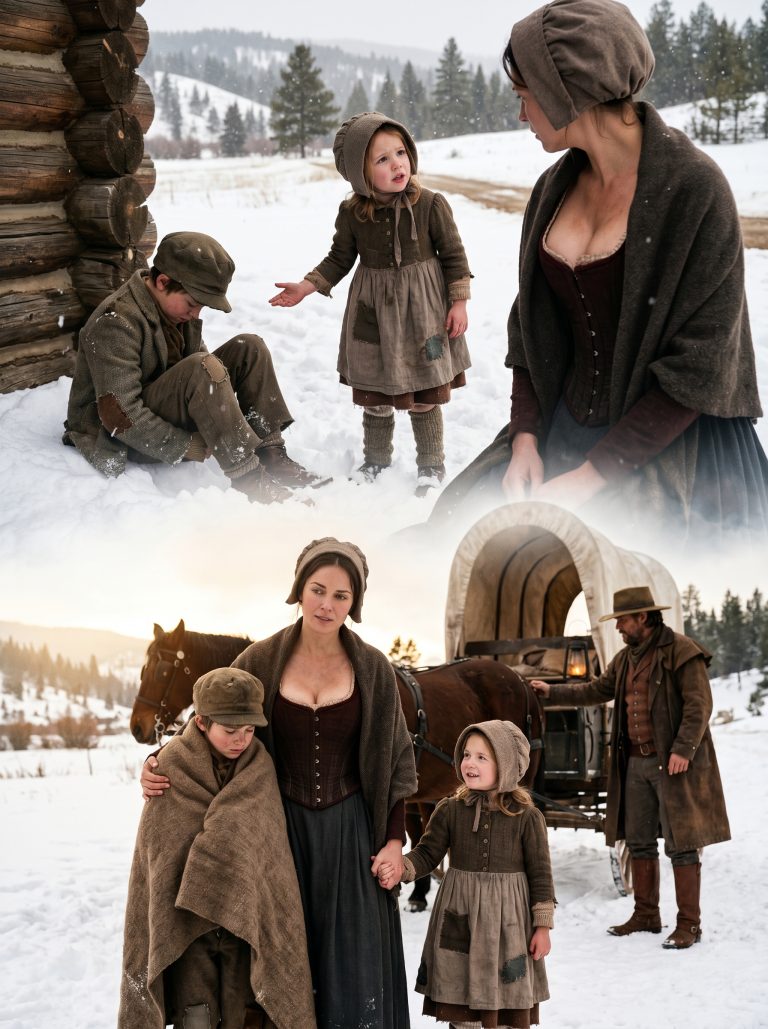
He came down off Raven’s Ridge with a hindquarter of venison lashed across his shoulders and the storm chasing him like something with teeth. Wind peeled snow off the drifts and flung it sideways, and the trail he’d walked for three winters running had gone strange under the white, familiar only by feel — the tilt of the ground, the gap between two black spruces, the place where the creek talked under the ice.
He told himself the meat was only extra weight he didn’t need. He told himself a man could set it on a porch and be gone before anyone opened the door to thank him.
He had heard about the widow at the mill crossing the way he heard most things — sitting silent near a stove while other men forgot the mountain carried voices further than they meant it to. A logger’s widow. Two children. A woodpile going thin. No fresh meat since the leaves turned.
That was three years now since fever had taken Silas’s wife, Ellen, and their son, Daniel, four days apart, in a cabin too far from any doctor to matter. Since then the high country had been the only place that didn’t ask anything of him. Stone didn’t expect a man to heal. Snow didn’t pretend to be sorry.
Then the widow’s door opened, and firelight hit him like a fist.
“Lord,” said the woman in the doorway, an iron poker held loose in one hand, “you’ll freeze where you stand. Get in here.”
Her name was Naomi Vance. She was narrow-shouldered and plain-spoken, with the kind of steadiness that came from surviving things nobody had thought to write down. Behind her, two children peered from a curtained corner — a boy near eight with serious eyes, a girl of four with her thumb near her mouth.
Silas set the meat on the table. It landed heavy enough to make the girl flinch.
“I’ll not stay,” he said.
“You’ll not make it back up that ridge either,” Naomi said, already ladling stew. “Sit.”
He sat because his knees, more honest than his pride, gave him no choice.
The boy, Ezra, wanted to know about the two missing fingers on Silas’s left hand, and got the truth instead of the bear story he was hoping for — frozen river, black flesh, a knife and no whiskey to dull it. The boy’s face fell the way boys’ faces do when a hero turns out to be a man instead.
The girl, whose name was Ruth, asked instead if his mother had ever kissed the hurt better.
“No,” Silas said, and the word cost him more than he expected it to.
“Someone should’ve,” Ruth said, and went back to her doll as if the matter were settled.
He reached for his boots twice that night, and twice something in the room stopped him — first Ezra’s small, smothered crying that he tried to hide and couldn’t, then, worse, one word from Ruth, sleepy and absolute.
“Stay.”
It landed in him like a stone dropped down a well he’d thought was empty. He heard, underneath it, a fever-bright five-year-old reaching for him from a bed that smelled of camphor and dying — stay, Pa — and he had to grip the doorframe to keep from either running or weeping, he wasn’t sure which the storm outside would have believed.
He turned around. He stayed.
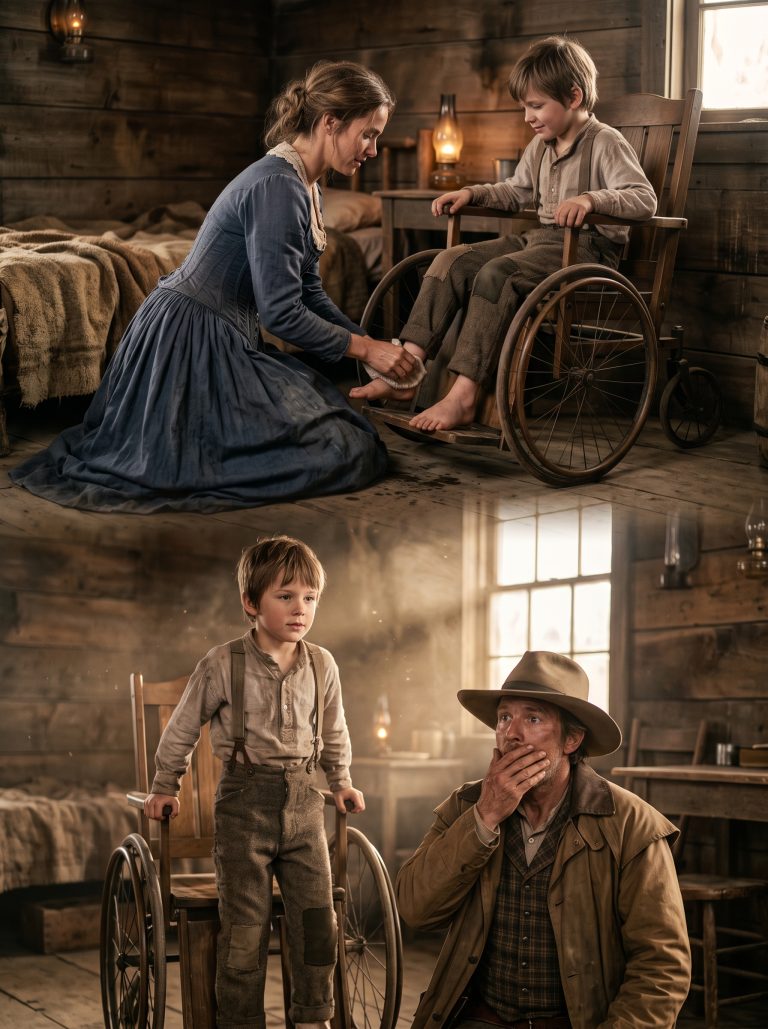
By morning the lean-to roof had come down under the snow’s weight, and Silas found himself splitting wood before he’d decided to. Ezra trailed him with a boy’s endless catalogue of questions. Ruth carried him water with both hands and spilled half of it and beamed like she’d handed him a kingdom when he drank what was left.
It was Naomi, mending his torn shirt by the fire that evening, who nearly undid him. The bend of her head. The patient draw of the thread. It was Ellen’s posture exactly, though nothing else about the two women matched, and panic moved through him faster than thought. He crossed the room and took the shirt from her hands too roughly.
“I never asked you to touch my things.”
Her hurt was quiet and did not turn to anger. “It was torn.”
“I know it was torn.”
He had his coat on before Ruth walked barefoot into the cold doorway and wrapped both small hands around his leg, saying nothing at all, simply leaning her cheek against his knee as though the matter of his staying had already been decided and the world only needed to catch up.
He had walked away from harder things than a child’s silence.
He did not walk away from this.
He closed the door against the mountain instead of opening it, and did not yet understand that the storm outside was the last easy choice he would be given for a long while.
Part 2
Three nights later, Ezra’s cough turned wet and would not stop.
Silas woke to it the way a man wakes to gunfire — already moving, already back inside a cabin he’d buried six feet under three years of silence, where a small boy’s breath had rattled just like this one before it stopped rattling altogether.
“I need your help,” Naomi said, and the four words pinned him where he stood.
He forced his hands steady. He knew fever, knew the wet-lung cough that mountain winters bred, knew it better than any doctor six miles off through drifted snow. He mixed onion and mustard into a poultice. He brewed willow bark and mint and fed Ezra small, bitter sips. He kept Naomi in the chair by force of argument when she would not go herself.
Once, deep in fever, Ezra’s hand found Silas’s sleeve. “Papa?” he mumbled, and Naomi’s face broke open at the word, and Silas had to look away from both of them.
By dawn the worst of it had not passed.
“I need the doctor,” Naomi said. “Six miles, to Amos Fell.”
“I’ll go.”
“You don’t know the lower road.”
“I know snow.”
She caught his sleeve before he reached the door — not to stop him, only to hold the moment a beat longer. “If you go,” she said, “come back.”
It was not a request about the weather.
“I’ll come back,” he said.
Her eyes searched him. “You told the children you’d survived worse than this storm.”
“I lied.”
He left before either of them could weigh that admission, and rode Naomi’s old gelding through drifts that swallowed the fence posts whole, his ruined hand gone numb on the reins, his breath tearing white the same as it had the night he came down off the ridge with meat over his shoulder — except this time he was riding toward help instead of arriving too late to need it.
Part 3
Doctor Amos Fell opened his door already scowling, spectacles low on his nose, a shawl pulled tight against the cold. “This had better be blood or birth.”
“Fever. Boy, eight. Wet cough, tight breathing. Widow Vance’s boy.”
The scowl didn’t soften, but something behind it did. “Vance,” he repeated, and for half a second something moved across the old man’s face that Silas was too worn to read. “I know the place.”
They rode back together through the brutal, brightening morning, and it wasn’t until they’d reached the cabin — until Fell had listened to Ezra’s chest, tasted the tea, examined the poultice, and grunted his grim approval — that the doctor turned to Silas with an odd, careful look.
“Cade,” he said slowly. “Silas Cade. Up off Raven’s Ridge.”
“That’s right.”
“You had a boy once. And a wife.”
The room went very still. Naomi’s hand paused on Ezra’s forehead.
“Three winters back,” Fell said, and now his voice had gone rough in a way Silas hadn’t heard from him before. “I was sent for. Snow took the lower crossing before I could reach you. I turned back at the ravine — told myself, told the man who fetched me, that no horse could make that trail that night. I have never known, in three years, whether that was true or whether I simply stopped trying too soon.”
Silas felt the old ground open beneath him — the half mile he’d dug with his bare hands, the doctor who never came, the two graves he’d cut into frozen earth alone because no one else could reach him either.
He had spent three years hating a man he’d never met. The man was standing in front of him now, old and tired and carrying his own version of the same unbearable question.
“You came for this one,” Silas said, when he could speak.
“I came because a fool rode six miles through a drift to fetch me and wouldn’t take no for an answer,” Fell said. “That’s the whole difference, son. Not whether a man’s willing. Whether somebody makes him try.”
It was not forgiveness, exactly — it was smaller and larger than that, a thing neither man had words for. But something in Silas’s chest that had been clenched shut for three years loosened by a fraction, the way ice loosens before it breaks up entirely, not all at once, but enough that water can move under it again.
Ezra’s fever broke by evening. His breathing eased. Naomi wept quietly into the edge of the bed and did not try to hide it.
Silas found himself, later, standing in the yard under a sky gone hard and clear, the mountains rising clean and distant and calling him the way they always had.
Naomi came out to stand beside him.
“You want to leave,” she said. It wasn’t a question.
“I don’t know how to stay,” he answered honestly.
“Then stay badly at first,” she said. “We are all of us doing something badly at first.”
He told her that night what he had never told anyone in the valley — Ellen’s name, and Daniel’s, the fever, the half mile of frozen ground, the doctor who came too late and the years he’d spent afterward making sure no one could need him wrongly again.
“I failed them,” he said.
“No,” she said. “Grief lies. It tells us that loving someone means we were owed the power to save them.”
He did not fully believe her that night. But he stayed to hear it again the next, and the one after.
Spring came slow and muddy. Silas rode up to his old cabin once, meaning perhaps to stay there, and found instead that everything in it had been waiting three years for nothing but ghosts — the cold mug by the stove, the traps on their pegs, and under the bed, wrapped and untouched, a small wooden horse with one broken wheel that had once belonged to a boy who never got the chance to wear it out.
He brought it down the mountain wrapped in cloth.
That evening he sat beside Ezra and taught him how to sand a peg and carve a new wheel from scrap pine, his ruined fingers clumsy on the small knife.
“Whose was it?” Ezra asked, turning the horse over.
“My son’s.”
Ezra went very still, the way children do when they understand they’ve been handed something that matters more than they first thought. “You sure I can keep it?”
“He’d like somebody playing with it,” Silas said, and found that saying it hurt less than he’d expected, and then, oddly, didn’t hurt at all.
The valley talked, of course. A trader made a crude joke about mountain men gone tame and left without selling a thing after Naomi told him plainly where her gate was. Doctor Fell rode out twice more that year — once for a real fever, once, Silas suspected, only to sit by the fire and watch two children argue over a wooden horse, as if that argument were doing something for the old man that medicine couldn’t.
In August, with the crickets loud and the porch boards still warm from the day’s heat, Silas turned his hat over in his hands and said what he’d been three years learning how to say.
“I don’t have much,” he told Naomi. “A cabin up the ridge nobody’s slept in properly for years. Hands that don’t work right in the cold. More grief than a woman ought to marry into.”
“I have some of my own,” she said.
“I loved Ellen. I love Daniel still. That won’t change, and I won’t ask it to.”
“I would not want it to,” she said. “I loved my husband, William. I do not ask you to replace him. I only ask if there’s room beside what was, for what comes next.”
“There’s room,” Silas said. “I think there’s been room the whole time. I just didn’t know a house could hold that much.”
She took his ruined hand in both of hers, the way she had the night everything had nearly ended before it began, and said, “Then yes.”
They married before the first hard frost, in the small church at the crossing, Ezra standing at Silas’s side with the mended wooden horse in his coat pocket for courage, Ruth scattering dried petals in a line too crooked to follow, and old Doctor Fell in the back pew, pretending not to wipe his eyes and not fooling anybody.
When the preacher asked if he would stay through sickness and health, want and plenty, Silas answered with a steadiness that surprised even him.
“I will.”
Not I do. A vow shaped like a choice a man intends to keep making, one ordinary morning at a time.
That winter the storms came just as hard as they always had. But the cabin no longer felt like a place defending itself against the mountain — it felt rooted, smoke rising steady from the chimney, wood stacked deep under a lean-to that no longer sagged, Ezra’s laughter carrying across a yard he was learning to split kindling in badly and proudly, Ruth’s crooked braids bouncing as she hauled scraps to the goats, Naomi singing over bread that had, for the first time in years, more than enough flour to spare.
Silas came in at dusk one evening with snow still melting on his shoulders, and Ruth ran to him the way she always did now, wrapping both arms around his leg — not pleading this time, only greeting, the word worn soft and easy with use.
“Stay,” she said.
He looked down at her. Then at Ezra by the fire, turning the mended horse over in his hands. Then at Naomi in the lamplight, flour on her sleeve, watching him the way a person watches a door they’ve been waiting three years to see close from the inside instead of the outside.
“I’m staying,” he said, and meant it the way a man means the truest things — quietly, and for good.
Years afterward, people in the valley would tell it different ways. Some said Naomi saved him the night she made him take off his boots. Some said a four-year-old’s single word did it. Doctor Fell, when he told it, always left in the part about the ravine and the snow and what it cost an old man to say out loud that he might have turned back too soon — because he believed, and said so more than once, that the truest mercy in the whole story wasn’t that Silas forgave him, but that neither of them let the guilt decide what they did next.
They were all of them a little right.
The deepest truth was quieter than any of their versions. Silas Cade had come down off that mountain meaning to leave a debt on a porch and vanish before kindness could find him, believing that a broken man belonged where the snow could bury what grief had already ruined. He had believed, without quite knowing he believed it, that staying alive and warm and needed was itself a kind of betrayal of the dead.
What he learned instead, slowly and very badly at first, was that love does not divide a heart into what’s finished and what’s new. It widens what’s already there. Ellen and Daniel did not leave him when he let himself be loved again — they simply moved, gently, into the part of the house that held remembering instead of the part that held only cold. A wooden horse on a mantel. A chest rub written out in a widow’s recipe book in another woman’s hand. A name spoken without flinching, at last, by firelight.
Naomi gave him a door he didn’t have to earn his way through. Ezra gave him a reason to keep his hands useful. Ruth gave him the one word he never learned how to walk away from.
Stay.
A child’s word. Small enough to fit in one syllable, and somehow large enough to hold a man’s whole ruined life and set it back down gently, facing forward.
And Silas Cade — who had survived frostbite, fever, burial, and three winters of a silence he’d mistaken for peace — came, in the end, to understand that the bravest thing he ever did wasn’t crossing a mountain in a blizzard with meat slung over his shoulder.
It was turning back from an open door, into a room full of noise and need and firelight.
And staying.
THE END