She Was Thrown Into the Cold With Only $5 and Her Kids—What She Built Next Shocked Everyone Who Watched Her Fall

PART 1
She had learned, in eleven long months of widowhood, that grief has a particular way of arriving quietly before it ever arrives loudly and completely — a held breath in a doorway, a held breath that never quite finished emptying out of her chest. She felt it now, standing on the Persian rug she used to beat clean every Tuesday, back when this parlor had still belonged partly to her.
Delphine Ashworth slid a five-dollar bill across the table the way a woman might push a dead insect away from good lace.
“You have had nearly a year to grieve my son,” Delphine said. “That is more than most women get.”
Freya’s husband, Anders, had been dead eleven months — a falling pine in the north lot during a late storm, and by the time the men carried him home on a wagon plank, she’d already read the answer on their faces. Not a wife anymore. A widow. A dependent. A problem to be solved.
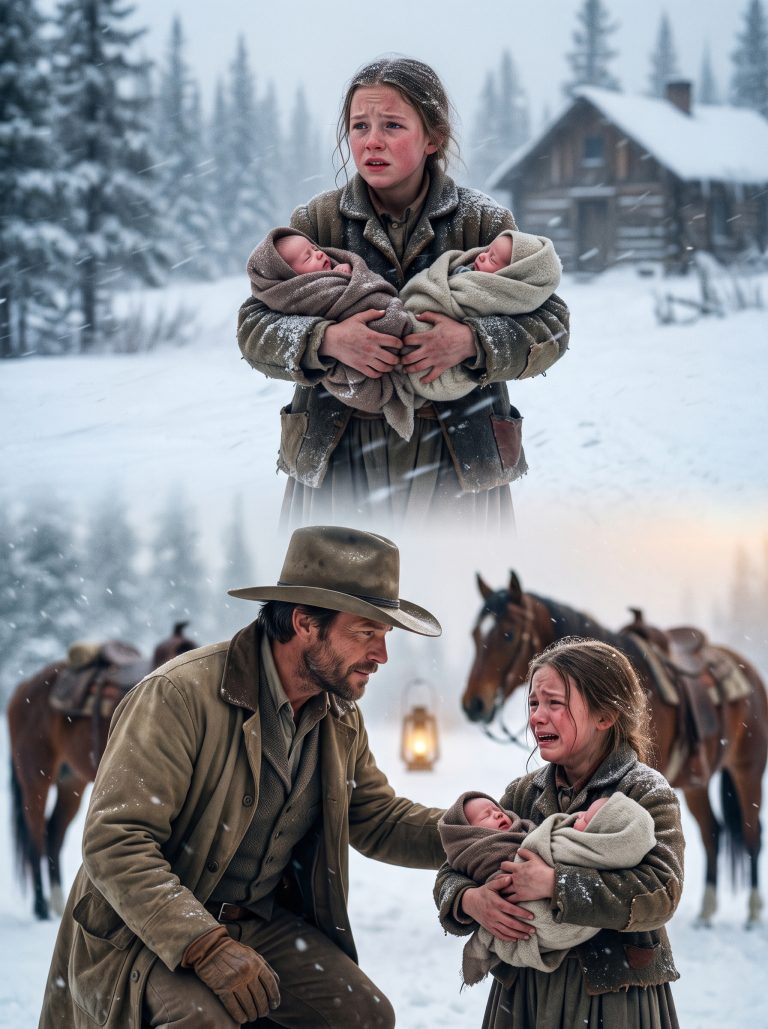
Her son Nils was seven, already old enough to understand that faces could strike harder than hands. Her daughter Liv was four, still sleeping with the corn-husk doll Anders had made her the Christmas before he died, its yarn hair braided with careful, uncomplicated love. Liv called it Little Mormor, after Anders’s grandmother Solveig, who had taught Freya more about endurance than any woman alive.
“The children are Ashworths by blood,” Delphine went on, hands folded white and smooth in her lap. “That is the only saving fact in this mess. Young enough still to be shaped properly. Without your influence. Without bare feet in creeks, or farm songs, or that Norwegian foolishness Solveig encouraged.”
“Farmor Solveig loved those songs.”
“Farmor Solveig is dead.”
By the window, Edmund Ashworth said nothing, as he never did when his wife’s voice filled a room. His knuckles had gone white against the sill.
“What are you asking of me, Mrs. Ashworth?” Freya said.
“I am not asking. Collect your things and leave this house by sundown.”
“The children come with me.”
For the first time that afternoon, Delphine smiled — thin, nearly pleased. “I hoped you would say that.” She set the bill on the table. “Take them. When the money’s spent, when you’re cold and hungry and ashamed, you’ll bring them back. I will raise them properly.”
“Anders loved me,” Freya said, before she could stop herself.
“Anders was a fool. Fools die young.”
Behind her, Edmund made a small broken sound — not a protest, not nearly enough to save anyone.
Freya packed in twelve minutes, because any longer would have meant sitting down on the bed and coming apart entirely. Two carpet bags. Anders’s knife. Solveig’s blue shawl. On the landing, Nils asked why his grandmother was shouting.
“She is not shouting.”
“Her face is.”
Freya knelt between her children. “We are going on an adventure. Just us three.” She had no answers for where, or how long — only the one true thing she could offer: “We will stay together.”
At the door, Edmund whispered so low she nearly missed it. “Anders loved you for a reason. We never looked close enough to see it.”
Then the door closed behind them, and Thornwell closed its doors one by one after that — the boarding house, the general store, the bank, each excuse thinner than the last, because Delphine Ashworth had already ridden ahead of them and planted quiet words in exactly the right ears. Only Marta Solberg, the blacksmith’s wife, pressed a warm loaf of rye into Freya’s hands on her porch and said nothing at all, which was its own kind of courage.
They slept that night in the church woodshed on straw Reverend Colby’s wife had left blankets for without ever showing her face.
“Mama,” Liv whispered near three in the morning, “is Papa mad we left the house?”
“No.”
“Can he see me?”
“He can see you.”
Liv lifted the doll toward the dark rafters. “Then I will hold her up so he can see her too.”
Freya turned her face into the blanket so her daughter wouldn’t hear her cry, and lay awake listening to her children breathe, the five-dollar bill folded uselessly in her pocket. Somewhere near dawn, Farmor Solveig’s voice rose out of memory, clear as if she’d never left: *The earth gives to those who ask with their hands, min kjære, not with their mouths.*
A woman with no place to stand was at everyone’s mercy.
But a woman who owned even one poor piece of earth had a beginning.
By morning, Freya knew exactly what she meant to do.
PART 2
Mr. Hargrove at the land office laughed quietly behind his hand when she asked, without hesitation, for the very cheapest poor piece of ground that absolutely nobody else in the county wanted. “Forty acres beyond Cutter’s Creek. The Osmund place. Five dollars flat, take it or leave it entirely.” Then, almost gleeful about the misery of it all: “It’s cursed, Mrs. Lindqvist. Thoroughly cursed. Water comes up through the floorboards constantly, day and night. Old Osmund cursed it himself, prayed over it more than once, and finally just walked away for good.”
“Write the deed.”
It took twenty minutes. She signed with a hand steadier than she felt, and stepped out owning forty acres of unwanted Minnesota dirt and one flooded, mocked cabin — the richest she’d ever been.
Four miles down a weed-soft track, the cabin sat sixteen by twenty feet, moss climbing its base logs, tin roof rusted through. Nils carried a carpet bag ahead of them with grave seven-year-old determination. When Freya pushed open the door, water covered the floor in a shining, moving sheet — rising near one corner, sliding across the planks, vanishing under the far wall.
Liv splashed straight in, barefoot. “It is cold, Mama!”
Freya knelt and pressed her palm to the wet boards. Clean water, biting cold, far colder than August had any right to allow — moving steadily, never souring, never warming.
Memory opened.
Farmor Solveig behind an old springhouse, years before, pressing Freya’s hand to stone: *August outside, but the water remembers winter. Moving water comes from deep. Water that moves is water that lives.*
The town called it a curse because water had entered the wrong building.
Solveig would have called it a spring.
“Mama,” Nils said slowly, watching her face change, “why are you smiling?”
“Because this cabin is not cursed.”
Liv tilted her head, listening to something none of them could quite hear yet. “Mama? I hear it. The water singing.”
A chill moved through Freya that had nothing to do with the cold water at her knees — and everything to do with the plan already forming, whole and impossible, in her mind.
PART 3
That night in the loft, the only dry place in the cabin, Freya lay under the rafters and built the plan properly, piece by piece, the way Solveig had once taught her to build anything that needed to last. A stone basin in the corner where the water rose strongest. Five feet square, three feet deep, fieldstone walls angled inward, an overflow channel cut through the south wall into a tank, a cold shelf above the flowing water where milk and medicine could keep fresh in August heat. Below her, through the floorboards, she could hear the spring whispering steadily in the dark, patient in a way nothing else in her life had been patient with her lately.
Other women had root cellars. She would have a cold river running under her kitchen.
At dawn she found a rusted shovel beside the cabin and began, her breath fogging in the cool morning air before the sun had properly cleared the cottonwoods. “There are two kinds of people in this world,” she told Nils, kneeling so he’d remember it. “Those who wait, and those who start. Your grandmother is waiting for us to fail. We are starting.” He straightened at that, asked what his job was, and became her foreman — sorting stones by size along the fence line, gray dust settling into the creases of his small hands until they looked older than his years warranted. Liv washed each one with serious devotion, setting Little Mormor on a dry shelf to supervise the proceedings with her painted blue eyes.
“Clean stones make clean water,” Liv announced one morning, before Freya had even said it herself, pushing up her tiny sleeves and returning to work as though she’d simply been waiting for someone to state the obvious.
The first week nearly broke her. She stood for hours in water that never warmed, prying rotten planks, digging through cold sand and gravel until her feet went numb and her palms split raw. On the fourth day she sat down in the water and cried silently into her hands — not the loud kind children remembered, but the kind that comes when a woman has gone past strength and can’t imagine the next motion.
“Mama,” Liv said from the ladder. “Are you the kind of broke that needs fixing, or the kind that needs a hug?”
“The second kind.”
Liv climbed down, soaked her nightgown crossing the floor, and pressed Little Mormor’s painted face to Freya’s cheek. “Papa says you’re not allowed to stop. He says you’re the strongest person he ever saw.” Freya asked when Anders had said that. “In my head,” Liv said. “When I was crying.”
“All right,” Freya said. “I will not stop.”
By the end of the third week the basin stood finished — one hundred eighty-seven stones fitted without mortar, sealed with pine pitch and beeswax pressed in by Liv’s small fingers, clear spring water bubbling up and spilling bright over the lip. Nils whistled. “Mama, it is beautiful.” It was — the first thing Freya had made with her own hands since Anders died that looked like possibility instead of survival.
Edmund Ashworth arrived with a wagon of cedar not long after, older-looking than the night she’d left, his hands shaking as he untied the load in the yard. Nils had been chopping weeds with a hatchet when the wagon appeared, and the hatchet stopped the moment he recognized the horse — a quiet yard with a seven-year-old boy in it was never a good quiet. “I saw smoke from your chimney every morning,” Edmund said, unable to meet Freya’s eyes at first. “Cordelia — Delphine says you’ll be back before frost.” “She is wrong.” “I know.” The words seemed to surprise him as much as they surprised her. “I owe you an apology. All those days I stood by a window and said nothing while Delphine found fault with everyone — with Anders, with you, with the children. I have been standing by windows for thirty years. I do not know yet how to stand up in my own house. So I brought cedar, because it’s what I know how to do.” He unloaded every board himself, working in silence while Nils watched from a careful distance. “Your father would be proud of you,” he told the boy when he’d finished, and Nils’s chin trembled but held.
“Is Grandpa a bad man?” Nils asked after Edmund had ridden away.
Freya knelt in the yard. “No. A scared man. Scared men sometimes do nothing when they should do something — that isn’t the same as being bad, but it isn’t good either. They can stop being scared, though. Little by little, like stones in a wall. One brave thing holds up the next.”
“I think Grandpa just laid his first stone.”
Dr. Julian Hale found her not long after that, wet to the elbows, hair loose, apron ruined, standing beside a basin of cold, moving water he’d only heard three different rumors about on his way out from town. He crouched, dipped a finger in, and laughed once in genuine astonishment. “Mrs. Lindqvist, do you have any idea what you have here? A constant cold source, year-round. Fever treatment. Medical storage. In a bad season, this could mean the difference between mourning and morning.” He stood abruptly, seemingly embarrassed by his own enthusiasm, and asked why she was building it alone. “Because no one else came,” she said. “I am here,” he answered — three plain words, no promise attached, no sermon, no pity — and rolled up his sleeves without waiting to be asked twice.
He came back three days later, then twice a week after that, arriving with practical offerings: nails, a proper level, clean cloth, beeswax candles, medicine bottles he claimed were spare. He never stayed for supper. He never pushed himself further into the family’s life than the work required. He simply worked, spoke kindly, and left before gratitude became too heavy for either of them to carry comfortably.
Delphine found out quickly and marched into his office in full black mourning. “Associate with that woman and no respectable family in Thornwell will enter your practice.” By morning his appointment book was empty. He came to Freya’s cabin that afternoon and sat on an overturned bucket, tired but unbroken. “I studied medicine to save lives,” he told her, “not to choose sides. Where does the next trough go, Mrs. Lindqvist?”
Marta Solberg walked four miles that Saturday with a rhubarb pie balanced carefully in one arm and her daughter Signe beside her, stood in the doorway studying the cold shelf and the cedar channel and the raised dry floor with open astonishment, and said, “This is not a flooded shack. It is a homestead.” Then, quieter, almost ashamed: “I should have taken you in that first night. I was afraid of Gunnar, of Delphine, of whispers up and down the street. I gave you bread and called it courage. It was not enough, and I have known that every single day since.” She told Freya something she’d never known before that afternoon — that Anders had once ridden to the city at night for medicine when Signe had scarlet fever, sat with Marta three long nights until the fever finally broke, and forbidden her ever to tell anyone because his mother would have disapproved of the Solbergs knowing such kindness. “Your husband loved you,” Marta said, taking Freya’s hand, “like a man loves a good well. Like he’d finally found the one thing that made life worth drinking.”
Then the drought came.
It did not announce itself with drama. It began as absence — no clouds over Thornwell for a week, then two, the sky paling at its edges while the grass lost its shine and Cutter’s Creek shrank first, its banks cracking into gray plates that children stopped playing on because there was nothing left to catch but dust. By the thirty-eighth rainless day, wells across the county began failing one after another — first the shallow ones, then the deep ones everybody had trusted without ever quite understanding why — including Delphine’s proud twenty-eight-foot well, the deepest private well in the county, lined with brick and fitted with an indoor pump, which coughed brown and stopped while she worked the handle until her palms blistered and split, and still she kept pumping, according to the cook who told Marta who told Freya.
Four miles away, Freya’s spring only strengthened — surging from two and a half gallons a minute to nearly four, spilling faster than the channel could carry it, threatening to undo weeks of careful work in a single afternoon. “The drought is pressing the aquifer,” she told Nils, breathless, watching him stand ankle-deep in overflow with an expression somewhere between alarm and wonder. “Other wells are shallow. This one is deep. It has to go somewhere, and it’s coming here.” When he asked, with the particular seriousness of a seven-year-old already learning how the world tried to price everything it feared, whether they’d sell it, she looked at him for a long moment and said, “No. Some things are given. The giving of this may be the most important thing we ever do.” He nodded slowly, absorbing that the way he absorbed most hard truths lately, and said they’d need more buckets.
Mrs. Kowalski walked four miles in shimmering heat carrying a six-month-old too weak even to cry properly, her own throat too dry to call out for help by the time she finally reached the yard. Freya caught her before she fell, sent Nils riding hard for Dr. Hale on the pony Edmund had quietly brought weeks before, and lowered the fevered baby into the cold basin water while Liv held a tin cup to the mother’s mouth with both small hands, solemn as a trained nurse twice her age. The baby’s face was flushed, lips cracked and dry, and for a long terrible minute nothing changed at all. Then, slowly, her color began to shift, her small chest working steadier against Freya’s supporting arm. By sundown the baby had nursed twice, and Mrs. Kowalski wept with her forehead pressed to the basin’s stone rim. “That would have been a funeral tomorrow,” Julian said afterward, sitting outside with Freya as the sky went red over dry grass. “You saved a life.” “We did,” Freya said. He shook his head slowly. “You saved it. I only helped.”
The buggies came the next day — Mr. Byrne first, hat in hand, unable to meet her eyes, mumbling an apology that trailed off before it properly finished. “Fill every jug you brought,” Freya told him, and when he tried to press coins into her hand, she pushed them gently back. “Do not insult the spring, Mr. Byrne.” He nodded, chastened, and filled his jugs in silence. By sunset, eleven families had come. By the end of that first week, seventeen. Some apologized at length, wringing their hats, searching her face for absolution. Some said nothing at all and simply filled their containers and left. Freya didn’t demand either response from anyone who came. She wasn’t running a confessional booth.
She was running a spring.
Delphine did not come herself, not at first. Edmund came alone, twice with jugs and sacks of flour, once with nothing at all but visible worry etched into his face. “She sits at the dry pump for hours at a stretch,” he told Freya, turning his hat over in his hands. “Turns the handle. Waits. Turns it again, as if patience alone might eventually convince the well to change its mind.” Anders’s sister was visiting with three children — five, seven, and nine — and Delphine had been quietly giving them her own share from the last pantry jug until there was simply nothing left to give. “Bring them here,” Freya said without hesitation. “She will not allow it,” Edmund said. “Then be their grandfather regardless of what she allows or does not allow.”
The Ashworth buggy came up the track the next afternoon, Delphine seated rigid in full mourning beside three hollow-eyed children, looking less like a woman seeking water than one arriving at her own trial. Nils stepped close to his mother’s side. “Do not let her in,” he said quietly, jaw set in a way that reminded Freya painfully of Anders. “If Papa were standing here, what would he do?” she asked. His chin trembled once. “He would let her drink.” “Yes.”
Before Freya could move, Liv walked barefoot across the yard with the tin cup, gave the youngest child a drink, then looked up at her grandmother, entirely unbothered by fifty years of a reputation she knew nothing about.
“Grandmother, do you want water too?”
Fifty years of a face built to rule rooms — a face that could silence servants, freeze neighbors, make grown men study their own boots — came apart in one second under the weight of a four-year-old’s plain, unguarded kindness. Delphine’s mouth opened; her chin dropped; one hand rose as if reaching for something no longer there and fell back into her lap. She did not weep yet. She simply broke, quietly and completely, in front of her whole family and half the road.
Edmund helped her down from the buggy. She stumbled, and for the first time in all the years Freya had known her, Delphine Ashworth leaned fully on her husband, who held her as though he’d been waiting thirty years for exactly this permission.
Inside, standing before the basin, cup shaking in her hands, Delphine finally spoke. “When I came to this family as a bride, my mother-in-law told me I was beneath her son. Put me in the back room. Made me eat in the kitchen for six months. Told the whole town I was common.” Her breath hitched. “I swore no one would ever make me feel small again. And I became her. I did not see it — not until a four-year-old handed me water and I saw myself at twenty-two, thirsty, ashamed, and waiting for someone, anyone, to look at me kindly. I have been her for fifty years, and I did not see it until today.”
Then she cried — not with dignity, not as an Ashworth, but like a child who had finally found the end of a long dark hallway she’d been wandering alone for half a century.
“I am sorry,” she finally whispered.
“I know.”
“It is not enough.”
“No.”
“What do I do?”
Freya looked at the basin, at the children drinking, at Edmund standing with his hand resting on the back of his wife’s chair as though he might never move it again. “Today, you drink water. You let the children drink. Tomorrow you come back. The day after that, too. When the wells run again, we will talk about the rest.”
Delphine nodded, and for once in her life, did exactly as she was told without argument.
The rain came on the forty-fifth day, three drops on the tin roof becoming a thousand, the smell of wet earth rising like a held prayer finally released. Beneath the floor, the spring kept moving exactly as it always had — unafraid of drought, uncelebrating of rain, simply alive.
Thornwell changed after that, slowly and then all at once, the way dry ground changes after rain — first at the surface, then deeper than anyone quite expected. Mr. Stanfield rode out with his hat in his hands to settle an account and offer a lifetime’s worth of civility he hadn’t previously bothered extending. Reverend Colby preached about wells in dry places without once saying Delphine’s name from the pulpit, though everyone in the congregation understood exactly whom he meant anyway. At Thanksgiving, Delphine invited Freya and the children to dinner, and though Freya nearly refused outright, Marta told her plainly, standing in the cabin doorway with the note still in Freya’s hand: “Go. For Anders. He belongs at that table, and if you don’t go, he sits there alone.” She wore a dress Marta had helped sew from good blue cloth; Nils wore his father’s mended boyhood jacket, brushed clean and sent over quietly by Edmund weeks before. When Freya entered the Wakefield — the Ashworth — parlor, the very same room where she had once been valued at exactly five dollars, Delphine crossed the room without hesitation and took both her hands in her own.
“Welcome home,” she said, and later, standing at the head of the polished table before the whole gathered family, added, voice steady until it wasn’t quite: “I told this woman she was worth five dollars. She turned a flood into a spring. She saved my grandchildren, my neighbors, and God forgive me, she saved me. Anders saw what I could not. From this day forward, Freya is not merely my daughter-in-law. She is my daughter.”
Freya married Julian Hale the following spring in a small ceremony at the church, Marta standing beside her, Edmund walking her down the aisle because she’d asked him to and because he’d wept openly at being asked, in a way that made refusing entirely impossible. Nils carried the rings with tremendous gravity. Liv scattered wildflower petals as though the fate of the whole ceremony rested on her doing it correctly. Delphine sat in the front pew wearing lavender instead of black for the first time in years, and never wore black again after that day, not even at her own husband’s funeral decades later.
The cabin grew — a second room, a proper pantry over the spring, a porch, a larger kitchen, eventually a second story built decades later by Nils’s own grown sons who’d heard the story of the flooded shack so many times they could recite it back to their grandmother word for word. But the original basin stayed exactly where Freya had built it, one hundred eighty-seven fieldstones renewed every few years by careful hands, known across three counties not because she ever sold water, but because she never once refused to give it to anyone who came asking, apologetic or otherwise.
Nils grew tall and serious, learned to hear water the way Liv had once heard it sing on that very first day, and men began bringing him to dry fields across the county where he’d walk in silence, stop without explanation, and say simply, “There.” They’d dig, skeptical and hopeful in equal measure, and more often than not water would rise to meet them. They called him the man who listens under the ground, and he never once charged for the listening. Liv became a teacher for forty-three years, patient and exacting, taking her class outside every spring when the creeks ran strong to stand quietly beside moving water. “Listen,” she would tell them, the same word her mother had once used without meaning to teach her anything at all. Some of her students heard only a creek. Some heard more, and those were the ones she remembered by name for the rest of her life.
Freya and Julian had a daughter of their own eventually and named her Solveig, after the grandmother neither of them had ever met but both had come to know intimately through a lifetime of borrowed wisdom. Solveig became a nurse, first beside her father, then in the city, where she delivered more than two thousand babies over the course of her career and kept a tin cup of cold water beside every laboring mother without fail. “A small thing,” she always said when anyone remarked on the habit. “Small things,” Freya answered every single time, “are what people remember when the hour is hard.”
Delphine lived eleven more years after that terrible drought, softening in increments no one quite noticed until it had already happened, Edmund holding her hand when she finally died on a February morning with snow falling steady outside the window she’d once stood beside for thirty years without speaking. Her funeral was the largest Thornwell had ever seen, filling the church and spilling out onto the steps. At the graveside, Edmund stepped forward, his voice steady in a way it had never been in life. “My wife was not always the woman many of you knew at the end,” he said. “The woman she became, she had to become against a lifetime of practice, against fifty years of exactly the opposite habit. I watched her do it, slowly, imperfectly, and without ever once asking for credit. I have never seen anything braver in my life.” Four years later, at his own funeral, a grown Nils spoke over his grandfather’s casket. “My grandfather brought cedar before he could bring words,” he said. “He brought wood before he could bring himself. But in the end, he brought us all of himself, one small brave thing at a time. He died a good man, not because he had always been good, but because he chose, late in life, to become better. That is harder than being good from the start.” Someone in the back of the church began clapping softly. Then everyone joined, which would have mortified Edmund entirely — and then, if anyone had explained why they were clapping, would have made him weep.
Freya lived long enough to see the cabin become a house and the house become a landmark that strangers sometimes traveled miles simply to look at, though she never quite understood why a pile of stones and cedar deserved that kind of attention. Julian died when she was seventy-four, and she said afterward that grief did not end so much as it found a smaller drawer to live in; she carried Anders in one drawer and Julian in another, and both stayed near her always, close enough to reach when the nights grew long and quiet. In her last years, Solveig came home to care for her, and because Freya’s hands shook too much to write anymore, Solveig wrote the whole story down as her mother spoke it aloud beside the pantry, where the old spring still moved steadily beneath the floor exactly as it always had. On her final morning, Solveig and a white-haired Liv helped her downstairs to sit with her feet in the basin water — cold, exactly as cold as it had been the first August day she’d stepped inside a cursed cabin with two children, one carpet bag, and a whole town waiting for her to fail.
“Do you remember what Farmor Solveig said?” Freya whispered.
Liv smiled through tears. “Water that moves is water that lives.”
“And what are we, baby?”
Liv pressed her forehead to her mother’s hand and didn’t answer.
She didn’t have to.
The spring kept moving beneath the floor, past stone and pitch and cedar, past drought and rain, past pride and every hard-won apology, past all the people who had once believed five dollars was the measure of a woman’s worth — because it had been there long before any of them, and it would remain long after, and because Freya Lindqvist had once asked the earth with her own two hands, it had risen through a ruined floor and taught an entire town what worth actually meant.