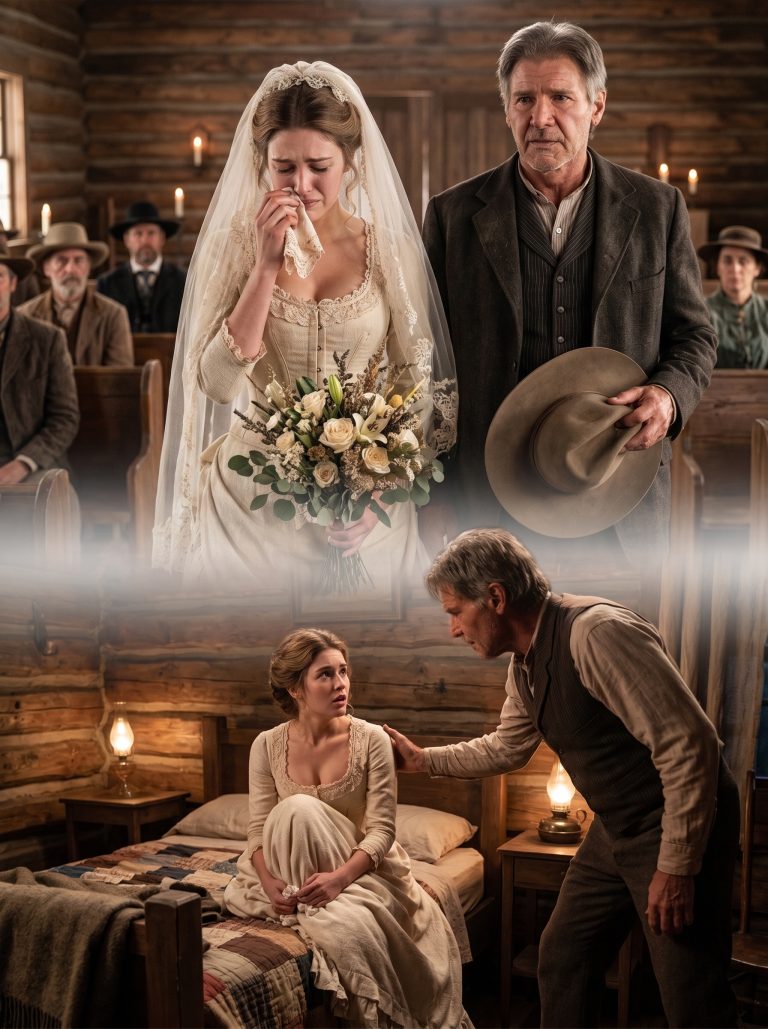
“You Keep Walking Me Home,” She Laughed—“Maybe I Like the Company,” He Replied

Part 1
By the third Wednesday, half the town had noticed that Luther Mason was walking in the wrong direction.
His house sat west of Bell’s Mill, past the equipment shed, past the barrel shop, a short, sensible walk from the office where he spent every daylight hour of his life. Flora Reed’s boarding house stood a quarter mile east. No man forgets the direction of his own door. Not once. Not three Wednesdays running.
The first time, there had been rain to blame. Not a soft rain — the kind that comes off the hills fast in late October and turns a dirt road to black water before the last wagon clears the yard. Luther had come out of the mill office with his coat already buttoned and said, flatly, that the road was poor, and he was headed that way.
He was not headed that way. Everything that belonged to his life stood west. East held nothing of his except the walk to her door.
Flora said nothing. She let him fall into step beside her, watched him steer her around the worst of the flooding without ever quite touching her elbow, and when she asked, half joking, whether the road in this town ever behaved itself, his answer came so dry she couldn’t tell if it was a joke at all.
“Only when watched.”
She decided to save the smile for later. Somewhere it would cost her less.
At the barrel shop, he stopped and looked back — not at the yard, not at the loading dock, but at the small square window of the office, where a lamp still burned. She understood something about him in that one glance: this was a man who could not stop worrying over what he’d left running, even after he’d already checked it twice.
At her door, he said good night the way a man says something he has rehearsed. She went inside and stood at the foot of the stairs a long while, listening to his footsteps recede — the wrong direction, the long way home, past a mill he had already locked up once that evening.
The next Wednesday, the sky was clear. There was no rain to excuse anything.
He came anyway.
Flora had been at Bell’s Mill only three weeks by then. She’d arrived at the tail end of harvest with one carpet bag, a soft-worn letter from Amos Bell promising her a bookkeeping position, and the last of her coach fare already spent. Amos was three weeks in the ground. Luther read the letter standing in the office doorway and told her plainly that the job had died with the man who’d offered it. Someone behind her — a farmer, low enough to pretend he hadn’t meant to be heard — said something about a woman and a pen.
She asked for until noon.
By noon she’d found what the mess on Amos’s desk had been hiding: a creditor’s claim against the mill that Amos had, in fact, already settled with his own hand, months before anyone thought to look twice. She set the proof where Luther would find it. He read it standing. He didn’t sit down until he’d said, flatly, “This was paid.”
By evening, the whole yard knew the woman in the office was staying.
What the yard didn’t yet understand was Wednesday.
The second walk came dry, unexplained, and undenied. He simply appeared at the dock with his coat on, and she didn’t ask why, and they went. When she pointed out — carefully, testing the ground — that his house sat the other direction entirely, he looked west toward it a long moment before he answered.
“I have been aware of it all week.”
“And yet here you are.”
“That,” he said, eyes still on the road, “seems to be the difficulty.”
Something moved across his mouth. Not quite a smile. Gone before it became one.
She looked away before he could see what her own face was doing.
He told her, that night, that Amos had taken him on at seventeen, too proud to say outright that he needed the work — and that Amos had never once made him say it. She understood, hearing that, exactly what kind of man she was walking beside: one who offered a thing before anyone had to ask for it, because he believed the asking should never be required of someone already ashamed enough to need it.
At her door, the cold settled between them, and neither of them moved to end it.
“You don’t have to keep walking me. I know that.”
The answer should have settled the matter. It didn’t.
“Then why do you?”
He considered it the way he considered a weight ticket he meant to get right the first time.
“Because I don’t like leaving before I know you’re in.”
She looked at the latch instead of at him.
“That is a poor reason to walk half a mile in the cold.”
“I have had worse ones.”
By Sunday, the whole congregation had a theory. Mrs. Carter cornered her on the church steps with gloved hands folded and a voice pitched for politeness, aimed like a blade.
“A man can walk a woman home every Wednesday, Miss Reed, and still leave her standing alone come winter.”
Flora had an answer ready. She did not yet have the one that mattered — the one that would only come from Luther Mason himself, on a night colder than this one, with his hat turning over and over in his hands like a man finally working up the nerve to say a true thing out loud…