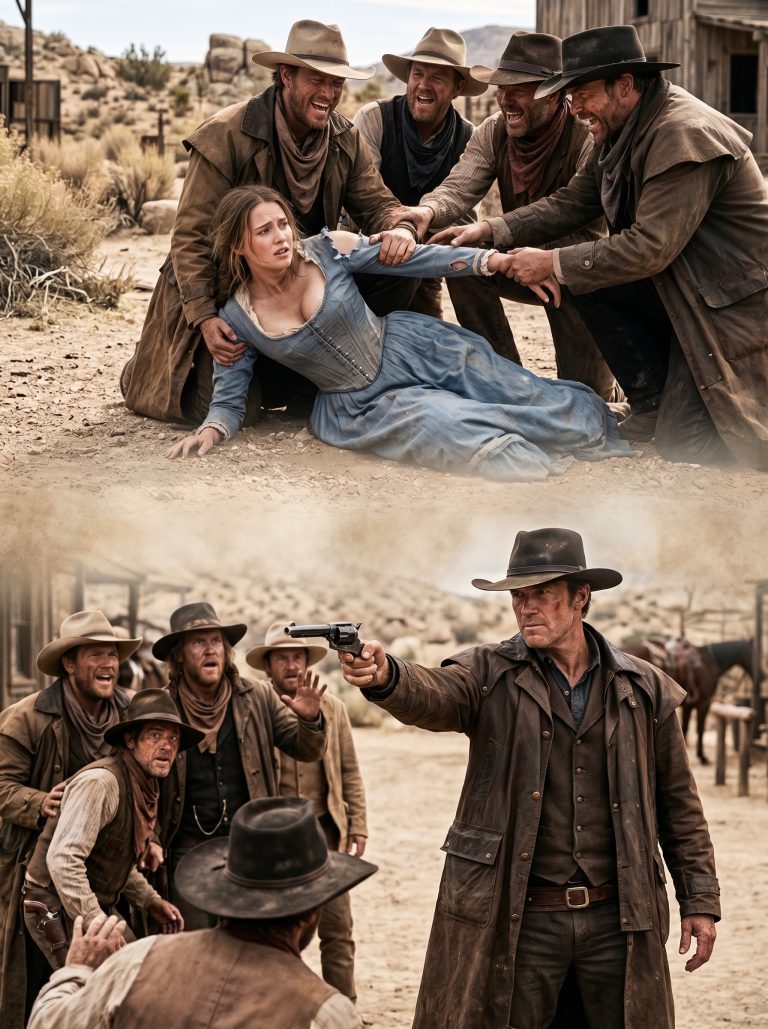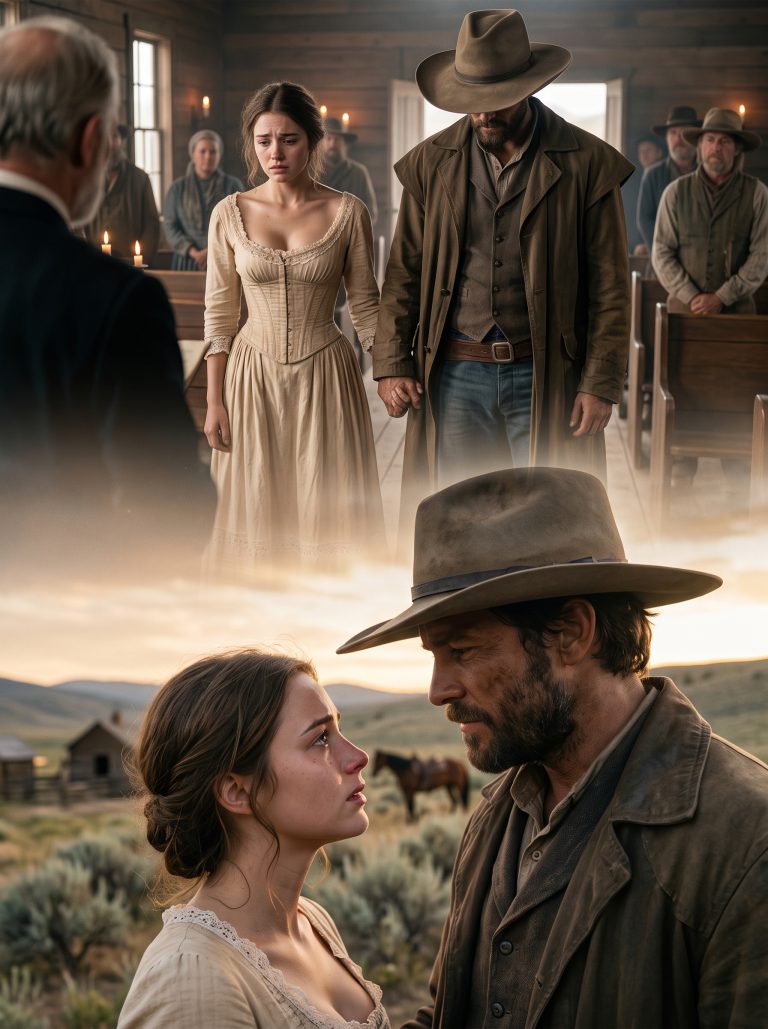
Four Wealthy Brothers Chose Mail-Order Brides — They Never Expected All Four Women to Be Sisters Looking for the Same Thing: Love

Part 1
Redemption Hollow smelled of dust, pine sap, and horse sweat — a town too small for its name and too stubborn to admit it. On the platform outside the stage office stood four brothers who had bet the last of their pride on a newspaper advertisement.
Caleb Hargrove, thirty and iron-jawed, had inherited the ranch and every debt, duty, and hard winter that came with it the day their father’s heart gave out in a hailstorm. He did not believe in luck. He believed in ledgers, fences, and getting through winter. It had been his practical idea, cold and utterly without romance, to persuade his three younger brothers to answer advertisements in the Frontier Matrimonial Gazette. A ranch needed hands that could keep a house as well as a herd.
Silas, twenty-five, had the easy grin of a man who’d never met a room he couldn’t charm. He’d picked his bride from a single phrase: quick with a retort. Wyoming, he figured, had enough silence in it already.
Thomas, quiet and bookish, had chosen a woman who wrote of pressed flowers and Emerson. He dreaded the awkwardness of meeting her and longed for it in equal measure.
Jesse, barely twenty, was the only one who let himself hope out loud. He had chosen a stranger for the simple, dangerous reason that her letters sounded kind.
“Three women,” Caleb reminded them as the dust cloud rose on the horizon. “Silas, Thomas, Jesse — each of you sent for one. I’m only here to drive the wagon.”
The coach rattled in and the driver, a leathery man named Odell, swung down and called out, “Special delivery for the Hargrove place. Four of ’em.”
The brothers looked at each other. Four.
The door opened.
The first down was barely nineteen, round-faced and wide-eyed at the whole dusty world — Lucy Bennett. Jesse’s breath caught; she looked exactly as kind as her letters had promised.
The second stepped down with a sketchbook hugged to her chest, gentle and watchful — Margaret Whitfield, twenty-four. Thomas found himself moving toward her before he’d decided to.
The third did not descend so much as arrive, chin lifted, eyes daring the town to try her — Josephine Whitfield, twenty-two. Silas’s grin widened. There was the sharp tongue he’d been hoping for.
Then the eldest appeared in the doorway and paused, surveying the four men with a steadiness that didn’t quite hide the exhaustion beneath it. Adelaide Whitfield, twenty-six.
Three of the women shared the same fine-boned Whitfield face. Lucy did not — and Adelaide, catching the brothers’ glances, spoke before anyone could ask.
“Miss Bennett has been our sister since childhood, though not by blood. Wherever we go, she goes.”
“Well, I’ll be,” Odell muttered. “All addressed to the Hargrove Ranch.”
Caleb stepped forward, hat in hand. “Ma’am, there’s some mistake. My brothers sent for three.”
“There is no mistake on our end, Mr. Hargrove,” Adelaide said. “The Gazette printed all four Hargrove names as seeking wives — yours included. When I wrote asking whether that was an error, the editor confirmed it stood, and that four women could travel under the single arrangement filed in your family’s name. We are the four who answered it.”
The wind rattled the stage-office sign. Caleb hadn’t written a single line to anyone.
“Whether the mistake was the Gazette’s or a careless clerk’s, I couldn’t say,” Adelaide went on, and something in her voice cracked just slightly before she caught it. “But it gave four of us a single chance to stay together. We took it.”
It was not four women seeking four futures. It was a family adrift, using a printer’s error as a raft.
Caleb studied the travel-worn dresses, the thin trunks, the way the four of them stood shoulder to shoulder like a wall built overnight. The ranch could barely feed four men, let alone eight souls. It was reckless. It was certain to fail.
And yet.
“Odell,” he said finally, “help us load the trunks.”
He turned back to Adelaide. “Ranch is two hours out. You’ll rest tonight. Tomorrow, we talk plainly.”
It wasn’t a promise. It was a stay of execution.
For four women who had crossed a continent on nothing but nerve, it was enough.
Part 2
The ranch house was built for four rough men, not eight people learning each other’s names. Silas upended a milk pail stepping aside for Josephine. Jesse tripped over a rug that had lain flat for a decade, simply because Lucy was standing near it.
But the women brought order faster than the brothers brought resistance. Adelaide ruled the kitchen with quiet command; the brothers ate bread and stew instead of bacon and regret. Margaret’s quilting patterns turned out to be architecture in thread — Thomas found himself lingering at her elbow each evening. Josephine’s sharp tongue met its match in Silas’s persistence, and neither one backed down, though the color rose in her cheeks at the wildflowers he kept leaving where she’d find them. Jesse and Lucy discovered they were both early risers; he started finding reasons to be at the well when she came for water, and by the second week neither of them bothered pretending it was a coincidence.
Between Caleb and Adelaide, something colder and more careful took shape.
“You can’t stay,” he told her by the hearth one night.
“Where would we go? We spent our last dollar on the fare.” Her pride didn’t waver, even as her hands, chapped and raw, betrayed the cost of the last month.
“That isn’t my burden.”
“Then let it be ours to earn. One month. If we’re still a burden, we’ll go.”
Caleb studied her — proud, exhausted, entirely too much like himself.
“One month,” he agreed, and lay awake that night listening to the unfamiliar hum of women’s voices through the wall, certain that something had already gone too far to undo.
Part 3
The month came and went, and nothing about the Whitfields — or Lucy — resembled a burden. Josephine gentled the meanest mule on the property with a look and two words. Margaret and Lucy turned a dead garden into rows of defiant green. Laughter came back to the supper table, and with it, four unspoken understandings that no one yet dared name aloud.
Then the mail pouch brought a letter addressed to Adelaide, postmarked Boston, and the fragile peace cracked down the middle.
She read it to her sisters behind a closed door, voice tight as wire.
A man from the Pinkerton Agency has been asking after your father’s affairs and your whereabouts. The name Ashford was mentioned. Burn this. — M.
Josephine went white. Margaret’s hand found the edge of the table. Lucy, who had never been told the full truth of what happened in Boston — only that her own father had died there, and that the Whitfields had never once let her feel like an afterthought because of it — watched Adelaide’s face and understood that a chapter of this family’s history was about to catch up with all of them at once.
Adelaide folded the letter. “We say nothing. Wyoming is far from Boston.”
It didn’t sound true, even to her.
A week later a well-dressed stranger began asking questions at Pruitt’s general store — a Pinkerton man, quiet and thorough, named Mr. Ives. Silas spotted him at a poker table and rode home uneasy.
That night, Adelaide found Caleb on the porch and told him what she’d been carrying since the stagecoach: that their father, Elias Whitfield, had been an inventor — honest, meticulous, and ruined. His business partner, Reginald Ashford, had stolen the patent for a steam-valve design worth a fortune, forged evidence of fraud, and let Elias Whitfield die in a Boston prison protesting his innocence. One of the few men who’d tried to speak up for him — a clerk named Bennett, Lucy’s father — had been found dead within the week, ruled a robbery gone wrong. No one in the family had ever quite believed that.
“Ashford had himself named legal guardian of my sisters not long after,” Adelaide said. “Margaret and Josephine were still minors then — fourteen and twelve. The order was never overturned; it simply became useless the moment we crossed into a territory Boston’s courts couldn’t reach. He’s counting on Wyoming’s sheriff not knowing that, and on us being too frightened to test it.”
“And the proof of what he did?”
“A private ledger. Father kept duplicate accounts of everything — payments, forged signatures, dates that didn’t match what Ashford told the court. It vanished the night Father was arrested. We’ve always assumed Ashford destroyed it.”
Caleb looked out at the dark shape of the mountains for a long moment.
“Then it isn’t an inconvenience anymore,” he said. “It’s a fight.”
Reginald Ashford did not arrive with guns. He arrived with paperwork, a rented buckboard, and a smile polished to a knife’s edge. Within a week he had quietly purchased the note on the Hargrove Ranch’s mortgage and paid off the family’s account at Pruitt’s, framing both as acts of concern. He told the town he was the girls’ guardian, rescued from opportunists who’d lured them west.
It was Margaret who found the first real thread to pull. Sorting her mother’s sewing box one night, she unfolded the memory quilt — the one their mother had stitched in the last year of her life — and noticed, along an inner seam never meant to show, a single line worked in tiny, deliberate cross-stitch: a name, Corliss, and beneath it, half-finished, keep safe.
“Father mentioned a Corliss once,” Adelaide said slowly. “His solicitor, before everything fell apart. I thought the name had died with the firm.”
They had no money to spare and no certainty the man was even alive. But Adelaide spent two precious dollars on a telegram to a Boston solicitor’s office that might no longer exist, on the thin chance that her mother’s needle had been trying to tell her something after all.
Nearly three weeks passed with no reply, and Adelaide had almost given up hope of one, by the time everything came to a head in the yard.
The confrontation came on a hard, bright afternoon, Sheriff Coburn and Mr. Ives trailing behind Ashford’s buckboard like men who already suspected which side they didn’t want to be on.
“Adelaide, my dear,” Ashford began, all Boston warmth. “Thank heaven I’ve found you.”
“We are not your dear girls,” Adelaide said.
He produced court papers. “I remain legal guardian of Margaret and Josephine Whitfield, an order never rescinded. These men have taken advantage of vulnerable wards.”
“Vulnerable wards who are twenty-two and twenty-four,” Josephine said. “That order was written for children who no longer exist, Mr. Ashford.”
“Five of us,” Jesse added, stepping beside Lucy, “since you seem to be forgetting to count Miss Bennett — though I suppose she was never useful enough to you to remember.”
Something flickered behind Ashford’s eyes at Lucy’s name, there and gone.
Caleb stepped forward. “These women are here of their own will. Every one of them is spoken for.”
Josephine shot Silas a look that promised a reckoning later — she had, after all, agreed to no such thing out loud — but she did not correct him in front of Ashford, and that, for the moment, was answer enough.
Ashford laughed and waved the mortgage deed like a winning hand. “Betrothed to ranch hands, over a legal guardianship? This is a business matter, and I hold the note on the very ground you’re standing on.”
It was Thomas — quiet, bookish Thomas — who answered. “A guardianship issued for minors in Massachusetts, years expired in fact if not on paper, doesn’t reach into Wyoming Territory over adult women who state their own free will. I’d be curious to hear the Sheriff’s opinion, since it’s his jurisdiction being tested, not yours.”
Sheriff Coburn shifted his boots and said nothing, which was answer enough. Ashford’s legal ground was thinner than he’d let himself believe, and he knew it.
That was when Mr. Ives spoke, and everything changed shape.
“Mr. Ashford,” he said, unhurried, “nearly three weeks ago my Boston office received a telegram from a solicitor named Corliss. Seems a Miss Whitfield had written to him first, out of the blue, on the strength of a name stitched into an old quilt. Corliss recognized the Whitfield name the moment he read it — he’d been keeping your late wife’s sealed instructions locked in his own safe for the better part of a decade, waiting for one of Elias Whitfield’s daughters to surface and claim them.”
Ashford went very still.
“Among them,” Ives continued, “a sealed deposition left by your late wife, Mrs. Constance Ashford, along with a duplicate business ledger she told Corliss you didn’t know she possessed. She wrote that her conscience wouldn’t let her carry the truth about Elias Whitfield to her grave, even if she couldn’t bring herself to speak it while she lived. Corliss has already forwarded certified copies to the territorial court in Cheyenne. I’m only here to tell you what’s already been done, not to ask your permission.”
“You’re lying,” Ashford said, but his voice had gone thin as paper. “My wife never — she wouldn’t have — that ledger is mine, whatever’s in it, and I’ll see it burned before —”
He lunged for the satchel at Ives’s hip, more animal instinct than plan, and Silas caught his wrist before he’d taken two steps.
“Won’t do you much good,” Ives said, not unkindly, prying the older man’s fingers loose. “What I’m carrying is a copy. The original’s already in a Cheyenne judge’s strongbox, along with sworn statements from two of Mr. Corliss’s clerks as to where it’s been sitting the last five years. You could burn every page in this territory and it wouldn’t change what’s already been filed.”
Ashford’s composure, built over nine years of other people’s ruin, came apart all at once. “The clerk,” he said, wheeling on Lucy with something ugly surfacing in his face. “Bennett’s girl. Did your father ever tell you what he saw the night before he died? Is that why you’re here — hunting me alongside them?”
“My father,” Lucy said, and her voice did not shake, “never got the chance to tell anyone anything, because someone made certain of that. I don’t need to hunt you, Mr. Ashford. It sounds like you’ve done that work yourself, for nine years, one lie at a time.”
Sheriff Coburn cleared his throat. “Reckon I misjudged this whole matter, Ashford. A man in a fine coat can blind a fellow to a great many things.” He tipped his hat to the sisters. “My apologies, ladies.”
Ashford’s hand went to the court papers still clutched in his fist, and for a moment it looked as though he might tear them apart out of pure spite, guardianship order and all. Coburn’s palm settled on the grip of his own revolver, unhurried but unmistakable. “Wouldn’t,” the sheriff said. “Whatever’s on that paper, it’s evidence now, same as everything else. Man who destroys evidence in front of a sheriff tends to make his own case worse.”
Ashford’s hand fell.
“You may have bought this ranch’s debt,” Ives said quietly, “but you never owned the one thing that could have protected you from all this. Turns out even you didn’t know your own wife.”
Something in Ashford finally cracked all the way through. “You think justice won today because you found an old woman’s ledger?” he said, low and bitter, to no one and everyone.
“No,” Caleb said.
Ashford looked at him.
“Justice won,” Caleb said, “because for the first time in nine years, nobody in this yard believes you. Not the sheriff. Not the detective you were paying. Not even the wife you buried. That’s not a ledger, Ashford. That’s just the truth catching up.”
Ashford looked once around the yard — at four brothers, four women, and a lawman no longer inclined to take his word for anything — and understood there was nothing left to purchase here. He climbed onto his buckboard without another word and rode back toward Redemption Hollow a smaller man than he’d arrived.
By winter, the certified evidence had done its work. The territorial court froze what remained of Ashford’s Wyoming holdings, including the Hargrove mortgage note, pending the outcome of proceedings back east; a portion of the restitution the Massachusetts court eventually awarded the Whitfield sisters, recovered from Ashford’s own seized assets, was used to buy the note back outright, leaving the ranch clear of his claim for good. Ashford himself was extradited to Massachusetts within the year to face charges of fraud, forgery, and conspiracy, and the newspapers that had once printed his name beside words like philanthropist printed it beside a different word entirely.
That evening, once the dust of his departure had settled, something in the house finally exhaled.
Caleb’s claim in the yard — every one of them is spoken for — hung over supper like a debt about to come due, and one by one, in their own corners of the ranch, four couples chose to pay it honestly, on their own terms.
Silas found Josephine by the corral, her usual fire banked to something quieter. “I owe you an apology,” he started. “I spoke for you today without asking.”
“You did,” she said. “I let it stand anyway. That should tell you something.”
“I’ve known plenty of beautiful, easy women,” he said. “Then I met one who looked at me like I was something stuck to her boot, and I have never in my life wanted anything more than to earn a better look than that. I’m a gambler, Josephine Whitfield. This is the first sure bet I’ve ever made — and this time, I’m asking properly.”
“That’s better,” she said, and a tear escaped despite her best efforts, before she said yes.
Thomas found Margaret spreading her mother’s memory quilt across the bed — the very one whose hidden stitching had set everything in motion. “Your mother’s needle did more for this family in one evening than most lawyers manage in a lifetime,” he said.
“She always said she was saving something for when we’d need it most,” Margaret answered. “I didn’t understand her until now.”
“I asked the Gazette for a woman who loved poetry,” Thomas said. “I didn’t understand yet that I wanted someone who was poetry — who finds the shape of something worth saving in a piece of cloth nobody else would look at twice.” He touched the quilt’s edge, where her mother’s stitches still held. “Every quilt you’ve ever made is pieced together out of scraps too small to be anything on their own. I think that’s what you do to broken things, Margaret — you don’t throw them out. You find a way to join them into something worth keeping.” She answered with her hand in his and no words at all.
In the garden, among the green shoots she and Lucy had coaxed out of hard soil, Jesse found the courage he’d been saving since that first morning at the well. “This was just dirt before you came,” he told her. “Now it’s growing. I loved you long before I knew anything about Boston, or your father, or any of it — and none of what I’ve learned since changes who you are to me.”
Her answer was laughter and tears together, and he spun her under the open sky.
Caleb found Adelaide last, at the kitchen table under a single lamp, the house gone quiet around them.
“What I told Ashford in the yard,” he said, “wasn’t a lie to save the ranch. It was true before I ever said it out loud. I didn’t send for a bride. But if I’d known to ask for one, I’d have asked for a woman with your kind of courage — the kind that doesn’t announce itself, just keeps showing up, even when the whole world’s counting on her to break.”
He took her chapped hands in his. “Will you build something here with me — not from necessity anymore, but because we choose it?”
“I came looking for a place to hide,” Adelaide said. “I found a home instead.” She said yes, and meant it the way a woman means a thing she has finally been given the safety to decide for herself.
Four weddings followed that autumn, small and unpolished and entirely real. The Hargrove Ranch became something it had never been under four lonely brothers — not merely a place that survived the winter, but one that was worth surviving it for.
Redemption Hollow told the story for years afterward, usually wrong in the details and always right in the point of it: that a printer’s mistake had brought four women west together instead of scattering them, that a dead woman’s stitched conscience had outlasted the man who never suspected he’d married one, and that the fourth young woman who arrived that day — the one who wasn’t a Whitfield at all, and never once needed to be — had belonged to the family long before any court or coach ticket said so.
Because the town had learned, watching the eight of them build a life out of a clerical error and a hard piece of prairie, that blood might start a family.
But it’s loyalty, chosen and kept even when no one is checking, that finishes one.
— The End —