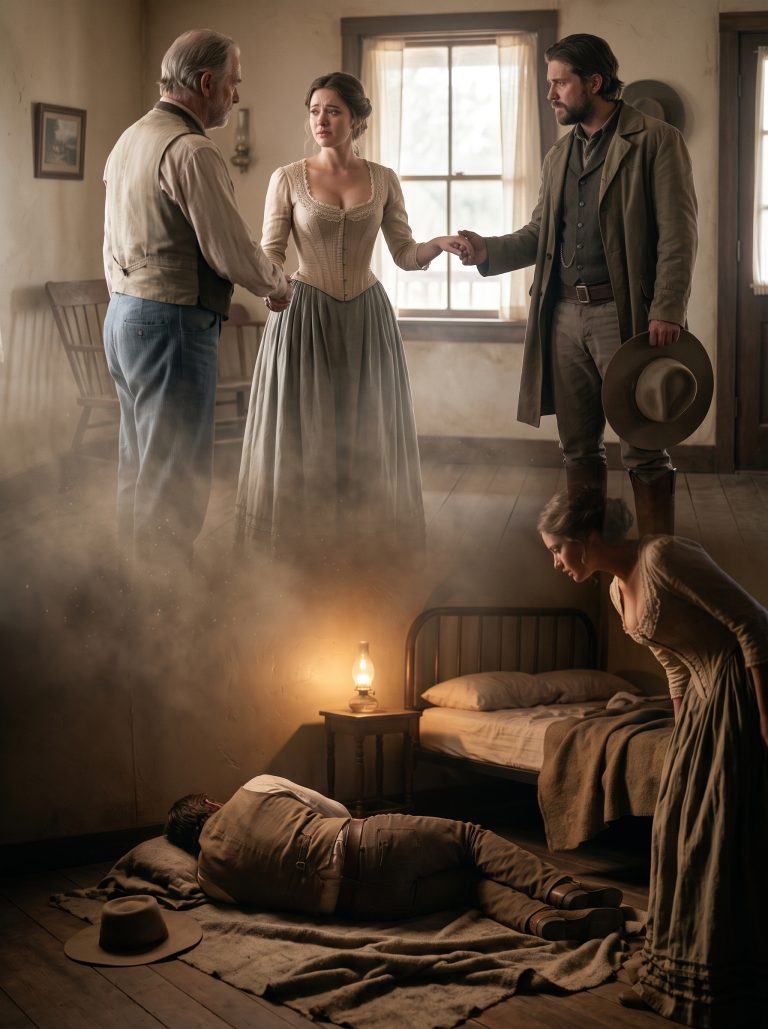
“You’re Going to Sleep With Us” — Said the 3 Giant Women Already Living on the Farm He Bought

Part 3
The trunk had belonged to his father. Silas read the letter that night by lamplight, while Marta held a second lamp steady over his shoulder because her hands, unlike his, weren’t shaking.
His father had surveyed the Thornwood valley forty-one years ago — the same council, the same “abandonment,” the same convenient absence of the families who actually lived there. He hadn’t filed the true survey. He’d taken Garrick’s father’s money to file a false one instead, and spent the rest of his life, according to the letter, ashamed of it in a way he’d never once said aloud to his son.
If you ever end up near that valley, the letter read, find whoever’s left of the people I helped erase, and give them back what the paper took. I never had the courage to undo it myself, so I did the smaller, cowardly thing instead — I kept the name of a territorial attorney, Cora Vell, out of Fort Adams, who wrote to me twice a year for thirty years asking if I was finally ready to tell the truth. I always told her not yet. If you’re reading this, tell her yes for me. She’s owed this family a debt of her own conscience for not pressing harder, and I think she’s been waiting as long as I have for someone to finally collect on it.
Silas set the letter down and didn’t trust his voice for a moment.
“Your father surveyed this land,” Marta said slowly, putting the pieces together before he said them.
“He falsified it,” Silas said. “For Garrick’s father. That’s how the claim got made in the first place.” He looked up at her, and at Odessa and Bridget standing in the doorway. “I didn’t ride into this valley as a stranger who happened to buy contested land. I rode in as the son of the man who helped steal it — and apparently as the heir to whatever money that theft was worth.”
“You could burn that letter,” Bridget said quietly, “and no one here would ever know.”
“I know,” Silas said. “That’s exactly why I’m not going to. I’m riding to Fort Adams in the morning to find this Cora Vell, if she’s still alive to find.”
“That’s four days there and back,” Odessa said. “Garrick won’t wait four days once he hears you’ve left.”
“Then someone will have to make him think I haven’t,” Silas said, and looked at Bridget, who understood him a half second before he finished the thought and didn’t look pleased about it.
Bridget rode Silas’s horse into town twice that week in his coat, close enough to be seen from the ridge and never close enough to be spoken to — a small, deliberate deception that bought three extra days and cost her, she told him afterward, more patience than she’d had to spare. It was the first real thing he’d asked of her, and the first time she’d trusted him with something that could get her hurt if it went wrong. “I didn’t do it for you,” she said flatly, when he thanked her. “I did it because Odessa asked me to, and because I wanted to see if you were worth the risk before I decided anything else about you.” It wasn’t warmth. It was the beginning of something that might one day become warmth, and both of them knew enough to leave it there.
Cora Vell was alive, sharp-eyed and unsurprised, as if she’d been expecting this exact letter for thirty years and had simply misplaced the date. She agreed to ride back with him — not as a rescue conjured from nowhere, but as the last payment on a debt she’d been carrying nearly as long as his father had.
They returned to find the ridge crawling with more riders than two. Garrick himself came down into the valley this time, older than Silas expected, tired in a way that looked less like conscience and more like a bookkeeper irritated by an unbalanced ledger.
“Elias’s debts transfer to the land,” Garrick said, without dismounting. “The land transfers to me. No need to make it complicated, Mr. Corbin.”
“It’s already complicated,” Silas said. “I have my father’s original field notes, in his own hand, naming the families this land actually belonged to before either of our fathers touched it. And I have Cora Vell, who’s carried a copy of his confession in her files for three decades waiting for someone to finally use it.”
Something flickered across Garrick’s face — not fear exactly, but the particular unease of a man watching an old debt he thought was buried start climbing back out of the ground. Then it passed, and something colder replaced it.
“Confession,” Garrick said. “Is that what he called it. My father’s books have called it something else for eleven years, Mr. Corbin — I’ve had the entry memorized since I was a young man and my father first showed it to me as a lesson in what a useful lie is worth. Not a surveyor’s fee. A partner’s share. Half the land’s assessed value, paid quietly, every year, for eleven years, so he could build the very stake you’ve been living off since he died. I’ve known your father’s name longer than you’ve known mine. You didn’t just inherit his shame. You inherited his half of what he stole.”
The valley went very still. Silas felt the ground shift under him a second time, worse than the first — because Cora Vell didn’t argue with it. Her silence was its own confirmation, and everyone standing on that porch understood it.
“Is that true?” Marta asked him, and for the first time since he’d arrived, her voice had nothing gentle in it at all.
“I don’t know,” Silas said, and hated how thin it sounded. “I never opened the letter until three nights ago. I’ve been spending that money for six years without asking where it came from, and the letter still doesn’t say — it only told me who to find. Everything past that is Garrick’s word, not mine.”
“Convenient,” Bridget said.
“Maybe,” Silas said. “Or maybe it’s exactly as ugly as it sounds, and I’ve been spending stolen money on stolen land for six years without asking a single hard question about either. I don’t get to decide which version is true just because I’d prefer one of them.”
Garrick, satisfied, turned his men around without another word — he’d said what he’d ridden down to say, and left the wreckage of it behind him on purpose.
Nothing resolved that week, or the one after. Cora Vell filed a countersuit with the circuit court, but the court moved the way courts move when the truth is inconvenient for men with money — slowly, and not at all in a straight line. And inside the farmhouse, something had cracked that no filing could repair on its own.
Marta stopped holding the second lamp for him. “You get to be generous with money you’re not even sure is clean,” she told him one evening, standing over the irrigation channels she’d dug with her own hands long before he’d ever seen this valley, “because your father’s shame came with a fortune attached to it, however he got it. Mine came with nothing but a story nobody with power ever had to listen to.” Silas didn’t argue with her. He spent the following months learning the old boundary lines the way she’d learned them — from her grandmother’s memory, walked out at dusk, marker by marker — not to earn forgiveness, but because it was the only honest work available to him while the larger question sat unanswered.
Bridget’s rifle came back out of the closet the week Garrick’s accusation landed, and stayed out longer than it had the first time. “I let my guard down once already,” she told him, “on the strength of a letter and a good story. I’m not doing it twice on the strength of a worse one.” What she respected, eventually, wasn’t an apology but the slower proof of it — the evenings Silas spent going through his father’s actual accounts with Cora Vell’s clerk, admitting out loud, in front of witnesses, exactly how much money was in question and where every dollar of it had gone since. It didn’t clear him. It just made the uncertainty an honest one instead of a comfortable one, and that was the only currency Bridget was willing to trade in.
Odessa carried the household through that stretch the way she’d carried it since the day Silas arrived, and it cost her more than she let anyone see until the night the accounts finally balanced — badly, ambiguously, half in his father’s favor and half not — and the court still hadn’t ruled. “I used to think being strong meant not needing anyone to notice how tired I was,” she said, not to Silas but to the dark beyond the porch rail. “I don’t know yet if trusting you was strength or just exhaustion wearing its clothes. Ask me again once the ruling comes.” He didn’t have an answer for that, and didn’t pretend to.
Two winters passed before the circuit court finally ruled, and even then it ruled in pieces: the original council seizure was found unlawful, the land’s true history entered into the territorial record at last — Marta’s grandmother’s name restored to a document for the first time in forty years. But the question of the money, the exact reckoning of what Silas’s father had taken and whether Silas owed any of it back beyond what he’d already spent rebuilding the farm, was referred to a second hearing that hadn’t been scheduled yet.
Garrick did not simply retreat and wait politely. Six weeks after the ruling, half the winter feed stores burned in the night — no riders seen, no note left, nothing provable in front of a judge, only the particular silence that follows a message meant to be understood rather than read.
They rebuilt through the coldest stretch of that year, hauling timber by lantern because the cattle couldn’t wait for spring. It was ugly, wary work at first. Bridget slept with the rifle against the wall nearest the door for the rest of that winter and didn’t apologize for it. Marta went whole days speaking to Silas only about boundary posts and feed rationing, nothing else, as if the burned stores had confirmed some private accounting she’d been keeping all along about how little she should expect from him. Odessa held the four of them together the way she always had, but there were nights she sat alone on the porch long after the others had gone in, and Silas learned not to follow her out there uninvited. Nobody spoke of anything softer than the next day’s labor for months. The fire had cost them more than feed, and none of them pretended a season of hard work alone would buy it back.
It was closer to a year before the wariness loosened at all, and even then it loosened slowly, one small trust at a time — Marta letting him walk a boundary line without her checking his work afterward; Bridget leaving the rifle by the door instead of within reach; Odessa staying out on the porch one night long enough to let him sit beside her without asking why. A spring came, eventually, before Bridget, unplanned, kissed him while they were mending fence posts, and neither of them mentioned it again for a week, less out of shyness than respect for how much was still genuinely unresolved between them. A second spring after that, Marta closed a different distance, choosing her moment the way she chose where to cut an irrigation channel — not impulsively, but exactly when the ground was ready for it, and not one day sooner.
Odessa never fully answered her own question from that winter porch. When Silas finally asked her, two years in, whether she’d decided if trusting him had been strength or exhaustion, she considered it a long time before answering. “Both, probably,” she said. “I don’t think I get to know which one wins until we’re a lot older than this. Ask me again in ten years.”
Three years after Silas Corbin first rode down into that valley, the second hearing was finally scheduled — eight months out, on a docket backed up with cases older and angrier than theirs. The four of them sat on the farmhouse porch the evening the notice arrived, watching cattle graze on ground whose full ownership, and whose true cost, were both still, technically, open questions.
“Any regrets?” Odessa asked.
Silas thought of his father’s letter, and the harder letter underneath it that Garrick had forced into the open. He thought of the strongbox money, half of it spent honestly and half of it still shadowed by a question no court had answered. He thought of Garrick, still out there, still patient, still waiting for the next hearing the way he’d waited for the last one.
“One,” he said. “That I don’t actually know, even now, how much of what I’ve given you was mine to give. I’ve made my peace with not knowing. I’m not sure any of you should have to.”
“That’s not a regret,” Marta said, without looking up from the fence rail she was mending by feel. “That’s just what it costs to fix something broken before either of us was born. A regret would be wishing you’d never opened that letter, or never told us the second half of it once Garrick made you.”
“No,” Silas admitted. “I don’t wish that.”
“Then you don’t have a regret,” Bridget said. “You’ve got an account that isn’t closed yet. Different thing entirely.”
Below them, the valley kept its long, unresolved quiet — the second hearing still eight months off, Garrick still patient on his ridge, the exact size of an old debt still uncounted. It was not an ending, and none of them pretended otherwise. It was, instead, the only honest place to stop for the night: not a debt paid in full, but a debt finally priced correctly, four people still adding up the sum together instead of one family quietly burying it for another forty years.
The End
A story about the difference between owning something and deserving it — and about how the truth, once spoken, doesn’t resolve a debt so much as reveal how much of it is still unpaid.