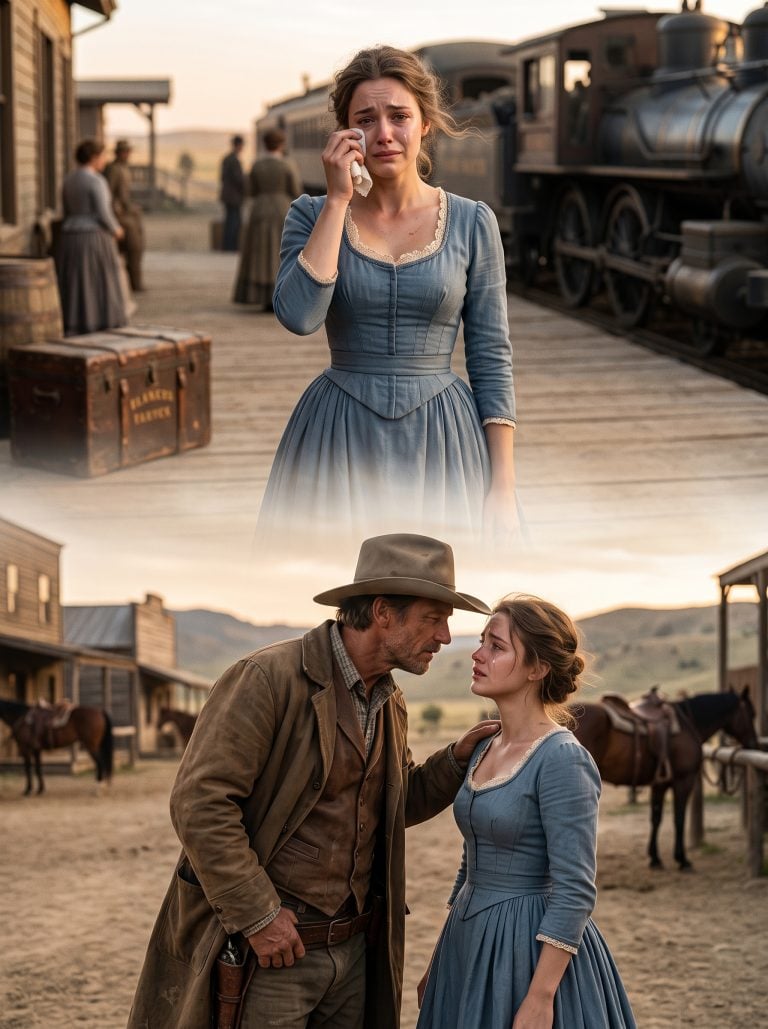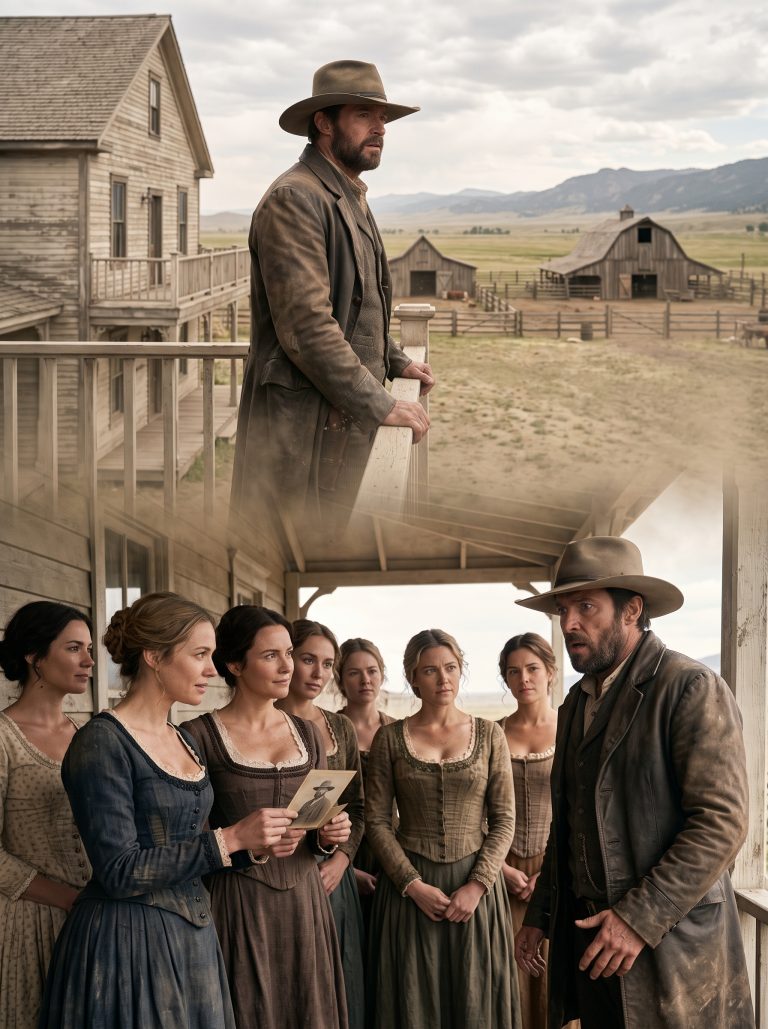
He Was Forced to Marry a Woman 30 Years Older — No One Expected What Happened Next

Part 1
The wedding suit didn’t fit. Silas Rourke stood in the back room of the Stone Creek chapel, tugging at a collar two sizes too small, and thought that if a man’s whole life could be summed up in one ill-fitting garment, this was surely his.
He was twenty-three. In an hour he would marry a woman he had met exactly once, for eleven minutes, on the porch of the county land office. Her name was Eliza Marsh. She was, by every account in town, a widow nearly twenty years his senior, quiet, unremarkable, and — according to the man who had arranged this whole affair — the only thing standing between the Rourke family and total ruin.
That man was Warrick Doyle, and he owned half the paper in the territory.
Silas’s father had borrowed against the ranch three winters running, chasing a silver claim that turned out to be nothing but rock and rumor. When the old man died of a bad heart last spring, the debt didn’t die with him. Doyle held the note, and Doyle had made Silas an offer instead of a foreclosure: marry the widow Marsh, and the debt would vanish, absorbed — Doyle said — into “an arrangement with mutual benefits for all parties.” Refuse, and the Rourke land would belong to the bank by Friday.
Silas hadn’t asked what Doyle’s benefit was. He suspected he didn’t want to know.
The chapel door creaked. He turned, expecting the preacher, and found instead the bride.
She was not what the town gossips had described. Her hair, threaded through with early silver at the temples, was pinned back with a precision that suggested discipline rather than age. Her eyes were a pale, watchful gray, the kind that seemed to be doing arithmetic on everything they landed on. She wore black, plainly cut but well-tailored, and she walked like a woman used to entering rooms where she was not entirely welcome.
She stopped an arm’s length away and studied him the way a buyer studies a horse.
“You look like a man walking to his own hanging,” she said.
“Might as well be.” He tried for a smile and failed. “No offense meant, ma’am.”
“None taken. I imagine I don’t look much like a prize either.” A faint, humorless curve touched her mouth. “Mr. Doyle has a talent for making people feel like livestock. It’s one of his more consistent qualities.”
That surprised a real laugh out of him — short, startled. She studied him again, and something in her expression eased, just slightly.
“I have rules, Mr. Rourke, if we’re to survive this arrangement with any dignity.”
“I’m listening.”
“First: you will not ask why a woman of my years is marrying a man of yours. Second: my room is my own, and it will stay locked. This is a contract, not a courtship.” She paused. “Third, and this one matters most — you will not go digging into my past. Whatever you hear in town, whatever names get spoken, you will let them lie.”
Silas thought of his father’s grave, of the note in Doyle’s safe, of the ranch that had raised four generations of Rourkes.
“I’ve got no interest in your ghosts, ma’am,” he said. “I’ve got enough of my own.”
It was, he would later understand, the first lie either of them told that day — and the only one that mattered.
The ceremony took six minutes. Doyle sat in the front pew like a man watching a business deal close, which, Silas supposed, was exactly what he was doing. When the preacher pronounced them married, Eliza’s kiss landed dry and quick on his cheek, and he caught, beneath the smell of lye soap, something sharper — gun oil, faint but unmistakable, the kind that clings to a person who cleans a weapon often and well.
He filed that away without knowing why it mattered.
Doyle shook his hand afterward with a grip like a closing trap. “The note’s torn up, Mr. Rourke. Your father’s debt, gone. I trust you’ll be a dutiful husband.” His eyes slid to Eliza, and something passed behind them — not warmth, not even triumph, but a kind of patient calculation, the look of a man checking a lock he’d spent months building.
“You’ve done well for yourself today,” Doyle told her, and left before she could answer.
Eliza watched him go with an expression Silas couldn’t read. Then she turned, all business again. “My place is four miles out. You’ll want your things.”
“Don’t have much to want.”
“Then you’ll want for nothing,” she said, and for the first time, it sounded almost like a kindness.
The wagon ride out of town was quiet. Silas noticed the rifle stowed beneath the bench, the way she checked the road behind them twice without seeming to, the calluses on her hands that no piano-playing lady of leisure should have. He noticed, too, that she stopped the wagon outside the post office on their way through town, unprompted, and came back with nothing in her hands but the satisfaction of a letter successfully sent — a small habit, he’d learn later, that she repeated like clockwork every week without fail. Every detail was a small contradiction, and together they built a picture of a woman who did not match the story the town told about her.
Her house, when they reached it, deepened the mystery. Books lined one wall, real leather-bound volumes, not the cheap dime novels most settlers owned. A rifle rack held three weapons, each oiled and ready. And on a shelf by the window sat a single framed photograph, turned face-down, as though she couldn’t decide whether to look at it or hide it.
“Your room’s upstairs,” she said, lighting a lamp. “Ask me no questions tonight, Mr. Rourke, and I’ll ask you none. Tomorrow we can discuss what kind of marriage this is going to be.”
Silas climbed the stairs, sat on the edge of an unfamiliar bed, and thought: whatever kind of marriage this is, it started with two people already lying to each other.
He didn’t yet know how close to true that was — or how much it would cost them both before the truth came out.