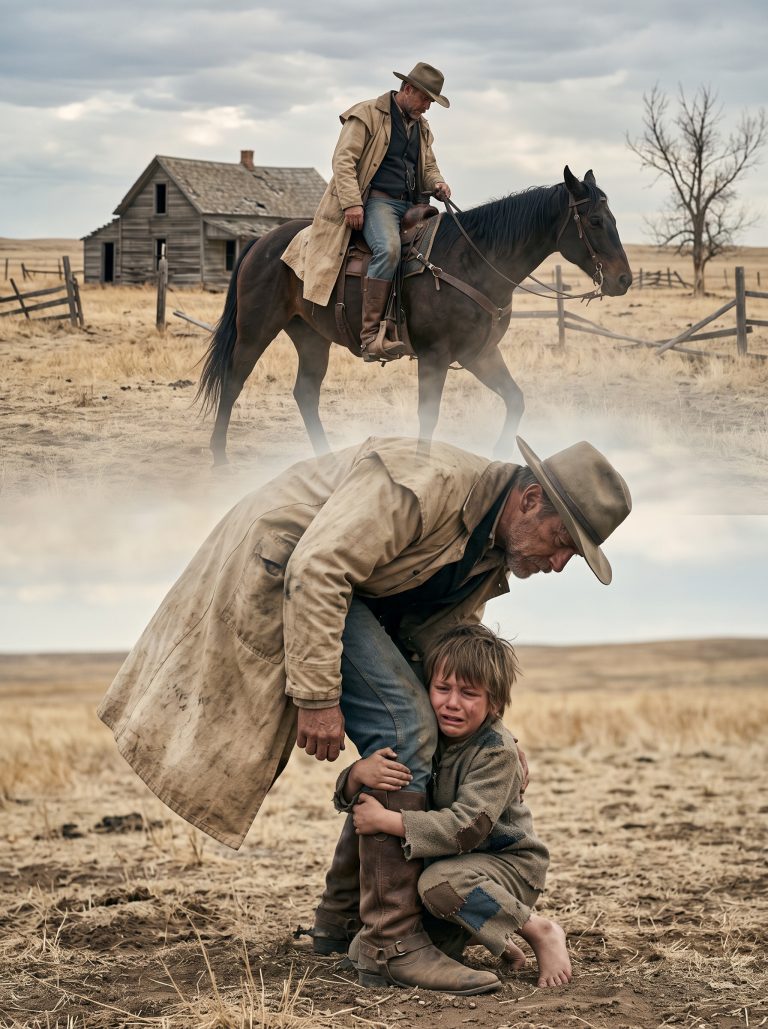
A Broken Child Crawled Onto His Porch Begging for Help — The Widow Beside Her Changed His Life Forever

PART 1
The child reached Gideon Holt’s porch sometime after midnight, leaving small, bloody handprints on the boards his dead wife had once scrubbed every Saturday morning.
She was not more than nine.
Her dress torn, feet bare and cut from stone and thorn, one side of her face struck badly enough that her eye had nearly closed. She lay collapsed near his boots, pressing the porch board as if the house might slide away.
She lifted her uninjured eye.
“Don’t let him find me.”
Gideon lowered the rifle.
Something he had believed buried eight years ago — buried with Clara and with four-year-old James beside her — rose so suddenly it nearly stopped him.
He crouched several feet from her.
“I will not let anyone take you from this porch tonight,” he said. “I will tell you before I touch you. Every time. You have my word.”
She looked at him the way a child looks at a man’s word when she has learned never to trust one.
Then she nodded.
He carried her inside and laid her on the cot near the stove. He seated himself on the floor, not the chair, so she would not have to look upward. Speaking before each movement, he cleaned gravel from her knee, her elbow, the cut along her chin.
When the cloth came near her collar, she recoiled with a cry too frightened for pain alone.
He withdrew at once. “I am sorry.”
She pressed both hands against her throat.
“What is beneath your collar?” he asked quietly.
She looked at the door. “He said if I told, he would put the next one on my face.”
His hand tightened on the cloth.
“May I look without touching?”
She turned her head by the smallest degree.
A round burn. Healing. Deliberate. Ugly.
He set the cloth down because his hands had begun shaking. He crossed to the wall, pressed his palm flat against it, and breathed through an anger fierce enough to frighten the very child he meant to protect.
When he turned back, his face was steady.
“What is your name?”
“Nora Caldwell.”
The name struck him flat.
Wade Caldwell owned the largest spread south of the river, supplied seed credit to half the county, donated stained glass to the church, and sat beside the judge at public suppers. Men who crossed him found mortgages called early and grazing agreements withdrawn.
“Your father was Thomas?”
“Yes.” Her lip trembled. “He drowned this spring.”
“I heard.”
“He did not drown.” She pressed the blanket to her mouth, then: “My uncle killed him. He wanted Daddy’s land. Daddy found oil sign under the old hay barn and refused to sell before I was grown. My uncle said he slipped in the river. But Daddy hid papers first. He told me where.”
“Where have you been since?”
“At Uncle Wade’s.”
“And the burn?”
She nodded once.
He had to look away briefly.
When he looked back: “You are not returning to Wade Caldwell tonight, tomorrow, or any day until a lawful man who cannot be purchased has heard every word you wish to say.”
“He owns the sheriff.”
“He believes so.”
“He owns everybody.”
“Not everybody.”
She studied him.
“You believe me?”
“Yes.”
“All of it?”
“All of it.”
A tear slipped from her good eye.
He took his son’s old shirt from the cedar chest — soft flannel, kept folded eight years because some losses were too complete to reduce to rags — and set it beside her.
“This belonged to my boy. You may wear it if you like. I will wait on the porch.”
He stepped outside.
The heat had not eased, but the night felt changed. For eight years he had sat on this porch and seen only chores arranged between waking and sleep. Tonight the dark beyond his fence contained something moving toward a frightened child under his roof.
The hoofbeats arrived twenty minutes later.
A rider halted beyond the gate.
“Gideon Holt?” the man called. “My name is Prescott. Work for Mr. Wade Caldwell. His niece has gone wandering. Poor girl not been right since her daddy died.”
“Sad circumstance.”
“You seen a girl pass?”
“No.”
The rider’s eyes moved toward the lamp glowing behind the curtain. “Fair amount of light for one man alone.”
“I read.”
“Mr. Caldwell would pay fifty dollars for information. And some advice: you bring her to the Caldwell place. You do not take her into town. You do not speak with the sheriff.”
Gideon’s hands stayed still on the rifle. “That a request?”
“Advice.”
“I have little fondness for advice offered after midnight by men who won’t dismount.”
The man’s expression flattened. “Mr. Caldwell does not forgive obstruction.”
“Then he and I may dislike each other.”
The rider touched his hat. “Morning may clarify matters for you.”
“I usually find it does.”
When the hoofbeats vanished, Gideon stepped inside.
The cot stood empty.
Nora had wedged herself behind the wood box near the kitchen wall, both hands over her mouth, swallowed nearly whole by James’s old shirt.
“He is gone,” Gideon said.
“He will come back. With my uncle.”
“Yes.”
Her breath hitched.
He held out his hand. “I have been failing to stop things for a long while. I believe I am finished with the habit.”
She crawled out slowly and let him settle her on the cot again.
He gave her bread in broth. She ate in careful little bites. Before dawn she slept, curled beneath the blanket, while Gideon sat with the rifle across his knees and thought, for the first time in years, about what the next morning required.
PART 2
Morning brought Wade Caldwell himself.
Polished wagon, three riders, black coat, practiced smile.
“You have my niece,” Wade said.
“Your niece is not livestock to be claimed at a gate.”
“She wandered in hysteria. Return her.”
“No.”
“Do you know who I am?”
“Yes. And she came bleeding to my porch and asked not to be found.”
Rage entered Wade’s eyes. “She lies.”
“You’ll have opportunity to say so before men not drawing wages from you.”
One rider put his hand near his pistol. Gideon raised the Winchester just enough for sunlight to catch the barrel.
Wade raised a gloved hand. “I will return with proper authority.”
“Bring proper authority. Don’t bring bought men wearing badges.”
He climbed into the wagon.
As it rolled out, Nora appeared silently behind Gideon.
“My daddy’s papers are under the old hay barn,” she said. “Rear stall. Floor board with a cross-shaped knot.”
“We need those papers. And we need another person.”
Nora’s face became intent. “Mrs. Grace Delaney. Her husband died at Uncle Wade’s last fall. She said once it was not so.”
Gideon reached for his hat.
“Door barred. Do not answer any voice but mine.”
“You will come back?”
“My word holds.”
The dry goods store went quiet when Gideon entered. The storekeeper told him he was out of cartridges, with the cartridges plainly visible on the shelf behind him.
The bell rang. A woman in black entered and read the room in one look.
“Mr. Holt.”
“Mrs. Delaney.”
She placed the basket on the counter. “Two boxes of cartridges and oats on my account, Able. Should Mr. Caldwell inquire, you may tell him Grace Delaney bought provisions for her own use. I would be interested to hear him explain why a widow is forbidden ammunition in a county where her husband died without justice.”
One stranger stepped toward her. Gideon stepped between them without drawing.
She looked past his shoulder. “You were about to say something?”
The man changed his mind.
Outside: “You have Nora Caldwell?”
“I have her. Badly hurt.”
“My husband died at Caldwell’s last fall. They said a horse. I knew better. I said nothing because every time I tried, someone explained why silence was safer.”
“Nora says her uncle killed her father.”
Grace’s hand tightened. “Then I am coming.”
“This may be dangerous.”
“My husband has been in the ground ten months because everyone chose safety. I am finished with that.”
“I have no right to ask—”
“You did not ask.”
Challenge and relief in one answer.
That night, Gideon opened Clara’s old sewing room — eight years untouched — placed fresh water and a lamp inside, and gave Nora the key.
“The door locks from inside. The key is yours.”
Nora’s fingers closed around it.
When the door shut, Gideon stood alone in the kitchen with bread on his table he had not made and Grace’s rifle leaning beside his near the door.
The hay barn waited. So did whatever came after.
PART 3
They rode beneath a thin moon with Nora between them, Gideon’s gentlest mare carrying the girl steady while Grace rode her late husband’s dark sorrel with a rifle across her lap, her black skirt divided for travel.
Near the Caldwell hay field, a lantern moved inside the old barn.
“They are already searching,” Grace whispered.
Nora’s face tightened. “He does not know the board.”
“Then we enter before he learns it,” Gideon said.
He crouched beside Nora. “You stay behind me until we reach the stall. You point to the board. I lift it and take the box. At the first sound of trouble, you run directly to Grace.”
“I can do it.”
“I know you can.”
He placed one hand before her, waiting.
After a moment, she took it.
They moved low through the hot hay field. Gideon eased aside a loose board at the rear of the barn large enough for Nora to slip through before him. A man muttered at the front stalls, lantern light shifting along rafters.
Nora pointed.
A floor board in the rear corner bore a cross-shaped knot.
Gideon worked his knife beneath it slowly, praying the old timber would not complain.
The board lifted.
Beneath it lay a wax-sealed tin box.
Nora gave a sound too small for the searching man to hear.
“It’s here,” she breathed.
Gideon put the box in her arms.
Then the lantern stopped moving.
“Well now,” a voice called. “Who’s in Mr. Caldwell’s barn?”
Gideon seized Nora’s hand. “Out.”
They slipped through the loosened board as the lantern came fast behind.
A shout split the night.
Grace rose from the hay field like a shadow, rifle already raised.
“Run!” she said.
Nora ran toward the mare clutching the tin box. Gideon caught her around the waist and lifted her into the saddle.
“Hold tight. Ride west toward the wash.”
“Not without you.”
“Nora—”
“Your word holds.”
His heart struck once, hard.
“So does yours. Ride.”
Grace fired one warning shot above an approaching rider, wheeled her sorrel, and reached Nora’s side before the child had taken three strides. Gideon mounted as men burst from the barn and horses thundered from the far side of the field.
They rode hard through open scrub.
The dry wash appeared as a pale scar beneath moonlight.
“Take Nora across!” Gideon shouted.
Grace looked over her shoulder. “You come behind us.”
“I will.”
“You promised the child.”
“I remember.”
Grace guided the mare down the bank with Nora low over the neck. Gideon turned at the rim and fired into the dirt before the leading pursuit horse. The animal reared, breaking the line behind it long enough for him to plunge after them through the wash.
Wade Caldwell’s voice cut across the dark.
“Holt!”
Gideon turned his horse sideways on the far rise.
“Caldwell.”
“Give me the girl and what she stole. I let you leave this county breathing.”
“Your brother left something in a box beneath a floor board.”
Silence.
Even the riders stilled.
“You have no notion what you possess,” Wade said.
“I expect we will learn.”
“I can give you five hundred acres beside your west line. More cattle than you could manage alone. Return my niece and the box.”
Grace had stopped ahead. Nora sat rigid upon the mare, the box held tight.
“You don’t know much about me, Caldwell,” Gideon said.
“I know a lonely rancher when I see one.”
“Then learn this. I may be poor and I have surely been lonely. But I am not cheap.”
Wade drew his pistol.
Grace’s rifle fired first, striking dirt beside his horse’s front hooves. The animal lurched sideways.
“That was a warning,” she called. “The next is less charitable.”
For the first time, Gideon heard her anger given full voice. Not wild. Exact. Restrained through ten months of unanswered death.
“Mrs. Delaney,” Wade said, recognition entering his tone. “Your husband’s accident has damaged your judgment.”
“My husband’s murder has sharpened it.”
They rode west through scrub and stony ground until pursuit sounds fell behind. Near a cedar rise, Gideon let the horses slow.
Nora was trembling badly enough that the tin box rattled against the saddle horn.
“Open it,” she said.
“Not until we reach—”
“Please.”
Grace guided her horse near the child. “Perhaps she needs to know her father did not die for an empty box.”
Gideon dismounted and broke the wax seal.
Inside lay deeds, account pages, a survey map, and a letter in Thomas Caldwell’s hand:
To whoever finds this after I am gone: protect my daughter first. Then carry these papers to Marshal Roy Givens in the capital. My brother Wade killed my wife for our land and will kill me next if I do not give him Nora’s inheritance.
Nora read only the first lines before she stopped.
“He killed Mama too,” she whispered.
Grace knelt in the dust beside her.
Nora crossed the distance herself.
Then Grace held her.
Gideon stood over them beneath the moonlight with the dead man’s letter in one hand and his rifle in the other. The world had offered this child no safe adult until she had been brave enough to find two.
“We ride for the capital,” he said.
“No.” Nora’s voice came from Grace’s shoulder, muffled but steady. “Not first.”
“Nora—”
She pulled back, wiping her face on the sleeve of James’s old shirt.
“He owns what people say. He owns what they whisper. If I disappear with papers, he will tell everyone you stole me and made me lie.” Her voice trembled, but her reasoning did not. “I want them to hear me. In town. Where he cannot make them forget they saw me.”
Grace went still.
Gideon looked at the small girl before him — bruised and frightened and steadier than half the men who had obeyed Wade Caldwell for years.
“He may try to stop you,” he said.
“He already tried.”
Grace opened her eyes. She rose.
“Then she does not stand there alone.”
“No,” Gideon said. “She does not.”
They reached Clover Ridge as dawn whitened the east.
The town square was already crowded.
Wade had beaten them by a faster road. He stood on the courthouse steps beside Sheriff Burke, four armed men behind him and respectable citizens gathered below, called from their breakfasts by rumors of kidnapping.
Gideon stopped his horse at the edge of the square.
Grace rode beside him with the rifle across her lap.
Nora sat between them, the tin box against her chest.
Sheriff Burke lifted a hand. “Gideon Holt, surrender that child.”
Gideon’s voice carried across the still street.
“She came to my porch injured and asking protection. I will surrender her to lawful care when she asks it herself and when the evidence she carries has been heard.”
Wade stepped forward.
“Neighbors, look what grief and isolation have made of this man. He has taken a distressed child and filled her head with accusations. Beside him is a widow whose sorrow has made her susceptible to the same delusion.”
Grace’s hands tightened on the rifle.
Gideon spoke before she could.
“Grace Delaney knows her own mind better than you know truth.”
She looked at him sharply.
It was the first time he had used her given name.
Even in that crowded, dangerous square, the sound of it passed between them.
Then Nora slid from the saddle.
She set her bare feet on the street and walked forward carrying the tin box.
Every man and woman in Clover Ridge watched her come.
She stopped before the courthouse steps.
“My name is Nora Caldwell,” she said.
Her voice was not loud. The silence made it carry.
“My father was Thomas Caldwell. My mother was Ruth Caldwell. They are both dead. My uncle Wade killed them because my father would not give him papers for our land.”
Wade shook his head with practiced sadness.
“You see? A child’s confused grief—”
Nora opened the tin box and drew out the letter.
“This is my father’s writing. Mr. Able has seen it. Mr. Pruett at the feed store has seen it. Sheriff Burke has seen my daddy sign tax papers.” She held the page toward the crowd. “It says that if my daddy died, Wade did it. It says he killed my mama first.”
A murmur moved through the square.
Wade’s face lost color.
“Give me that, child.”
“No.”
“Nora—”
“No.”
She placed the letter on the box, then pulled aside the collar of James’s old shirt enough for the healing burn at her neck to show in the morning light.
A woman near the mercantile cried aloud.
“My uncle did this when I tried to tell someone he killed my daddy,” Nora said. “He told me next time it would be my face.”
The preacher’s wife stepped into the street with both hands over her mouth.
“Nora,” she choked. “You came to me.”
“Yes, ma’am.”
“I sent you back.”
“Yes, ma’am.”
The woman sank to her knees. “I am sorry.”
Those words broke something open in the town.
An old farmer came forward and spoke of a son beaten on Caldwell land and paid to stay silent. Another man named a cousin who had disappeared. A woman called from the boardwalk that her brother had signed acreage under threat of jail.
At last an elderly former deputy approached Sheriff Burke with a yellowed sheet.
“I recorded a statement nine years ago from a kitchen servant who saw Wade Caldwell standing beside Ruth Caldwell’s cistern with wet sleeves the night she died,” he said. “I never filed it because he paid for my daughter’s medicine. I have carried that shame since.”
Burke accepted the statement with a shaking hand.
Wade stared at him.
“Burke.”
The sheriff looked at Nora. Looked at the bruising on her face.
“Mr. Caldwell, step down from those stairs.”
Wade moved with startling speed.
His pistol came from beneath his coat — not aimed at Gideon, not at Grace or the sheriff.
Aimed at Nora.
Gideon was off his horse before the shot broke.
He caught the child around the middle and turned his body over hers.
The bullet struck him low beneath the ribs.
Grace screamed his name.
Her rifle fired.
Wade fell to one knee, his gun spinning into the dust, his shoulder darkening with blood. When he lunged for the weapon again, Grace fired a second time into the street inches from his hand.
“Reach once more,” she said, her voice steady despite tears running down her face, “and I will send you to every grave you filled.”
Sheriff Burke and two townsmen seized Wade and forced him face-down in the dust.
Grace dropped her rifle and ran.
Gideon lay curled over Nora while blood spread through his shirt.
“Mister,” Nora sobbed. “Mister, get up.”
He managed to roll enough to look at her.
“You spoke,” he said.
“You’re hurt.”
“You spoke the truth where everybody could hear.”
Grace knelt and pressed both hands hard against his side.
“Gideon Holt, do not you dare close your eyes.”
He looked at her through pain.
“You are very commanding, Grace.”
Her breath broke.
“You have heard nothing yet.”
His mouth moved.
Almost a smile.
“Good,” he said.
—
The bullet missed vital structures by luck and passed clean enough for the doctor to offer guarded hope after long, brutal hours.
When Gideon woke that evening, Nora slept in a chair beside his bed with her cheek resting against his hand.
Grace stood at the window.
Her black dress bore stains no washing would remove entirely.
“You are still here,” he said.
She turned. “Where did you expect me to be?”
“I did not know.”
“That appears to be a recurring difficulty with you.”
He tried to smile and grimaced.
She came to the bedside and poured water.
“You saved her,” she said.
“She saved herself. I only interrupted a bullet.”
“Don’t diminish what you did because she was also brave.”
He took the cup she held.
Her fingers trembled slightly against the tin.
“You fired at Caldwell,” he said.
“I did.”
“You wanted to kill him.”
“I wanted him alive long enough to hear her believed.”
Her eyes filled.
Gideon lifted his uninjured hand from the blanket.
“Grace.”
She looked at him.
“May I hold your hand?”
Her tears fell then.
She gave it to him and sat beside the bed, careful not to disturb Nora sleeping against his other side.
No one spoke for a long while.
The room smelled of carbolic, summer dust, and broth cooling near the door. Outside, Clover Ridge gathered at the sheriff’s office to give testimony people had swallowed for years.
Inside, three wounded people held on to one another in the first quiet room any of them had trusted in a very long time.
—
The marshal from the capital arrived three days later.
He was a square-built man with a graying beard, an unadorned badge, and no patience for powerful criminals. He read Thomas Caldwell’s letter, took Nora’s full statement in Grace’s presence, and questioned Gideon from his sickbed. He spent most of one day collecting accounts from townspeople who had suddenly discovered their voices.
That evening he returned with documents.
“Thomas Caldwell prepared guardianship instructions before his death,” he told Gideon. “He named a cousin in Arkansas first. But he added that if Nora, being older than seven, named a different guardian of good character, her preference was to be honored pending court approval.”
Nora sat upright.
“I name Gideon.”
The marshal looked at her. “You understand what you are saying?”
“I do. I name Mr. Gideon Holt, and I will not name anyone else.”
Gideon’s chest tightened painfully from reasons separate from the wound.
“Nora, there may be easier houses. Bigger ones. A cousin who understands girls better than—”
“I don’t need easier,” she said. “I need safe. I choose you.”
Grace turned her face away and pressed her cheek with one knuckle.
The marshal extended the pen.
“Willing, Holt?”
Gideon looked at Nora: hair still uneven from neglect, bruises fading yellow, Clara’s old quilt around her shoulders because Grace had brought it from the ranch that morning.
“I have been willing since she reached my porch.”
He signed.
Nora cried then with the complete abandon of a child finally permitted to be one. Gideon drew her carefully to his uninjured side while Grace stood behind her smoothing tangled hair.
When the child had exhausted herself into sleep, the marshal withdrew.
Grace remained near the bed.
“You will need help when you return home,” she said.
“I expect I will.”
“Nora will need more.”
“Yes.”
“She should not be left alone with a recovering man while Caldwell’s case remains unsettled.”
“No.”
Grace lifted her chin — the way she had before confronting armed men.
“I will remain at your place temporarily. Until the trial. I can use the small room off the kitchen. I will contribute through work or wages as soon as my own affairs are restored.”
His heart rose and hurt in the same moment.
“You owe no payment for helping Nora.”
“I know.” Her eyes met his. “That is why I can offer it freely.”
He nodded slowly.
“The room is yours as long as you wish it.”
“Until the trial,” she said.
“Until you choose otherwise.”
Her gaze lowered.
Something unspoken settled between them — tender enough to frighten both.
—
Autumn entered the Holt house with harvest papers, Nora’s school books, and Grace Delaney’s small trunk placed in the room that had held Clara’s sewing basket.
She hung two black dresses on the pegs and folded the rest into the trunk, leaving its lid open as if unwilling to claim permanence through assumption.
Nora slept in James’s old bed. The key remained beneath her pillow.
Gideon returned from the doctor’s office pale, walking carefully. Grace had scrubbed the kitchen, changed the linens, and placed a jar of wild sunflowers near the window. She told herself the flowers were for Nora.
Gideon saw them before he noticed the chair arranged near the hearth for his recovery.
“The house looks different,” he said.
“It needed washing.”
“I have washed it before.”
Grace gave him one measured look. “Not correctly.”
A laugh escaped him before the movement hurt.
Nora stared at him in delight. “You laugh.”
“Apparently.”
“Do it again when you are healed.”
“I’ll try.”
Grace turned to the stove, not quickly enough to hide the smile at the corner of her mouth.
The daily work of becoming a household began without announcement.
Grace cooked because Gideon could not stand long enough. She taught Nora to knead bread without pressing anger into it, and to braid pie crust, and to trim the collar of James’s old shirt with soft cotton so it would not rub the scar at her neck.
Gideon sat at the table sorting Caldwell evidence for the marshal and teaching Nora to identify cattle brands from an old range book.
“Why does that one look like a sideways H?” she asked.
“Because its owner believed it looked distinguished.”
“Does it?”
“No.”
Grace laughed while peeling apples.
Gideon found himself turning toward the sound every time it came.
When he grew strong enough to walk to the barn, he found his tools sharpened and arranged. Grace denied responsibility until Nora informed him that she had watched Mrs. Delaney work an oilstone after supper.
“You should not lift heavy tools alone,” he told Grace.
“You should not instruct a man who can barely carry his own boots.”
“I am improved.”
“You are upright. The distinction matters.”
He leaned against the barn door, watching her brush the mare.
“Your husband kept horses?”
“One mare and a young gelding. The gelding was taken on a false debt after he died. The mare went lame and I sold her for winter rent.” The brush moved in long, even strokes. “Poverty after widowhood is humiliating in small ways first. Men arriving for harness. The grocer’s expression when he extends credit. Women inviting you to supper because they pity the empty chair but fear you will speak too plainly about how it became empty.”
He wanted to place his hand against her back.
He did not.
“What will you do when your land is restored?” he asked.
“Work it.”
“Alone?”
She looked at him.
“I have worked alone before.”
“That was not criticism.”
“No.” Her face softened slightly. “I know.”
The brush moved in slow strokes.
“At one time,” Grace said, “I thought I might have children.”
Gideon went still.
“James and I were married six years. It did not happen. Then he died, and I told myself perhaps it was a mercy because a child would have made the loss harder.” She looked toward the pasture. “When Nora reached for my hand in your kitchen, I understood that was a lie people tell themselves because the true wish hurts more than the lie.”
He breathed slowly.
“Nora reached for you because she knows safe people.”
Grace’s mouth trembled.
“You are very certain of that child.”
“I am.”
“And of me?”
His answer came quietly.
“Yes.”
She turned back to the mare before he could see what those words did to her.
—
The trial in Austin lasted nine days.
Grace walked beside Nora from the boardinghouse to the courthouse each morning, one gloved hand available but not forcing contact. On the first day, Nora took it before crossing the street.
Gideon watched Grace lower her face briefly beneath her bonnet.
Thomas Caldwell’s letter was admitted into evidence with the deeds, account books, and testimony from people who had remained silent too long. The preacher’s wife spoke of sending Nora back when the child had tried to report the burn. The old former deputy presented his nine-year-old statement about the death of Ruth Caldwell. Grace testified about her husband’s warnings and about riding with Gideon and Nora to recover the hidden box.
Caldwell’s attorney tried to diminish her.
“You were living in Mr. Holt’s house by the time of these proceedings?”
“I was helping care for a child under his lawful guardianship while he recovered from a bullet fired by your client.”
“And you have grown attached to Mr. Holt?”
Grace did not look toward Gideon.
“Yes.”
The courtroom quieted.
The attorney smiled.
“Attached enough to benefit should the child’s inheritance remain connected to his household?”
Grace’s face became perfectly still.
“My own land has been restored to me. I possess a lawful home and income. I remain near Nora because she wishes me near. I remain near Gideon Holt because whether I care for him is not business that belongs to Wade Caldwell, to you, or to any man hoping a woman’s affection makes her testimony less truthful.”
Someone near the rear bench coughed to hide approval.
Gideon’s entire body went warm despite the winter chill.
When Grace passed him afterward, their hands brushed for one instant.
Neither spoke.
Nora testified on the final morning in a soft green dress Grace had sewn through several late nights, a high collar she could choose to loosen or keep closed.
Before taking the stand, she asked to wear her mother’s small brooch, recovered from the tin box.
Grace fastened it for her.
“You need say only what you wish,” she whispered.
Nora nodded. “I want to say all of it once. Then I want to stop carrying it alone.”
The child’s voice trembled when she began.
It steadied as she named her father.
It became clear when she named her mother.
When she said Wade Caldwell’s name, the man at the defense table looked away first.
The verdict came before supper.
Guilty of murder, conspiracy, assault, fraud, and the attempted killing of Nora Caldwell and Gideon Holt.
No cheer rose in the courtroom.
Nora only took Gideon’s hand and Grace’s hand and held them together between hers.
Wade Caldwell was sentenced and removed from the county he had ruled by fear. Courts ordered over thirty wrongfully obtained properties returned, including Grace’s acreage and the inheritance belonging to Nora. A trust was established for the child’s land, overseen by the marshal, a court-appointed attorney, and — at Nora’s insistence — Grace Delaney.
“She knows what men do when women don’t read papers,” Nora told the judge.
The judge approved the arrangement.
—
The night the proceedings ended, Nora fell asleep within minutes.
Grace stood near the window folding dresses into the trunk.
Gideon watched from the doorway.
“You are packing,” he said.
She did not turn. “The trial is finished.”
“Yes.”
“Nora is safe. Your guardianship is confirmed. My land is returned.”
“Yes.”
“My house will need repair.”
“I have already ordered glass and roofing timber.”
Her hands stopped.
“You ordered materials for my house?”
“I told you I would make it habitable.”
She turned then.
He had never seen her look so sad.
“You are a good man, Gideon.”
He flinched. Good sounded like farewell.
“I am attempting to be.”
He entered the room only far enough to rest one hand on the chair back.
“Grace, I do not want you to leave.”
The words came plainly. No speech prepared.
Her breath caught.
“Then why have you spent a month making ready for me to do so?”
“Because wanting you does not entitle me to keep you without somewhere else to stand.”
She stared at him.
“You lost your husband. You lost your land for a time. You spent months in a town that preferred your silence to your truth. I will not be another man who makes shelter conditional upon pleasing him.”
“Gideon—”
“I love you.”
The room seemed to still around them.
He had not expected the confession to be graceful. It was not. It was bare and awkward and months too late.
“I love you when you argue with Nora over whether bread dough has rested long enough. I love the blue apron hanging in your room. I love the way you speak James’s name without making me feel I must compete with a good dead man.” His throat tightened. “I loved Clara. I love my boy. Grief does not stop being true because you walked into my kitchen. But neither does life stop having the right to ask something more of me.”
Grace had begun crying.
He took one step closer and stopped.
“I will repair your house and put your deed in order and return every belonging of James’s to its proper place. And when it is all done, if you choose that home instead of mine, I will drive your trunk there myself.”
She pressed a hand over her heart.
“Why would you say that after telling me you love me?”
“Because I mean both.”
For a moment she could not speak.
Then she crossed the room.
“May I tell you something about James?”
“Yes.”
“He was kind. Steady. He believed a woman’s intelligence was something to rely on rather than endure. When he died, I thought the better part of my life had already happened.” She took a shaking breath. “Then a stubborn widower walked into a dry goods store without cartridges because an entire town had failed him, and he told me the truth without softening it. I saw Nora in his house. I saw the shirt he had given her and the key placed in her hand. I saw him trust me with her life in the hay field.”
Gideon’s eyes burned.
“I did not remain because I had nowhere to live,” she said. “I remained because your house was the first place since James died where my grief was not the only thing anyone saw when they looked at me.”
She reached for his hand.
“I love you too.”
He closed his fingers around hers as though uncertain the mercy could be real.
“Grace.”
“Do not ask me to go merely to prove you would let me.”
A broken laugh left him. “I shall try not to be so honorable as to become foolish.”
“You may find that difficult.”
“I expect instruction.”
Her smile trembled through tears.
He lifted her hand and kissed her knuckles.
Then he hesitated.
“May I kiss you?”
She looked at the man before her: a man who had buried his wife and child and let grief hollow him out rather than make him cruel; who had knelt below a beaten child so she would not have to fear his height; who loved Grace enough to make certain she could leave.
“Yes,” she whispered.
His kiss was careful, almost painfully so, until she placed both hands against his coat and leaned closer.
Then restraint gentled into tenderness.
There was no erasure in it. No forgetting. Clara and James remained true. James Delaney remained true. Thomas and Ruth Caldwell remained true.
But love was not a house with only one room.
When he drew back, Grace rested her forehead against his chest.
“What will Nora say?” he asked.
“She will say you required an extraordinary amount of time.”
From the next room, a sleepy voice called: “I heard that.”
Grace hid her face in his coat.
Gideon smiled fully — the kind of smile that had not visited him in eight years and was working out how to stay.
Nora appeared in the doorway wrapped in a quilt, hair tousled.
“Does this mean Mrs. Delaney is staying?”
Grace crouched before her. “It means I wish to stay, if you will have me.”
Nora’s face shone with fragile hope.
“You can have the room forever. Or Papa can build another one. He builds things when he cannot say what he feels.”
Gideon stared at her. “When did you learn that?”
“Months ago.”
Grace laughed and opened her arms.
Nora went into them.
Gideon knelt carefully, his healed wound still pulling, and held them both.
For a man who had spent eight years with nothing beneath his roof but ghosts, it was almost too much happiness to bear.
—
They returned to Clover Ridge in winter.
Grace did not move back to her own property.
She did, however, insist on repairing it.
“It remains mine,” she told Gideon as they stood in the kitchen where James’s blue apron still hung.
“Of course.”
“I may lease it. Mrs. Garza and her daughters need decent rent. Or I might set one room aside for women learning useful work.”
“Both seem sensible.”
“You do not intend to argue?”
He looked at the failing stovepipe.
“I intend to argue that this chimney must be rebuilt before anyone spends a night here.”
She smiled. “There you are.”
They worked through the cold months side by side. Nora helped sand the windowsill and coated herself thoroughly in dust while asking why grown-up work always required splinters.
In February, Grace signed the lease in her own name.
Gideon waited outside the recorder’s office, not because he had no interest but because the deed was hers and he knew what that meant.
When she came out holding the recorded document, she came to him on the steps.
“I am still a property-owning widow,” she said.
“Yes.”
“And you are a land-poor rancher with a roof that needs shingles.”
“Yes.”
“And if I marry you, neither fact changes unless we agree to change it.”
His heart began beating harder.
“Are we discussing marriage?”
“I am considering whether you intend to do so before spring.”
He removed his hat.
“Grace Delaney, would you permit me to ask properly at supper after I have washed sawdust from my shirt and confirmed Nora is not listening from behind a rain barrel?”
“No.”
His face fell.
“I mean no, you may not postpone it further. You have postponed enough.”
A laugh escaped him.
There on the recorder’s steps, beneath a windy Texas sky with wagons passing and townspeople entirely capable of witnessing, Gideon took both her hands.
“Grace, I loved one woman before you, and you loved one man before me. I do not ask you to leave James behind or become less yourself to fit my house. I ask whether you will choose the ordinary days with me: the cold mornings, the sick calves, Nora’s lessons, your papers on my table, your blue apron beside Clara’s old bread bowl, and whatever years God permits us after so much was taken.”
Tears shone in her eyes.
“Yes,” she said. “On one condition.”
“Name it.”
“You stop calling it your house as though Nora and I are visitors.”
He swallowed. “Our house, then.”
“Our house.”
He kissed her hand.
She leaned closer. “Gideon.”
“Yes?”
“There are no rain barrels here.”
He understood an instant before she kissed him in full view of the recorder’s office, the livery stable, and two elderly women who pretended not to notice while exchanging a look of profound satisfaction.
—
They married in April beneath the oak tree where Clara and James Walker lay.
Grace did not find this unusual.
“They belonged to your heart before I did,” she told Gideon. “I will not begin our life by asking any part of you to stand outside it.”
James Delaney’s Bible rested on a small table beside Thomas Caldwell’s tin box. Nora carried wildflowers in a jar tied with ribbon. The marshal attended, and the preacher’s wife, and half of Clover Ridge — many of whom had discovered that remorse lived better as action than as apology.
Nora stood between Gideon and Grace before the ceremony began.
“I have a question,” she said.
Gideon looked down. “You generally do.”
“When she marries you, may I call her Mama?”
Grace’s hand flew to her mouth.
Gideon crouched beside the child.
“That is for you and Grace to decide.”
Nora turned.
Grace knelt carefully in the grass.
“You may call me anything that feels safe and true,” she said.
Nora looked at the two graves beneath the oak, then at her mother’s small brooch pinned to her dress.
“I had a mama,” she said.
“Yes.”
“I want to remember her.”
“You always will.”
“But I think she would want someone to know when my bad dreams come.”
Grace’s tears fell.
“I would be honored,” she whispered.
Nora leaned forward.
“Then Mama Grace,” she said into her shoulder.
Gideon bowed his head.
When the preacher called them forward, his voice shook nearly as much as the bridegroom’s.
Their wedding supper was held on the Holt porch beneath lanterns strung between the oak and the eaves. Grace wore cream, with James’s small silver watch pinned inside one pocket. Gideon wore a dark coat Nora had secretly inspected twice for dust. The child ate two helpings of pie, declared that marriage created enormous hunger in families, and fell asleep with her head on Grace’s lap before the lanterns burned low.
After the last guest departed, Gideon carried Nora inside and tucked the quilt around her.
He paused looking at the child’s hand resting loose and open on the coverlet.
“She sleeps open-handed now,” he said quietly.
Grace stood in the doorway. “Yes.”
He led her back to the kitchen.
Her trunk, closed only for travel, now stood open beside the room they would share. James’s blue apron hung on a peg near Clara’s old bread bowl. On the shelf above the hearth, Gideon had placed three things: Thomas Caldwell’s letter preserved in a wooden case, Ruth Caldwell’s brooch for when Nora was not wearing it, and a carved wooden horse he had begun one October evening when his hands finally remembered how to make something for the pleasure of it.
Grace touched the shelf.
“You did this without telling me.”
“I was attempting romance through carpentry.”
“It appears to be your most reliable method.”
He smiled.
Outside, the cattle shifted in the night pasture. A breeze moved through the oak leaves. From Nora’s room came the peaceful silence of a child who expected morning rather than feared it.
Gideon drew Grace gently against him.
“Are you certain?” he asked.
She understood everything he meant: certain of him, of this house built partly from loss, of letting happiness grow where grief had seemed entitled to every acre.
“Yes,” she said. “I am home.”
—
The years that followed did not spare them from hardship.
Dry summers. A flooded creek. Nights when Nora woke crying and days when the sight of a dark wagon on the road sent fear across her face before she mastered it.
There were also sunflowers.
Grace planted them along the eastern fence because Nora liked the way their heads followed the sun. By midsummer they grew taller than the girl, who ran between them with a yellow dog named Biscuit bounding behind her and her braids coming loose.
At twelve, Nora helped a frightened neighbor’s daughter tell the sheriff about a stepfather’s cruelty, sitting beside her through every word.
At fifteen, she stood beneath the oak tree and said she intended someday to study law.
Gideon, hearing this from a respectful distance, wiped his eyes and blamed the pasture dust.
One June evening, the three of them sat on the porch while fireflies rose from the high grass.
Grace mended a work shirt. Gideon carved a piece of cedar. Nora lay on the top step with Biscuit’s head across her knees.
“Papa?”
“Yes, baby?”
“Do you think broken people can make a proper family?”
Gideon’s knife stopped.
Grace’s needle stilled.
He looked at Nora — her eyes healed, the scar at her neck faint and sun-browned, her mouth no longer trained into silence.
Then he looked at Grace — mourning black long put away, her face warm and familiar and lit gold by the evening.
He set down the carving.
“Come here.”
Nora shifted close.
He took one of her hands and reached his other toward Grace.
She placed hers in it.
“I have been broken since I buried Clara and James,” he said. “Your mama Grace was broken when her husband was taken from her. You were hurt before you ever found this porch.”
Nora’s eyes lowered.
“And here we are,” Gideon said.
She looked up.
“Yes.”
“Broken people do not only make proper families, sweetheart. Sometimes they make the strongest ones. Because they know what it costs not to let go.”
Grace’s fingers tightened around his.
Nora swallowed.
“I love you, Papa.”
Gideon drew her hand to his chest.
“I love you, Nora Holt.”
Her face lit.
“I’m a Holt?”
“You are whatever name you choose. But you are my daughter as surely as if I had held you the day you were born.”
She turned to Grace.
Grace’s eyes were full.
“I am your mother when you need one, Ruth Caldwell’s grateful friend when you need to remember her, and Gideon’s wife every day he is wise enough to keep me.”
Gideon looked wounded. “I am improving.”
“You are.”
Nora laughed — a clear, unguarded sound that crossed the porch and rolled out toward the pasture.
Gideon closed his eyes to hear it better.
Eight years before, he had believed every tender sound his house would ever hold had been buried beneath the oak. He had been wrong.
The house glowed behind them. Grace’s books shared a shelf with Clara’s Bible. James’s repaired watch lay beside Gideon’s pocketknife on the mantel. Nora’s school papers rested on the kitchen table beside a jar of sunflower heads she planned to dry for seed.
No one had been replaced.
No sorrow had been made meaningless.
Love had simply come back by another road — barefoot and bleeding in the dark, followed by a widow in black carrying a rifle and a grief she had not yet known would become tenderness.
Gideon lifted Grace’s hand to his mouth.
She leaned her shoulder against his.
Nora rested her head on Grace’s lap while Biscuit sighed contentedly at their feet.
Beyond the porch rail, fireflies drifted above the long grass. The first stars opened over the Texas pasture. Frogs called softly along the creek in the warm dark.
And at the Holt place — where a frightened child had once whispered please in the dark — three people sat close together beneath the lamplight, no longer hiding from grief, no longer bargaining with loneliness, no longer uncertain whether they belonged.
Grace turned her face toward him.
“What are you thinking?”
He looked at the woman beside him, the daughter between them, and the house whose windows now shone like welcome rather than memory.
“That my word held,” he said.
Grace smiled.
“So did ours.”
He kissed her gently as Nora pretended not to notice and the night settled soft over the land.
The family they had built was not untouched by sorrow.
It was better than untouched.
It was chosen.
THE END